Vietnam south korea sun care cosmetics market report size, share, growth drivers, trends, opportunities & forecast 2025–2030

Vietnam South Korea Sun Care Cosmetics Market, valued at USD 660 million, grows due to UV protection awareness, tourism, and e-commerce. Sunscreens dominate, with opportunities in natural formulations.

Region:Asia

Author(s):Geetanshi

Product Code:KRAC9400

Pages:81

Published On:November 2025
About the Report

Base Year 2024

Vietnam South Korea Sun Care Cosmetics Market Overview

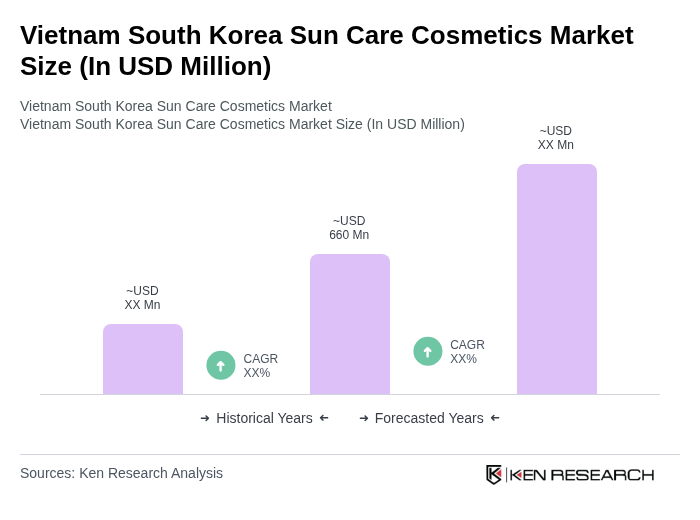
  • The Vietnam South Korea Sun Care Cosmetics Market is valued at USD 660 million, based on a five-year historical analysis. This estimate is derived from the combined value of the sun care segment in Vietnam and South Korea, with Vietnam’s sun and skin care segment accounting for a significant share of the broader cosmetics market and South Korea’s sun care market contributing a substantial portion as well . Growth is primarily driven by increasing consumer awareness of skin health, rising disposable incomes, and a growing trend towards sun protection products among the younger population. The demand for high-quality sun care products has surged, reflecting a shift in consumer preferences towards premium, natural, and effective formulations. Notably, there is a rising preference for multifunctional and eco-friendly sun care products, influenced by social media trends and the popularity of K-beauty .
  • Key growth hubs in this market include major cities such as Ho Chi Minh City and Hanoi, which dominate due to their large urban populations and higher purchasing power. The influence of South Korean beauty trends has significantly impacted consumer behavior, leading to a preference for innovative, natural, and effective sun care solutions. The presence of numerous beauty retailers and robust e-commerce platforms in these cities further enhances market accessibility and drives the adoption of new product launches and premium brands .
  • The Ministry of Health of Vietnam issued Circular No. 06/2011/TT-BYT, which mandates that all cosmetic products, including sun care items, must undergo safety assessments and obtain product notification certification before being marketed. This regulation requires manufacturers and importers to submit a product information file (PIF), including safety and efficacy data, and comply with labeling and ingredient standards to ensure consumer safety and product quality .
Vietnam South Korea Sun Care Cosmetics Market Size

Vietnam South Korea Sun Care Cosmetics Market Segmentation

By Product Type:The product type segmentation includes categories such as sunscreens, after-sun products, tinted moisturizers with SPF, sun protection clothing and accessories, sun serums and facial mists, and others. Among these,sunscreens—including SPF creams, lotions, gels, sticks, and sprays—dominate the market due to their essential role in daily skincare routines. The increasing awareness of skin damage caused by UV rays, especially in tropical climates and urban environments, has led to a surge in demand for effective sun protection products. There is also growing interest in multifunctional products that combine sun protection with skincare benefits, such as hydration and anti-aging .

Vietnam South Korea Sun Care Cosmetics Market segmentation by Product Type.

By Skin Type:The skin type segmentation encompasses categories including oily skin, dry skin, combination skin, sensitive skin, acne-prone skin, and others. Theoily skinsegment is particularly prominent, as many consumers in Vietnam and South Korea seek lightweight, non-comedogenic sun care products that provide effective sun protection without exacerbating oiliness. This trend is driven by the increasing prevalence of skin concerns such as acne and sensitivity, leading to a demand for specialized and gentle formulations .

Vietnam South Korea Sun Care Cosmetics Market segmentation by Skin Type.

Vietnam South Korea Sun Care Cosmetics Market Competitive Landscape

The Vietnam South Korea Sun Care Cosmetics Market is characterized by a dynamic mix of regional and international players. Leading participants such as Amorepacific Corporation, LG Household & Health Care Ltd., Innisfree Corporation, Missha (ABLE C&C Co., Ltd.), The Face Shop (LG Household & Health Care), Etude House (Amorepacific), Skin Food Co., Ltd., Biore (Kao Corporation), Neutrogena (Johnson & Johnson), Nivea (Beiersdorf AG), L'Oréal Groupe, Shiseido Company, Limited, Cetaphil (Galderma S.A.), Vichy (L'Oréal Groupe), La Roche-Posay (L'Oréal Groupe), Unilever Vietnam International Co., Ltd., Rohto-Mentholatum Vietnam Co., Ltd., Cocoon (Nature Story Cosmetics Co., Ltd.), Sunplay (Rohto-Mentholatum Vietnam), Anessa (Shiseido Company, Limited) contribute to innovation, geographic expansion, and service delivery in this space.

Amorepacific Corporation

1945

Seoul, South Korea

LG Household & Health Care Ltd.

1947

Seoul, South Korea

Innisfree Corporation

2000

Jeju, South Korea

Missha (ABLE C&C Co., Ltd.)

2000

Seoul, South Korea

The Face Shop (LG Household & Health Care)

2003

Seoul, South Korea

Company

Establishment Year

Headquarters

Group Size (Large, Medium, or Small as per industry convention)

Revenue Growth Rate (YoY %)

Market Penetration Rate (share in Vietnam/South Korea sun care market)

Customer Retention Rate (%)

Average Selling Price (ASP) per unit

Product Innovation Rate (new SKUs launched per year)

Vietnam South Korea Sun Care Cosmetics Market Industry Analysis

Growth Drivers

  • Increasing Awareness of Skin Protection:The Vietnamese population is becoming increasingly aware of the importance of skin protection, particularly against UV rays. In future, it is estimated that 70% of urban consumers will prioritize sun care products, reflecting a significant rise from 55% in 2020. This shift is driven by rising skin cancer rates, with over 10,000 new cases reported annually, prompting consumers to invest in protective cosmetics.
  • Rising Disposable Incomes:Vietnam's GDP per capita is projected to reach approximately $4,300 in future, up from $4,000 in the previous year. This increase in disposable income allows consumers to spend more on premium sun care products. As a result, the demand for high-quality, effective sun care cosmetics is expected to grow, with a notable increase in sales of products priced above $20, which are perceived as more effective and reliable.
  • Growth in Tourism and Outdoor Activities:Vietnam's tourism sector is anticipated to welcome over 20 million international visitors in future, a significant increase from 18 million in the previous year. This influx of tourists, combined with a growing local interest in outdoor activities, is driving demand for sun care products. The outdoor recreation market is expected to grow by 15% annually, further boosting the need for effective sun protection solutions among both locals and tourists.

Market Challenges

  • Intense Competition Among Brands:The sun care cosmetics market in Vietnam is characterized by fierce competition, with over 150 brands vying for market share. This saturation leads to aggressive pricing strategies, making it challenging for new entrants to establish themselves. In future, the top five brands are expected to control only 40% of the market, indicating a fragmented landscape that complicates brand loyalty and consumer retention.
  • Regulatory Compliance Issues:Navigating the regulatory landscape in Vietnam poses significant challenges for sun care brands. Stricter labeling requirements and safety testing mandates are expected to increase compliance costs by 20% in future. Additionally, brands must adapt to evolving environmental regulations, which could further complicate product development and market entry, particularly for foreign companies unfamiliar with local laws.

Vietnam South Korea Sun Care Cosmetics Market Future Outlook

The Vietnam South Korea sun care cosmetics market is poised for significant growth, driven by increasing consumer awareness and rising disposable incomes. As the market evolves, brands will need to innovate and adapt to changing consumer preferences, particularly in sustainability and multifunctionality. The rise of e-commerce will also reshape distribution channels, allowing brands to reach a broader audience. Overall, the market is expected to thrive as consumers prioritize skin health and protection in their beauty routines.

Market Opportunities

  • Development of Organic and Natural Products:There is a growing consumer preference for organic and natural sun care products, with sales expected to increase by 30% in future. This trend presents an opportunity for brands to innovate and cater to health-conscious consumers seeking safer, eco-friendly options that align with their values.
  • E-commerce Growth:E-commerce sales in Vietnam's beauty sector are projected to reach $1 billion in future, up from $800 million in the previous year. This growth offers brands a chance to expand their online presence and engage with consumers directly, leveraging digital marketing strategies to enhance brand visibility and drive sales.

Scope of the Report

SegmentSub-Segments
By Product Type

Sunscreens (SPF creams, lotions, gels, sticks, sprays)

After-sun products (soothing gels, lotions, creams)

Tinted moisturizers with SPF

Sun protection clothing & accessories (hats, sleeves, UPF-rated apparel)

Sun serums and facial mists

Others (lip balms with SPF, baby/kids sun care)

By Skin Type

Oily skin

Dry skin

Combination skin

Sensitive skin

Acne-prone skin

Others

By Distribution Channel

Online retail (e-commerce platforms, brand websites)

Supermarkets/Hypermarkets

Specialty beauty stores

Pharmacies/Drugstores

Department stores

Others (salons, direct sales)

By Consumer Age Group

Children (0-12 years)

Teenagers (13-19 years)

Adults (20-59 years)

Seniors (60+ years)

Others

By Brand Positioning

Premium brands

Mid-range brands

Budget brands

Indie/Local brands

Others

By Packaging Type

Tube

Bottle

Spray

Jar

Sachet/Single-use

Others

By Ingredient Type

Chemical filters (e.g., avobenzone, octinoxate)

Physical/mineral filters (e.g., zinc oxide, titanium dioxide)

Natural/organic ingredients (e.g., aloe vera, green tea, centella asiatica)

Vegan/reef-safe formulations

Others

Key Target Audience

Investors and Venture Capitalist Firms

Government and Regulatory Bodies (e.g., Ministry of Industry and Trade, Ministry of Health)

Manufacturers and Producers

Distributors and Retailers

Importers and Exporters

Beauty and Cosmetic Trade Associations

Market Analysts and Industry Experts

Financial Institutions

Players Mentioned in the Report:

Amorepacific Corporation

LG Household & Health Care Ltd.

Innisfree Corporation

Missha (ABLE C&C Co., Ltd.)

The Face Shop (LG Household & Health Care)

Etude House (Amorepacific)

Skin Food Co., Ltd.

Biore (Kao Corporation)

Neutrogena (Johnson & Johnson)

Nivea (Beiersdorf AG)

L'Oreal Groupe

Shiseido Company, Limited

Cetaphil (Galderma S.A.)

Vichy (L'Oreal Groupe)

La Roche-Posay (L'Oreal Groupe)

Unilever Vietnam International Co., Ltd.

Rohto-Mentholatum Vietnam Co., Ltd.

Cocoon (Nature Story Cosmetics Co., Ltd.)

Sunplay (Rohto-Mentholatum Vietnam)

Anessa (Shiseido Company, Limited)

Table of Contents

Market Assessment Phase

1. Executive Summary and Approach


2. Vietnam South Korea Sun Care Cosmetics Market Overview

2.1 Key Insights and Strategic Recommendations

2.2 Vietnam South Korea Sun Care Cosmetics Market Overview

2.3 Definition and Scope

2.4 Evolution of Market Ecosystem

2.5 Timeline of Key Regulatory Milestones

2.6 Value Chain & Stakeholder Mapping

2.7 Business Cycle Analysis

2.8 Policy & Incentive Landscape


3. Vietnam South Korea Sun Care Cosmetics Market Analysis

3.1 Growth Drivers

3.1.1 Increasing awareness of skin protection
3.1.2 Rising disposable incomes
3.1.3 Growth in tourism and outdoor activities
3.1.4 Expansion of retail channels

3.2 Market Challenges

3.2.1 Intense competition among brands
3.2.2 Regulatory compliance issues
3.2.3 Consumer skepticism towards product claims
3.2.4 Price sensitivity among consumers

3.3 Market Opportunities

3.3.1 Development of organic and natural products
3.3.2 E-commerce growth
3.3.3 Customization and personalization trends
3.3.4 Collaborations with influencers and beauty experts

3.4 Market Trends

3.4.1 Increasing demand for multifunctional products
3.4.2 Shift towards sustainable packaging
3.4.3 Rise of male grooming products
3.4.4 Popularity of K-beauty products

3.5 Government Regulation

3.5.1 Stricter labeling requirements
3.5.2 Import tariffs on foreign products
3.5.3 Safety and efficacy testing mandates
3.5.4 Environmental regulations on packaging

4. SWOT Analysis


5. Stakeholder Analysis


6. Porter's Five Forces Analysis


7. Vietnam South Korea Sun Care Cosmetics Market Market Size, 2019-2024

7.1 By Value

7.2 By Volume

7.3 By Average Selling Price


8. Vietnam South Korea Sun Care Cosmetics Market Segmentation

8.1 By Product Type

8.1.1 Sunscreens (SPF creams, lotions, gels, sticks, sprays)
8.1.2 After-sun products (soothing gels, lotions, creams)
8.1.3 Tinted moisturizers with SPF
8.1.4 Sun protection clothing & accessories (hats, sleeves, UPF-rated apparel)
8.1.5 Sun serums and facial mists
8.1.6 Others (lip balms with SPF, baby/kids sun care)

8.2 By Skin Type

8.2.1 Oily skin
8.2.2 Dry skin
8.2.3 Combination skin
8.2.4 Sensitive skin
8.2.5 Acne-prone skin
8.2.6 Others

8.3 By Distribution Channel

8.3.1 Online retail (e-commerce platforms, brand websites)
8.3.2 Supermarkets/Hypermarkets
8.3.3 Specialty beauty stores
8.3.4 Pharmacies/Drugstores
8.3.5 Department stores
8.3.6 Others (salons, direct sales)

8.4 By Consumer Age Group

8.4.1 Children (0-12 years)
8.4.2 Teenagers (13-19 years)
8.4.3 Adults (20-59 years)
8.4.4 Seniors (60+ years)
8.4.5 Others

8.5 By Brand Positioning

8.5.1 Premium brands
8.5.2 Mid-range brands
8.5.3 Budget brands
8.5.4 Indie/Local brands
8.5.5 Others

8.6 By Packaging Type

8.6.1 Tube
8.6.2 Bottle
8.6.3 Spray
8.6.4 Jar
8.6.5 Sachet/Single-use
8.6.6 Others

8.7 By Ingredient Type

8.7.1 Chemical filters (e.g., avobenzone, octinoxate)
8.7.2 Physical/mineral filters (e.g., zinc oxide, titanium dioxide)
8.7.3 Natural/organic ingredients (e.g., aloe vera, green tea, centella asiatica)
8.7.4 Vegan/reef-safe formulations
8.7.5 Others

9. Vietnam South Korea Sun Care Cosmetics Market Competitive Analysis

9.1 Market Share of Key Players(Micro, Small, Medium, Large Enterprises)

9.2 Cross Comparison of Key Players

9.2.1 Company Name
9.2.2 Group Size (Large, Medium, or Small as per industry convention)
9.2.3 Revenue Growth Rate (YoY %)
9.2.4 Market Penetration Rate (share in Vietnam/South Korea sun care market)
9.2.5 Customer Retention Rate (%)
9.2.6 Average Selling Price (ASP) per unit
9.2.7 Product Innovation Rate (new SKUs launched per year)
9.2.8 Distribution Network Coverage (number of retail/e-commerce points)
9.2.9 Brand Awareness Index (survey-based or digital reach)
9.2.10 Customer Satisfaction Score (NPS or equivalent)
9.2.11 Share of Natural/Organic Product Sales (%)
9.2.12 Digital Engagement Rate (social media, influencer campaigns)

9.3 SWOT Analysis of Top Players

9.4 Pricing Analysis(By Class and Payload)

9.5 Detailed Profile of Major Companies

9.5.1 Amorepacific Corporation
9.5.2 LG Household & Health Care Ltd.
9.5.3 Innisfree Corporation
9.5.4 Missha (ABLE C&C Co., Ltd.)
9.5.5 The Face Shop (LG Household & Health Care)
9.5.6 Etude House (Amorepacific)
9.5.7 Skin Food Co., Ltd.
9.5.8 Biore (Kao Corporation)
9.5.9 Neutrogena (Johnson & Johnson)
9.5.10 Nivea (Beiersdorf AG)
9.5.11 L'Oréal Groupe
9.5.12 Shiseido Company, Limited
9.5.13 Cetaphil (Galderma S.A.)
9.5.14 Vichy (L'Oréal Groupe)
9.5.15 La Roche-Posay (L'Oréal Groupe)
9.5.16 Unilever Vietnam International Co., Ltd.
9.5.17 Rohto-Mentholatum Vietnam Co., Ltd.
9.5.18 Cocoon (Nature Story Cosmetics Co., Ltd.)
9.5.19 Sunplay (Rohto-Mentholatum Vietnam)
9.5.20 Anessa (Shiseido Company, Limited)

10. Vietnam South Korea Sun Care Cosmetics Market End-User Analysis

10.1 Procurement Behavior of Key Ministries

10.1.1 Government procurement policies
10.1.2 Budget allocation for health and beauty
10.1.3 Preference for local vs. international brands
10.1.4 Sustainability considerations

10.2 Corporate Spend on Infrastructure & Energy

10.2.1 Investment in marketing and advertising
10.2.2 Spending on R&D for product development
10.2.3 Budget for sustainability initiatives
10.2.4 Allocation for distribution and logistics

10.3 Pain Point Analysis by End-User Category

10.3.1 Concerns over product safety
10.3.2 Difficulty in finding suitable products
10.3.3 Price sensitivity
10.3.4 Lack of awareness about sun care

10.4 User Readiness for Adoption

10.4.1 Awareness of sun care benefits
10.4.2 Willingness to pay for quality
10.4.3 Accessibility of products
10.4.4 Influence of social media

10.5 Post-Deployment ROI and Use Case Expansion

10.5.1 Measurement of customer satisfaction
10.5.2 Analysis of repeat purchase rates
10.5.3 Evaluation of brand loyalty
10.5.4 Opportunities for product line expansion

11. Vietnam South Korea Sun Care Cosmetics Market Future Size, 2025-2030

11.1 By Value

11.2 By Volume

11.3 By Average Selling Price


Go-To-Market Strategy Phase

1. Whitespace Analysis + Business Model Canvas

1.1 Market gaps identification

1.2 Value proposition development

1.3 Revenue model exploration

1.4 Customer segmentation analysis

1.5 Competitive landscape overview

1.6 Key partnerships identification

1.7 Cost structure analysis


2. Marketing and Positioning Recommendations

2.1 Branding strategies

2.2 Product USPs

2.3 Target audience definition

2.4 Communication strategy

2.5 Digital marketing tactics

2.6 Influencer collaboration plans

2.7 Customer engagement initiatives


3. Distribution Plan

3.1 Urban retail vs rural NGO tie-ups

3.2 E-commerce strategy

3.3 Partnerships with local retailers

3.4 Logistics and supply chain management

3.5 Distribution channel optimization

3.6 Inventory management strategies

3.7 Sales force deployment


4. Channel & Pricing Gaps

4.1 Underserved routes

4.2 Pricing bands

4.3 Competitor pricing analysis

4.4 Value-based pricing strategies

4.5 Discount and promotion strategies

4.6 Price elasticity assessment

4.7 Customer willingness to pay


5. Unmet Demand & Latent Needs

5.1 Category gaps

5.2 Consumer segments

5.3 Emerging trends analysis

5.4 Product innovation opportunities

5.5 Market entry barriers

5.6 Customer feedback incorporation

5.7 Future demand forecasting


6. Customer Relationship

6.1 Loyalty programs

6.2 After-sales service

6.3 Customer feedback mechanisms

6.4 Community engagement initiatives

6.5 Customer education programs

6.6 Relationship management tools

6.7 Personalization strategies


7. Value Proposition

7.1 Sustainability

7.2 Integrated supply chains

7.3 Unique selling points

7.4 Customer-centric approach

7.5 Brand differentiation strategies

7.6 Value delivery mechanisms

7.7 Long-term customer value


8. Key Activities

8.1 Regulatory compliance

8.2 Branding

8.3 Distribution setup

8.4 Marketing execution

8.5 Product development

8.6 Performance monitoring

8.7 Stakeholder engagement


9. Entry Strategy Evaluation

9.1 Domestic Market Entry Strategy

9.1.1 Product mix
9.1.2 Pricing band
9.1.3 Packaging
9.1.4 Marketing approach
9.1.5 Distribution strategy
9.1.6 Customer acquisition tactics
9.1.7 Brand positioning

9.2 Export Entry Strategy

9.2.1 Target countries
9.2.2 Compliance roadmap
9.2.3 Market entry barriers
9.2.4 Distribution partnerships
9.2.5 Marketing localization
9.2.6 Risk assessment
9.2.7 Export pricing strategy

10. Entry Mode Assessment

10.1 JV

10.2 Greenfield

10.3 M&A

10.4 Distributor Model

10.5 Risk vs. control analysis

10.6 Strategic fit evaluation

10.7 Long-term partnership potential


11. Capital and Timeline Estimation

11.1 Capital requirements

11.2 Timelines

11.3 Funding sources

11.4 Financial projections


Research Methodology

ApproachModellingSample

Phase 1: Approach1

Desk Research

  • Analysis of market reports from industry associations and government publications on sun care cosmetics in Vietnam and South Korea
  • Review of consumer behavior studies and demographic data from national statistics offices
  • Examination of online retail trends and e-commerce growth statistics specific to the beauty and personal care sector

Primary Research

  • Interviews with product managers and marketing executives from leading sun care brands operating in Vietnam and South Korea
  • Surveys targeting consumers to understand preferences, purchasing behavior, and brand loyalty in sun care products
  • Focus group discussions with dermatologists and skincare experts to gather insights on product efficacy and consumer education

Validation & Triangulation

  • Cross-validation of findings through comparison with historical sales data and market growth rates
  • Triangulation of insights from consumer surveys, expert interviews, and secondary data sources
  • Sanity checks conducted through expert panel reviews to ensure data reliability and relevance

Phase 2: Market Size Estimation1

Top-down Assessment

  • Estimation of the overall beauty and personal care market size in Vietnam and South Korea, with a focus on sun care segment
  • Analysis of market share distribution among various product categories such as lotions, sprays, and creams
  • Incorporation of macroeconomic factors and consumer spending trends on skincare products

Bottom-up Modeling

  • Collection of sales data from major retailers and e-commerce platforms to establish baseline revenue figures
  • Estimation of average selling prices and volume sold for different sun care products
  • Calculation of growth rates based on historical sales data and projected market trends

Forecasting & Scenario Analysis

  • Development of forecasting models using historical data and market indicators such as UV index trends and consumer awareness
  • Scenario analysis based on potential regulatory changes and shifts in consumer preferences towards natural and organic products
  • Creation of multiple growth scenarios (baseline, optimistic, and pessimistic) to project market size through 2030

Phase 3: CATI Sample Composition1

Scope Item/SegmentSample SizeTarget Respondent Profiles
Consumer Preferences in Sun Care100Skincare Enthusiasts, Regular Sun Care Users
Retail Insights on Sun Care Products60Store Managers, Beauty Advisors
Expert Opinions on Sun Care Efficacy40Dermatologists, Skincare Specialists
Market Trends in E-commerce for Sun Care50E-commerce Managers, Digital Marketing Specialists
Brand Loyalty and Consumer Behavior80Brand Loyalists, New Users

Frequently Asked Questions

What is the current value of the Vietnam South Korea Sun Care Cosmetics Market?

The Vietnam South Korea Sun Care Cosmetics Market is valued at approximately USD 660 million, reflecting a significant share of the broader cosmetics market in both countries, driven by increasing consumer awareness and demand for high-quality sun care products.

What factors are driving growth in the Vietnam South Korea Sun Care Cosmetics Market?

Which cities are the main hubs for the sun care cosmetics market in Vietnam?

What are the regulatory requirements for sun care products in Vietnam?

Other Adjacent Reports

UAE Skincare Products Market

Singapore Anti-Aging Cosmetics Market

Kuwait natural cosmetics market size, share, growth drivers, trends, opportunities & forecast 2025–2030

South Africa K-Beauty Products Market

UAE Dermatological Skincare Market

Indonesia Beauty Supplements Market Outlook to 2030

Philippines Cosmetic Ingredients Market

Middle East personal care packaging market size, share, growth drivers, trends, opportunities & forecast 2025–2030

Qatar E-Commerce Beauty Market

Malaysia Luxury Cosmetics Market

Why Buy From Us?

Refine Robust Result (RRR) Framework

What makes us stand out is that our consultants follow Robust, Refine and Result (RRR) methodology. Robust for clear definitions, approaches and sanity checking, Refine for differentiating respondents' facts and opinions, and Result for presenting data with story.

Our Reach Is Unmatched

We have set a benchmark in the industry by offering our clients with syndicated and customized market research reports featuring coverage of entire market as well as meticulous research and analyst insights.

Shifting the Research Paradigm

While we don't replace traditional research, we flip the method upside down. Our dual approach of Top Bottom & Bottom Top ensures quality deliverable by not just verifying company fundamentals but also looking at the sector and macroeconomic factors.

More Insights-Better Decisions

With one step in the future, our research team constantly tries to show you the bigger picture. We help with some of the tough questions you may encounter along the way: How is the industry positioned? Best marketing channel? KPI's of competitors? By aligning every element, we help maximize success.

Transparency and Trust

Our report gives you instant access to the answers and sources that other companies might choose to hide. We elaborate each steps of research methodology we have used and showcase you the sample size to earn your trust.

Round the Clock Support

If you need any support, we are here! We pride ourselves on universe strength, data quality, and quick, friendly, and professional service.

Why Clients Choose Us?

400000+
Reports in repository
150+
Consulting projects a year
100+
Analysts
8000+
Client Queries in 2022








