About the Report
Base Year 2024Germany Nutritional Supplements & Functional Foods Market Overview
- The Germany Nutritional Supplements & Functional Foods Market is valued at approximately EUR 7.8 billion, based on a five-year historical analysis. This growth is primarily driven by increasing health consciousness among consumers, a rising trend towards preventive healthcare, and the growing popularity of plant-based diets. The market has seen a significant uptick in demand for products that support overall wellness and specific health needs. The COVID-19 pandemic further accelerated demand, with heightened focus on immunity, stress management, and metabolic health. Additionally, the aging population and prevalence of chronic conditions such as diabetes have spurred demand for targeted supplements, including vitamins, magnesium, and protein-based products .
- Key cities such as Berlin, Munich, and Hamburg dominate the market due to their large populations, high disposable incomes, and a strong focus on health and wellness. These urban centers are also home to numerous health food stores, pharmacies, and wellness centers, making them hotspots for nutritional supplements and functional foods .
- The placing of nutritional supplements and novel functional foods on the German market is governed by Regulation (EU) 2015/2283 on novel foods, issued by the European Parliament and the Council. This regulation requires that any food not consumed to a significant degree in the EU before 15 May 1997 must undergo a pre-market safety assessment and authorization. The regulation sets out operational requirements for safety evaluation, labeling, and compliance, ensuring that new food products, including supplements, meet strict safety and nutritional standards before entering the market .

Germany Nutritional Supplements & Functional Foods Market Segmentation
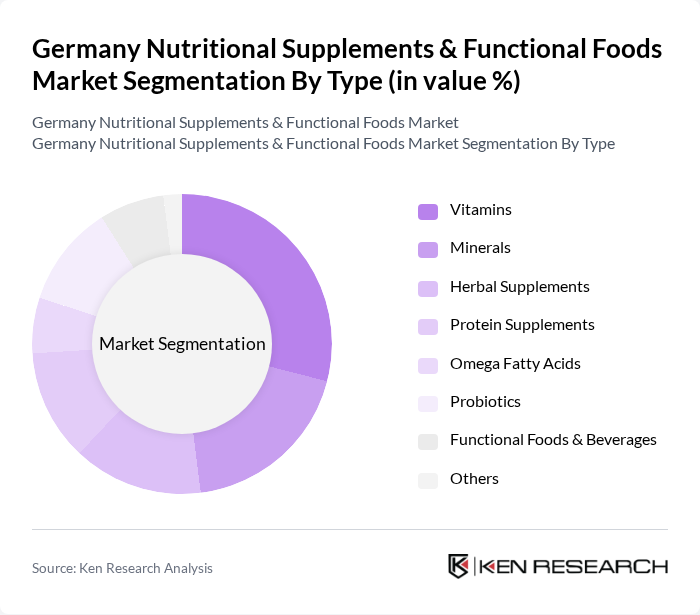
By Type:The market is segmented into various types of nutritional supplements and functional foods, including vitamins, minerals, herbal supplements, protein supplements, omega fatty acids, probiotics, functional foods & beverages, and others. Each of these subsegments caters to specific consumer needs and preferences. Vitamins and protein supplements are particularly popular due to their perceived health benefits, with vitamins leading the market owing to widespread micronutrient deficiencies and increased preventive health awareness. Protein supplements are also experiencing strong growth, driven by sports nutrition trends and the adoption of plant-based diets .
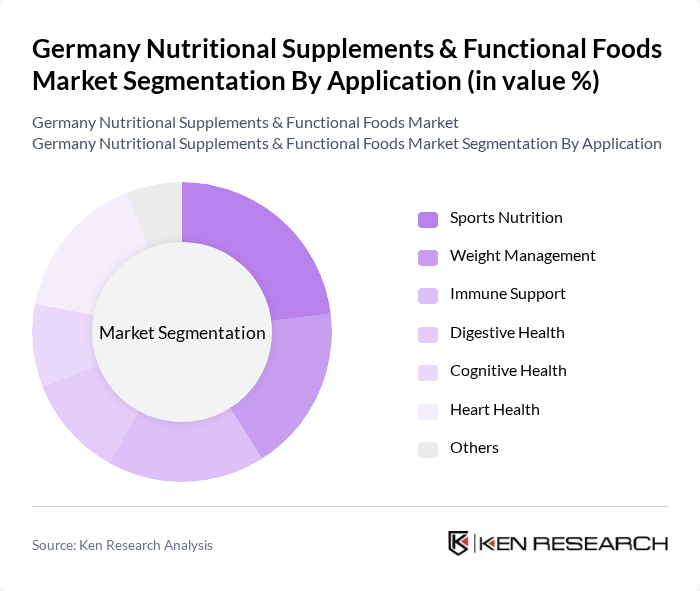
By Application:The applications of nutritional supplements and functional foods include sports nutrition, weight management, immune support, digestive health, cognitive health, heart health, and others. Sports nutrition and weight management remain significant due to the rising number of health-conscious consumers and fitness enthusiasts. Immune support has gained particular prominence post-pandemic, with consumers seeking products containing vitamin C, zinc, and probiotics. Digestive and cognitive health applications are also expanding, reflecting broader wellness trends .
Germany Nutritional Supplements & Functional Foods Market Competitive Landscape
The Germany Nutritional Supplements & Functional Foods Market is characterized by a dynamic mix of regional and international players. Leading participants such as Bayer AG, Queisser Pharma GmbH & Co. KG, Orthomol pharmazeutische Vertriebs GmbH, DMK Group (Deutsches Milchkontor GmbH), Nestlé S.A., Danone S.A., Dr. B. Scheffler Nachfolger GmbH & Co. KG, ZeinPharma Germany GmbH, Pascoe Naturmedizin, Denk Pharma GmbH & Co. KG, Ayanda GmbH, Sabinsa Europe GmbH, Pamex Pharmaceuticals GmbH, Glanbia plc, Herbalife Nutrition Ltd. contribute to innovation, geographic expansion, and service delivery in this space .
Germany Nutritional Supplements & Functional Foods Market Industry Analysis
Growth Drivers
- Increasing Health Consciousness:The German population is increasingly prioritizing health, with 70% of adults actively seeking healthier lifestyles. This trend is supported by a report from the Federal Statistical Office, indicating that 24% of adults reported using dietary supplements in the last twelve months. The rise in health awareness is further fueled by the aging population, with 22% of the population over 65, driving demand for nutritional products that support longevity and wellness.
- Rising Demand for Preventive Healthcare:Preventive healthcare is gaining traction in Germany, with healthcare expenditures projected to reach €500 billion. The government’s focus on reducing healthcare costs has led to increased investments in preventive measures, including nutritional supplements. A survey by the German Nutrition Society found that 45% of consumers are now using supplements to prevent health issues, reflecting a significant shift towards proactive health management.
- Expansion of E-commerce Platforms:E-commerce sales of nutritional supplements in Germany are expected to exceed €1 billion, driven by the convenience of online shopping. According to Statista, online sales in the health and wellness sector have grown by approximately 20% annually. This growth is supported by the increasing penetration of smartphones and internet access, with over 90% of the population now online, facilitating easier access to a variety of products.
Market Challenges
- Stringent Regulatory Compliance:The nutritional supplements market in Germany faces rigorous regulatory scrutiny, particularly under the EU Food Supplements Directive. Compliance costs can reach up to €200,000 for new product approvals, creating barriers for smaller companies. Additionally, the complexity of regulations can lead to delays in product launches, hindering market entry and innovation, as companies must navigate a labyrinth of legal requirements.
- High Competition and Market Saturation:The German market is characterized by intense competition, with over 1,500 brands vying for consumer attention. This saturation has led to price wars, with some products being sold at margins as low as 5%. According to a market analysis, 40% of new entrants struggle to establish a foothold, as established brands dominate shelf space and consumer loyalty, making differentiation crucial for survival.
Germany Nutritional Supplements & Functional Foods Market Future Outlook
The future of the nutritional supplements and functional foods market in Germany appears promising, driven by evolving consumer preferences and technological advancements. As health consciousness continues to rise, companies are likely to innovate with clean label products and personalized nutrition solutions. Additionally, the integration of digital platforms for marketing and sales will enhance consumer engagement. The focus on sustainability and ethical sourcing will also shape product offerings, aligning with the values of environmentally conscious consumers.
Market Opportunities
- Growth in Vegan and Plant-Based Products:The demand for vegan and plant-based nutritional supplements is surging, with sales projected to reach €300 million. This trend is driven by a significant increase in veganism among Germans, reflecting a shift towards sustainable and ethical consumption. Companies that innovate in this space can capture a growing segment of health-conscious consumers seeking plant-based alternatives.
- Increasing Popularity of Personalized Nutrition:Personalized nutrition is becoming a key trend, with the market expected to grow to €150 million. Advances in technology, such as DNA testing and AI-driven dietary recommendations, are enabling tailored supplement solutions. This trend presents opportunities for brands to differentiate themselves by offering customized products that meet individual health needs and preferences.
Scope of the Report
| Segment | Sub-Segments |
|---|---|
| By Type | Vitamins Minerals Herbal Supplements Protein Supplements Omega Fatty Acids Probiotics Functional Foods & Beverages Others |
| By Application | Sports Nutrition Weight Management Immune Support Digestive Health Cognitive Health Heart Health Others |
| By Distribution Channel | Supermarkets/Hypermarkets Health Food Stores Online Retail Pharmacies/Drugstores Direct Sales Others |
| By Consumer Demographics | Age Group (Children, Adults, Seniors) Gender (Male, Female) Lifestyle (Active, Sedentary) Income Level (Low, Middle, High) |
| By Formulation | Tablets Capsules Powders Liquids Gummies Others |
| By Packaging Type | Bottles Blister Packs Pouches Jars Sachets Others |
| By Price Range | Economy Mid-Range Premium Others |
Key Target Audience
Investors and Venture Capitalist Firms
Government and Regulatory Bodies (e.g., Federal Ministry of Food and Agriculture, Federal Office of Consumer Protection and Food Safety)
Manufacturers and Producers
Distributors and Retailers
Health and Wellness Organizations
Pharmaceutical Companies
Food Safety Authorities
Market Analysts and Industry Experts
Players Mentioned in the Report:
Bayer AG
Queisser Pharma GmbH & Co. KG
Orthomol pharmazeutische Vertriebs GmbH
DMK Group (Deutsches Milchkontor GmbH)
Nestle S.A.
Danone S.A.
Dr. B. Scheffler Nachfolger GmbH & Co. KG
ZeinPharma Germany GmbH
Pascoe Naturmedizin
Denk Pharma GmbH & Co. KG
Ayanda GmbH
Sabinsa Europe GmbH
Pamex Pharmaceuticals GmbH
Glanbia plc
Herbalife Nutrition Ltd.
Table of Contents
Market Assessment Phase
1. Executive Summary and Approach
2. Germany Nutritional Supplements & Functional Foods Market Overview
2.1 Key Insights and Strategic Recommendations
2.2 Germany Nutritional Supplements & Functional Foods Market Overview
2.3 Definition and Scope
2.4 Evolution of Market Ecosystem
2.5 Timeline of Key Regulatory Milestones
2.6 Value Chain & Stakeholder Mapping
2.7 Business Cycle Analysis
2.8 Policy & Incentive Landscape
3. Germany Nutritional Supplements & Functional Foods Market Analysis
3.1 Growth Drivers
3.1.1 Increasing Health Consciousness
3.1.2 Rising Demand for Preventive Healthcare
3.1.3 Expansion of E-commerce Platforms
3.1.4 Innovation in Product Formulations
3.2 Market Challenges
3.2.1 Stringent Regulatory Compliance
3.2.2 High Competition and Market Saturation
3.2.3 Consumer Skepticism towards Supplements
3.2.4 Fluctuating Raw Material Prices
3.3 Market Opportunities
3.3.1 Growth in Vegan and Plant-Based Products
3.3.2 Increasing Popularity of Personalized Nutrition
3.3.3 Expansion into Emerging Markets
3.3.4 Collaborations with Health Professionals
3.4 Market Trends
3.4.1 Rise of Clean Label Products
3.4.2 Integration of Technology in Product Development
3.4.3 Focus on Sustainable Sourcing
3.4.4 Growth of Online Health Communities
3.5 Government Regulation
3.5.1 EU Food Supplements Directive
3.5.2 Novel Food Regulation
3.5.3 Health Claims Regulation
3.5.4 Labelling and Advertising Standards
4. SWOT Analysis
5. Stakeholder Analysis
6. Porter's Five Forces Analysis
7. Germany Nutritional Supplements & Functional Foods Market Market Size, 2019-2024
7.1 By Value
7.2 By Volume
7.3 By Average Selling Price
8. Germany Nutritional Supplements & Functional Foods Market Segmentation
8.1 By Type
8.1.1 Vitamins
8.1.2 Minerals
8.1.3 Herbal Supplements
8.1.4 Protein Supplements
8.1.5 Omega Fatty Acids
8.1.6 Probiotics
8.1.7 Functional Foods & Beverages
8.1.8 Others
8.2 By Application
8.2.1 Sports Nutrition
8.2.2 Weight Management
8.2.3 Immune Support
8.2.4 Digestive Health
8.2.5 Cognitive Health
8.2.6 Heart Health
8.2.7 Others
8.3 By Distribution Channel
8.3.1 Supermarkets/Hypermarkets
8.3.2 Health Food Stores
8.3.3 Online Retail
8.3.4 Pharmacies/Drugstores
8.3.5 Direct Sales
8.3.6 Others
8.4 By Consumer Demographics
8.4.1 Age Group (Children, Adults, Seniors)
8.4.2 Gender (Male, Female)
8.4.3 Lifestyle (Active, Sedentary)
8.4.4 Income Level (Low, Middle, High)
8.5 By Formulation
8.5.1 Tablets
8.5.2 Capsules
8.5.3 Powders
8.5.4 Liquids
8.5.5 Gummies
8.5.6 Others
8.6 By Packaging Type
8.6.1 Bottles
8.6.2 Blister Packs
8.6.3 Pouches
8.6.4 Jars
8.6.5 Sachets
8.6.6 Others
8.7 By Price Range
8.7.1 Economy
8.7.2 Mid-Range
8.7.3 Premium
8.7.4 Others
9. Germany Nutritional Supplements & Functional Foods Market Competitive Analysis
9.1 Market Share of Key Players
9.2 Cross Comparison of Key Players
9.2.1 Company Name
9.2.2 Group Size (Large, Medium, or Small as per industry convention)
9.2.3 Revenue (Germany, EUR million)
9.2.4 Revenue Growth Rate (YoY %)
9.2.5 Market Share (%)
9.2.6 Product Portfolio Breadth (Number of SKUs)
9.2.7 Distribution Channel Coverage (Number of Outlets/Platforms)
9.2.8 R&D Investment (% of Revenue)
9.2.9 Brand Awareness Index (Survey-Based)
9.2.10 Innovation Pipeline (Number of New Launches, 3-Year)
9.2.11 Sustainability Initiatives (Qualitative/Quantitative)
9.3 SWOT Analysis of Top Players
9.4 Pricing Analysis
9.5 Detailed Profile of Major Companies
9.5.1 Bayer AG
9.5.2 Queisser Pharma GmbH & Co. KG
9.5.3 Orthomol pharmazeutische Vertriebs GmbH
9.5.4 DMK Group (Deutsches Milchkontor GmbH)
9.5.5 Nestlé S.A.
9.5.6 Danone S.A.
9.5.7 Dr. B. Scheffler Nachfolger GmbH & Co. KG
9.5.8 ZeinPharma Germany GmbH
9.5.9 Pascoe Naturmedizin
9.5.10 Denk Pharma GmbH & Co. KG
9.5.11 Ayanda GmbH
9.5.12 Sabinsa Europe GmbH
9.5.13 Pamex Pharmaceuticals GmbH
9.5.14 Glanbia plc
9.5.15 Herbalife Nutrition Ltd.
10. Germany Nutritional Supplements & Functional Foods Market End-User Analysis
10.1 Procurement Behavior of Key Ministries
10.1.1 Health Ministry Initiatives
10.1.2 Nutrition Guidelines and Recommendations
10.1.3 Public Health Campaigns
10.1.4 Funding for Nutritional Research
10.2 Corporate Spend on Infrastructure & Energy
10.2.1 Investment in Health and Wellness Programs
10.2.2 Corporate Wellness Initiatives
10.2.3 Partnerships with Nutritional Brands
10.3 Pain Point Analysis by End-User Category
10.3.1 Lack of Awareness about Nutritional Supplements
10.3.2 Accessibility Issues in Rural Areas
10.3.3 Price Sensitivity among Consumers
10.4 User Readiness for Adoption
10.4.1 Awareness of Health Benefits
10.4.2 Availability of Products
10.4.3 Trust in Brand Quality
10.5 Post-Deployment ROI and Use Case Expansion
10.5.1 Measurement of Health Outcomes
10.5.2 Consumer Feedback and Adaptation
10.5.3 Expansion into New Demographics
11. Germany Nutritional Supplements & Functional Foods Market Future Size, 2025-2030
11.1 By Value
11.2 By Volume
11.3 By Average Selling Price
Go-To-Market Strategy Phase
1. Whitespace Analysis + Business Model Canvas
1.1 Market Gaps Identification
1.2 Value Proposition Development
1.3 Revenue Streams Analysis
1.4 Cost Structure Evaluation
1.5 Key Partnerships Exploration
1.6 Customer Segmentation
1.7 Channels of Distribution
2. Marketing and Positioning Recommendations
2.1 Branding Strategies
2.2 Product USPs
2.3 Target Audience Engagement
2.4 Digital Marketing Tactics
2.5 Offline Marketing Strategies
3. Distribution Plan
3.1 Urban Retail Strategies
3.2 Rural NGO Tie-ups
3.3 E-commerce Integration
3.4 Direct-to-Consumer Approaches
4. Channel & Pricing Gaps
4.1 Underserved Routes
4.2 Pricing Bands Analysis
4.3 Competitor Pricing Strategies
5. Unmet Demand & Latent Needs
5.1 Category Gaps Identification
5.2 Consumer Segments Exploration
5.3 Product Development Opportunities
6. Customer Relationship
6.1 Loyalty Programs
6.2 After-sales Service
6.3 Customer Feedback Mechanisms
7. Value Proposition
7.1 Sustainability Initiatives
7.2 Integrated Supply Chains
7.3 Community Engagement
8. Key Activities
8.1 Regulatory Compliance
8.2 Branding Efforts
8.3 Distribution Setup
9. Entry Strategy Evaluation
9.1 Domestic Market Entry Strategy
9.1.1 Product Mix Considerations
9.1.2 Pricing Band Strategy
9.1.3 Packaging Innovations
9.2 Export Entry Strategy
9.2.1 Target Countries Analysis
9.2.2 Compliance Roadmap Development
10. Entry Mode Assessment
10.1 Joint Ventures
10.2 Greenfield Investments
10.3 Mergers & Acquisitions
10.4 Distributor Model Evaluation</h4
Research Methodology
Phase 1: Approach1
Desk Research
- Analysis of market reports from industry associations and government publications on nutritional supplements and functional foods in Germany
- Review of academic journals and articles focusing on consumer behavior and trends in health and wellness
- Examination of sales data and market share reports from leading companies in the nutritional supplements sector
Primary Research
- Interviews with nutritionists and dietitians to understand consumer preferences and trends
- Surveys conducted with health food retailers to gather insights on product demand and customer feedback
- Focus group discussions with consumers to explore attitudes towards nutritional supplements and functional foods
Validation & Triangulation
- Cross-validation of findings through comparison with existing market studies and reports
- Triangulation of data from consumer surveys, expert interviews, and sales data
- Sanity checks through expert panel reviews to ensure the reliability of the data collected
Phase 2: Market Size Estimation1
Top-down Assessment
- Estimation of the overall market size based on national health expenditure and consumer spending on health products
- Segmentation of the market by product type, including vitamins, minerals, and herbal supplements
- Incorporation of demographic trends and health awareness levels among the German population
Bottom-up Modeling
- Collection of sales data from key retailers and distributors in the nutritional supplements market
- Estimation of average selling prices and volume sold across different product categories
- Analysis of growth rates based on historical sales data and emerging market trends
Forecasting & Scenario Analysis
- Utilization of time-series analysis to project future market growth based on historical data
- Scenario modeling based on potential regulatory changes and shifts in consumer preferences
- Development of multiple growth scenarios (baseline, optimistic, and pessimistic) through 2030
Phase 3: CATI Sample Composition1
| Scope Item/Segment | Sample Size | Target Respondent Profiles |
|---|---|---|
| Nutritional Supplements Retailers | 100 | Store Managers, Product Buyers |
| Health and Wellness Consumers | 150 | Health-Conscious Individuals, Fitness Enthusiasts |
| Functional Foods Manufacturers | 80 | Product Development Managers, Marketing Directors |
| Healthcare Professionals | 40 | Nutritionists, Dietitians |
| Market Analysts and Researchers | 40 | Market Research Analysts, Industry Experts |
Frequently Asked Questions
What is the current value of the Germany Nutritional Supplements & Functional Foods Market?
The Germany Nutritional Supplements & Functional Foods Market is valued at approximately EUR 7.8 billion, reflecting a significant growth trend driven by increasing health consciousness and demand for preventive healthcare among consumers.
What factors are driving the growth of the nutritional supplements market in Germany?
Which cities are the largest markets for nutritional supplements in Germany?
What types of products are included in the Germany Nutritional Supplements Market?
Other Regional/Country Reports
Other Adjacent Reports
UAE Vitamins and Minerals Market
Brazil Weight Management Products Market
Qatar immune health supplements market report Size, Share, Growth Drivers, Trends, Opportunities & Forecast 2025–2030Why Buy From Us?

What makes us stand out is that our consultants follow Robust, Refine and Result (RRR) methodology. Robust for clear definitions, approaches and sanity checking, Refine for differentiating respondents' facts and opinions, and Result for presenting data with story.

We have set a benchmark in the industry by offering our clients with syndicated and customized market research reports featuring coverage of entire market as well as meticulous research and analyst insights.

While we don't replace traditional research, we flip the method upside down. Our dual approach of Top Bottom & Bottom Top ensures quality deliverable by not just verifying company fundamentals but also looking at the sector and macroeconomic factors.

With one step in the future, our research team constantly tries to show you the bigger picture. We help with some of the tough questions you may encounter along the way: How is the industry positioned? Best marketing channel? KPI's of competitors? By aligning every element, we help maximize success.

Our report gives you instant access to the answers and sources that other companies might choose to hide. We elaborate each steps of research methodology we have used and showcase you the sample size to earn your trust.

If you need any support, we are here! We pride ourselves on universe strength, data quality, and quick, friendly, and professional service.