About the Report
Base Year 2024Indonesia Pest Control Products Market Overview
- The Indonesia Pest Control Products Market is valued at USD 1.25 billion, based on a five-year historical analysis. This growth is primarily driven by increasing urbanization, agricultural expansion, and rising awareness of pest-related health issues. The demand for effective pest control solutions has surged, particularly in urban areas where pest infestations are more prevalent. The market is further supported by government initiatives to improve public health and food security, as well as the adoption of integrated pest management (IPM) practices in both residential and agricultural sectors .
- Key cities such as Jakarta, Surabaya, and Bandung dominate the market due to their high population density and significant commercial activities. The concentration of industries and agricultural activities in these regions further drives the demand for pest control products, making them critical hubs for market growth. Java, in particular, accounts for a major share of the market, supported by intensive agricultural systems and a dense distribution network .
- In 2023, the Indonesian government implemented stricter regulations on pesticide usage to ensure environmental safety and public health. This includes mandatory registration and evaluation of pest control products, aimed at reducing harmful chemical exposure and promoting safer alternatives in pest management. The regulation is governed by the Ministry of Agriculture through the National Food Agency (NFA) protocols, which require all pest control products to undergo rigorous safety and efficacy assessments before market entry .

Indonesia Pest Control Products Market Segmentation
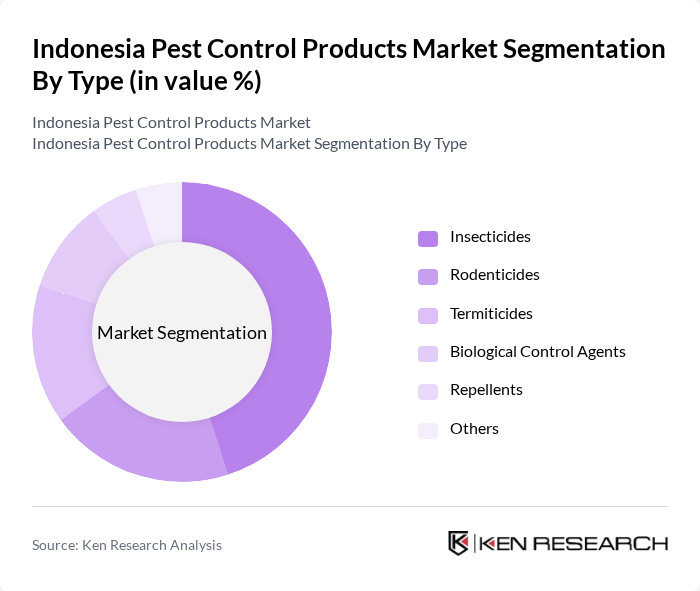
By Type:The pest control products market can be segmented into various types, including insecticides, rodenticides, termiticides, biological control agents, repellents, and others. Among these, insecticides are the most widely used due to their effectiveness in controlling a broad range of pests, particularly in agricultural and residential settings. The increasing prevalence of pests and the need for effective pest management solutions have led to a higher demand for insecticides, making them the dominant sub-segment in the market. The market share for insecticides is supported by ongoing pest pressure in irrigated rice and vegetable systems, as well as the expansion of commercial crops such as oil palm and rubber .
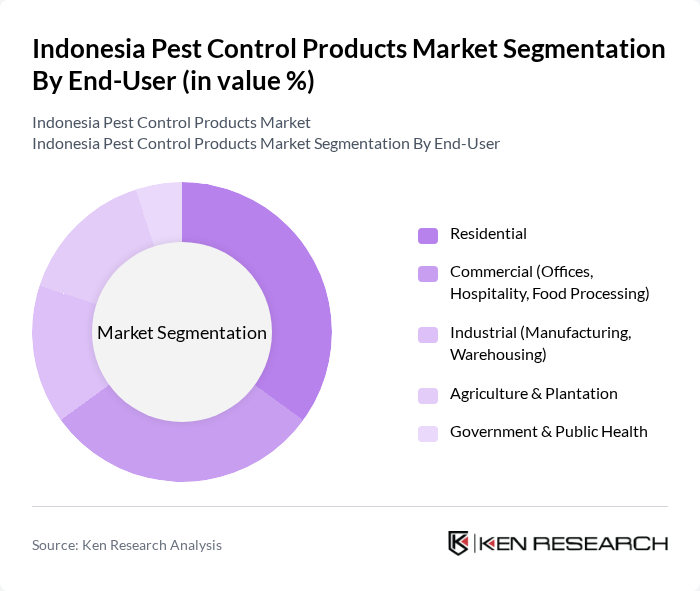
By End-User:The market can also be segmented based on end-users, including residential, commercial (offices, hospitality, food processing), industrial (manufacturing, warehousing), agriculture & plantation, and government & public health. The residential segment is witnessing significant growth due to increasing awareness of pest-related health risks and the rising demand for pest control services in urban households. This segment's focus on maintaining hygiene and safety in living spaces has made it a leading sub-segment in the market. The commercial and industrial segments are also expanding, driven by stricter hygiene standards in food processing and manufacturing facilities .
Indonesia Pest Control Products Market Competitive Landscape
The Indonesia Pest Control Products Market is characterized by a dynamic mix of regional and international players. Leading participants such as PT Bayer Indonesia, PT Syngenta Indonesia, PT BASF Indonesia, PT FMC Indonesia, PT UPL Indonesia, PT Corteva Agriscience Indonesia, PT Petrokimia Gresik, PT Agricon, PT Sari Bumi Sukses, PT Citra Pestindo, PT Mitra Pesticides, PT Pupuk Kaltim, PT Bina Agri Sejahtera, PT Tunas Sumber Rejeki, PT Sumber Makmur contribute to innovation, geographic expansion, and service delivery in this space.
Indonesia Pest Control Products Market Industry Analysis
Growth Drivers
- Increasing Urbanization:Indonesia's urban population is projected to reach 70% in future, up from 57% according to the World Bank. This rapid urbanization leads to higher pest infestations in densely populated areas, driving demand for pest control products. The urban housing sector is expected to grow by 5.5% annually, further increasing the need for effective pest management solutions. As urban areas expand, the pest control market is poised to benefit significantly from this demographic shift.
- Rising Health Awareness:The Indonesian government reported a 15% increase in health-related campaigns in recent periods, emphasizing the importance of pest control in preventing diseases. With rising awareness of health risks associated with pests, such as dengue fever and malaria, consumers are increasingly investing in pest control solutions. The healthcare expenditure in Indonesia is projected to reach approximately $46 billion, indicating a growing focus on health and hygiene, which directly influences pest control product demand.
- Government Initiatives for Pest Control:The Indonesian government allocated approximately $200 million for pest control initiatives aimed at agricultural and urban areas. These initiatives include public awareness campaigns and subsidies for pest control products. The Ministry of Agriculture has also introduced regulations to promote integrated pest management practices, which are expected to enhance the effectiveness of pest control measures and stimulate market growth in the coming years.
Market Challenges
- Stringent Regulatory Compliance:The pest control industry in Indonesia faces strict regulatory requirements, including pesticide registration and safety standards. The Ministry of Agriculture mandates that all pest control products undergo rigorous testing, which can take up to 18 months. This lengthy approval process can hinder market entry for new products and increase operational costs for manufacturers, limiting their ability to respond quickly to market demands.
- Environmental Concerns:Growing environmental awareness among consumers and NGOs has led to increased scrutiny of chemical pest control products. In recent periods, over 30% of consumers expressed concerns about the environmental impact of pesticides, according to a local survey. This shift in consumer sentiment is prompting companies to invest in eco-friendly alternatives, which may require significant R&D investments and could impact profit margins in the short term.
Indonesia Pest Control Products Market Future Outlook
The future of the pest control products market in Indonesia appears promising, driven by urbanization and health awareness. As the population continues to migrate to urban areas, the demand for effective pest management solutions will likely increase. Additionally, the government's commitment to pest control initiatives will further support market growth. Companies that adapt to consumer preferences for eco-friendly products and invest in technology will be well-positioned to capitalize on emerging opportunities in this evolving landscape.
Market Opportunities
- Technological Advancements:The integration of smart technology in pest control, such as IoT devices and automated monitoring systems, presents significant opportunities. In future, the adoption of these technologies is expected to increase by 25%, enhancing efficiency and effectiveness in pest management. Companies that leverage these advancements can improve service delivery and customer satisfaction, leading to increased market share.
- Expansion of E-commerce:The rise of e-commerce platforms in Indonesia is transforming the distribution of pest control products. With online sales projected to grow by 30% in future, companies can reach a broader audience and enhance accessibility. This shift allows for targeted marketing strategies and improved customer engagement, creating new revenue streams for pest control businesses in the region.
Scope of the Report
| Segment | Sub-Segments |
|---|---|
| By Type | Insecticides Rodenticides Termiticides Biological Control Agents Repellents Others |
| By End-User | Residential Commercial (Offices, Hospitality, Food Processing) Industrial (Manufacturing, Warehousing) Agriculture & Plantation Government & Public Health |
| By Region | Java Sumatra Bali & Nusa Tenggara Kalimantan Sulawesi & Eastern Indonesia |
| By Application | Crop Protection (Agriculture) Structural Pest Control (Buildings, Homes) Vector Control (Mosquitoes, Public Health) Stored Product Pest Control Livestock Pest Control Others |
| By Distribution Channel | Online Retail Agrochemical Stores Modern Trade (Supermarkets, Hypermarkets) Direct Sales Distributors/Dealers |
| By Product Formulation | Liquid Formulations Granular Formulations Aerosol/Spray Baits Dusts & Powders Others |
| By Policy Support | Subsidies Tax Exemptions Regulatory Support Others |
Key Target Audience
Investors and Venture Capitalist Firms
Government and Regulatory Bodies (e.g., Ministry of Agriculture, Ministry of Health)
Manufacturers and Producers
Distributors and Retailers
Pest Control Service Providers
Environmental NGOs and Advocacy Groups
Industry Associations (e.g., Indonesian Pest Control Association)
Financial Institutions
Players Mentioned in the Report:
PT Bayer Indonesia
PT Syngenta Indonesia
PT BASF Indonesia
PT FMC Indonesia
PT UPL Indonesia
PT Corteva Agriscience Indonesia
PT Petrokimia Gresik
PT Agricon
PT Sari Bumi Sukses
PT Citra Pestindo
PT Mitra Pesticides
PT Pupuk Kaltim
PT Bina Agri Sejahtera
PT Tunas Sumber Rejeki
PT Sumber Makmur
Table of Contents
Market Assessment Phase
1. Executive Summary and Approach
2. Indonesia Pest Control Products Market Overview
2.1 Key Insights and Strategic Recommendations
2.2 Indonesia Pest Control Products Market Overview
2.3 Definition and Scope
2.4 Evolution of Market Ecosystem
2.5 Timeline of Key Regulatory Milestones
2.6 Value Chain & Stakeholder Mapping
2.7 Business Cycle Analysis
2.8 Policy & Incentive Landscape
3. Indonesia Pest Control Products Market Analysis
3.1 Growth Drivers
3.1.1 Increasing Urbanization
3.1.2 Rising Health Awareness
3.1.3 Government Initiatives for Pest Control
3.1.4 Growth in Agriculture Sector
3.2 Market Challenges
3.2.1 Stringent Regulatory Compliance
3.2.2 Environmental Concerns
3.2.3 High Competition
3.2.4 Limited Consumer Awareness
3.3 Market Opportunities
3.3.1 Technological Advancements
3.3.2 Expansion of E-commerce
3.3.3 Increasing Demand for Organic Products
3.3.4 Collaborations with Local Farmers
3.4 Market Trends
3.4.1 Shift Towards Eco-friendly Products
3.4.2 Growth of Integrated Pest Management
3.4.3 Rise in DIY Pest Control Solutions
3.4.4 Increased Use of Smart Technology
3.5 Government Regulation
3.5.1 Pesticide Registration Requirements
3.5.2 Safety Standards for Pest Control Products
3.5.3 Environmental Protection Laws
3.5.4 Import Regulations for Chemical Products
4. SWOT Analysis
5. Stakeholder Analysis
6. Porter's Five Forces Analysis
7. Indonesia Pest Control Products Market Market Size, 2019-2024
7.1 By Value
7.2 By Volume
7.3 By Average Selling Price
8. Indonesia Pest Control Products Market Segmentation
8.1 By Type
8.1.1 Insecticides
8.1.2 Rodenticides
8.1.3 Termiticides
8.1.4 Biological Control Agents
8.1.5 Repellents
8.1.6 Others
8.2 By End-User
8.2.1 Residential
8.2.2 Commercial (Offices, Hospitality, Food Processing)
8.2.3 Industrial (Manufacturing, Warehousing)
8.2.4 Agriculture & Plantation
8.2.5 Government & Public Health
8.3 By Region
8.3.1 Java
8.3.2 Sumatra
8.3.3 Bali & Nusa Tenggara
8.3.4 Kalimantan
8.3.5 Sulawesi & Eastern Indonesia
8.4 By Application
8.4.1 Crop Protection (Agriculture)
8.4.2 Structural Pest Control (Buildings, Homes)
8.4.3 Vector Control (Mosquitoes, Public Health)
8.4.4 Stored Product Pest Control
8.4.5 Livestock Pest Control
8.4.6 Others
8.5 By Distribution Channel
8.5.1 Online Retail
8.5.2 Agrochemical Stores
8.5.3 Modern Trade (Supermarkets, Hypermarkets)
8.5.4 Direct Sales
8.5.5 Distributors/Dealers
8.6 By Product Formulation
8.6.1 Liquid Formulations
8.6.2 Granular Formulations
8.6.3 Aerosol/Spray
8.6.4 Baits
8.6.5 Dusts & Powders
8.6.6 Others
8.7 By Policy Support
8.7.1 Subsidies
8.7.2 Tax Exemptions
8.7.3 Regulatory Support
8.7.4 Others
9. Indonesia Pest Control Products Market Competitive Analysis
9.1 Market Share of Key Players
9.2 Cross Comparison of Key Players
9.2.1 Company Name
9.2.2 Group Size (Large, Medium, or Small as per industry convention)
9.2.3 Revenue (USD, latest available year)
9.2.4 Revenue Growth Rate (CAGR %)
9.2.5 Market Share (%)
9.2.6 Product Portfolio Breadth (Number of SKUs/Active Ingredients)
9.2.7 Geographic Coverage (Number of Provinces/Regions Served)
9.2.8 Distribution Network Strength (Number of Distributors/Dealers)
9.2.9 R&D Investment (% of Revenue)
9.2.10 Regulatory Compliance Record (Number of Product Registrations/Recalls)
9.2.11 Customer Segmentation Focus (e.g., Agriculture, Urban, Public Health)
9.2.12 Digital/Smart Solution Adoption (e.g., IoT, Drone, App Integration)
9.2.13 Sustainability Initiatives (e.g., Biopesticide Share, Eco-labels)
9.2.14 Brand Recognition Score
9.2.15 Customer Satisfaction Index
9.3 SWOT Analysis of Top Players
9.4 Pricing Analysis
9.5 Detailed Profile of Major Companies
9.5.1 PT Bayer Indonesia
9.5.2 PT Syngenta Indonesia
9.5.3 PT BASF Indonesia
9.5.4 PT FMC Indonesia
9.5.5 PT UPL Indonesia
9.5.6 PT Corteva Agriscience Indonesia
9.5.7 PT Petrokimia Gresik
9.5.8 PT Agricon
9.5.9 PT Sari Bumi Sukses
9.5.10 PT Citra Pestindo
9.5.11 PT Mitra Pesticides
9.5.12 PT Pupuk Kaltim
9.5.13 PT Bina Agri Sejahtera
9.5.14 PT Tunas Sumber Rejeki
9.5.15 PT Sumber Makmur
10. Indonesia Pest Control Products Market End-User Analysis
10.1 Procurement Behavior of Key Ministries
10.1.1 Ministry of Agriculture
10.1.2 Ministry of Health
10.1.3 Ministry of Environment
10.1.4 Ministry of Trade
10.2 Corporate Spend on Infrastructure & Energy
10.2.1 Investment in Pest Control Solutions
10.2.2 Budget Allocation for Public Health
10.2.3 Corporate Sustainability Initiatives
10.2.4 Infrastructure Development Projects
10.3 Pain Point Analysis by End-User Category
10.3.1 Residential Users
10.3.2 Commercial Establishments
10.3.3 Agricultural Sector
10.3.4 Government Agencies
10.4 User Readiness for Adoption
10.4.1 Awareness of Pest Control Solutions
10.4.2 Willingness to Invest
10.4.3 Training and Support Needs
10.4.4 Feedback Mechanisms
10.5 Post-Deployment ROI and Use Case Expansion
10.5.1 Measurement of Effectiveness
10.5.2 Cost Savings Analysis
10.5.3 User Experience Feedback
10.5.4 Opportunities for Upselling
11. Indonesia Pest Control Products Market Future Size, 2025-2030
11.1 By Value
11.2 By Volume
11.3 By Average Selling Price
Go-To-Market Strategy Phase
1. Whitespace Analysis + Business Model Canvas
1.1 Market Gaps Identification
1.2 Value Proposition Development
1.3 Revenue Streams Analysis
1.4 Customer Segmentation
1.5 Key Partnerships
1.6 Cost Structure Analysis
1.7 Channels of Distribution
2. Marketing and Positioning Recommendations
2.1 Branding Strategies
2.2 Product USPs
2.3 Target Market Positioning
2.4 Communication Strategies
2.5 Digital Marketing Approaches
2.6 Customer Engagement Tactics
2.7 Performance Metrics
3. Distribution Plan
3.1 Urban Retail Strategies
3.2 Rural NGO Tie-ups
3.3 E-commerce Integration
3.4 Logistics and Supply Chain Management
3.5 Distribution Partnerships
3.6 Inventory Management
3.7 Customer Service Channels
4. Channel & Pricing Gaps
4.1 Underserved Routes
4.2 Pricing Bands Analysis
4.3 Competitor Pricing Strategies
4.4 Value-based Pricing Models
4.5 Discount and Promotion Strategies
4.6 Price Sensitivity Analysis
4.7 Customer Perception of Value
5. Unmet Demand & Latent Needs
5.1 Category Gaps
5.2 Consumer Segments Analysis
5.3 Emerging Trends Identification
5.4 Product Development Opportunities
5.5 Market Entry Barriers
5.6 Customer Feedback Mechanisms
5.7 Future Demand Projections
6. Customer Relationship
6.1 Loyalty Programs
6.2 After-sales Service
6.3 Customer Feedback Systems
6.4 Community Engagement Initiatives
6.5 Customer Education Programs
6.6 Relationship Management Tools
6.7 Performance Tracking
7. Value Proposition
7.1 Sustainability Initiatives
7.2 Integrated Supply Chains
7.3 Customer-Centric Innovations
7.4 Competitive Differentiation
7.5 Value Delivery Mechanisms
7.6 Brand Loyalty Factors
7.7 Long-term Value Creation
8. Key Activities
8.1 Regulatory Compliance
8.2 Branding Initiatives
8.3 Distribution Setup
8.4 Market Research Activities
8.5 Training and Development
8.6 Performance Monitoring
8.7 Stakeholder Engagement
9. Entry Strategy Evaluation
9.1 Domestic Market Entry Strategy
9.1.1 Product Mix
9.1.2 Pricing Band
9.1.3 Packaging Strategies
9.2 Export Entry Strategy
9.2.1 Target Countries
9.2.2 Compliance Roadmap
10. Entry Mode Assessment
10.1 JV Opportunities
10.2 Greenfield Investments
10.3 M&A Considerations
10.4 Distributor Model Evaluation
11. Capital and Timeline Estimation
11.1 Capital Requirements
11.2 Timelines for Implementation
12. Control vs Risk Trade-Off
12.1 Ownership vs Partnerships
13. Profitability Outlook
13.1 Breakeven Analysis
13.2 Long-term Sustainability
14. Potential Partner List
14.1 Distributors
14.2 JVs
14.3 Acquisition Targets
15. Execution Roadmap
15.1 Phased Plan for Market Entry
15.1.1 Market Setup
15.1.2 Market Entry
15.1.3 Growth Acceleration
15.1.4 Scale & Stabilize
15.2 Key Activities and Milestones
15.2.1 Milestone Tracking
15.2.2 Activity Scheduling
Research Methodology
Phase 1: Approach1
Desk Research
- Analysis of industry reports from government agencies and trade associations related to pest control products
- Review of market trends and forecasts from academic journals and research publications
- Examination of regulatory frameworks and compliance requirements from Indonesian environmental authorities
Primary Research
- In-depth interviews with key stakeholders in the pest control industry, including manufacturers and distributors
- Surveys targeting agricultural professionals and pest control service providers to gather insights on product usage
- Field visits to pest control service operations to observe practices and gather qualitative data
Validation & Triangulation
- Cross-validation of findings through comparison with historical market data and growth trends
- Triangulation of insights from primary interviews with secondary data sources to ensure consistency
- Expert panel reviews to validate assumptions and findings from the research
Phase 2: Market Size Estimation1
Top-down Assessment
- Estimation of total market size based on national agricultural spending and pest control product consumption
- Segmentation of the market by product type, application area, and end-user demographics
- Incorporation of growth rates from related sectors such as agriculture and urban pest management
Bottom-up Modeling
- Collection of sales data from leading pest control product manufacturers and distributors
- Estimation of market share based on product volume and pricing strategies
- Analysis of customer purchasing behavior and frequency of pest control service usage
Forecasting & Scenario Analysis
- Development of predictive models using historical data and market trends to forecast future growth
- Scenario analysis based on potential regulatory changes and shifts in consumer preferences
- Creation of multiple growth scenarios (baseline, optimistic, and pessimistic) through 2030
Phase 3: CATI Sample Composition1
| Scope Item/Segment | Sample Size | Target Respondent Profiles |
|---|---|---|
| Commercial Pest Control Services | 85 | Pest Control Operators, Business Owners |
| Agricultural Pest Management | 72 | Agronomists, Farm Managers |
| Residential Pest Control Products | 68 | Homeowners, DIY Enthusiasts |
| Regulatory Compliance Insights | 45 | Environmental Compliance Officers, Regulatory Affairs Managers |
| Distribution Channel Analysis | 80 | Distributors, Retail Managers |
Frequently Asked Questions
What is the current value of the Indonesia Pest Control Products Market?
The Indonesia Pest Control Products Market is valued at approximately USD 1.25 billion, reflecting significant growth driven by urbanization, agricultural expansion, and increased awareness of pest-related health issues.
What factors are driving the growth of the pest control market in Indonesia?
Which cities in Indonesia are the largest markets for pest control products?
What types of pest control products are most commonly used in Indonesia?
Other Regional/Country Reports
Other Adjacent Reports
Vietnam Agricultural Pesticides Market
UAE Insecticides MarketUAE Rodenticides MarketBelgium Termiticides Market
Philippines Biological Control Agents Market
Malaysia Repellents Market
Australia Crop Protection Chemicals Market Size, Share & Forecast, By Product Type, Crop Type & Application Method, 2026–2031KSA Integrated Pest Management Market
Kuwait Public Health Pesticides Market
Indonesia Agrochemicals Market Size, Share & Forecast, By Product Type, Crop Type & Application, 2026-2032Why Buy From Us?

What makes us stand out is that our consultants follow Robust, Refine and Result (RRR) methodology. Robust for clear definitions, approaches and sanity checking, Refine for differentiating respondents' facts and opinions, and Result for presenting data with story.

We have set a benchmark in the industry by offering our clients with syndicated and customized market research reports featuring coverage of entire market as well as meticulous research and analyst insights.

While we don't replace traditional research, we flip the method upside down. Our dual approach of Top Bottom & Bottom Top ensures quality deliverable by not just verifying company fundamentals but also looking at the sector and macroeconomic factors.

With one step in the future, our research team constantly tries to show you the bigger picture. We help with some of the tough questions you may encounter along the way: How is the industry positioned? Best marketing channel? KPI's of competitors? By aligning every element, we help maximize success.

Our report gives you instant access to the answers and sources that other companies might choose to hide. We elaborate each steps of research methodology we have used and showcase you the sample size to earn your trust.

If you need any support, we are here! We pride ourselves on universe strength, data quality, and quick, friendly, and professional service.