Region:Asia
Author(s):Rebecca
Product Code:KRAA4294
Pages:81
Published On:January 2026
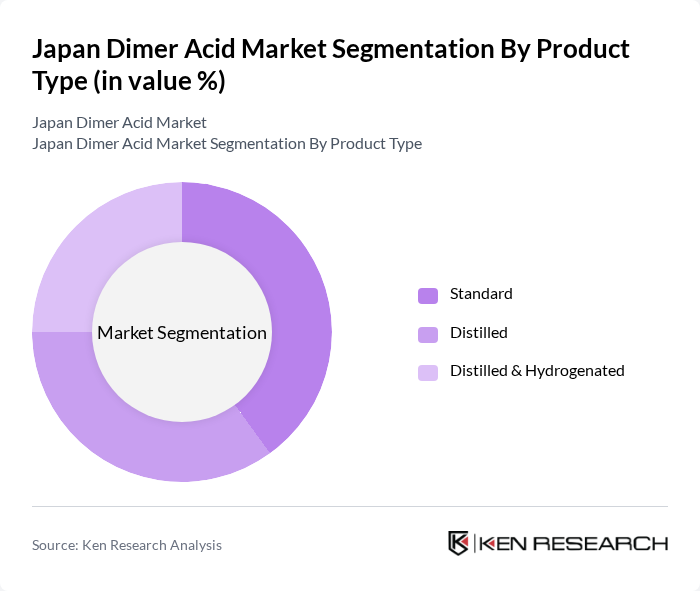
By Product Type:The product type segmentation includes Standard, Distilled, and Distilled & Hydrogenated dimer acids. The Standard type is widely used due to its cost-effectiveness and versatility in applications such as alkyd resins, basic polyamide resins, adhesives, and general-purpose lubricants. Distilled dimer acids, which offer higher purity and more consistent performance, are preferred for high-performance coatings, reactive polyamide resins, and specialty adhesives that require improved mechanical strength and corrosion resistance. Distilled & Hydrogenated dimer acids are gaining traction for their enhanced oxidative stability, color stability, and low odor, making them suitable for premium lubricants, hot?melt adhesives, and applications where long-term durability and appearance are critical.
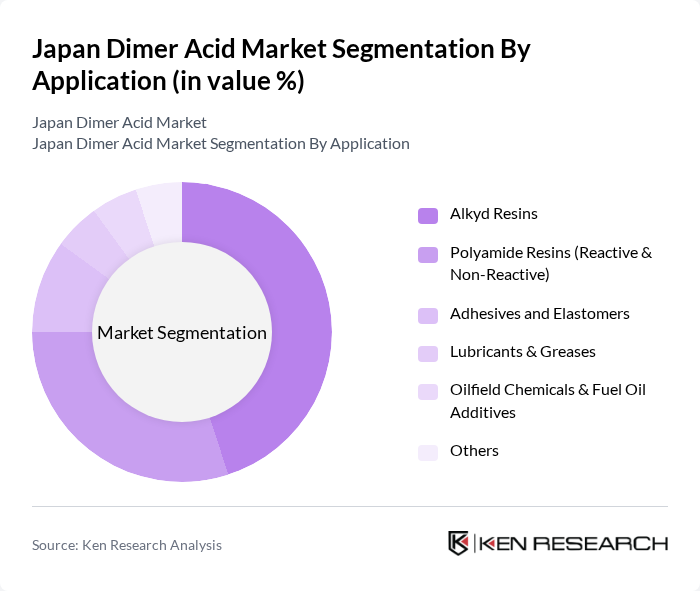
By Application:The application segmentation includes Alkyd Resins, Polyamide Resins (Reactive & Non-Reactive), Adhesives and Elastomers, Lubricants & Greases, Oilfield Chemicals & Fuel Oil Additives, and Others. Alkyd Resins account for a significant share due to their extensive use in architectural and industrial paints and coatings, where dimer acids enhance flexibility, weatherability, and adhesion. Polyamide Resins (Reactive & Non-Reactive) are favored for their durability, chemical resistance, and adhesion properties, especially in metal coatings, inks, and structural adhesives. Adhesives and Elastomers leverage dimer-acid?based polyamides and urethanes to achieve improved toughness and low?temperature flexibility, while Lubricants & Greases utilize dimer acids for synthetic esters with good lubricity and biodegradability. Oilfield Chemicals & Fuel Oil Additives use dimer-acid derivatives for corrosion inhibition and dispersant functions, and the Others category covers niche uses in personal care, inks, and specialty polymers.
The Japan Dimer Acid Market is characterized by a dynamic mix of regional and international players. Leading participants such as Kraton Corporation, Croda International Plc, Oleon NV, Emery Oleochemicals, Florachem Corporation, Jarchem Industries Inc., Aturex Group, Shandong Huijin Chemical Co., Ltd., Harima Chemicals Group, Inc., and other notable Japan-focused players contribute to innovation, geographic expansion, and service delivery in this space.
The future of the dimer acid market in Japan appears promising, driven by increasing consumer awareness of sustainability and the need for eco-friendly products. As industries adapt to stringent regulations, the demand for innovative, bio-based solutions is expected to rise. Furthermore, advancements in production technologies will likely enhance efficiency and reduce costs, making dimer acids more accessible. The market is poised for growth as companies invest in research and development to meet evolving consumer preferences and regulatory requirements.
| Segment | Sub-Segments |
|---|---|
| By Product Type | Standard Distilled Distilled & Hydrogenated |
| By Application | Alkyd Resins Polyamide Resins (Reactive & Non-Reactive) Adhesives and Elastomers Lubricants & Greases Oilfield Chemicals & Fuel Oil Additives Others |
| By End-Use Industry | Automotive Construction & Infrastructure Paints, Coatings & Inks Personal Care & Cosmetics Industrial & Marine Others |
| By Sales Channel | Direct (Manufacturers to End-Users) Distributors & Traders Online / E-commerce Others |
| By Region | Kanto Kansai Chubu Kyushu & Okinawa Tohoku Hokkaido Others |
| Scope Item/Segment | Sample Size | Target Respondent Profiles |
|---|---|---|
| Coatings Industry | 100 | Product Managers, R&D Directors |
| Adhesives and Sealants | 80 | Procurement Managers, Technical Sales Representatives |
| Lubricants Sector | 70 | Operations Managers, Quality Control Specialists |
| Polymer Manufacturing | 60 | Production Supervisors, Chemical Engineers |
| Research Institutions | 40 | Research Scientists, Industry Analysts |
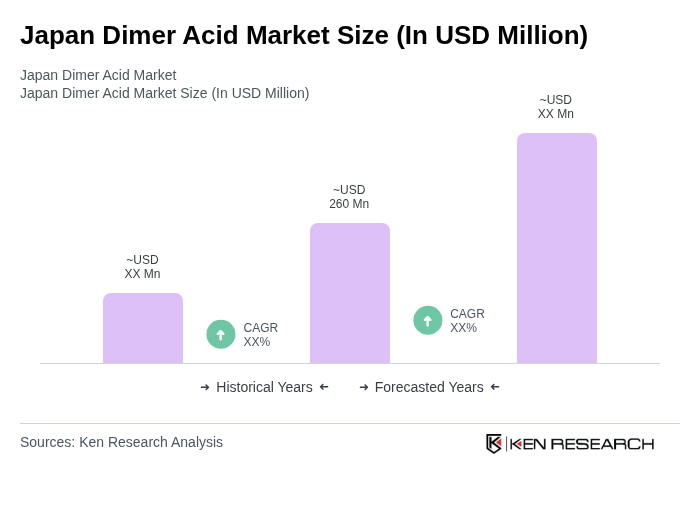
The Japan Dimer Acid Market is valued at approximately USD 260 million, reflecting a five-year historical analysis of Japan's share in the global dimer acid and hydrogenated dimer acid markets.

What makes us stand out is that our consultants follow Robust, Refine and Result (RRR) methodology. Robust for clear definitions, approaches and sanity checking, Refine for differentiating respondents' facts and opinions, and Result for presenting data with story.

We have set a benchmark in the industry by offering our clients with syndicated and customized market research reports featuring coverage of entire market as well as meticulous research and analyst insights.

While we don't replace traditional research, we flip the method upside down. Our dual approach of Top Bottom & Bottom Top ensures quality deliverable by not just verifying company fundamentals but also looking at the sector and macroeconomic factors.

With one step in the future, our research team constantly tries to show you the bigger picture. We help with some of the tough questions you may encounter along the way: How is the industry positioned? Best marketing channel? KPI's of competitors? By aligning every element, we help maximize success.

Our report gives you instant access to the answers and sources that other companies might choose to hide. We elaborate each steps of research methodology we have used and showcase you the sample size to earn your trust.

If you need any support, we are here! We pride ourselves on universe strength, data quality, and quick, friendly, and professional service.













