About the Report
Base Year 2024Listen to the audio summary
Malaysia Location Based Entertainment Market Overview
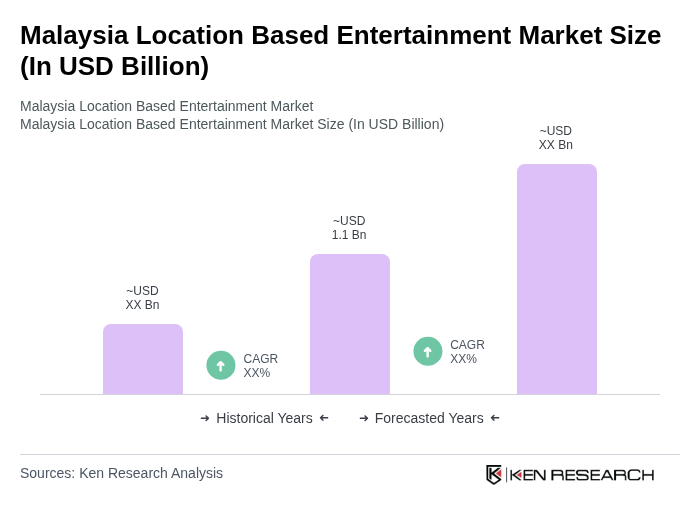
- The Malaysia Location Based Entertainment market is valued at USD 1.1 billion, based on a five-year historical analysis and benchmarked against Asia Pacific’s leading role in the global location-based entertainment market, where the region accounts for a significant share of global revenue driven by rapid urbanization and rising disposable incomes. This growth is primarily driven by increasing disposable incomes, urbanization, and a growing demand for leisure activities among families and young adults, trends that mirror the broader Asia Pacific pattern of consumers favoring out-of-home immersive and tech-enabled entertainment experiences. The rise in domestic tourism and international visitors has further fueled the expansion of entertainment venues across the country, supported by Malaysia’s tourism development strategies that emphasize diversified attractions, including theme parks and family entertainment venues.
- Key cities such as Kuala Lumpur, Penang, and Johor Bahru dominate the Malaysia Location Based Entertainment market due to their high population density, robust infrastructure, and vibrant tourism sectors, aligning with their status as major urban and tourism hubs in Malaysia’s economic corridors. These cities attract both local and international tourists, making them prime locations for various entertainment offerings, including theme parks, family entertainment centers, and immersive attractions, as evidenced by the concentration of major venues such as Sunway Lagoon, Berjaya Times Square Theme Park, Genting SkyWorlds, and LEGOLAND Malaysia in these metropolitan areas.
- In 2020, the Malaysian government launched the National Tourism Policy 2020–2030, issued by the Ministry of Tourism, Arts and Culture, which aims to enhance the tourism sector by promoting sustainable practices, accelerating digitalization, and improving tourism infrastructure. This policy includes initiatives to support the development and upgrading of tourism-related facilities and attractions, including location-based entertainment offerings, by encouraging investment, adherence to quality and safety standards, and the development of innovative, technology-enabled experiences that meet international expectations and contribute to the overall growth and competitiveness of the tourism industry.
Malaysia Location Based Entertainment Market Segmentation
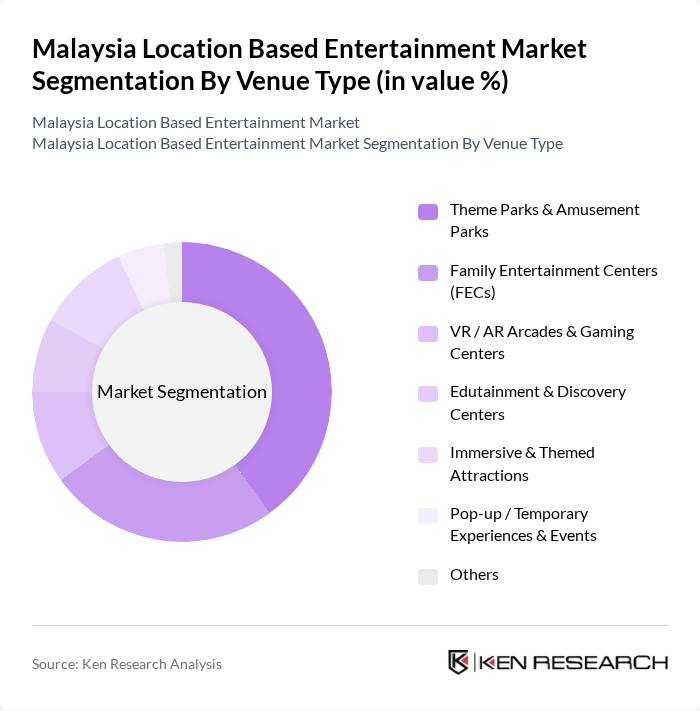
By Venue Type:The venue type segmentation includes various subsegments such as Theme Parks & Amusement Parks, Family Entertainment Centers (FECs), VR / AR Arcades & Gaming Centers, Edutainment & Discovery Centers, Immersive & Themed Attractions, Pop-up / Temporary Experiences & Events, and Others. Among these, Theme Parks & Amusement Parks are leading the market due to their ability to attract large crowds and provide diverse entertainment options for families and tourists, which is consistent with global trends where amusement and theme parks represent the largest end-use share in location-based entertainment. The popularity of these venues is driven by their extensive marketing efforts, seasonal events, and the integration of new technologies such as VR-enhanced rides, immersive storytelling zones, and digital queue and ticketing systems to enhance visitor experiences and increase dwell time.
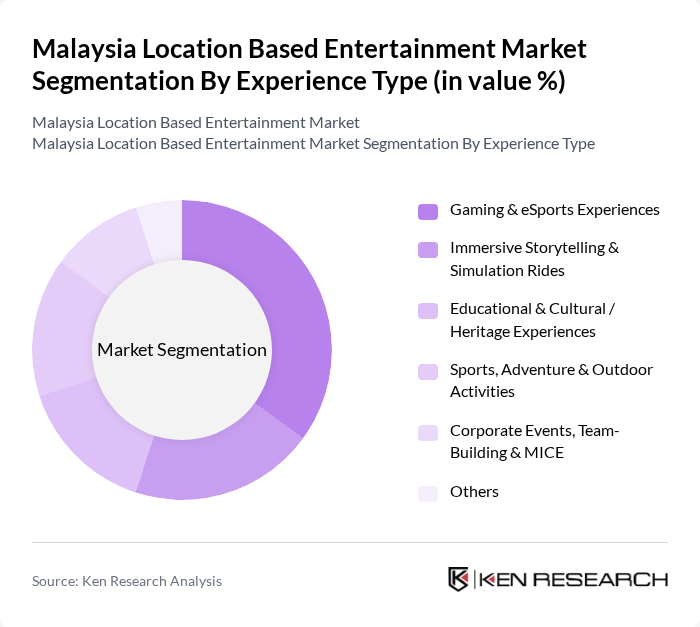
By Experience Type:The experience type segmentation encompasses Gaming & eSports Experiences, Immersive Storytelling & Simulation Rides, Educational & Cultural / Heritage Experiences, Sports, Adventure & Outdoor Activities, Corporate Events, Team-Building & MICE, and Others. Gaming & eSports Experiences are currently dominating this segment, driven by the increasing popularity of competitive gaming and the rise of digital entertainment, which mirrors regional trends where Asia Pacific hosts a rapidly growing eSports ecosystem and dedicated gaming venues. The growing engagement of youth and young adults in eSports has led to a surge in dedicated venues and events, including gaming arenas in major malls and mixed-use developments, making it a key focus area for investors and operators who are integrating high-speed connectivity, VR/AR experiences, and tournament-ready infrastructure into their offerings.
Malaysia Location Based Entertainment Market Competitive Landscape
The Malaysia Location Based Entertainment Market is characterized by a dynamic mix of regional and international players. Leading participants such as Sunway Lagoon, Berjaya Times Square Theme Park, KidZania Kuala Lumpur, ESCAPE Challenge / ESCAPE Petaling Jaya, i-City Theme Park (i-City Leisure Park), Genting SkyWorlds Theme Park, Lost World of Tambun, LEGOLAND Malaysia Resort, A'Famosa Resort Melaka, Taman Tasik Titiwangsa (Titiwangsa Lake Gardens), 1 Utama Shopping Centre, Sunway Pyramid, Mid Valley Megamall, The Curve, Pavilion Kuala Lumpur contribute to innovation, geographic expansion, and service delivery in this space by offering differentiated attractions, integrating advanced technologies such as VR, AR and projection mapping, and positioning themselves as anchor destinations within larger mixed-use retail and tourism developments.
Malaysia Location Based Entertainment Market Industry Analysis
Growth Drivers
- Increasing Urbanization:Malaysia's urban population is projected to reach 80% in future, up from 77% in recent periods, according to the World Bank. This rapid urbanization drives demand for location-based entertainment (LBE) as urban dwellers seek leisure activities close to home. The growth of urban centers, such as Kuala Lumpur and Penang, has led to increased foot traffic in entertainment venues, contributing to higher revenue generation. Urban areas are becoming hubs for family-friendly attractions, enhancing the overall entertainment landscape.
- Rising Disposable Income:The average disposable income in Malaysia is expected to rise to MYR 3,000 per month in future, up from MYR 2,800 in recent periods, as reported by the Department of Statistics Malaysia. This increase allows consumers to allocate more funds towards leisure and entertainment activities. As families have more disposable income, they are more likely to invest in experiences such as theme parks, arcades, and immersive entertainment, driving growth in the LBE sector significantly.
- Growth in Tourism:Malaysia's tourism sector is anticipated to welcome 30 million international visitors in future, a significant increase from 25 million in recent periods, according to Tourism Malaysia. This influx of tourists creates a robust market for location-based entertainment, as visitors seek unique experiences. Attractions such as cultural festivals, amusement parks, and interactive exhibits cater to both local and international tourists, enhancing the overall appeal of Malaysia as a travel destination and boosting LBE revenues.
Market Challenges
- High Initial Investment Costs:Establishing location-based entertainment facilities often requires substantial capital investment, with costs ranging from MYR 5 million to MYR 50 million depending on the scale and type of attraction. This financial barrier can deter potential investors, particularly smaller businesses. The need for advanced technology and infrastructure further exacerbates this challenge, making it difficult for new entrants to compete effectively in the market.
- Regulatory Hurdles:The LBE sector in Malaysia faces stringent regulatory requirements, including licensing and safety compliance, which can delay project timelines. For instance, obtaining necessary permits can take up to six months, according to industry reports. These regulatory challenges can increase operational costs and complicate the entry process for new businesses, limiting market growth and innovation in the sector.
Malaysia Location Based Entertainment Market Future Outlook
The future of the Malaysia location-based entertainment market appears promising, driven by evolving consumer preferences and technological advancements. As urbanization continues, entertainment venues will increasingly focus on providing immersive experiences that cater to diverse demographics. Additionally, the integration of sustainable practices and eco-friendly attractions will likely become a priority, aligning with global trends. The market is expected to adapt to changing consumer behaviors, emphasizing experiential offerings that foster social interaction and community engagement.
Market Opportunities
- Expansion of Family Entertainment Centers:The demand for family entertainment centers (FECs) is on the rise, with an estimated 20 new centers expected to open in future. These centers provide a variety of activities, appealing to families seeking comprehensive entertainment options. This expansion presents a lucrative opportunity for investors to tap into a growing market segment focused on family-oriented experiences.
- Integration of Virtual Reality Experiences:The incorporation of virtual reality (VR) into entertainment offerings is gaining traction, with an estimated MYR 200 million investment in VR technologies anticipated in future. This trend allows operators to create unique, immersive experiences that attract tech-savvy consumers. By leveraging VR, businesses can differentiate themselves and enhance customer engagement, driving growth in the LBE sector.
Scope of the Report
| Segment | Sub-Segments |
|---|---|
| By Venue Type | Theme Parks & Amusement Parks Family Entertainment Centers (FECs) VR / AR Arcades & Gaming Centers Edutainment & Discovery Centers Immersive & Themed Attractions Pop?up / Temporary Experiences & Events Others |
| By Experience Type | Gaming & eSports Experiences Immersive Storytelling & Simulation Rides Educational & Cultural / Heritage Experiences Sports, Adventure & Outdoor Activities Corporate Events, Team?Building & MICE Others |
| By Technology | Virtual Reality (VR) Augmented Reality (AR) Mixed Reality & Projection Mapping Motion Simulation & 4D/5D Experiences Interactive & Location?Aware Digital Systems Others |
| By Revenue Model | Pay?Per?Use / Ticketing Memberships & Season Passes Bundled Packages & Dynamic Pricing Sponsorships, Licensing & IP?Led Revenues Ancillary Revenues (F&B, Merchandise, Parking) Others |
| By End?User Segment | Families with Children Youth & Young Adults International Tourists Domestic Leisure Travellers Corporates & Institutions Schools & Educational Bodies Others |
| By Location Setting | Urban Integrated Malls & Mixed?Use Developments Stand?Alone Destination Parks Hotels, Resorts & Integrated Tourism Complexes Transport Hubs (Airports, Transit?Oriented) Other Indoor & Outdoor Venues |
Key Target Audience
Investors and Venture Capitalist Firms
Government and Regulatory Bodies (e.g., Ministry of Tourism, Arts and Culture Malaysia)
Manufacturers and Producers of Entertainment Equipment
Distributors and Retailers of Entertainment Products
Theme Park Operators
Technology Providers for Augmented and Virtual Reality
Industry Associations (e.g., Malaysia Association of Theme Parks and Attractions)
Financial Institutions and Banks
Players Mentioned in the Report:
Sunway Lagoon
Berjaya Times Square Theme Park
KidZania Kuala Lumpur
ESCAPE Challenge / ESCAPE Petaling Jaya
i-City Theme Park (i-City Leisure Park)
Genting SkyWorlds Theme Park
Lost World of Tambun
LEGOLAND Malaysia Resort
A'Famosa Resort Melaka
Taman Tasik Titiwangsa (Titiwangsa Lake Gardens)
1 Utama Shopping Centre
Sunway Pyramid
Mid Valley Megamall
The Curve
Pavilion Kuala Lumpur
Table of Contents
Market Assessment Phase
1. Executive Summary and Approach
2. Malaysia Location Based Entertainment Market Overview
2.1 Key Insights and Strategic Recommendations
2.2 Malaysia Location Based Entertainment Market Overview
2.3 Definition and Scope
2.4 Evolution of Market Ecosystem
2.5 Timeline of Key Regulatory Milestones
2.6 Value Chain & Stakeholder Mapping
2.7 Business Cycle Analysis
2.8 Policy & Incentive Landscape
3. Malaysia Location Based Entertainment Market Analysis
3.1 Growth Drivers
3.1.1 Increasing Urbanization
3.1.2 Rising Disposable Income
3.1.3 Growth in Tourism
3.1.4 Technological Advancements
3.2 Market Challenges
3.2.1 High Initial Investment Costs
3.2.2 Regulatory Hurdles
3.2.3 Competition from Online Entertainment
3.2.4 Seasonal Demand Fluctuations
3.3 Market Opportunities
3.3.1 Expansion of Family Entertainment Centers
3.3.2 Integration of Virtual Reality Experiences
3.3.3 Development of Themed Attractions
3.3.4 Collaborations with Local Businesses
3.4 Market Trends
3.4.1 Rise of Experiential Entertainment
3.4.2 Focus on Sustainability
3.4.3 Increased Use of Mobile Technology
3.4.4 Growth of Social Media Marketing
3.5 Government Regulation
3.5.1 Licensing Requirements for Operators
3.5.2 Safety Standards Compliance
3.5.3 Tax Incentives for Investment
3.5.4 Environmental Regulations
4. SWOT Analysis
5. Stakeholder Analysis
6. Porter's Five Forces Analysis
7. Malaysia Location Based Entertainment Market Market Size, 2019-2024
7.1 By Value
7.2 By Volume
7.3 By Average Selling Price
8. Malaysia Location Based Entertainment Market Segmentation
8.1 By Venue Type
8.1.1 Theme Parks & Amusement Parks
8.1.2 Family Entertainment Centers (FECs)
8.1.3 VR / AR Arcades & Gaming Centers
8.1.4 Edutainment & Discovery Centers
8.1.5 Immersive & Themed Attractions
8.1.6 Pop?up / Temporary Experiences & Events
8.1.7 Others
8.2 By Experience Type
8.2.1 Gaming & eSports Experiences
8.2.2 Immersive Storytelling & Simulation Rides
8.2.3 Educational & Cultural / Heritage Experiences
8.2.4 Sports, Adventure & Outdoor Activities
8.2.5 Corporate Events, Team?Building & MICE
8.2.6 Others
8.3 By Technology
8.3.1 Virtual Reality (VR)
8.3.2 Augmented Reality (AR)
8.3.3 Mixed Reality & Projection Mapping
8.3.4 Motion Simulation & 4D/5D Experiences
8.3.5 Interactive & Location?Aware Digital Systems
8.3.6 Others
8.4 By Revenue Model
8.4.1 Pay?Per?Use / Ticketing
8.4.2 Memberships & Season Passes
8.4.3 Bundled Packages & Dynamic Pricing
8.4.4 Sponsorships, Licensing & IP?Led Revenues
8.4.5 Ancillary Revenues (F&B, Merchandise, Parking)
8.4.6 Others
8.5 By End?User Segment
8.5.1 Families with Children
8.5.2 Youth & Young Adults
8.5.3 International Tourists
8.5.4 Domestic Leisure Travellers
8.5.5 Corporates & Institutions
8.5.6 Schools & Educational Bodies
8.5.7 Others
8.6 By Location Setting
8.6.1 Urban Integrated Malls & Mixed?Use Developments
8.6.2 Stand?Alone Destination Parks
8.6.3 Hotels, Resorts & Integrated Tourism Complexes
8.6.4 Transport Hubs (Airports, Transit?Oriented)
8.6.5 Other Indoor & Outdoor Venues
9. Malaysia Location Based Entertainment Market Competitive Analysis
9.1 Market Share of Key Players
9.2 Cross Comparison of Key Players
9.2.1 Company Name
9.2.2 Group Size (Large, Medium, or Small as per industry convention)
9.2.3 Annual Malaysia LBE Revenue (MYR)
9.2.4 3?Year Revenue CAGR (%)
9.2.5 EBITDA Margin (%)
9.2.6 Capex Intensity (% of Revenue)
9.2.7 Average Ticket Yield per Visitor (MYR)
9.2.8 Annual Footfall / Unique Visitors
9.2.9 Revenue per Square Foot (MYR/sq.ft.)
9.2.10 Occupancy / Utilization Rate (%)
9.2.11 Digital / Online Booking Share of Sales (%)
9.2.12 Customer Satisfaction / NPS Score
9.2.13 Marketing Spend as % of Revenue
9.2.14 Market Share in Malaysia LBE (%)
9.3 SWOT Analysis of Top Players
9.4 Pricing Analysis
9.5 Detailed Profile of Major Companies
9.5.1 Sunway Lagoon
9.5.2 Berjaya Times Square Theme Park
9.5.3 KidZania Kuala Lumpur
9.5.4 ESCAPE Challenge / ESCAPE Petaling Jaya
9.5.5 i-City Theme Park (i-City Leisure Park)
9.5.6 Genting SkyWorlds Theme Park
9.5.7 Lost World of Tambun
9.5.8 LEGOLAND Malaysia Resort
9.5.9 A'Famosa Resort Melaka
9.5.10 Taman Tasik Titiwangsa (Titiwangsa Lake Gardens)
9.5.11 1 Utama Shopping Centre
9.5.12 Sunway Pyramid
9.5.13 Mid Valley Megamall
9.5.14 The Curve
9.5.15 Pavilion Kuala Lumpur
10. Malaysia Location Based Entertainment Market End-User Analysis
10.1 Procurement Behavior of Key Ministries
10.1.1 Ministry of Tourism, Arts and Culture
10.1.2 Ministry of Youth and Sports
10.1.3 Ministry of Education
10.1.4 Ministry of Finance
10.2 Corporate Spend on Infrastructure & Energy
10.2.1 Investment in Entertainment Infrastructure
10.2.2 Budget Allocation for Events and Promotions
10.2.3 Partnerships with Private Sector
10.2.4 Funding for Cultural Programs
10.3 Pain Point Analysis by End-User Category
10.3.1 Accessibility Issues
10.3.2 Affordability Concerns
10.3.3 Quality of Experience
10.3.4 Safety and Security
10.4 User Readiness for Adoption
10.4.1 Awareness of Offerings
10.4.2 Willingness to Pay
10.4.3 Technological Familiarity
10.4.4 Feedback Mechanisms
10.5 Post-Deployment ROI and Use Case Expansion
10.5.1 Measurement of Customer Satisfaction
10.5.2 Analysis of Repeat Visits
10.5.3 Revenue from Ancillary Services
10.5.4 Expansion into New Markets
11. Malaysia Location Based Entertainment Market Future Size, 2025-2030
11.1 By Value
11.2 By Volume
11.3 By Average Selling Price
Go-To-Market Strategy Phase
1. Whitespace Analysis + Business Model Canvas
1.1 Market Gaps Identification
1.2 Business Model Development
2. Marketing and Positioning Recommendations
2.1 Branding Strategies
2.2 Product USPs
3. Distribution Plan
3.1 Urban Retail vs Rural NGO Tie-ups
4. Channel & Pricing Gaps
4.1 Underserved Routes
4.2 Pricing Bands
5. Unmet Demand & Latent Needs
5.1 Category Gaps
5.2 Consumer Segments
6. Customer Relationship
6.1 Loyalty Programs
6.2 After-sales Service
7. Value Proposition
7.1 Sustainability
7.2 Integrated Supply Chains
8. Key Activities
8.1 Regulatory Compliance
8.2 Branding
8.3 Distribution Setup
9. Entry Strategy Evaluation
9.1 Domestic Market Entry Strategy
9.1.1 Product Mix
9.1.2 Pricing Band
9.1.3 Packaging
9.2 Export Entry Strategy
9.2.1 Target Countries
9.2.2 Compliance Roadmap
10. Entry Mode Assessment
10.1 JV
10.2 Greenfield
10.3 M&A
10.4 Distributor Model
11. Capital and Timeline Estimation
11.1 Capital Requirements
11.2 Timelines
12. Control vs Risk Trade-Off
12.1 Ownership vs Partnerships
13. Profitability Outlook
13.1 Breakeven Analysis
13.2 Long-term Sustainability
14. Potential Partner List
14.1 Distributors
14.2 JVs
14.3 Acquisition Targets
15. Execution Roadmap
15.1 Phased Plan for Market Entry
15.1.1 Market Setup
15.1.2 Market Entry
15.1.3 Growth Acceleration
15.1.4 Scale & Stabilize
15.2 Key Activities and Milestones
15.2.1 Activity Timeline
15.2.2 Milestone Tracking
Research Methodology
Phase 1: Approach1
Desk Research
- Analysis of industry reports from Malaysian tourism and entertainment authorities
- Review of market trends and consumer behavior studies published by local research firms
- Examination of demographic and economic data from the Department of Statistics Malaysia
Primary Research
- Interviews with executives from leading location-based entertainment venues
- Surveys targeting consumers who frequently engage in entertainment activities
- Focus groups with families and young adults to understand preferences and spending habits
Validation & Triangulation
- Cross-validation of findings through multiple data sources, including government publications and industry reports
- Triangulation of consumer insights with financial performance data from entertainment companies
- Sanity checks conducted through expert panel discussions with industry veterans
Phase 2: Market Size Estimation1
Top-down Assessment
- Estimation of market size based on national entertainment expenditure statistics
- Segmentation of the market by type of entertainment (e.g., theme parks, arcades, VR experiences)
- Incorporation of growth rates from tourism and local entertainment initiatives
Bottom-up Modeling
- Collection of revenue data from major location-based entertainment operators
- Estimation of average ticket prices and visitor numbers across different venues
- Calculation of total market size based on aggregated venue performance metrics
Forecasting & Scenario Analysis
- Development of growth scenarios based on economic recovery post-pandemic
- Analysis of consumer trends towards experiential entertainment and technology integration
- Projections of market growth through 2030 under various economic conditions
Phase 3: CATI Sample Composition1
| Scope Item/Segment | Sample Size | Target Respondent Profiles |
|---|---|---|
| Theme Park Visitors | 120 | Families, Young Adults |
| Arcade and Gaming Center Patrons | 90 | Teenagers, College Students |
| Virtual Reality Experience Users | 60 | Tech Enthusiasts, Gamers |
| Cultural and Heritage Site Visitors | 60 | Tourists, Local Residents |
| Event and Festival Attendees | 70 | General Public |
Frequently Asked Questions
What is the current value of the Malaysia Location Based Entertainment market?
The Malaysia Location Based Entertainment market is valued at approximately USD 1.1 billion, reflecting significant growth driven by urbanization, rising disposable incomes, and increasing demand for leisure activities among families and young adults.
Which cities are the main hubs for Location Based Entertainment in Malaysia?
What factors are driving the growth of the Location Based Entertainment market in Malaysia?
What challenges does the Malaysia Location Based Entertainment market face?
Other Regional/Country Reports
Other Adjacent Reports
KSA Tourism Market
Saudi Arabia Hospitality MarketIndia Virtual Reality Market Size, Share & Forecast, By Solution Type, Application & End-Use Industry, 2026-2032APAC augmented reality market Size, Share, Growth Drivers, Trends, Opportunities & Forecast 2025–2030Egypt eSports Market
Indonesia Video Game Market Size, Share & Forecast, By Platform, Game Type & Revenue Model, 2026-2032Global Theme Park Market Size, Share, Trends & Forecast, By Park Type, Revenue Stream & Visitor Group, 2026-2031Asia Pacific Amusement Park Market Size, Share & Forecast, By Ride Type, Revenue Source & Visitor Age, 2026-2031Oman Retail Entertainment Market
Middle East Event Management Market Size, Share & Forecast, By Event Type, Service Type & Delivery Mode, 2026-2031Why Buy From Us?

What makes us stand out is that our consultants follow Robust, Refine and Result (RRR) methodology. Robust for clear definitions, approaches and sanity checking, Refine for differentiating respondents' facts and opinions, and Result for presenting data with story.

We have set a benchmark in the industry by offering our clients with syndicated and customized market research reports featuring coverage of entire market as well as meticulous research and analyst insights.

While we don't replace traditional research, we flip the method upside down. Our dual approach of Top Bottom & Bottom Top ensures quality deliverable by not just verifying company fundamentals but also looking at the sector and macroeconomic factors.

With one step in the future, our research team constantly tries to show you the bigger picture. We help with some of the tough questions you may encounter along the way: How is the industry positioned? Best marketing channel? KPI's of competitors? By aligning every element, we help maximize success.

Our report gives you instant access to the answers and sources that other companies might choose to hide. We elaborate each steps of research methodology we have used and showcase you the sample size to earn your trust.

If you need any support, we are here! We pride ourselves on universe strength, data quality, and quick, friendly, and professional service.