About the Report
Base Year 2024Middle East Social Commerce Market Overview
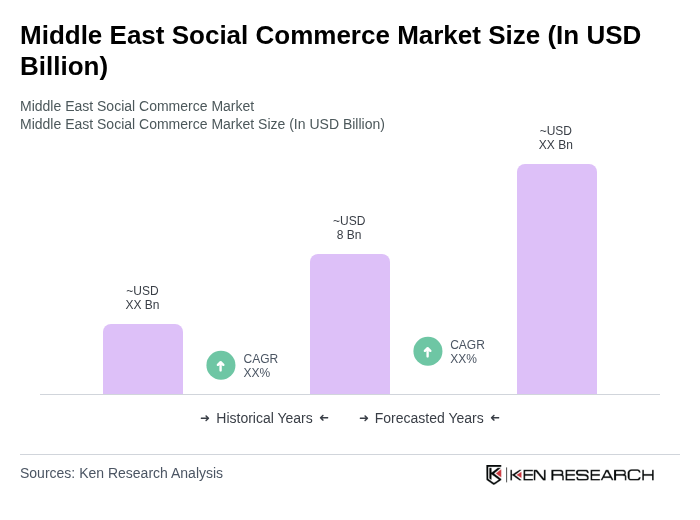
- The Middle East Social Commerce Market is valued at USD 8 billion, based on a five-year historical analysis. This growth is primarily driven by the increasing penetration of smartphones and social media platforms, which have transformed consumer shopping behaviors. The rise of influencer marketing and user-generated content has further fueled engagement and purchasing decisions among consumers, making social commerce a vital channel for brands.
- Key players in this market include the United Arab Emirates, Saudi Arabia, and Egypt. The UAE leads due to its advanced digital infrastructure and high internet penetration rates, while Saudi Arabia benefits from a young, tech-savvy population. Egypt's growing middle class and increasing smartphone usage also contribute to its prominence in the social commerce landscape, supported by strong adoption of fashion, beauty, and electronics categories in online and cross-border commerce.
- In 2023, the Saudi Arabian government implemented regulations to enhance consumer protection in e-commerce through the E-Commerce Law Implementing Regulations issued by the Ministry of Commerce in 2020, which require online retailers to display clear terms, including return and refund policies, total prices, and all fees to consumers. These rules build on the E-Commerce Law issued by Royal Decree No. M/126 of 2019, which mandates transparency in pricing, accurate product descriptions, and clear disclosure of trader identity and contact details for all e-commerce providers. This regulatory framework aims to build consumer trust and encourage more online shopping, thereby supporting the growth of the social commerce sector.
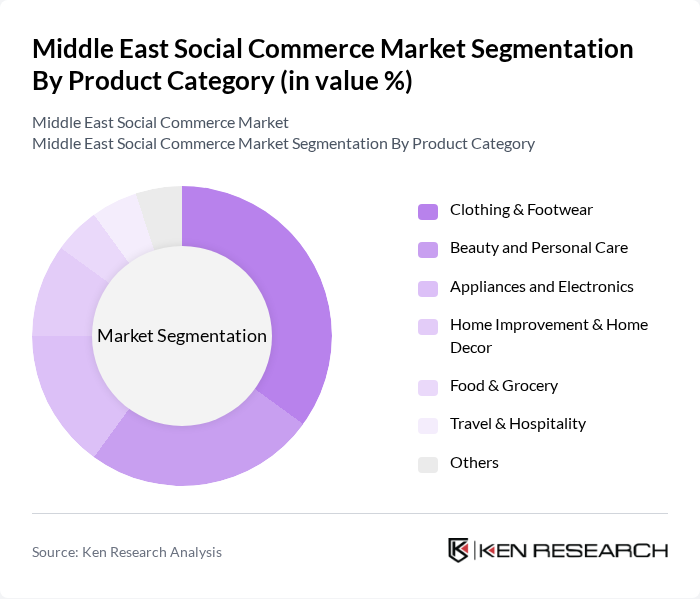
Middle East Social Commerce Market Segmentation
By Product Category:The product categories in the social commerce market include Clothing & Footwear, Beauty and Personal Care, Appliances and Electronics, Home Improvement & Home Decor, Food & Grocery, Travel & Hospitality, and Others. This structure is consistent with broader regional e-commerce and cross-border e-commerce segmentations, where fashion and apparel, electronics and gadgets, and beauty and personal care are among the most purchased online categories. Among these, Clothing & Footwear is the leading subsegment, driven by the growing trend of online fashion shopping, high adoption of social-media-driven fashion inspiration, and the strong role of influencers and live shopping formats in the region. Consumers are increasingly turning to social platforms for fashion inspiration and discovery of international and regional brands, making this category a significant contributor to overall market growth.
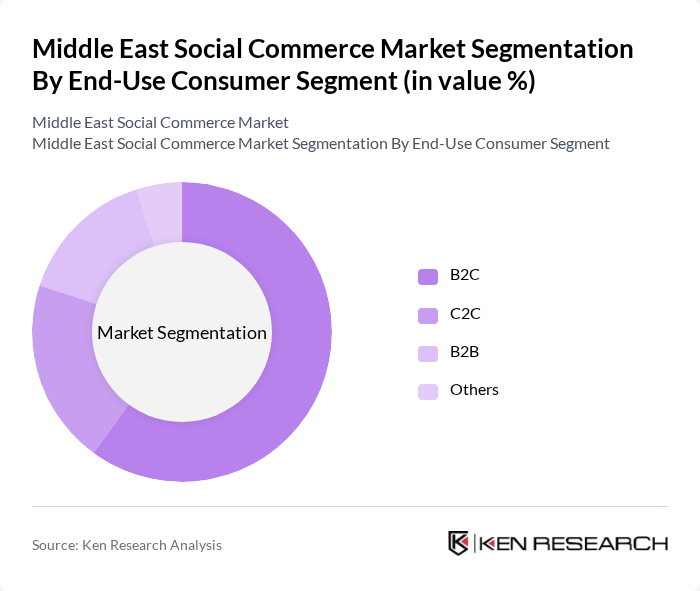
By End-Use Consumer Segment:The end-use consumer segments in the social commerce market include B2C, C2C, B2B, and Others. This segmentation is aligned with regional social commerce analyses that distinguish between direct-to-consumer, reseller, and business-focused models. The B2C segment dominates the market, as brands and large retailers increasingly leverage platforms such as Instagram Shopping, TikTok Shop, and WhatsApp Business to directly engage with consumers through shoppable posts, live streams, and creator collaborations. This direct interaction fosters brand loyalty, enables personalized recommendations, and encourages impulse buying, making B2C a critical driver of revenue in the social commerce landscape.
Middle East Social Commerce Market Competitive Landscape
The Middle East Social Commerce Market is characterized by a dynamic mix of regional and international players. Leading participants such as Amazon (Amazon.sa, Amazon.ae), Noon, Namshi, Ounass, AliExpress, Shein, Jarir Bookstore, Carrefour Middle East, Chalhoub Group, Al Tayer Group, Sephora Middle East, IKEA Middle East, Nike, TikTok Shop (Middle East), Instagram Shopping & Facebook Shops (Meta) contribute to innovation, geographic expansion, and service delivery in this space, increasingly integrating influencer-led campaigns, live shopping, and AI-assisted recommendation tools into their social commerce strategies.
Middle East Social Commerce Market Industry Analysis
Growth Drivers
- Increasing Smartphone Penetration:As of future, the Middle East boasts a smartphone penetration rate of approximately 80%, translating to around 70 million users. This surge in smartphone adoption facilitates easier access to social commerce platforms, enabling consumers to shop directly through social media. The World Bank reports that mobile internet subscriptions in the region have increased by 20% annually, further driving engagement in social commerce activities and enhancing the overall shopping experience.
- Rise of Social Media Platforms:The Middle East has seen a significant increase in social media usage, with over 100 million active users reported in future. Platforms like Instagram and TikTok are becoming essential for brands to connect with consumers. According to Statista, the average daily time spent on social media in the region is around 4 hours, creating a fertile ground for social commerce initiatives and allowing brands to leverage user-generated content effectively.
- Enhanced Digital Payment Solutions:The adoption of digital payment solutions in the Middle East is accelerating, with a 30% increase in e-wallet usage reported in future. The introduction of secure payment gateways and mobile wallets has made transactions seamless for consumers. According to the International Monetary Fund, the value of digital transactions in the region is projected to reach $60 billion, significantly boosting consumer confidence in social commerce platforms and driving sales growth.
Market Challenges
- Regulatory Hurdles:The Middle East faces various regulatory challenges that hinder the growth of social commerce. In future, over 70% of businesses reported difficulties in navigating complex e-commerce regulations. The lack of a unified regulatory framework across countries complicates compliance for international brands. According to the World Bank, these regulatory barriers can lead to increased operational costs, limiting market entry for new players and stifling innovation in the sector.
- Trust and Security Concerns:Trust issues remain a significant barrier to social commerce growth in the Middle East. A future survey indicated that 80% of consumers express concerns about data privacy and online security. High-profile data breaches have heightened these fears, leading to hesitance in making online purchases. The International Telecommunication Union reports that enhancing cybersecurity measures is crucial for building consumer trust and encouraging more users to engage in social commerce.
Middle East Social Commerce Market Future Outlook
The future of social commerce in the Middle East appears promising, driven by technological advancements and evolving consumer behaviors. As digital literacy improves, more consumers are expected to embrace online shopping through social media platforms. Additionally, the integration of innovative technologies like augmented reality will enhance the shopping experience, making it more interactive. Brands that prioritize personalized marketing strategies and invest in secure payment solutions will likely capture a larger market share, fostering sustainable growth in the sector.
Market Opportunities
- Expansion of Influencer Marketing:The influencer marketing sector in the Middle East is projected to grow significantly, with an estimated value of $2 billion by future. Brands can leverage influencers to reach targeted demographics effectively, enhancing brand visibility and driving sales through authentic endorsements. This trend presents a lucrative opportunity for businesses to engage consumers in a more relatable manner.
- Integration of AR/VR Technologies:The adoption of augmented and virtual reality technologies in social commerce is gaining traction, with investments expected to reach $600 million in future. These technologies can provide immersive shopping experiences, allowing consumers to visualize products in their environment. This innovation can significantly enhance customer engagement and satisfaction, creating a competitive edge for early adopters in the market.
Scope of the Report
| Segment | Sub-Segments |
|---|---|
| By Product Category | Clothing & Footwear Beauty and Personal Care Appliances and Electronics Home Improvement & Home Decor Food & Grocery Travel & Hospitality Others |
| By End-Use Consumer Segment | B2C C2C B2B Others |
| By Country | Saudi Arabia United Arab Emirates Egypt Qatar Rest of Middle East |
| By Social Platform | TikTok Snapchat Others |
| By Payment Method | Digital Wallets Credit/Debit Cards Bank Transfers Cash on Delivery Buy Now Pay Later (BNPL) Others |
| By Business Model | Marketplace-led Brand/retailer-owned social stores Influencer/creator-led commerce Social group buying & community commerce Others |
| By Device & Customer Journey | Mobile-first purchases (in-app) Desktop/Web-social referrals In-app checkout Click-to-chat / conversational commerce Others |
Key Target Audience
Investors and Venture Capitalist Firms
Government and Regulatory Bodies (e.g., Ministry of Commerce and Investment, Telecommunications Regulatory Authority)
Social Media Platforms and Influencers
E-commerce Platforms and Marketplaces
Logistics and Supply Chain Companies
Payment Solution Providers
Advertising and Marketing Agencies
Consumer Goods Manufacturers
Players Mentioned in the Report:
Amazon (Amazon.sa, Amazon.ae)
Noon
Namshi
Ounass
AliExpress
Shein
Jarir Bookstore
Carrefour Middle East
Chalhoub Group
Al Tayer Group
Sephora Middle East
IKEA Middle East
Nike
TikTok Shop (Middle East)
Instagram Shopping & Facebook Shops (Meta)
Table of Contents
Market Assessment Phase
1. Executive Summary and Approach
2. Middle East Social Commerce Market Overview
2.1 Key Insights and Strategic Recommendations
2.2 Middle East Social Commerce Market Overview
2.3 Definition and Scope
2.4 Evolution of Market Ecosystem
2.5 Timeline of Key Regulatory Milestones
2.6 Value Chain & Stakeholder Mapping
2.7 Business Cycle Analysis
2.8 Policy & Incentive Landscape
3. Middle East Social Commerce Market Analysis
3.1 Growth Drivers
3.1.1 Increasing smartphone penetration
3.1.2 Rise of social media platforms
3.1.3 Growing e-commerce adoption
3.1.4 Enhanced digital payment solutions
3.2 Market Challenges
3.2.1 Regulatory hurdles
3.2.2 Trust and security concerns
3.2.3 Limited digital literacy
3.2.4 Intense competition
3.3 Market Opportunities
3.3.1 Expansion of influencer marketing
3.3.2 Integration of AR/VR technologies
3.3.3 Development of niche markets
3.3.4 Collaborations with local brands
3.4 Market Trends
3.4.1 Personalization of shopping experiences
3.4.2 Growth of live shopping events
3.4.3 Increased focus on sustainability
3.4.4 Use of AI in customer service
3.5 Government Regulation
3.5.1 Data protection laws
3.5.2 E-commerce regulations
3.5.3 Consumer protection policies
3.5.4 Taxation frameworks for online sales
4. SWOT Analysis
5. Stakeholder Analysis
6. Porter's Five Forces Analysis
7. Middle East Social Commerce Market Market Size, 2019-2024
7.1 By Value
7.2 By Volume
7.3 By Average Selling Price
8. Middle East Social Commerce Market Segmentation
8.1 By Product Category
8.1.1 Clothing & Footwear
8.1.2 Beauty and Personal Care
8.1.3 Appliances and Electronics
8.1.4 Home Improvement & Home Decor
8.1.5 Food & Grocery
8.1.6 Travel & Hospitality
8.1.7 Others
8.2 By End-Use Consumer Segment
8.2.1 B2C
8.2.2 C2C
8.2.3 B2B
8.2.4 Others
8.3 By Country
8.3.1 Saudi Arabia
8.3.2 United Arab Emirates
8.3.3 Egypt
8.3.4 Qatar
8.3.5 Rest of Middle East
8.4 By Social Platform
8.4.1 Instagram
8.4.2 TikTok
8.4.3 Snapchat
8.4.4 Facebook
8.4.5 WhatsApp
8.4.6 Others
8.5 By Payment Method
8.5.1 Digital Wallets
8.5.2 Credit/Debit Cards
8.5.3 Bank Transfers
8.5.4 Cash on Delivery
8.5.5 Buy Now Pay Later (BNPL)
8.5.6 Others
8.6 By Business Model
8.6.1 Marketplace-led
8.6.2 Brand/retailer-owned social stores
8.6.3 Influencer/creator-led commerce
8.6.4 Social group buying & community commerce
8.6.5 Others
8.7 By Device & Customer Journey
8.7.1 Mobile-first purchases (in-app)
8.7.2 Desktop/Web-social referrals
8.7.3 In-app checkout
8.7.4 Click-to-chat / conversational commerce
8.7.5 Others
9. Middle East Social Commerce Market Competitive Analysis
9.1 Market Share of Key Players
9.2 Cross Comparison of Key Players
9.2.1 Company Name
9.2.2 Group Size (Large, Medium, or Small as per industry convention)
9.2.3 Gross Merchandise Value (GMV)
9.2.4 Revenue from Social Commerce
9.2.5 Customer Acquisition Cost (CAC)
9.2.6 Customer Lifetime Value (CLV)
9.2.7 Conversion Rate from Social Traffic
9.2.8 Average Order Value (AOV)
9.2.9 Return on Advertising Spend (ROAS)
9.2.10 Paid vs Organic Traffic Mix
9.2.11 Social Media Engagement Rate
9.2.12 Active User Base in Middle East
9.2.13 Market Penetration Rate
9.3 SWOT Analysis of Top Players
9.4 Pricing Analysis
9.5 Detailed Profile of Major Companies
9.5.1 Amazon (Amazon.sa, Amazon.ae)
9.5.2 Noon
9.5.3 Namshi
9.5.4 Ounass
9.5.5 AliExpress
9.5.6 Shein
9.5.7 Jarir Bookstore
9.5.8 Carrefour Middle East
9.5.9 Chalhoub Group
9.5.10 Al Tayer Group
9.5.11 Sephora Middle East
9.5.12 IKEA Middle East
9.5.13 Nike
9.5.14 TikTok Shop (Middle East)
9.5.15 Instagram Shopping & Facebook Shops (Meta)
10. Middle East Social Commerce Market End-User Analysis
10.1 Procurement Behavior of Key Ministries
10.1.1 Digital procurement initiatives
10.1.2 Budget allocation for social commerce
10.1.3 Collaboration with private sectors
10.1.4 Adoption of e-procurement platforms
10.2 Corporate Spend on Infrastructure & Energy
10.2.1 Investment in digital infrastructure
10.2.2 Spending on marketing technologies
10.2.3 Budget for social media campaigns
10.2.4 Allocation for customer engagement tools
10.3 Pain Point Analysis by End-User Category
10.3.1 Difficulty in reaching target audiences
10.3.2 Challenges in measuring ROI
10.3.3 Issues with customer trust
10.3.4 Limited access to analytics tools
10.4 User Readiness for Adoption
10.4.1 Awareness of social commerce benefits
10.4.2 Familiarity with digital payment methods
10.4.3 Willingness to engage with brands online
10.4.4 Readiness to share personal data
10.5 Post-Deployment ROI and Use Case Expansion
10.5.1 Evaluation of campaign effectiveness
10.5.2 Opportunities for upselling
10.5.3 Expansion into new customer segments
10.5.4 Long-term customer retention strategies
11. Middle East Social Commerce Market Future Size, 2025-2030
11.1 By Value
11.2 By Volume
11.3 By Average Selling Price
Go-To-Market Strategy Phase
1. Whitespace Analysis + Business Model Canvas
1.1 Market gaps identification
1.2 Value proposition development
1.3 Revenue model exploration
1.4 Customer segment targeting
1.5 Key partnerships identification
1.6 Cost structure analysis
1.7 Channels of distribution
2. Marketing and Positioning Recommendations
2.1 Branding strategies
2.2 Product USPs
2.3 Target audience engagement
2.4 Digital marketing tactics
2.5 Content strategy
2.6 Social media presence
2.7 Influencer partnerships
3. Distribution Plan
3.1 Urban retail strategies
3.2 Rural NGO tie-ups
3.3 E-commerce platform partnerships
3.4 Logistics and supply chain management
3.5 Customer service integration
3.6 Distribution channel optimization
3.7 Inventory management solutions
4. Channel & Pricing Gaps
4.1 Underserved routes
4.2 Pricing bands analysis
4.3 Competitor pricing strategies
4.4 Customer willingness to pay
4.5 Value-based pricing models
4.6 Discounting strategies
4.7 Bundling opportunities
5. Unmet Demand & Latent Needs
5.1 Category gaps identification
5.2 Consumer segments analysis
5.3 Emerging trends exploration
5.4 Feedback mechanisms
5.5 Product development opportunities
5.6 Market entry strategies
5.7 Customer experience enhancement
6. Customer Relationship
6.1 Loyalty programs
6.2 After-sales service
6.3 Customer feedback loops
6.4 Community engagement initiatives
6.5 Personalization strategies
6.6 Customer support channels
6.7 Retention strategies
7. Value Proposition
7.1 Sustainability initiatives
7.2 Integrated supply chains
7.3 Unique selling propositions
7.4 Customer-centric approaches
7.5 Brand differentiation strategies
7.6 Value delivery mechanisms
7.7 Competitive advantages
8. Key Activities
8.1 Regulatory compliance
8.2 Branding efforts
8.3 Distribution setup
8.4 Marketing campaigns
8.5 Partnership development
8.6 Performance monitoring
8.7 Continuous improvement processes
9. Entry Strategy Evaluation
9.1 Domestic Market Entry Strategy
9.1.1 Product mix considerations
9.1.2 Pricing band analysis
9.1.3 Packaging strategies
9.2 Export Entry Strategy
9.2.1 Target countries identification
9.2.2 Compliance roadmap development
10. Entry Mode Assessment
10.1 JV opportunities
10.2 Greenfield investments
10.3 M&A considerations
10.4 Distributor model evaluation
11. Capital and Timeline Estimation
11.1 Capital requirements analysis
11.2 Timelines for market entry
12. Control vs Risk Trade-Off
12.1 Ownership considerations
12.2 Partnerships evaluation
13. Profitability Outlook
13.1 Breakeven analysis
13.2 Long-term sustainability strategies
14. Potential Partner List
14.1 Distributors identification
14.2 JVs exploration
14.3 Acquisition targets
15. Execution Roadmap
15.1 Phased Plan for Market Entry
15.1.1 Market Setup
15.1.2 Market Entry
15.1.3 Growth Acceleration
15.1.4 Scale & Stabilize
15.2 Key Activities and Milestones
15.2.1 Activity timelines
15.2.2 Milestone tracking
Research Methodology
Phase 1: Approach1
Desk Research
- Analysis of market reports from regional trade associations and government publications
- Review of academic journals and white papers focusing on social commerce trends in the Middle East
- Examination of demographic and economic data from national statistics offices and international organizations
Primary Research
- Interviews with key stakeholders in social commerce platforms, including executives and product managers
- Surveys targeting consumers to understand purchasing behavior and preferences in social commerce
- Focus groups with small business owners utilizing social commerce for sales and marketing
Validation & Triangulation
- Cross-validation of findings through multiple data sources, including consumer surveys and expert interviews
- Triangulation of qualitative insights with quantitative data from market reports
- Sanity checks conducted through expert panel reviews to ensure data accuracy and relevance
Phase 2: Market Size Estimation1
Top-down Assessment
- Estimation of total market size based on regional e-commerce growth rates and social media penetration
- Segmentation of the market by product categories and consumer demographics
- Incorporation of trends in mobile commerce and digital payment adoption in the region
Bottom-up Modeling
- Collection of sales data from leading social commerce platforms operating in the Middle East
- Estimation of average transaction values and frequency of purchases across different demographics
- Analysis of user engagement metrics to project growth in social commerce activities
Forecasting & Scenario Analysis
- Development of predictive models using historical data and current market trends
- Scenario analysis based on varying levels of consumer adoption and regulatory impacts
- Creation of baseline, optimistic, and pessimistic forecasts for the next five years
Phase 3: CATI Sample Composition1
| Scope Item/Segment | Sample Size | Target Respondent Profiles |
|---|---|---|
| Consumer Behavior in Social Commerce | 150 | Online Shoppers, Social Media Users |
| Small Business Utilization of Social Platforms | 100 | Small Business Owners, Marketing Managers |
| Influencer Marketing Impact | 80 | Social Media Influencers, Brand Managers |
| Payment Preferences in Social Commerce | 120 | Consumers, Financial Service Providers |
| Trends in Mobile Commerce | 90 | Mobile App Developers, E-commerce Analysts |
Frequently Asked Questions
What is the current value of the Middle East Social Commerce Market?
The Middle East Social Commerce Market is valued at approximately USD 8 billion, driven by increased smartphone penetration and the rise of social media platforms, which have transformed consumer shopping behaviors in the region.
Which countries are leading in the Middle East Social Commerce Market?
What are the main product categories in the Middle East Social Commerce Market?
How has influencer marketing impacted social commerce in the Middle East?
Other Regional/Country Reports
Other Adjacent Reports
Singapore Social Media Advertising Market
Mexico Cross-Border E-Commerce MarketJapan Fashion Retail Market
India Beauty and Personal Care Market Outlook to 2030APAC augmented reality market Size, Share, Growth Drivers, Trends, Opportunities & Forecast 2025–2030UAE Nordics Cybersecurity MarketWhy Buy From Us?

What makes us stand out is that our consultants follow Robust, Refine and Result (RRR) methodology. Robust for clear definitions, approaches and sanity checking, Refine for differentiating respondents' facts and opinions, and Result for presenting data with story.

We have set a benchmark in the industry by offering our clients with syndicated and customized market research reports featuring coverage of entire market as well as meticulous research and analyst insights.

While we don't replace traditional research, we flip the method upside down. Our dual approach of Top Bottom & Bottom Top ensures quality deliverable by not just verifying company fundamentals but also looking at the sector and macroeconomic factors.

With one step in the future, our research team constantly tries to show you the bigger picture. We help with some of the tough questions you may encounter along the way: How is the industry positioned? Best marketing channel? KPI's of competitors? By aligning every element, we help maximize success.

Our report gives you instant access to the answers and sources that other companies might choose to hide. We elaborate each steps of research methodology we have used and showcase you the sample size to earn your trust.

If you need any support, we are here! We pride ourselves on universe strength, data quality, and quick, friendly, and professional service.