United Arab Emirates Thermal Conductive Additives Market Report Size Share Growth Drivers Trends Opportunities & Forecast 2025–2030

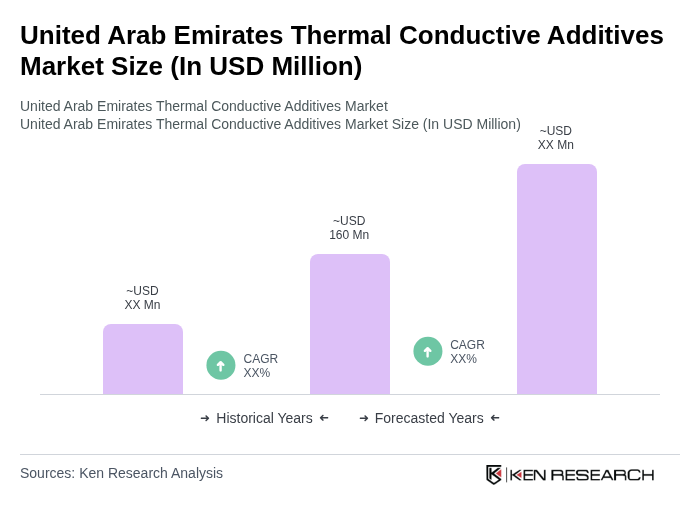
UAE Thermal Conductive Additives Market, valued at USD 160 Mn, grows with trends in miniaturization, energy efficiency, and regulations in key sectors like electronics and automotive.

Region:Middle East

Author(s):Rebecca

Product Code:KRAE4198

Pages:93

Published On:March 2026
About the Report

Base Year 2024

United Arab Emirates Thermal Conductive Additives Market Overview

  • The United Arab Emirates Thermal Conductive Additives Market is valued at USD 160 million, based on a five-year historical analysis and benchmarking against regional specialty and plastic additives spending in the UAE.This growth is primarily driven by the increasing demand for efficient thermal management solutions across various industries, including electronics, automotive, and aerospace, in line with global trends for thermally conductive additives.The rising trend of miniaturization in electronic devices and the growing focus on energy efficiency have further propelled the market's expansion, supported by the broader adoption of thermal interface and heat dissipation materials worldwide.
  • Key cities such as Dubai and Abu Dhabi dominate the market due to their robust industrial infrastructure and significant investments in technology and innovation, including large-scale initiatives in advanced manufacturing, electronics assembly, aerospace, and automotive-related activities under UAE industrial strategies.Dubai's strategic location as a trade hub and Abu Dhabi's focus on diversifying its economy away from oil dependency through petrochemicals, specialty chemicals, and advanced materials have created a conducive environment for the growth of thermal conductive additives.
  • In 2023, the UAE government implemented regulations aimed at enhancing energy efficiency in industrial processes. This includes mandatory standards for thermal management materials used in electronics and automotive applications, promoting the use of high-performance thermal conductive additives to meet these standards. A key instrument is the UAE Cabinet Decision No. 34 of 2014 on the UAE Energy Efficiency Standardization and Labeling Scheme for electrical appliances, issued by the UAE Cabinet and implemented through the Emirates Authority for Standardization and Metrology (now MOIAT), which sets minimum energy performance and efficiency requirements for electrical and electronic equipment and drives the adoption of advanced thermal management and heat-dissipating materials in products placed on the UAE market.
United Arab Emirates Thermal Conductive Additives Market Size

United Arab Emirates Thermal Conductive Additives Market Segmentation

By Additive Type:The market is segmented into various additive types, including graphite-based additives, ceramic-based additives (e.g., boron nitride, alumina, aluminum nitride), metallic-based additives, polymer-based additives, and others, consistent with global thermally conductive additive classifications.Graphite-based additives are currently leading the market due to their excellent thermal conductivity, good processability in polymers, and cost-effectiveness, making them a preferred choice in electronics and automotive applications where high thermal performance and electrical conductivity are acceptable.Ceramic-based additives are also gaining traction, particularly in high-temperature and electrically insulating applications such as power electronics, LEDs, and aerospace components, while metallic and polymer-based additives cater to specific niche markets requiring very high conductivity, electromagnetic shielding, or lightweight, formable compounds.
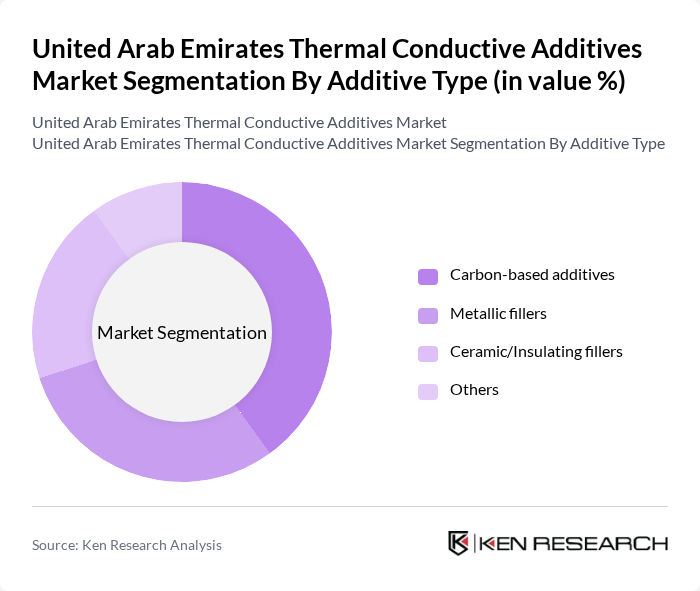
United Arab Emirates Thermal Conductive Additives Market segmentation by Additive Type.

By Application:The applications of thermal conductive additives include electronics cooling and thermal interface materials, automotive thermal management, LED lighting and power electronics, industrial machinery and equipment, aerospace and defense, and others, which are aligned with global end-use patterns for thermally conductive additives.The electronics cooling and thermal interface materials segment is the most significant, driven by the rapid growth of the electronics and consumer electronics industries, the proliferation of data centers, and the need for efficient heat dissipation solutions in compact, high-power-density devices.Automotive thermal management is also a growing application, fueled by the increasing demand for electric and hybrid vehicles, battery packs, on-board power electronics, and advanced driver-assistance systems that require reliable thermal control and thermally conductive polymer compounds.
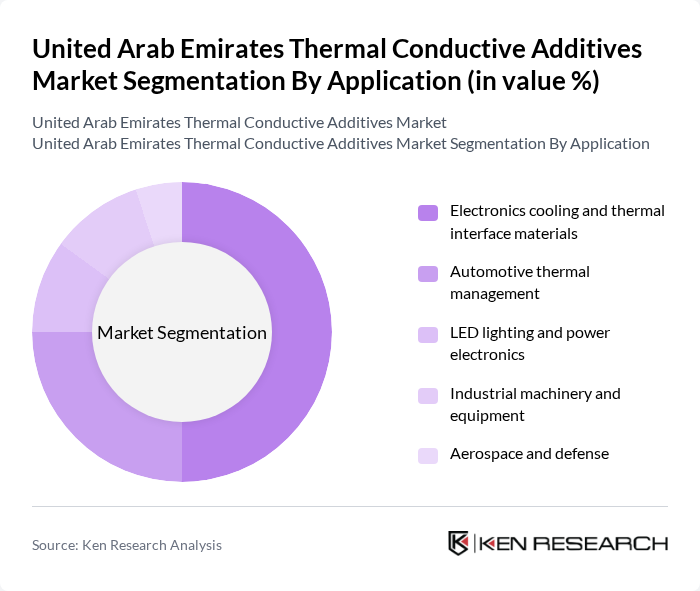
United Arab Emirates Thermal Conductive Additives Market segmentation by Application.

United Arab Emirates Thermal Conductive Additives Market Competitive Landscape

The United Arab Emirates Thermal Conductive Additives Market is characterized by a dynamic mix of regional and international players. Leading participants such as Henkel AG & Co. KGaA, 3M Company, Momentive Performance Materials Inc., Dow Inc., Saint-Gobain S.A., Mitsubishi Chemical Group Corporation, BASF SE, Huntsman Corporation, Solvay S.A., LyondellBasell Industries N.V., RTP Company, Avient Corporation (formerly PolyOne Corporation), Celanese Corporation, Kaneka Corporation, and other regional and niche players contribute to innovation, geographic expansion, and service delivery in this space, reflecting the global competitive landscape described for thermally conductive additives and related advanced materials.

Henkel AG & Co. KGaA

1876

Düsseldorf, Germany

3M Company

1902

Maplewood, Minnesota, USA

Momentive Performance Materials Inc.

2006

Waterford, New York, USA

Dow Inc.

1897

Midland, Michigan, USA

Saint-Gobain S.A.

1665

Courbevoie, France

Company

Establishment Year

Headquarters

UAE thermal conductive additives revenue (USD million)

3-year CAGR in UAE revenue (%)

EBITDA margin (%)

R&D intensity (% of revenue)

Market share in UAE thermal conductive additives (%)

Average selling price index (vs market average = 100)

United Arab Emirates Thermal Conductive Additives Market Industry Analysis

Growth Drivers

  • Increasing Demand for Energy-Efficient Materials:The United Arab Emirates is witnessing a significant shift towards energy-efficient materials, driven by apending verificationincrease in energy costs over the past two years. This trend is further supported by the UAE's commitment to reducing energy consumption bypending verificationby 2050, as outlined in its Energy Strategy. Consequently, industries are increasingly adopting thermal conductive additives to enhance energy efficiency in applications such as insulation and electronics, leading to a robust market demand.
  • Expansion of the Electronics and Automotive Industries:The UAE's electronics sector is projected to grow bypending verificationannually, fueled by rising consumer electronics demand. Simultaneously, the automotive industry is expected to reach a market value ofAED 20 billionbypending verification, driven by increased vehicle production and sales. This expansion necessitates advanced thermal management solutions, propelling the demand for thermal conductive additives in both sectors, thereby enhancing product performance and reliability.
  • Rising Awareness of Thermal Management Solutions:As industries increasingly recognize the importance of effective thermal management, the demand for thermal conductive additives is surging. A recent survey indicated thatpending verificationof manufacturers in the UAE are prioritizing thermal management in product design. This awareness is further supported by the UAE's focus on innovation and technology, with the government investingAED 1 billionin research and development initiatives aimed at improving material performance and sustainability.

Market Challenges

  • High Production Costs of Thermal Conductive Additives:The production costs for thermal conductive additives in the UAE are notably high, averagingAED 150 per kilogram. This is primarily due to the expensive raw materials and advanced manufacturing processes required. As a result, manufacturers face pressure to maintain competitive pricing while ensuring product quality, which can hinder market growth and limit accessibility for smaller companies.
  • Limited Availability of Raw Materials:The thermal conductive additives market in the UAE is challenged by a scarcity of essential raw materials, with imports constituting overpending verificationof the supply. This reliance on foreign sources exposes the market to fluctuations in global prices and supply chain disruptions. Consequently, manufacturers may struggle to secure consistent material availability, impacting production schedules and overall market stability.

United Arab Emirates Thermal Conductive Additives Market Future Outlook

The future of the thermal conductive additives market in the UAE appears promising, driven by technological advancements and a growing emphasis on sustainability. As industries increasingly adopt eco-friendly materials, the demand for innovative thermal management solutions is expected to rise. Additionally, the government's commitment to fostering research and development will likely lead to breakthroughs in additive technologies, enhancing performance and efficiency across various applications, including electronics and automotive sectors.

Market Opportunities

  • Growth in Renewable Energy Applications:The UAE's renewable energy sector is projected to reachAED 600 billionbypending verification, creating significant opportunities for thermal conductive additives. These materials are essential for improving the efficiency of solar panels and energy storage systems, positioning manufacturers to capitalize on this expanding market segment and contribute to the nation's sustainability goals.
  • Development of New Composite Materials:The ongoing research into composite materials presents a lucrative opportunity for thermal conductive additives. With the UAE investingAED 500 millionin material science research, innovations in composites that incorporate these additives can enhance performance in various applications, including construction and automotive, thereby driving market growth and diversification.

Scope of the Report

SegmentSub-Segments
By Additive Type

Graphite-based additives

Ceramic-based additives (e.g., boron nitride, alumina, aluminum nitride)

Metallic-based additives

Polymer-based additives

Others

By Application

Electronics cooling and thermal interface materials

Automotive thermal management

LED lighting and power electronics

Industrial machinery and equipment

Aerospace and defense

Others

By End-Use Industry

Electronics and electricals

Automotive and transportation

Aerospace

Construction and infrastructure

Medical and healthcare devices

Others

By Material Form

Powders

Pastes and gels

Films and sheets

Fibers and flakes

Others

By Resin Type

Thermoplastics (PA, PBT, PC, others)

Thermosets (epoxy, phenolic, others)

By Thermal Conductivity Range

Below 1 W/mK

–5 W/mK

–10 W/mK

Above 10 W/mK

By Geography

Abu Dhabi

Dubai

Sharjah

Ajman

Others

Key Target Audience

Investors and Venture Capitalist Firms

Government and Regulatory Bodies (e.g., Ministry of Climate Change and Environment, Abu Dhabi Department of Economic Development)

Manufacturers and Producers

Distributors and Retailers

Construction and Building Material Companies

Automotive and Aerospace Industries

Energy and Power Sector Companies

Chemical and Material Suppliers

Players Mentioned in the Report:

Henkel AG & Co. KGaA

3M Company

Momentive Performance Materials Inc.

Dow Inc.

Saint-Gobain S.A.

Mitsubishi Chemical Group Corporation

BASF SE

Huntsman Corporation

Solvay S.A.

LyondellBasell Industries N.V.

RTP Company

Avient Corporation (formerly PolyOne Corporation)

Celanese Corporation

Kaneka Corporation

Other regional and niche players

Table of Contents

Market Assessment Phase

1. Executive Summary and Approach


2. United Arab Emirates Thermal Conductive Additives Market Overview

2.1 Key Insights and Strategic Recommendations

2.2 United Arab Emirates Thermal Conductive Additives Market Overview

2.3 Definition and Scope

2.4 Evolution of Market Ecosystem

2.5 Timeline of Key Regulatory Milestones

2.6 Value Chain & Stakeholder Mapping

2.7 Business Cycle Analysis

2.8 Policy & Incentive Landscape


3. United Arab Emirates Thermal Conductive Additives Market Analysis

3.1 Growth Drivers

3.1.1 Increasing demand for energy-efficient materials
3.1.2 Expansion of the electronics and automotive industries
3.1.3 Rising awareness of thermal management solutions
3.1.4 Government initiatives promoting advanced materials

3.2 Market Challenges

3.2.1 High production costs of thermal conductive additives
3.2.2 Limited availability of raw materials
3.2.3 Stringent regulatory requirements
3.2.4 Competition from alternative materials

3.3 Market Opportunities

3.3.1 Growth in renewable energy applications
3.3.2 Development of new composite materials
3.3.3 Increasing investments in R&D
3.3.4 Expansion into emerging markets

3.4 Market Trends

3.4.1 Shift towards sustainable and eco-friendly materials
3.4.2 Technological advancements in additive manufacturing
3.4.3 Rising demand for lightweight materials in automotive
3.4.4 Integration of smart technologies in thermal management

3.5 Government Regulation

3.5.1 Compliance with environmental standards
3.5.2 Regulations on material safety and performance
3.5.3 Incentives for using sustainable materials
3.5.4 Import/export regulations affecting raw materials

4. SWOT Analysis


5. Stakeholder Analysis


6. Porter's Five Forces Analysis


7. United Arab Emirates Thermal Conductive Additives Market Market Size, 2019-2024

7.1 By Value

7.2 By Volume

7.3 By Average Selling Price


8. United Arab Emirates Thermal Conductive Additives Market Segmentation

8.1 By Additive Type

8.1.1 Graphite-based additives
8.1.2 Ceramic-based additives (e.g., boron nitride, alumina, aluminum nitride)
8.1.3 Metallic-based additives
8.1.4 Polymer-based additives
8.1.5 Others

8.2 By Application

8.2.1 Electronics cooling and thermal interface materials
8.2.2 Automotive thermal management
8.2.3 LED lighting and power electronics
8.2.4 Industrial machinery and equipment
8.2.5 Aerospace and defense
8.2.6 Others

8.3 By End-Use Industry

8.3.1 Electronics and electricals
8.3.2 Automotive and transportation
8.3.3 Aerospace
8.3.4 Construction and infrastructure
8.3.5 Medical and healthcare devices
8.3.6 Others

8.4 By Material Form

8.4.1 Powders
8.4.2 Pastes and gels
8.4.3 Films and sheets
8.4.4 Fibers and flakes
8.4.5 Others

8.5 By Resin Type

8.5.1 Thermoplastics (PA, PBT, PC, others)
8.5.2 Thermosets (epoxy, phenolic, others)

8.6 By Thermal Conductivity Range

8.6.1 Below 1 W/mK
8.6.2 1–5 W/mK
8.6.3 5–10 W/mK
8.6.4 Above 10 W/mK

8.7 By Geography

8.7.1 Abu Dhabi
8.7.2 Dubai
8.7.3 Sharjah
8.7.4 Ajman
8.7.5 Others

9. United Arab Emirates Thermal Conductive Additives Market Competitive Analysis

9.1 Market Share of Key Players

9.2 Cross Comparison of Key Players

9.2.1 Company Name
9.2.2 UAE thermal conductive additives revenue (USD million)
9.2.3 3-year CAGR in UAE revenue (%)
9.2.4 EBITDA margin (%)
9.2.5 R&D intensity (% of revenue)
9.2.6 Market share in UAE thermal conductive additives (%)
9.2.7 Average selling price index (vs market average = 100)
9.2.8 Customer concentration (top 5 customers’ share %)
9.2.9 UAE production capacity utilization (%)
9.2.10 Order book / backlog coverage (months of sales)
9.2.11 New product launch count (last 3 years)
9.2.12 Share of sales to strategic segments (electronics, EV, LED, %)

9.3 SWOT Analysis of Top Players

9.4 Pricing Analysis

9.5 Detailed Profile of Major Companies

9.5.1 Henkel AG & Co. KGaA
9.5.2 3M Company
9.5.3 Momentive Performance Materials Inc.
9.5.4 Dow Inc.
9.5.5 Saint-Gobain S.A.
9.5.6 Mitsubishi Chemical Group Corporation
9.5.7 BASF SE
9.5.8 Huntsman Corporation
9.5.9 Solvay S.A.
9.5.10 LyondellBasell Industries N.V.
9.5.11 RTP Company
9.5.12 Avient Corporation (formerly PolyOne Corporation)
9.5.13 Celanese Corporation
9.5.14 Kaneka Corporation
9.5.15 Other regional and niche players

10. United Arab Emirates Thermal Conductive Additives Market End-User Analysis

10.1 Procurement Behavior of Key Ministries

10.1.1 Key procurement policies
10.1.2 Budget allocation trends
10.1.3 Supplier selection criteria
10.1.4 Contract management practices

10.2 Corporate Spend on Infrastructure & Energy

10.2.1 Investment trends in energy efficiency
10.2.2 Budget allocation for thermal management solutions
10.2.3 Corporate sustainability initiatives
10.2.4 Future spending forecasts

10.3 Pain Point Analysis by End-User Category

10.3.1 Challenges faced by electronics manufacturers
10.3.2 Issues in automotive thermal management
10.3.3 Pain points in industrial applications
10.3.4 Others

10.4 User Readiness for Adoption

10.4.1 Awareness of thermal conductive additives
10.4.2 Readiness to invest in new technologies
10.4.3 Training and support needs
10.4.4 Others

10.5 Post-Deployment ROI and Use Case Expansion

10.5.1 Measurement of ROI in thermal management
10.5.2 Case studies of successful implementations
10.5.3 Future use case opportunities
10.5.4 Others

11. United Arab Emirates Thermal Conductive Additives Market Future Size, 2025-2030

11.1 By Value

11.2 By Volume

11.3 By Average Selling Price


Go-To-Market Strategy Phase

1. Whitespace Analysis + Business Model Canvas

1.1 Market gaps and opportunities

1.2 Business model components


2. Marketing and Positioning Recommendations

2.1 Branding strategies

2.2 Product USPs


3. Distribution Plan

3.1 Urban retail vs rural NGO tie-ups


4. Channel & Pricing Gaps

4.1 Underserved routes

4.2 Pricing bands


5. Unmet Demand & Latent Needs

5.1 Category gaps

5.2 Consumer segments


6. Customer Relationship

6.1 Loyalty programs

6.2 After-sales service


7. Value Proposition

7.1 Sustainability

7.2 Integrated supply chains


8. Key Activities

8.1 Regulatory compliance

8.2 Branding

8.3 Distribution setup


9. Entry Strategy Evaluation

9.1 Domestic Market Entry Strategy

9.1.1 Product mix
9.1.2 Pricing band
9.1.3 Packaging

9.2 Export Entry Strategy

9.2.1 Target countries
9.2.2 Compliance roadmap

10. Entry Mode Assessment

10.1 JV

10.2 Greenfield

10.3 M&A

10.4 Distributor Model


11. Capital and Timeline Estimation

11.1 Capital requirements

11.2 Timelines


12. Control vs Risk Trade-Off

12.1 Ownership vs Partnerships


13. Profitability Outlook

13.1 Breakeven analysis

13.2 Long-term sustainability


14. Potential Partner List

14.1 Distributors

14.2 JVs

14.3 Acquisition targets


15. Execution Roadmap

15.1 Phased Plan for Market Entry

15.1.1 Market Setup
15.1.2 Market Entry
15.1.3 Growth Acceleration
15.1.4 Scale & Stabilize

15.2 Key Activities and Milestones

15.2.1 Milestone tracking
15.2.2 Activity scheduling

Research Methodology

ApproachModellingSample

Phase 1: Approach1

Desk Research

  • Analysis of industry reports from the UAE Ministry of Economy and relevant trade associations
  • Review of market studies and white papers published by leading chemical industry analysts
  • Examination of import/export data from UAE customs and trade statistics

Primary Research

  • Interviews with product managers at thermal conductive additive manufacturers
  • Surveys with end-users in electronics, automotive, and construction sectors
  • Field interviews with R&D teams in companies utilizing thermal conductive additives

Validation & Triangulation

  • Cross-validation of findings through multiple data sources including trade publications and expert insights
  • Triangulation of market size estimates using both qualitative and quantitative data
  • Sanity checks conducted through expert panel reviews and feedback sessions

Phase 2: Market Size Estimation1

Top-down Assessment

  • Estimation of market size based on national consumption data of thermal conductive materials
  • Segmentation by application areas such as electronics, automotive, and construction
  • Incorporation of growth trends in the UAE's manufacturing and construction sectors

Bottom-up Modeling

  • Collection of sales data from key manufacturers and distributors of thermal conductive additives
  • Estimation of market share based on production capacities and sales volumes
  • Analysis of pricing strategies and cost structures of leading suppliers

Forecasting & Scenario Analysis

  • Development of forecasts using historical growth rates and market trends
  • Scenario analysis based on potential regulatory changes and technological advancements
  • Creation of baseline, optimistic, and pessimistic forecasts through 2030

Phase 3: CATI Sample Composition1

Scope Item/SegmentSample SizeTarget Respondent Profiles
Electronics Manufacturing100Product Development Engineers, Procurement Managers
Automotive Applications80Quality Assurance Managers, R&D Directors
Construction Materials70Project Managers, Material Engineers
Consumer Electronics90Supply Chain Managers, Technical Directors
Industrial Applications60Operations Managers, Product Line Managers

Frequently Asked Questions

What is the current value of the United Arab Emirates Thermal Conductive Additives Market?

The United Arab Emirates Thermal Conductive Additives Market is valued at approximately USD 160 million, reflecting a robust growth trajectory driven by increasing demand for efficient thermal management solutions across various industries, including electronics and automotive.

What are the main drivers of growth in the UAE Thermal Conductive Additives Market?

Which cities in the UAE are leading in the Thermal Conductive Additives Market?

What types of thermal conductive additives are available in the UAE market?

Why Buy From Us?

Refine Robust Result (RRR) Framework

What makes us stand out is that our consultants follow Robust, Refine and Result (RRR) methodology. Robust for clear definitions, approaches and sanity checking, Refine for differentiating respondents' facts and opinions, and Result for presenting data with story.

Our Reach Is Unmatched

We have set a benchmark in the industry by offering our clients with syndicated and customized market research reports featuring coverage of entire market as well as meticulous research and analyst insights.

Shifting the Research Paradigm

While we don't replace traditional research, we flip the method upside down. Our dual approach of Top Bottom & Bottom Top ensures quality deliverable by not just verifying company fundamentals but also looking at the sector and macroeconomic factors.

More Insights-Better Decisions

With one step in the future, our research team constantly tries to show you the bigger picture. We help with some of the tough questions you may encounter along the way: How is the industry positioned? Best marketing channel? KPI's of competitors? By aligning every element, we help maximize success.

Transparency and Trust

Our report gives you instant access to the answers and sources that other companies might choose to hide. We elaborate each steps of research methodology we have used and showcase you the sample size to earn your trust.

Round the Clock Support

If you need any support, we are here! We pride ourselves on universe strength, data quality, and quick, friendly, and professional service.

Why Clients Choose Us?

400000+
Reports in repository
150+
Consulting projects a year
100+
Analysts
8000+
Client Queries in 2022








