About the Report
Base Year 2024Listen to the audio summary
Oman Air Freight Market Overview
- The Oman Air Freight Market is valued at approximately USD 1.0 billion, based on a five-year historical analysis. This growth is primarily driven by the increasing demand for air cargo services due to the rise in e-commerce, global trade, and the need for faster delivery of goods. The expansion of logistics infrastructure and the strategic location of Oman as a gateway to the Middle East further contribute to the market's growth.
- Key air cargo hubs in this market include Muscat, Salalah, and Sohar, which dominate due to their well-developed logistics facilities and proximity to major shipping routes. Muscat serves as the capital and a central hub for air freight operations, while Salalah's port enhances connectivity to international markets. Sohar is emerging as a significant hub due to its free zone and industrial development.
- In recent years, the Omani government has implemented trade facilitation and customs-simplification measures aimed at reducing clearance times and improving air cargo efficiency. This initiative is designed to improve the efficiency of air freight services and attract more international cargo operators to Oman.

Oman Air Freight Market Segmentation
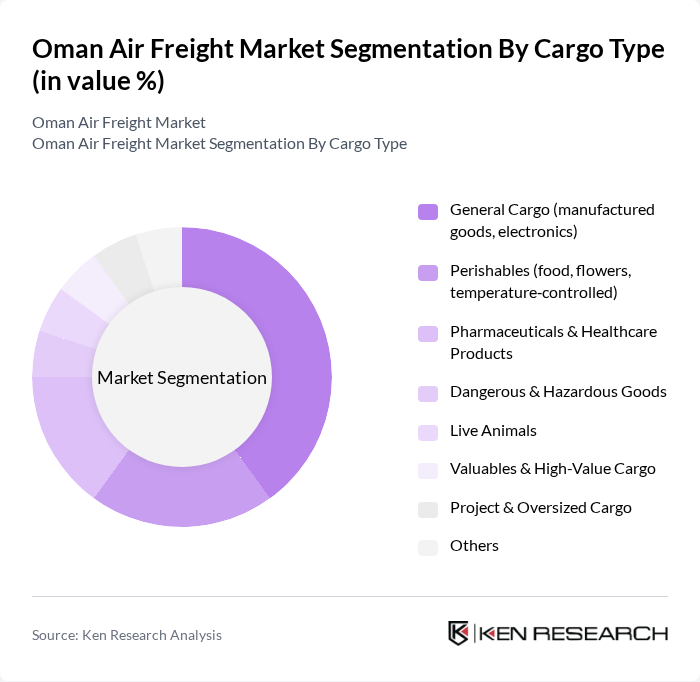
By Cargo Type:The air freight market is segmented into various cargo types, including General Cargo, Perishables, Pharmaceuticals & Healthcare Products, Dangerous & Hazardous Goods, Live Animals, Valuables & High-Value Cargo, Project & Oversized Cargo, and Others. Among these, General Cargo is the leading segment due to the high volume of manufactured goods and electronics being transported. The increasing demand for quick delivery of consumer products and industrial supplies drives this segment's growth.
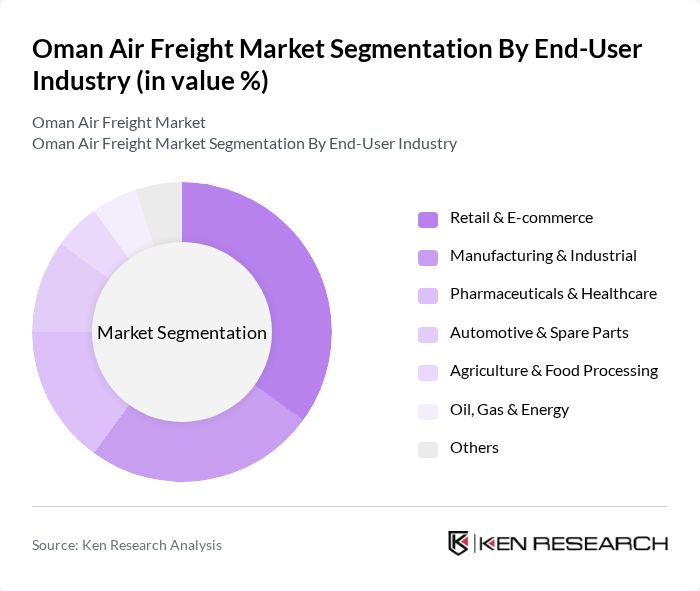
By End-User Industry:The air freight market is also segmented by end-user industries, including Retail & E-commerce, Manufacturing & Industrial, Pharmaceuticals & Healthcare, Automotive & Spare Parts, Agriculture & Food Processing, Oil, Gas & Energy, and Others. The Retail & E-commerce segment is currently the dominant force, driven by the surge in online shopping and the need for rapid delivery services. This trend has led to increased demand for air freight solutions to meet consumer expectations for quick shipping.
Oman Air Freight Market Competitive Landscape
The Oman Air Freight Market is characterized by a dynamic mix of regional and international players. Leading participants such as Oman Air Cargo, Oman Airports Management Company (cargo operations), ASYAD Group (including Asyad Express), SalamAir Cargo, DHL Express / DHL Aviation, Aramex, Emirates SkyCargo, Qatar Airways Cargo, Etihad Cargo, Turkish Cargo, Saudia Cargo, FedEx Express, UPS Airlines / UPS Supply Chain Solutions, Cargolux Airlines International, Singapore Airlines Cargo contribute to innovation, geographic expansion, and service delivery in this space.
Oman Air Freight Market Industry Analysis
Growth Drivers
- Increasing E-commerce Demand:The e-commerce sector in Oman is projected to reach approximately $1.5 billion in future, driven by a growing consumer base and increased internet penetration, which is expected to hit 98% in future. This surge in online shopping is significantly boosting air freight demand, as businesses require rapid delivery services to meet customer expectations. The rise in e-commerce logistics is anticipated to contribute to a 20% increase in air freight volumes in the region.
- Strategic Geographic Location:Oman’s strategic position as a gateway between Asia, Europe, and Africa enhances its air freight capabilities. The Sultanate's proximity to major shipping routes allows for efficient transit times, with Muscat International Airport handling over 1.5 million tons of cargo annually. This advantageous location is expected to attract more international freight operators, further solidifying Oman’s role as a logistics hub in the region, particularly for time-sensitive goods.
- Infrastructure Development:Oman is investing heavily in its logistics infrastructure, with the government allocating $1.2 billion for the development of new cargo terminals and upgrades to existing facilities in future. The expansion of Muscat International Airport and the establishment of the Duqm Port are pivotal projects aimed at enhancing air freight capacity. These developments are projected to increase cargo handling efficiency by 30%, facilitating smoother operations for air freight companies.
Market Challenges
- Regulatory Compliance Issues:The air freight industry in Oman faces significant regulatory compliance challenges, particularly concerning international air transport regulations. The International Air Transport Association (IATA) reports that compliance costs can account for up to 15% of operational expenses for air freight companies. These regulatory hurdles can hinder operational efficiency and increase costs, making it difficult for local players to compete with established international carriers.
- Fluctuating Fuel Prices:The volatility of fuel prices poses a substantial challenge to the air freight sector in Oman. In future, jet fuel prices are projected to average around $90 per barrel, significantly impacting operational costs. This fluctuation can lead to unpredictable pricing for air freight services, affecting profit margins and potentially leading to increased shipping costs for consumers. Companies must develop strategies to mitigate these risks to maintain competitiveness.
Oman Air Freight Market Future Outlook
The Oman air freight market is poised for significant growth, driven by the increasing demand for e-commerce and ongoing infrastructure enhancements. As logistics hubs expand and technological advancements streamline operations, the sector is expected to adapt to evolving consumer needs. Additionally, sustainability initiatives are likely to gain traction, influencing operational practices. The combination of these factors will create a dynamic environment, fostering innovation and competitiveness in the air freight industry throughout the coming years.
Market Opportunities
- Expansion of Logistics Hubs:The establishment of new logistics hubs in Oman presents a significant opportunity for air freight operators. With the government’s commitment to enhancing infrastructure, these hubs can facilitate faster processing times and improved connectivity, potentially increasing cargo volumes by 25% over the next few years. This expansion will attract more international players, enhancing competition and service offerings.
- Technological Advancements in Freight Handling:The adoption of advanced technologies, such as AI and IoT, in freight handling is set to revolutionize the air freight industry in Oman. These technologies can enhance tracking, improve inventory management, and optimize routes, leading to cost reductions of up to 20%. Embracing these innovations will not only improve operational efficiency but also enhance customer satisfaction through better service delivery.
Scope of the Report
| Segment | Sub-Segments |
|---|---|
| By Cargo Type | General Cargo (manufactured goods, electronics) Perishables (food, flowers, temperature?controlled) Pharmaceuticals & Healthcare Products Dangerous & Hazardous Goods Live Animals Valuables & High-Value Cargo Project & Oversized Cargo Others |
| By End-User Industry | Retail & E-commerce Manufacturing & Industrial Pharmaceuticals & Healthcare Automotive & Spare Parts Agriculture & Food Processing Oil, Gas & Energy Others |
| By Corridor / Destination | Intra-GCC & Middle East Asia–Pacific (including India & China) Europe Africa Rest of World |
| By Service Type | Scheduled Airline Freight Services Express & Courier / Integrator Services Air Freight Forwarding & Consolidation Charter & Project Cargo Services Others |
| By Carrier Type | Belly-Hold Cargo (Passenger Aircraft) Dedicated Freighter Aircraft Integrator / Express Network Aircraft Others |
| By Shipment Size | Small Parcels & Documents (< 45 kg) Medium Shipments (45–300 kg) Large & Bulk Shipments (> 300 kg) Project & Oversized Loads |
| By Delivery Speed | Express / Time-Definite Standard Economy / Deferred |
Key Target Audience
Investors and Venture Capitalist Firms
Government and Regulatory Bodies (e.g., Oman Civil Aviation Authority, Ministry of Transport, Communications and Information Technology)
Air Freight Forwarders
Logistics and Supply Chain Companies
Freight Handling and Ground Services Providers
Airlines and Cargo Carriers
Customs Brokers and Compliance Specialists
Infrastructure Developers and Port Authorities
Players Mentioned in the Report:
Oman Air Cargo
Oman Airports Management Company (cargo operations)
ASYAD Group (including Asyad Express)
SalamAir Cargo
DHL Express / DHL Aviation
Aramex
Emirates SkyCargo
Qatar Airways Cargo
Etihad Cargo
Turkish Cargo
Saudia Cargo
FedEx Express
UPS Airlines / UPS Supply Chain Solutions
Cargolux Airlines International
Singapore Airlines Cargo
Table of Contents
Market Assessment Phase
1. Executive Summary and Approach
2. Oman Air Freight Market Overview
2.1 Key Insights and Strategic Recommendations
2.2 Oman Air Freight Market Overview
2.3 Definition and Scope
2.4 Evolution of Market Ecosystem
2.5 Timeline of Key Regulatory Milestones
2.6 Value Chain & Stakeholder Mapping
2.7 Business Cycle Analysis
2.8 Policy & Incentive Landscape
3. Oman Air Freight Market Analysis
3.1 Growth Drivers
3.1.1 Increasing E-commerce Demand
3.1.2 Strategic Geographic Location
3.1.3 Infrastructure Development
3.1.4 Government Initiatives for Trade
3.2 Market Challenges
3.2.1 Regulatory Compliance Issues
3.2.2 Competition from Other Modes of Transport
3.2.3 Fluctuating Fuel Prices
3.2.4 Limited Air Cargo Capacity
3.3 Market Opportunities
3.3.1 Expansion of Logistics Hubs
3.3.2 Technological Advancements in Freight Handling
3.3.3 Partnerships with E-commerce Platforms
3.3.4 Growth in Cold Chain Logistics
3.4 Market Trends
3.4.1 Rise of Digital Freight Solutions
3.4.2 Sustainability Initiatives in Air Freight
3.4.3 Increased Focus on Customer Experience
3.4.4 Adoption of Automation in Operations
3.5 Government Regulation
3.5.1 Air Cargo Security Regulations
3.5.2 Environmental Compliance Standards
3.5.3 Trade Facilitation Policies
3.5.4 Licensing and Operational Guidelines
4. SWOT Analysis
5. Stakeholder Analysis
6. Porter's Five Forces Analysis
7. Oman Air Freight Market Market Size, 2019-2024
7.1 By Value
7.2 By Volume
7.3 By Average Selling Price
8. Oman Air Freight Market Segmentation
8.1 By Cargo Type
8.1.1 General Cargo (manufactured goods, electronics)
8.1.2 Perishables (food, flowers, temperature?controlled)
8.1.3 Pharmaceuticals & Healthcare Products
8.1.4 Dangerous & Hazardous Goods
8.1.5 Live Animals
8.1.6 Valuables & High-Value Cargo
8.1.7 Project & Oversized Cargo
8.1.8 Others
8.2 By End-User Industry
8.2.1 Retail & E-commerce
8.2.2 Manufacturing & Industrial
8.2.3 Pharmaceuticals & Healthcare
8.2.4 Automotive & Spare Parts
8.2.5 Agriculture & Food Processing
8.2.6 Oil, Gas & Energy
8.2.7 Others
8.3 By Corridor / Destination
8.3.1 Intra-GCC & Middle East
8.3.2 Asia–Pacific (including India & China)
8.3.3 Europe
8.3.4 Africa
8.3.5 Rest of World
8.4 By Service Type
8.4.1 Scheduled Airline Freight Services
8.4.2 Express & Courier / Integrator Services
8.4.3 Air Freight Forwarding & Consolidation
8.4.4 Charter & Project Cargo Services
8.4.5 Others
8.5 By Carrier Type
8.5.1 Belly-Hold Cargo (Passenger Aircraft)
8.5.2 Dedicated Freighter Aircraft
8.5.3 Integrator / Express Network Aircraft
8.5.4 Others
8.6 By Shipment Size
8.6.1 Small Parcels & Documents (< 45 kg)
8.6.2 Medium Shipments (45–300 kg)
8.6.3 Large & Bulk Shipments (> 300 kg)
8.6.4 Project & Oversized Loads
8.7 By Delivery Speed
8.7.1 Express / Time-Definite
8.7.2 Standard
8.7.3 Economy / Deferred
9. Oman Air Freight Market Competitive Analysis
9.1 Market Share of Key Players
9.2 Cross Comparison of Key Players
9.2.1 Company Name
9.2.2 Fleet & Network Scale (owned / leased aircraft, destinations served)
9.2.3 Oman Air Freight Revenue (USD, latest year)
9.2.4 Revenue Growth Rate (CAGR over review period)
9.2.5 Cargo Throughput (tonnes handled via Oman)
9.2.6 Load Factor / Capacity Utilization
9.2.7 Yield per Tonne-Kilometer
9.2.8 On-Time Performance (OTP %)
9.2.9 Average Transit Time on Key Lanes
9.2.10 Share of Special Cargo (pharma, perishables, etc.) in Mix
9.2.11 Contract Logistics & Value-Added Services Offering
9.2.12 Digitalization Level (e-AWB adoption, tracking, portals)
9.2.13 Customer Base Diversification (SME vs large accounts)
9.2.14 Compliance & Safety Certifications (IATA CEIV, ISO, etc.)
9.3 SWOT Analysis of Top Players
9.4 Pricing Analysis
9.5 Detailed Profile of Major Companies
9.5.1 Oman Air Cargo
9.5.2 Oman Airports Management Company (cargo operations)
9.5.3 ASYAD Group (including Asyad Express)
9.5.4 SalamAir Cargo
9.5.5 DHL Express / DHL Aviation
9.5.6 Aramex
9.5.7 Emirates SkyCargo
9.5.8 Qatar Airways Cargo
9.5.9 Etihad Cargo
9.5.10 Turkish Cargo
9.5.11 Saudia Cargo
9.5.12 FedEx Express
9.5.13 UPS Airlines / UPS Supply Chain Solutions
9.5.14 Cargolux Airlines International
9.5.15 Singapore Airlines Cargo
10. Oman Air Freight Market End-User Analysis
10.1 Procurement Behavior of Key Ministries
10.1.1 Ministry of Transport
10.1.2 Ministry of Health
10.1.3 Ministry of Commerce
10.1.4 Ministry of Defense
10.2 Corporate Spend on Infrastructure & Energy
10.2.1 Investment in Logistics Infrastructure
10.2.2 Spending on Technology Upgrades
10.2.3 Budget Allocation for Air Freight Services
10.2.4 Others
10.3 Pain Point Analysis by End-User Category
10.3.1 Delays in Delivery
10.3.2 High Shipping Costs
10.3.3 Lack of Transparency
10.3.4 Others
10.4 User Readiness for Adoption
10.4.1 Awareness of Air Freight Options
10.4.2 Willingness to Switch Providers
10.4.3 Readiness for Digital Solutions
10.4.4 Others
10.5 Post-Deployment ROI and Use Case Expansion
10.5.1 Measurement of Cost Savings
10.5.2 Evaluation of Service Quality Improvements
10.5.3 Expansion into New Markets
10.5.4 Others
11. Oman Air Freight Market Future Size, 2025-2030
11.1 By Value
11.2 By Volume
11.3 By Average Selling Price
Go-To-Market Strategy Phase
1. Whitespace Analysis + Business Model Canvas
1.1 Market Gaps Identification
1.2 Value Proposition Development
1.3 Revenue Streams Analysis
1.4 Cost Structure Evaluation
1.5 Key Partnerships Exploration
1.6 Customer Segmentation
1.7 Channels of Distribution
2. Marketing and Positioning Recommendations
2.1 Branding Strategies
2.2 Product USPs
2.3 Target Market Identification
2.4 Communication Strategy
2.5 Digital Marketing Tactics
3. Distribution Plan
3.1 Urban Retail Strategies
3.2 Rural NGO Tie-ups
3.3 Logistics Partnerships
3.4 Distribution Channel Optimization
4. Channel & Pricing Gaps
4.1 Underserved Routes
4.2 Pricing Bands Analysis
4.3 Competitor Pricing Comparison
5. Unmet Demand & Latent Needs
5.1 Category Gaps Identification
5.2 Consumer Segments Analysis
5.3 Future Demand Projections
6. Customer Relationship
6.1 Loyalty Programs
6.2 After-sales Service Enhancements
6.3 Customer Feedback Mechanisms
7. Value Proposition
7.1 Sustainability Initiatives
7.2 Integrated Supply Chains
7.3 Competitive Advantages
8. Key Activities
8.1 Regulatory Compliance
8.2 Branding Initiatives
8.3 Distribution Setup
9. Entry Strategy Evaluation
9.1 Domestic Market Entry Strategy
9.1.1 Product Mix Considerations
9.1.2 Pricing Band Strategy
9.1.3 Packaging Solutions
9.2 Export Entry Strategy
9.2.1 Target Countries Identification
9.2.2 Compliance Roadmap Development
10. Entry Mode Assessment
10.1 Joint Ventures
10.2 Greenfield Investments
10.3 Mergers & Acquisitions
10.4 Distributor Model Evaluation
11. Capital and Timeline Estimation
11.1 Capital Requirements Analysis
11.2 Timelines for Implementation
12. Control vs Risk Trade-Off
12.1 Ownership Considerations
12.2 Partnerships Evaluation
13. Profitability Outlook
13.1 Breakeven Analysis
13.2 Long-term Sustainability Strategies
14. Potential Partner List
14.1 Distributors Identification
14.2 Joint Ventures Opportunities
14.3 Acquisition Targets
15. Execution Roadmap
15.1 Phased Plan for Market Entry
15.1.1 Market Setup
15.1.2 Market Entry
15.1.3 Growth Acceleration
15.1.4 Scale & Stabilize
15.2 Key Activities and Milestones
15.2.1 Milestone Planning
15.2.2 Activity Tracking
Research Methodology
Phase 1: Approach1
Desk Research
- Analysis of trade statistics from the Oman Ministry of Transport, Communications and Information Technology
- Review of logistics and freight reports published by the Oman Chamber of Commerce and Industry
- Examination of regulatory frameworks and policies affecting air freight operations in Oman
Primary Research
- Interviews with logistics managers at major air freight companies operating in Oman
- Surveys conducted with customs officials to understand regulatory impacts on air freight
- Field interviews with airport authorities to gather insights on infrastructure and capacity
Validation & Triangulation
- Cross-validation of findings through multiple data sources including government reports and industry publications
- Triangulation of data from primary interviews with secondary research findings
- Sanity checks through expert panel reviews comprising industry veterans and academic professionals
Phase 2: Market Size Estimation1
Top-down Assessment
- Estimation of total air freight volume based on national trade data and import/export statistics
- Segmentation of the market by key industries such as pharmaceuticals, electronics, and perishables
- Incorporation of government initiatives aimed at enhancing air freight capabilities and infrastructure
Bottom-up Modeling
- Collection of operational data from leading air freight carriers regarding shipment volumes and pricing
- Estimation of costs associated with air freight services, including fuel, handling, and customs fees
- Calculation of market size based on volume and average cost per shipment
Forecasting & Scenario Analysis
- Utilization of time series analysis to project future air freight volumes based on historical trends
- Scenario modeling based on potential economic growth rates and changes in trade policies
- Development of best-case, worst-case, and most-likely scenarios through 2030
Phase 3: CATI Sample Composition1
| Scope Item/Segment | Sample Size | Target Respondent Profiles |
|---|---|---|
| Pharmaceutical Air Freight | 100 | Logistics Managers, Compliance Officers |
| Electronics and High-Value Goods | 80 | Supply Chain Directors, Operations Managers |
| Perishable Goods Transportation | 70 | Cold Chain Managers, Quality Assurance Heads |
| Textile and Apparel Shipping | 60 | Procurement Officers, Logistics Coordinators |
| General Cargo Operations | 90 | Air Freight Managers, Customs Brokers |
Frequently Asked Questions
What is the current value of the Oman Air Freight Market?
The Oman Air Freight Market is valued at approximately USD 1.0 billion, driven by increasing demand for air cargo services due to e-commerce growth, global trade, and the need for faster delivery of goods.
What are the key air cargo hubs in Oman?
How is the Omani government supporting the air freight industry?
What cargo types are prevalent in the Oman Air Freight Market?
Other Regional/Country Reports
Other Adjacent Reports
Qatar Sea Freight Market
India Road Freight Market Outlook to 2028Bahrain Rail Freight Market
GCC Road Express (Parcel & LTL) E-commerce Logistics Market Size, Share, Growth Drivers, Trends, Opportunities, Competitive Landscape & Forecast 2025–2030South Africa Pharmaceutical Logistics MarketJapan Cold Chain Logistics Market Size, Share & Forecast, By Service Type, Mode of Transport & End-Use Industry, 2025–2032Mexico Freight Forwarding Market Size, Share & Forecast, By Service Type, Mode of Transport & End-Use Industry, 2025–2032India Supply Chain Management Market Size, Share & Forecast, By Solution Type, Deployment Model & End-Use Industry, 2026-2031Singapore Airport Infrastructure Market
South Korea Cargo Handling Equipment Market
Why Buy From Us?

What makes us stand out is that our consultants follow Robust, Refine and Result (RRR) methodology. Robust for clear definitions, approaches and sanity checking, Refine for differentiating respondents' facts and opinions, and Result for presenting data with story.

We have set a benchmark in the industry by offering our clients with syndicated and customized market research reports featuring coverage of entire market as well as meticulous research and analyst insights.

While we don't replace traditional research, we flip the method upside down. Our dual approach of Top Bottom & Bottom Top ensures quality deliverable by not just verifying company fundamentals but also looking at the sector and macroeconomic factors.

With one step in the future, our research team constantly tries to show you the bigger picture. We help with some of the tough questions you may encounter along the way: How is the industry positioned? Best marketing channel? KPI's of competitors? By aligning every element, we help maximize success.

Our report gives you instant access to the answers and sources that other companies might choose to hide. We elaborate each steps of research methodology we have used and showcase you the sample size to earn your trust.

If you need any support, we are here! We pride ourselves on universe strength, data quality, and quick, friendly, and professional service.