About the Report
Base Year 2024Listen to the audio summary
Global Air Freight Market Overview
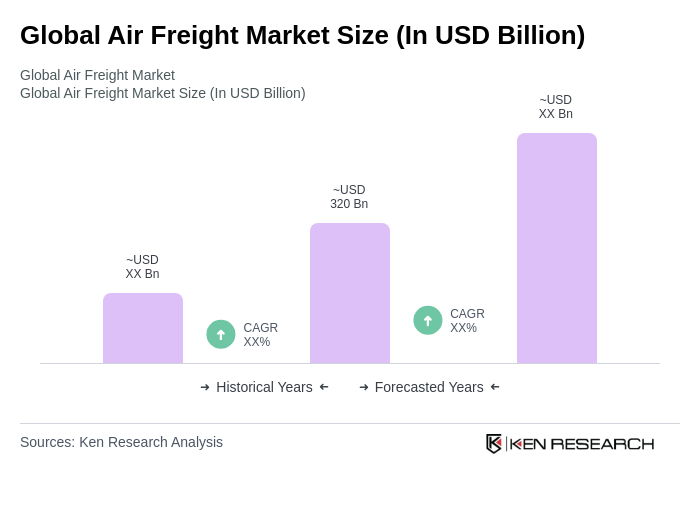
- The Global Air Freight Market is valued at USD 320 billion, based on a five-year historical analysis. This growth is driven by the rapid expansion of e-commerce, rising demand for fast and reliable shipping—especially for high-value and time-sensitive goods—and the increasing globalization of supply chains. Technological advancements such as automation and digital tracking, as well as the need for efficient logistics solutions amid global trade growth, have further propelled the market, making air freight a preferred choice for urgent deliveries.
- Key players in this market includethe United States, China, and Germany, which dominate due to robust manufacturing bases, extensive logistics networks, and strategic geographical locations. The U.S. benefits from advanced infrastructure and high consumer demand; China serves as a global manufacturing and export hub; and Germany acts as a central logistics point in Europe, facilitating trade across the continent.
- In 2023, the U.S. government implemented regulations to enhance air cargo security, mandating stricter screening processes for air freight shipments. The“Air Cargo Advance Screening (ACAS) Final Rule” issued by the U.S. Department of Homeland Security in 2023requires all inbound air cargo to undergo advanced data submission and risk assessment prior to loading, ensuring comprehensive inspection and bolstering the safety and reliability of air freight services. The regulation applies to all carriers transporting cargo to the United States, requiring electronic data submission and compliance with enhanced screening protocols.
Global Air Freight Market Segmentation
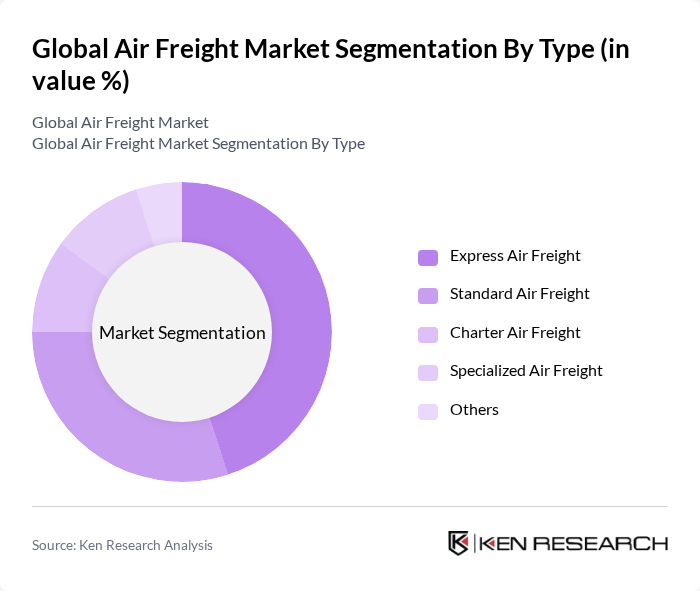
By Type:The air freight market is segmented into Express Air Freight, Standard Air Freight, Charter Air Freight, Specialized Air Freight, and Others.Express Air Freightremains the dominant segment, fueled by the surge in e-commerce and the increasing need for rapid, reliable delivery in high-value sectors. Businesses are prioritizing speed and reliability to meet customer expectations, driving the adoption of express services.
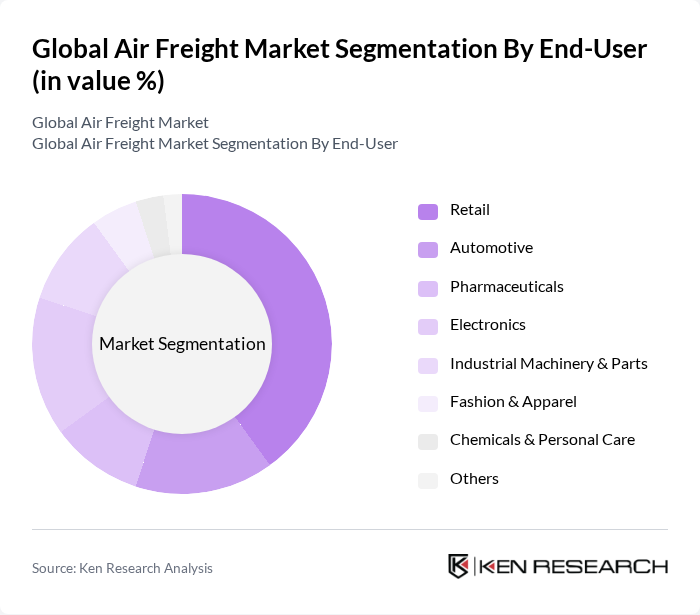
By End-User:The end-user segmentation includes Retail, Automotive, Pharmaceuticals, Electronics, Industrial Machinery & Parts, Fashion & Apparel, Chemicals & Personal Care, and Others. TheRetail segmentleads the market, driven by the explosive growth in e-commerce and online shopping. Retailers are increasingly using air freight to ensure timely delivery and enhance customer satisfaction, a trend that is expected to persist as digital sales channels expand.
Global Air Freight Market Competitive Landscape
The Global Air Freight Market is characterized by a dynamic mix of regional and international players. Leading participants such as DHL International GmbH, FedEx Corporation, United Parcel Service, Inc. (UPS), Kuehne + Nagel International AG, DB Schenker, C.H. Robinson Worldwide, Inc., Expeditors International of Washington, Inc., Nippon Express Co., Ltd., XPO Logistics, Inc., CEVA Logistics, DSV A/S, Agility Logistics, Sinotrans Limited, Toll Group, Emirates SkyCargo, Qatar Airways Cargo, Cathay Pacific Cargo, Turkish Cargo, Lufthansa Cargo AG, Korean Air Cargo, Singapore Airlines Cargo, Air France-KLM Cargo, ANA Cargo, China Airlines Cargo, Atlas Air Worldwide Holdings, Inc., Cargolux Airlines International S.A., EVA Air Cargo, Saudia Cargo, AirBridgeCargo Airlines, MASkargo (Malaysia Airlines Cargo) contribute to innovation, geographic expansion, and service delivery in this space.
Global Air Freight Market Industry Analysis
Growth Drivers
- Increasing E-commerce Demand:The global e-commerce market is projected to reach $6.4 trillion, driving significant demand for air freight services. In future, e-commerce accounted for approximately 19% of total retail sales, highlighting a shift in consumer purchasing behavior. This surge in online shopping necessitates faster delivery options, with air freight being a preferred choice for time-sensitive shipments. The rise in cross-border e-commerce further amplifies the need for efficient air logistics solutions, contributing to market growth.
- Global Supply Chain Optimization:Companies are increasingly focusing on optimizing their supply chains to enhance efficiency and reduce costs. In future, global supply chain spending is expected to exceed $2.1 trillion, with air freight playing a crucial role in just-in-time inventory management. The need for rapid transportation of goods, especially perishable items, is driving investments in air freight capabilities. Enhanced logistics strategies are leading to improved delivery times, thereby boosting demand for air freight services across various sectors.
- Technological Advancements in Logistics:The integration of advanced technologies such as AI, IoT, and blockchain is revolutionizing the logistics sector. In future, the global logistics technology market is anticipated to reach $80 billion, facilitating better tracking, inventory management, and route optimization. These innovations enhance operational efficiency and reduce delays in air freight services. As logistics providers adopt these technologies, they can offer more reliable and transparent services, further driving the growth of the air freight market.
Market Challenges
- High Operational Costs:The air freight industry faces significant operational costs, with fuel expenses accounting for nearly 30% of total costs. In future, jet fuel prices are projected to average $3.80 per gallon, impacting profit margins for air freight carriers. Additionally, labor costs and maintenance expenses contribute to the financial burden. These high operational costs can deter smaller players from entering the market, limiting competition and innovation within the industry.
- Capacity Constraints:The air freight sector is grappling with capacity constraints, particularly in peak seasons. In future, global air cargo capacity was reported to be approximately 6% lower than pre-pandemic levels, leading to increased freight rates and delays. Limited availability of cargo space on passenger flights, which typically account for about 50% of air freight capacity, exacerbates this issue. As demand continues to rise, addressing these capacity challenges will be crucial for maintaining service levels and customer satisfaction.
Global Air Freight Market Future Outlook
The future of the air freight market appears promising, driven by ongoing advancements in technology and a growing emphasis on sustainability. As companies increasingly adopt digital solutions, the efficiency of air freight operations is expected to improve significantly. Furthermore, the rising demand for environmentally friendly logistics practices will likely lead to the development of greener air freight options. These trends indicate a transformative period for the industry, with enhanced service offerings and operational efficiencies on the horizon.
Market Opportunities
- Expansion into Emerging Markets:Emerging markets, particularly in Asia and Africa, present significant growth opportunities for air freight services. With a combined population of over 2.6 billion, these regions are experiencing rapid urbanization and increasing consumer demand. Investments in infrastructure and logistics capabilities will enable air freight providers to tap into these lucrative markets, enhancing their global reach and service offerings.
- Adoption of Sustainable Practices:The push for sustainability is creating opportunities for air freight companies to innovate. In future, the global green logistics market is expected to reach $1.1 trillion, driven by demand for eco-friendly transportation solutions. By adopting sustainable practices, such as using biofuels and optimizing routes, air freight providers can reduce their carbon footprint and attract environmentally conscious customers, positioning themselves favorably in a competitive landscape.
Scope of the Report
| Segment | Sub-Segments |
|---|---|
| By Type | Express Air Freight Standard Air Freight Charter Air Freight Specialized Air Freight Others |
| By End-User | Retail Automotive Pharmaceuticals Electronics Industrial Machinery & Parts Fashion & Apparel Chemicals & Personal Care Others |
| By Service Type | Door-to-Door Service Port-to-Port Service Airport-to-Airport Service Customs Clearance & Documentation Warehousing & Distribution Others |
| By Cargo Type | General Cargo Perishable Goods Dangerous Goods Oversized Cargo Time-sensitive Shipments Others |
| By Distribution Mode | Direct Distribution Indirect Distribution Third-Party Logistics (3PL) Freight Forwarders Others |
| By Pricing Model | Flat Rate Pricing Variable Rate Pricing Contractual Pricing Spot Pricing Others |
| By Region | North America Europe Asia-Pacific Latin America Middle East & Africa |
Key Target Audience
Investors and Venture Capitalist Firms
Government and Regulatory Bodies (e.g., Federal Aviation Administration, International Civil Aviation Organization)
Air Freight Carriers
Logistics and Supply Chain Management Companies
Customs Brokers and Freight Forwarders
Aerospace Manufacturers
Trade Associations and Industry Groups
Insurance Companies Specializing in Cargo and Freight
Players Mentioned in the Report:
DHL International GmbH
FedEx Corporation
United Parcel Service, Inc. (UPS)
Kuehne + Nagel International AG
DB Schenker
C.H. Robinson Worldwide, Inc.
Expeditors International of Washington, Inc.
Nippon Express Co., Ltd.
XPO Logistics, Inc.
CEVA Logistics
DSV A/S
Agility Logistics
Sinotrans Limited
Toll Group
Emirates SkyCargo
Qatar Airways Cargo
Cathay Pacific Cargo
Turkish Cargo
Lufthansa Cargo AG
Korean Air Cargo
Singapore Airlines Cargo
Air France-KLM Cargo
ANA Cargo
China Airlines Cargo
Atlas Air Worldwide Holdings, Inc.
Cargolux Airlines International S.A.
EVA Air Cargo
Saudia Cargo
AirBridgeCargo Airlines
MASkargo (Malaysia Airlines Cargo)
Table of Contents
Market Assessment Phase
1. Executive Summary and Approach
2. Global Air Freight Market Overview
2.1 Key Insights and Strategic Recommendations
2.2 Global Air Freight Market Overview
2.3 Definition and Scope
2.4 Evolution of Market Ecosystem
2.5 Timeline of Key Regulatory Milestones
2.6 Value Chain & Stakeholder Mapping
2.7 Business Cycle Analysis
2.8 Policy & Incentive Landscape
3. Global Air Freight Market Analysis
3.1 Growth Drivers
3.1.1 Increasing E-commerce Demand
3.1.2 Global Supply Chain Optimization
3.1.3 Technological Advancements in Logistics
3.1.4 Rising International Trade
3.2 Market Challenges
3.2.1 High Operational Costs
3.2.2 Capacity Constraints
3.2.3 Regulatory Compliance Issues
3.2.4 Environmental Concerns
3.3 Market Opportunities
3.3.1 Expansion into Emerging Markets
3.3.2 Adoption of Sustainable Practices
3.3.3 Integration of AI and Automation
3.3.4 Development of Cold Chain Logistics
3.4 Market Trends
3.4.1 Shift Towards Digitalization
3.4.2 Increased Focus on Sustainability
3.4.3 Growth of On-Demand Freight Services
3.4.4 Enhanced Visibility and Tracking Solutions
3.5 Government Regulation
3.5.1 International Air Transport Association (IATA) Guidelines
3.5.2 Customs Regulations and Compliance
3.5.3 Environmental Regulations on Emissions
3.5.4 Security Regulations in Air Freight
4. SWOT Analysis
5. Stakeholder Analysis
6. Porter's Five Forces Analysis
7. Global Air Freight Market Market Size, 2019-2024
7.1 By Value
7.2 By Volume
7.3 By Average Selling Price
8. Global Air Freight Market Segmentation
8.1 By Type
8.1.1 Express Air Freight
8.1.2 Standard Air Freight
8.1.3 Charter Air Freight
8.1.4 Specialized Air Freight
8.1.5 Others
8.2 By End-User
8.2.1 Retail
8.2.2 Automotive
8.2.3 Pharmaceuticals
8.2.4 Electronics
8.2.5 Industrial Machinery & Parts
8.2.6 Fashion & Apparel
8.2.7 Chemicals & Personal Care
8.2.8 Others
8.3 By Service Type
8.3.1 Door-to-Door Service
8.3.2 Port-to-Port Service
8.3.3 Airport-to-Airport Service
8.3.4 Customs Clearance & Documentation
8.3.5 Warehousing & Distribution
8.3.6 Others
8.4 By Cargo Type
8.4.1 General Cargo
8.4.2 Perishable Goods
8.4.3 Dangerous Goods
8.4.4 Oversized Cargo
8.4.5 Time-sensitive Shipments
8.4.6 Others
8.5 By Distribution Mode
8.5.1 Direct Distribution
8.5.2 Indirect Distribution
8.5.3 Third-Party Logistics (3PL)
8.5.4 Freight Forwarders
8.5.5 Others
8.6 By Pricing Model
8.6.1 Flat Rate Pricing
8.6.2 Variable Rate Pricing
8.6.3 Contractual Pricing
8.6.4 Spot Pricing
8.6.5 Others
8.7 By Region
8.7.1 North America
8.7.2 Europe
8.7.3 Asia-Pacific
8.7.4 Latin America
8.7.5 Middle East & Africa
9. Global Air Freight Market Competitive Analysis
9.1 Market Share of Key Players
9.2 Cross Comparison of Key Players
9.2.1 Company Name
9.2.2 Group Size (Large, Medium, or Small as per industry convention)
9.2.3 Revenue Growth Rate (YoY %)
9.2.4 Market Share (%)
9.2.5 Freight Tonne Kilometers (FTK)
9.2.6 Average Delivery Time (Hours/Days)
9.2.7 On-Time Delivery Rate (%)
9.2.8 Fleet Size (Number of Aircraft)
9.2.9 Fleet Utilization Rate (%)
9.2.10 Network Coverage (Number of Destinations)
9.2.11 Customer Retention Rate (%)
9.2.12 Service Quality Index
9.2.13 Operational Efficiency (Cost per Tonne-Kilometer)
9.2.14 Sustainability Initiatives (CO? Emissions per Tonne-Kilometer)
9.3 SWOT Analysis of Top Players
9.4 Pricing Analysis
9.5 Detailed Profile of Major Companies
9.5.1 DHL International GmbH
9.5.2 FedEx Corporation
9.5.3 United Parcel Service, Inc. (UPS)
9.5.4 Kuehne + Nagel International AG
9.5.5 DB Schenker
9.5.6 C.H. Robinson Worldwide, Inc.
9.5.7 Expeditors International of Washington, Inc.
9.5.8 Nippon Express Co., Ltd.
9.5.9 XPO Logistics, Inc.
9.5.10 CEVA Logistics
9.5.11 DSV A/S
9.5.12 Agility Logistics
9.5.13 Sinotrans Limited
9.5.14 Toll Group
9.5.15 Emirates SkyCargo
9.5.16 Qatar Airways Cargo
9.5.17 Cathay Pacific Cargo
9.5.18 Turkish Cargo
9.5.19 Lufthansa Cargo AG
9.5.20 Korean Air Cargo
9.5.21 Singapore Airlines Cargo
9.5.22 Air France-KLM Cargo
9.5.23 ANA Cargo
9.5.24 China Airlines Cargo
9.5.25 Atlas Air Worldwide Holdings, Inc.
9.5.26 Cargolux Airlines International S.A.
9.5.27 EVA Air Cargo
9.5.28 Saudia Cargo
9.5.29 AirBridgeCargo Airlines
9.5.30 MASkargo (Malaysia Airlines Cargo)
10. Global Air Freight Market End-User Analysis
10.1 Procurement Behavior of Key Ministries
10.1.1 Government Procurement Policies
10.1.2 Budget Allocations for Air Freight
10.1.3 Supplier Selection Criteria
10.1.4 Contract Management Practices
10.2 Corporate Spend on Infrastructure & Energy
10.2.1 Investment in Air Freight Infrastructure
10.2.2 Energy Efficiency Initiatives
10.2.3 Budget Trends in Logistics
10.3 Pain Point Analysis by End-User Category
10.3.1 Delays in Delivery
10.3.2 High Shipping Costs
10.3.3 Lack of Transparency
10.3.4 Regulatory Compliance Issues
10.4 User Readiness for Adoption
10.4.1 Technology Adoption Rates
10.4.2 Training and Support Needs
10.4.3 Infrastructure Readiness
10.5 Post-Deployment ROI and Use Case Expansion
10.5.1 Measurement of ROI
10.5.2 Expansion into New Use Cases
10.5.3 Long-term Value Realization
11. Global Air Freight Market Future Size, 2025-2030
11.1 By Value
11.2 By Volume
11.3 By Average Selling Price
Go-To-Market Strategy Phase
1. Whitespace Analysis + Business Model Canvas
1.1 Market Gaps Identification
1.2 Business Model Framework
2. Marketing and Positioning Recommendations
2.1 Branding Strategies
2.2 Product USPs
3. Distribution Plan
3.1 Urban Retail Strategies
3.2 Rural NGO Tie-ups
4. Channel & Pricing Gaps
4.1 Underserved Routes
4.2 Pricing Bands Analysis
5. Unmet Demand & Latent Needs
5.1 Category Gaps
5.2 Consumer Segments
6. Customer Relationship
6.1 Loyalty Programs
6.2 After-sales Service
7. Value Proposition
7.1 Sustainability Initiatives
7.2 Integrated Supply Chains
8. Key Activities
8.1 Regulatory Compliance
8.2 Branding Efforts
8.3 Distribution Setup
9. Entry Strategy Evaluation
9.1 Domestic Market Entry Strategy
9.1.1 Product Mix Considerations
9.1.2 Pricing Band Strategy
9.1.3 Packaging Solutions
9.2 Export Entry Strategy
9.2.1 Target Countries
9.2.2 Compliance Roadmap
10. Entry Mode Assessment
10.1 Joint Ventures
10.2 Greenfield Investments
10.3 Mergers & Acquisitions
10.4 Distributor Model
11. Capital and Timeline Estimation
11.1 Capital Requirements
11.2 Timelines for Implementation
12. Control vs Risk Trade-Off
12.1 Ownership vs Partnerships
13. Profitability Outlook
13.1 Breakeven Analysis
13.2 Long-term Sustainability
14. Potential Partner List
14.1 Distributors
14.2 Joint Ventures
14.3 Acquisition Targets
15. Execution Roadmap
15.1 Phased Plan for Market Entry
15.1.1 Market Setup
15.1.2 Market Entry
15.1.3 Growth Acceleration
15.1.4 Scale & Stabilize
15.2 Key Activities and Milestones
15.2.1 Milestone Planning
15.2.2 Activity Tracking
Research Methodology
Phase 1: Approach1
Desk Research
- Analysis of global air freight market reports from industry associations and trade bodies
- Review of financial statements and annual reports from leading air freight companies
- Examination of government publications and international trade statistics related to air cargo
Primary Research
- Interviews with logistics executives and air freight managers from major airlines
- Surveys conducted with freight forwarders and customs brokers to gather insights on market trends
- Field interviews with airport authorities and cargo handling service providers
Validation & Triangulation
- Cross-validation of data through multiple sources including trade publications and expert opinions
- Triangulation of findings from primary interviews with secondary data insights
- Sanity checks performed through expert panel discussions and feedback sessions
Phase 2: Market Size Estimation1
Top-down Assessment
- Estimation of total air freight volume based on global trade growth rates and GDP correlations
- Segmentation of market size by region, service type, and cargo category
- Incorporation of trends in e-commerce and perishables driving air freight demand
Bottom-up Modeling
- Collection of operational data from key air freight carriers and freight forwarders
- Estimation of average revenue per ton-mile for different cargo types
- Volume and pricing analysis based on historical data and current market conditions
Forecasting & Scenario Analysis
- Development of forecasting models using historical growth rates and economic indicators
- Scenario analysis based on potential disruptions such as regulatory changes and geopolitical factors
- Creation of baseline, optimistic, and pessimistic forecasts through 2030
Phase 3: CATI Sample Composition1
| Scope Item/Segment | Sample Size | Target Respondent Profiles |
|---|---|---|
| International Air Freight Operations | 100 | Airline Operations Managers, Freight Forwarding Executives |
| Regional Air Cargo Trends | 60 | Logistics Analysts, Regional Sales Managers |
| Perishable Goods Transportation | 40 | Cold Chain Managers, Supply Chain Coordinators |
| Pharmaceutical Air Freight Services | 40 | Pharma Logistics Managers, Compliance Officers |
| E-commerce Air Freight Solutions | 50 | E-commerce Logistics Managers, Operations Directors |
Frequently Asked Questions
What is the current value of the Global Air Freight Market?
The Global Air Freight Market is valued at approximately USD 320 billion, reflecting significant growth driven by e-commerce expansion, demand for fast shipping, and globalization of supply chains.
What factors are driving the growth of the air freight market?
Which countries dominate the Global Air Freight Market?
What are the main segments of the air freight market?
Other Regional/Country Reports
Other Adjacent Reports
Thailand Ocean Freight Market
India Road Freight Market Outlook to 2028Oman Rail Freight Market
Australia E-Commerce Logistics Market Size, Share & Forecast, By Service Type, Mode of Transport & Shipment Flow, 2025–2032South Africa Pharmaceutical Logistics MarketJapan Cold Chain Logistics Market Size, Share & Forecast, By Service Type, Mode of Transport & End-Use Industry, 2025–2032Mexico Freight Forwarding Market Size, Share & Forecast, By Service Type, Mode of Transport & End-Use Industry, 2025–2032India Supply Chain Management Market Size, Share & Forecast, By Solution Type, Deployment Model & End-Use Industry, 2026-2031Colombia Logistics Software MarketIndonesia Cargo Insurance Market
Why Buy From Us?

What makes us stand out is that our consultants follow Robust, Refine and Result (RRR) methodology. Robust for clear definitions, approaches and sanity checking, Refine for differentiating respondents' facts and opinions, and Result for presenting data with story.

We have set a benchmark in the industry by offering our clients with syndicated and customized market research reports featuring coverage of entire market as well as meticulous research and analyst insights.

While we don't replace traditional research, we flip the method upside down. Our dual approach of Top Bottom & Bottom Top ensures quality deliverable by not just verifying company fundamentals but also looking at the sector and macroeconomic factors.

With one step in the future, our research team constantly tries to show you the bigger picture. We help with some of the tough questions you may encounter along the way: How is the industry positioned? Best marketing channel? KPI's of competitors? By aligning every element, we help maximize success.

Our report gives you instant access to the answers and sources that other companies might choose to hide. We elaborate each steps of research methodology we have used and showcase you the sample size to earn your trust.

If you need any support, we are here! We pride ourselves on universe strength, data quality, and quick, friendly, and professional service.