About the Report
Base Year 2024US Air Freight Market Overview
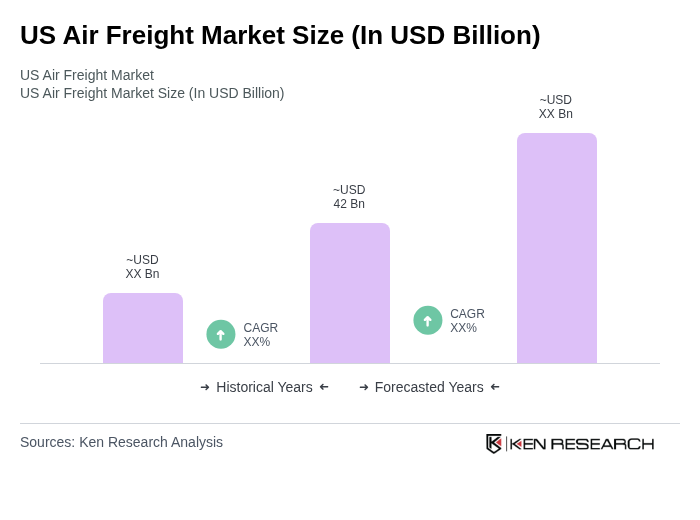
- The US Air Freight Market is valued at approximately USD 42 billion, based on a five-year historical analysis. This growth is primarily driven by the increasing demand for e-commerce, which has led to a surge in express delivery services. Additionally, the need for rapid transportation of perishable goods, pharmaceuticals, and high-value electronics has further fueled the market's expansion. Technological advancements such as automation, AI-powered logistics, and real-time tracking have enhanced operational efficiency and reliability, supporting this growth.
- Key players in this market include major cities such as Los Angeles, Chicago, and New York, which dominate due to their strategic locations, extensive transportation networks, and proximity to major airports like LAX, ORD, and JFK. These cities serve as critical hubs for logistics and distribution, facilitating efficient air freight operations and attracting significant investments in infrastructure, including expanded cargo handling facilities and state-of-the-art security systems.
- In 2023, the US government implemented the Aviation and Transportation Security Act (ATSA), issued by the Transportation Security Administration (TSA), mandating that all air freight shipments undergo advanced screening processes including non-intrusive inspection technologies and enhanced cargo security protocols. This regulation aims to bolster safety measures and ensure compliance with international security standards such as those set by the International Civil Aviation Organization (ICAO), thereby improving the overall integrity and security of the air freight system.
US Air Freight Market Segmentation
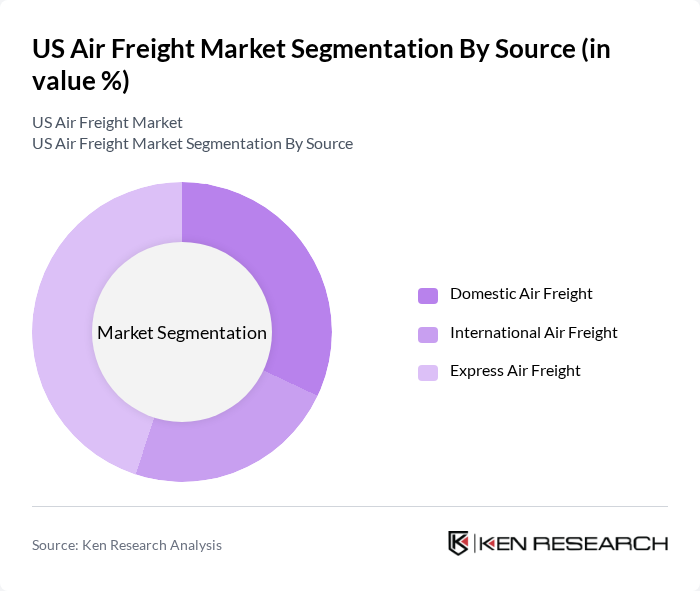
By Source:The air freight market can be segmented based on the source of the cargo. The primary subsegments include domestic air freight, international air freight, and express air freight. Among these, the express air freight subsegment dominates the market due to the increasing demand for fast delivery services, particularly driven by e-commerce growth. Consumers and businesses increasingly opt for express shipping to meet tight delivery windows, supported by innovations in last-mile delivery and integrated logistics platforms. The convenience, speed, and reliability of express services are key factors driving its growth.
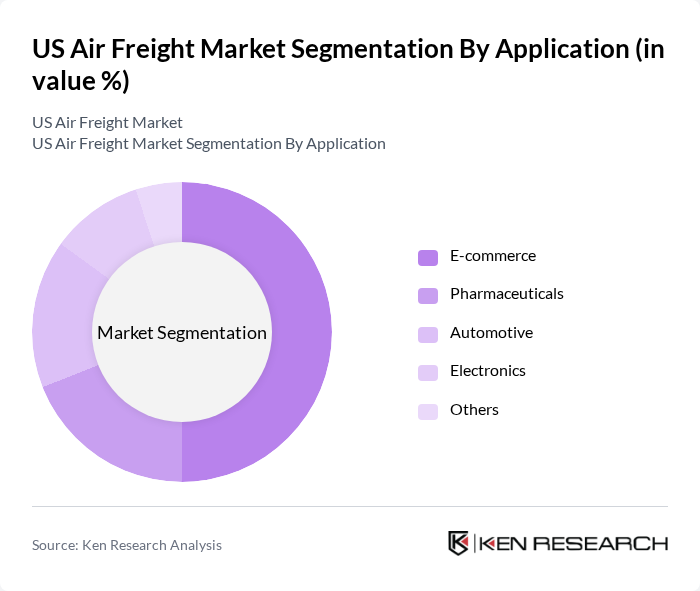
By Application:The air freight market is also segmented by application, including e-commerce, pharmaceuticals, automotive, electronics, and others. The e-commerce subsegment leads the market, propelled by rapid online retail growth and consumer demand for expedited shipping. Pharmaceuticals represent a significant share due to the critical need for temperature-controlled, time-sensitive shipments. Automotive and electronics sectors contribute notably, driven by just-in-time manufacturing and high-value components requiring secure, fast transport. Advancements in cold chain logistics and digital supply chain management further support these segments.
US Air Freight Market Competitive Landscape
The US Air Freight Market is characterized by a dynamic mix of regional and international players. Leading participants such as United Parcel Service (UPS), FedEx Corporation, Atlas Air Worldwide Holdings, American Airlines Group (Cargo Division), Delta Air Lines (Cargo Division), Southwest Airlines (Cargo Division), DHL Express (US Operations), XPO Logistics, C.H. Robinson Worldwide, Expeditors International, Kuehne + Nagel (North America), DB Schenker (USA), CEVA Logistics, Forward Air Corporation, ABX Air (ArcBest subsidiary) contribute to innovation, geographic expansion, and service delivery in this space.
US Air Freight Market Industry Analysis
Growth Drivers
- Increased E-commerce Demand:The US e-commerce sector is projected to reach **USD 1 trillion** in sales in future, driving significant demand for air freight services. With online retail sales expected to grow by **USD 200 billion**, logistics companies are investing heavily in air freight capabilities to meet the rapid delivery expectations of consumers. This surge in e-commerce is expected to increase air freight volumes by approximately **15 million tons annually**, highlighting the critical role of air transport in fulfilling consumer needs.
- Technological Advancements:The integration of advanced technologies such as AI and IoT in logistics is enhancing operational efficiency in the air freight sector. Investments in logistics technology are anticipated to exceed **USD 50 billion** in future, improving tracking, inventory management, and route optimization. These innovations are expected to reduce operational costs by **10%**, enabling air freight companies to offer more competitive services and expand their market share significantly.
- Global Trade Recovery:The US is projected to see a **5% increase in exports**, reaching **USD 1.8 trillion** in future, as global trade recovers from previous disruptions. This growth is expected to boost air freight demand, particularly for high-value goods that require expedited shipping. The increase in trade agreements and partnerships will further enhance air freight volumes, with an estimated additional **12 million tons** of cargo expected to be transported via air in the coming year.
Market Challenges
- Rising Fuel Costs:Fuel prices are projected to average **USD 3.50 per gallon** in future, significantly impacting operational costs for air freight companies. With fuel accounting for approximately **30%** of total operating expenses, these rising costs could lead to increased shipping rates, potentially reducing demand. Companies may need to implement cost-cutting measures or invest in fuel-efficient technologies to mitigate these financial pressures and maintain profitability.
- Regulatory Compliance:The air freight industry faces stringent regulatory requirements, including safety and environmental standards. Compliance costs are expected to rise by **8%** in future, driven by new regulations aimed at reducing carbon emissions. These increased costs can strain smaller operators, limiting their ability to compete with larger firms that have more resources to adapt. Navigating these regulations effectively will be crucial for maintaining operational viability in a competitive market.
US Air Freight Market Future Outlook
The US air freight market is poised for significant transformation as it adapts to evolving consumer demands and technological advancements. With the anticipated growth in e-commerce and global trade, air freight volumes are expected to rise sharply. Companies will increasingly leverage technology to enhance efficiency and reduce costs. However, challenges such as rising fuel prices and regulatory compliance will require strategic planning. Overall, the market is likely to experience robust growth, driven by innovation and increased demand for rapid delivery services.
Market Opportunities
- Expansion of Cold Chain Logistics:The demand for temperature-sensitive goods is rising, particularly in pharmaceuticals and perishables. The cold chain logistics market is expected to grow by **USD 10 billion** in future, presenting air freight companies with opportunities to expand their services and capture new market segments. Investing in specialized air freight solutions can enhance service offerings and meet the needs of this growing sector.
- Emerging Markets Penetration:As emerging markets continue to develop, air freight companies have the opportunity to expand their reach. The growth of middle-class consumers in regions like Southeast Asia is expected to increase demand for imported goods. Targeting these markets can lead to a projected increase of **20%** in air freight volumes, providing significant growth potential for companies willing to invest in new routes and partnerships.
Scope of the Report
Key Target Audience
Investors and Venture Capitalist Firms
Government and Regulatory Bodies (e.g., Federal Aviation Administration, Department of Transportation)
Air Freight Carriers
Logistics and Supply Chain Management Companies
Freight Forwarders
Customs Brokers
Airports and Cargo Handling Facilities
Insurance Companies Specializing in Cargo Insurance
Players Mentioned in the Report:
United Parcel Service (UPS)
FedEx Corporation
Atlas Air Worldwide Holdings
American Airlines Group (Cargo Division)
Delta Air Lines (Cargo Division)
Southwest Airlines (Cargo Division)
DHL Express (US Operations)
XPO Logistics
C.H. Robinson Worldwide
Expeditors International
Kuehne + Nagel (North America)
DB Schenker (USA)
CEVA Logistics
Forward Air Corporation
ABX Air (ArcBest subsidiary)
Table of Contents
Research Methodology
Phase 1: Approach1
Desk Research
- Analysis of industry reports from the Federal Aviation Administration (FAA) and the Bureau of Transportation Statistics (BTS)
- Review of market trends and forecasts from logistics and transportation journals
- Examination of trade publications and white papers focusing on air freight logistics
Primary Research
- Interviews with logistics executives from major air freight companies
- Surveys targeting freight forwarders and third-party logistics providers (3PLs)
- Field interviews with airport operations managers and cargo handlers
Validation & Triangulation
- Cross-validation of findings through multiple data sources including government statistics and industry reports
- Triangulation of insights from primary interviews with secondary data trends
- Sanity checks conducted through expert panels comprising industry veterans
Phase 2: Market Size Estimation1
Top-down Assessment
- Estimation of total air freight market size based on national logistics expenditure
- Segmentation by cargo type, including perishables, electronics, and pharmaceuticals
- Incorporation of growth rates from e-commerce and international trade data
Bottom-up Modeling
- Volume data collected from leading air freight carriers and freight forwarders
- Cost analysis based on service pricing and operational expenses of air cargo
- Calculation of market size using volume x average cost per shipment
Forecasting & Scenario Analysis
- Multi-variable regression analysis incorporating economic indicators and trade policies
- Scenario modeling based on potential disruptions such as regulatory changes and global events
- Development of baseline, optimistic, and pessimistic forecasts through 2030
Phase 3: CATI Sample Composition1
| Scope Item/Segment | Sample Size | Target Respondent Profiles |
|---|---|---|
| Perishable Goods Air Freight | 120 | Logistics Managers, Supply Chain Coordinators |
| Pharmaceuticals Air Cargo | 95 | Operations Directors, Compliance Officers |
| Electronics and High-Value Goods | 90 | Product Managers, Freight Forwarding Specialists |
| Automotive Parts Logistics | 70 | Procurement Managers, Warehouse Supervisors |
| E-commerce Fulfillment Strategies | 110 | eCommerce Operations Managers, Logistics Analysts |
Frequently Asked Questions
What is the current value of the US Air Freight Market?
The US Air Freight Market is valued at approximately USD 42 billion, driven by increasing e-commerce demand and the need for rapid transportation of perishable goods, pharmaceuticals, and high-value electronics.
What factors are driving the growth of the US Air Freight Market?
Which cities are the major hubs for air freight in the US?
What regulations impact the US Air Freight Market?
Other Regional/Country Reports
Other Adjacent Reports
Vietnam Aviation Technology Market
Malaysia Air Cargo Security Market
Germany Logistics Technology MarketJapan International Trade Logistics Market
Why Buy From Us?

What makes us stand out is that our consultants follow Robust, Refine and Result (RRR) methodology. Robust for clear definitions, approaches and sanity checking, Refine for differentiating respondents' facts and opinions, and Result for presenting data with story.

We have set a benchmark in the industry by offering our clients with syndicated and customized market research reports featuring coverage of entire market as well as meticulous research and analyst insights.

While we don't replace traditional research, we flip the method upside down. Our dual approach of Top Bottom & Bottom Top ensures quality deliverable by not just verifying company fundamentals but also looking at the sector and macroeconomic factors.

With one step in the future, our research team constantly tries to show you the bigger picture. We help with some of the tough questions you may encounter along the way: How is the industry positioned? Best marketing channel? KPI's of competitors? By aligning every element, we help maximize success.

Our report gives you instant access to the answers and sources that other companies might choose to hide. We elaborate each steps of research methodology we have used and showcase you the sample size to earn your trust.

If you need any support, we are here! We pride ourselves on universe strength, data quality, and quick, friendly, and professional service.