About the Report
Base Year 2024Philippines Flooring Market Overview
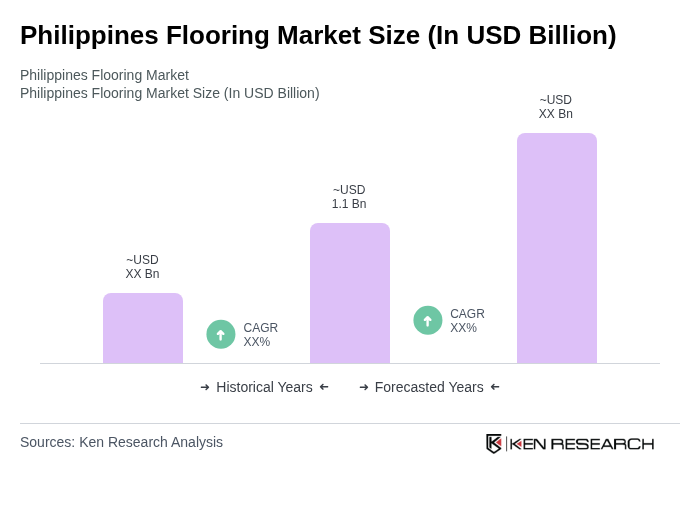
- The Philippines Flooring Market is valued at USD 1.1 billion, based on a five-year historical analysis of key segments including resilient flooring and wood & laminate flooring, and considering their combined share within the broader flooring space. This growth is primarily driven by the booming construction sector, increased urbanization, and rising disposable incomes, which have led to a surge in demand for various flooring solutions across residential, commercial, and industrial applications. The Philippine construction industry has recorded strong growth, with the construction market expanding at a robust pace and expected to reach around PHP 1.94 trillion, underpinned by infrastructure and real estate investments, which directly support demand for flooring materials and services.
- Metro Manila, Cebu, and Davao are the dominant cities in the Philippines Flooring Market. Metro Manila, as the capital region, has a high concentration of commercial, office, and high-density residential developments, while Cebu and Davao are emerging as key urban centers with significant infrastructure, tourism-related, and mixed-use development projects, driving the demand for flooring products across retail, hospitality, residential, and institutional buildings.
- The Philippine government’s flagship infrastructure program widely known as “Build, Build, Build,” initiated under the previous administration, has been continued and evolved under the current “Build Better More” agenda, which aims to accelerate infrastructure development across the country through large-scale investments in transport, public works, and housing projects; this sustained pipeline of projects is boosting demand for flooring materials and installation services in both public and private construction. Key policy frameworks such as the Republic Act No. 11201 (Department of Human Settlements and Urban Development Act of 2019), which created the Department of Human Settlements and Urban Development (DHSUD), and the National Building Code of the Philippines (Presidential Decree No. 1096, 1977) set requirements for building design, materials, and safety standards that govern construction and, by extension, specifications for floor assemblies and finishes in residential, commercial, and institutional buildings.
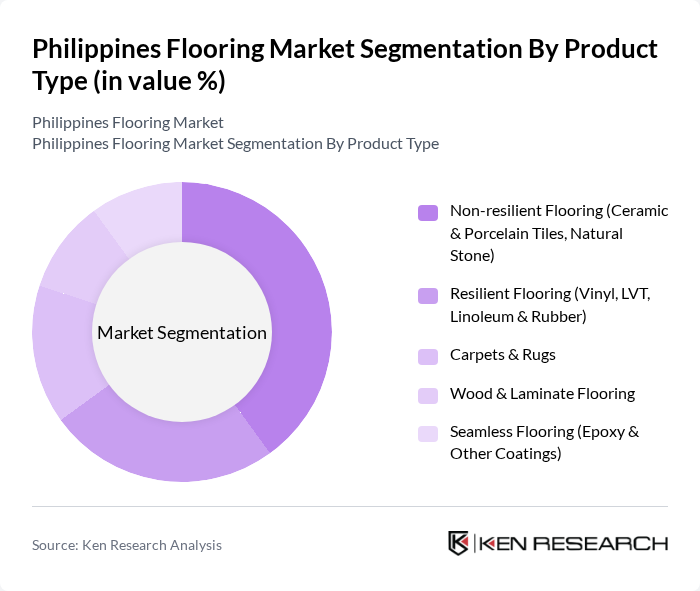
Philippines Flooring Market Segmentation
By Product Type:The product type segmentation includes various flooring materials that cater to different consumer preferences and applications. The subsegments are Non-resilient Flooring (Ceramic & Porcelain Tiles, Natural Stone), Resilient Flooring (Vinyl, LVT, Linoleum & Rubber), Carpets & Rugs, Wood & Laminate Flooring, and Seamless Flooring (Epoxy & Other Coatings). Among these, Non-resilient Flooring is currently dominating the market due to its durability, ease of maintenance, and aesthetic appeal, making it a preferred choice for both residential and commercial spaces. Ceramic and porcelain tiles represent a sizable and growing share of floor finishes in the country, supported by rising middle-class housing demand and renovation activities, while resilient flooring (including vinyl and LVT) and wood & laminate flooring are also expanding as consumers increasingly seek modern designs, moisture resistance, and cost-effective alternatives.
By Application:The application segmentation encompasses the various sectors where flooring products are utilized, including Residential, Commercial, and Industrial applications. The Residential segment is currently leading the market, supported by strong demand for new housing, vertical condominiums, and subdivision developments, as well as increasing home renovations among middle-income households. The growing trend of interior design, home improvement, and preference for easy-to-clean, durable surfaces has significantly influenced consumer preferences towards high-quality flooring solutions, while commercial projects such as offices, retail, hospitality, and institutional buildings also represent a substantial and growing user base for resilient, tile, and wood-based flooring.

Philippines Flooring Market Competitive Landscape
The Philippines Flooring Market is characterized by a dynamic mix of regional and international players. Leading participants such as Floor Center, Wilcon Depot, FC Tile Depot, CW Home Depot, Mapei Philippines Inc., Mariwasa Siam Ceramics Inc., Apo Floors, Nexent Coatings Inc., ABC Phil., Inc. (ABC Adhesives & Coatings), Pride Asia Marketing (Vinyl & LVT), Kaufman, Inc., Matimco, Inc., Kent Floors, Armstrong Flooring (Regional Presence), Interface, Inc. (Modular Carpet Tiles) contribute to innovation, geographic expansion, and service delivery in this space. Many of these companies are strengthening portfolios in ceramic tiles, resilient flooring, and engineered wood, while also promoting eco-friendlier options such as low-VOC adhesives and coatings, reflecting a broader regional shift toward sustainable building materials.
Philippines Flooring Market Industry Analysis
Growth Drivers
- Increasing Urbanization:The Philippines is experiencing rapid urbanization, with urban areas projected to house 58% of the population in future, up from 54% in the recent past. This shift is driving demand for residential and commercial flooring solutions, as new constructions and renovations become more prevalent. The urban population is expected to reach approximately 63 million, leading to a significant increase in flooring requirements across various sectors, including residential, commercial, and industrial.
- Rising Disposable Income:The average disposable income in the Philippines is projected to rise to approximately PHP 350,000 per capita in future, reflecting a growing middle class. This increase in disposable income is encouraging consumers to invest in home improvements, including flooring upgrades. As households prioritize aesthetics and quality, the demand for premium flooring options, such as hardwood and luxury vinyl tiles, is expected to surge, further stimulating market growth.
- Demand for Sustainable Flooring Solutions:With environmental awareness on the rise, the demand for sustainable flooring solutions is increasing. The market for eco-friendly flooring materials, such as bamboo and recycled products, is expected to grow significantly, with a projected increase of 25% in future. This trend is supported by government initiatives promoting sustainability and consumer preferences shifting towards environmentally responsible products, creating a robust market for sustainable flooring options.
Market Challenges
- High Competition:The Philippines flooring market is characterized by intense competition, with over 250 local and international players vying for market share. This saturation leads to price wars and reduced profit margins, making it challenging for new entrants to establish themselves. Companies must differentiate their offerings through innovation and quality to survive in this competitive landscape, which can strain resources and limit growth potential.
- Fluctuating Raw Material Prices:The flooring industry is heavily reliant on raw materials such as wood, vinyl, and ceramics, which are subject to price volatility. In future, the price of wood is expected to increase by 20% due to supply chain disruptions and increased demand. This fluctuation can significantly impact production costs and profit margins for flooring manufacturers, forcing them to adapt their pricing strategies and potentially pass costs onto consumers.
Philippines Flooring Market Future Outlook
The Philippines flooring market is poised for significant growth driven by urbanization, rising disposable incomes, and a shift towards sustainable products. As the construction sector expands, particularly in urban areas, the demand for innovative flooring solutions will increase. Companies that invest in technology and eco-friendly materials will likely gain a competitive edge. Additionally, the rise of e-commerce platforms will facilitate greater access to diverse flooring options, enhancing consumer choice and market dynamics in the coming years.
Market Opportunities
- Expansion of E-commerce Platforms:The growth of e-commerce in the Philippines presents a significant opportunity for flooring companies. With online retail sales projected to reach approximately PHP 250 billion in future, businesses can leverage digital platforms to reach a broader audience, streamline sales processes, and enhance customer engagement, ultimately driving sales growth in the flooring sector.
- Innovations in Flooring Technology:Advancements in flooring technology, such as smart flooring solutions that integrate IoT capabilities, are gaining traction. The market for smart flooring is expected to grow by 30% in future, driven by consumer interest in home automation and energy efficiency. Companies that embrace these innovations can capture new market segments and enhance their product offerings.
Scope of the Report
| Segment | Sub-Segments |
|---|---|
| By Product Type | Non-resilient Flooring (Ceramic & Porcelain Tiles, Natural Stone) Resilient Flooring (Vinyl, LVT, Linoleum & Rubber) Carpets & Rugs Wood & Laminate Flooring Seamless Flooring (Epoxy & Other Coatings) |
| By Application | Residential Commercial Industrial |
| By Region | Luzon Visayas Mindanao |
| By Installation Type | New Installation Renovation / Retrofitting |
| By Price Range | Budget Mid-range Premium |
Key Target Audience
Investors and Venture Capitalist Firms
Government and Regulatory Bodies (e.g., Department of Trade and Industry, Housing and Land Use Regulatory Board)
Manufacturers and Producers
Distributors and Retailers
Construction and Real Estate Developers
Interior Designers and Architects
Industry Associations (e.g., Philippine Institute of Interior Designers)
Financial Institutions
Players Mentioned in the Report:
Floor Center
Wilcon Depot
FC Tile Depot
CW Home Depot
Mapei Philippines Inc.
Mariwasa Siam Ceramics Inc.
Apo Floors
Nexent Coatings Inc.
ABC Phil., Inc. (ABC Adhesives & Coatings)
Pride Asia Marketing (Vinyl & LVT)
Kaufman, Inc.
Matimco, Inc.
Kent Floors
Armstrong Flooring (Regional Presence)
Interface, Inc. (Modular Carpet Tiles)
Table of Contents
Market Assessment Phase
1. Executive Summary and Approach
2. Philippines Flooring Market Overview
2.1 Key Insights and Strategic Recommendations
2.2 Philippines Flooring Market Overview
2.3 Definition and Scope
2.4 Evolution of Market Ecosystem
2.5 Timeline of Key Regulatory Milestones
2.6 Value Chain & Stakeholder Mapping
2.7 Business Cycle Analysis
2.8 Policy & Incentive Landscape
3. Philippines Flooring Market Analysis
3.1 Growth Drivers
3.1.1 Increasing Urbanization
3.1.2 Rising Disposable Income
3.1.3 Demand for Sustainable Flooring Solutions
3.1.4 Growth in the Construction Sector
3.2 Market Challenges
3.2.1 High Competition
3.2.2 Fluctuating Raw Material Prices
3.2.3 Regulatory Compliance Issues
3.2.4 Limited Consumer Awareness
3.3 Market Opportunities
3.3.1 Expansion of E-commerce Platforms
3.3.2 Innovations in Flooring Technology
3.3.3 Increasing Demand for Eco-friendly Products
3.3.4 Government Infrastructure Projects
3.4 Market Trends
3.4.1 Shift Towards Luxury Vinyl Tiles (LVT)
3.4.2 Growth of Smart Flooring Solutions
3.4.3 Customization and Personalization in Flooring
3.4.4 Rise of Online Retailing
3.5 Government Regulation
3.5.1 Environmental Compliance Standards
3.5.2 Building Code Regulations
3.5.3 Import Tariffs on Flooring Materials
3.5.4 Safety Standards for Flooring Products
4. SWOT Analysis
5. Stakeholder Analysis
6. Porter's Five Forces Analysis
7. Philippines Flooring Market Market Size, 2019-2024
7.1 By Value
7.2 By Volume
7.3 By Average Selling Price
8. Philippines Flooring Market Segmentation
8.1 By Product Type
8.1.1 Non-resilient Flooring (Ceramic & Porcelain Tiles, Natural Stone)
8.1.2 Resilient Flooring (Vinyl, LVT, Linoleum & Rubber)
8.1.3 Carpets & Rugs
8.1.4 Wood & Laminate Flooring
8.1.5 Seamless Flooring (Epoxy & Other Coatings)
8.2 By Application
8.2.1 Residential
8.2.2 Commercial
8.2.3 Industrial
8.3 By Region
8.3.1 Luzon
8.3.2 Visayas
8.3.3 Mindanao
8.4 By Installation Type
8.4.1 New Installation
8.4.2 Renovation / Retrofitting
8.5 By Price Range
8.5.1 Budget
8.5.2 Mid-range
8.5.3 Premium
9. Philippines Flooring Market Competitive Analysis
9.1 Market Share of Key Players
9.2 Cross Comparison of Key Players
9.2.1 Company Name
9.2.2 Revenue (Latest Year, USD Million)
9.2.3 2019–2024 Revenue CAGR (%)
9.2.4 EBITDA Margin (%)
9.2.5 Philippines Flooring Revenue Share in Total Sales (%)
9.2.6 Market Share in Philippines Flooring Market (%)
9.2.7 Capex Intensity (% of Revenue)
9.2.8 Average Selling Price Positioning (vs. Market Average)
9.2.9 Channel Mix (Retail / Project / Online, % of Revenue)
9.2.10 Portfolio Mix (Tiles / Vinyl & LVT / Wood & Laminate / Others, % of Revenue)
9.2.11 Export Revenue Share (%)
9.2.12 Working Capital Days
9.2.13 Return on Capital Employed (ROCE, %)
9.3 SWOT Analysis of Top Players
9.4 Pricing Analysis
9.5 Detailed Profile of Major Companies
9.5.1 Floor Center
9.5.2 Wilcon Depot
9.5.3 FC Tile Depot
9.5.4 CW Home Depot
9.5.5 Mapei Philippines Inc.
9.5.6 Mariwasa Siam Ceramics Inc.
9.5.7 Apo Floors
9.5.8 Nexent Coatings Inc.
9.5.9 ABC Phil., Inc. (ABC Adhesives & Coatings)
9.5.10 Pride Asia Marketing (Vinyl & LVT)
9.5.11 Kaufman, Inc.
9.5.12 Matimco, Inc.
9.5.13 Kent Floors
9.5.14 Armstrong Flooring (Regional Presence)
9.5.15 Interface, Inc. (Modular Carpet Tiles)
10. Philippines Flooring Market End-User Analysis
10.1 Procurement Behavior of Key Ministries
10.1.1 Key Ministries Involved
10.1.2 Procurement Processes
10.1.3 Budget Allocations
10.1.4 Decision-Making Criteria
10.2 Corporate Spend on Infrastructure & Energy
10.2.1 Investment Trends
10.2.2 Major Projects
10.2.3 Budget Priorities
10.3 Pain Point Analysis by End-User Category
10.3.1 Residential Pain Points
10.3.2 Commercial Pain Points
10.3.3 Industrial Pain Points
10.3.4 Government Pain Points
10.4 User Readiness for Adoption
10.4.1 Awareness Levels
10.4.2 Adoption Barriers
10.4.3 Training Needs
10.5 Post-Deployment ROI and Use Case Expansion
10.5.1 ROI Metrics
10.5.2 Use Case Scenarios
10.5.3 Feedback Mechanisms
11. Philippines Flooring Market Future Size, 2025-2030
11.1 By Value
11.2 By Volume
11.3 By Average Selling Price
Go-To-Market Strategy Phase
1. Whitespace Analysis + Business Model Canvas
1.1 Market Gaps Identification
1.2 Business Model Framework
2. Marketing and Positioning Recommendations
2.1 Branding Strategies
2.2 Product USPs
3. Distribution Plan
3.1 Urban Retail Strategies
3.2 Rural NGO Tie-ups
4. Channel & Pricing Gaps
4.1 Underserved Routes
4.2 Pricing Bands
5. Unmet Demand & Latent Needs
5.1 Category Gaps
5.2 Consumer Segments
6. Customer Relationship
6.1 Loyalty Programs
6.2 After-sales Service
7. Value Proposition
7.1 Sustainability Initiatives
7.2 Integrated Supply Chains
8. Key Activities
8.1 Regulatory Compliance
8.2 Branding Efforts
8.3 Distribution Setup
9. Entry Strategy Evaluation
9.1 Domestic Market Entry Strategy
9.1.1 Product Mix
9.1.2 Pricing Band
9.1.3 Packaging Strategies
9.2 Export Entry Strategy
9.2.1 Target Countries
9.2.2 Compliance Roadmap
10. Entry Mode Assessment
10.1 Joint Ventures
10.2 Greenfield Investments
10.3 Mergers & Acquisitions
10.4 Distributor Model
11. Capital and Timeline Estimation
11.1 Capital Requirements
11.2 Timelines
12. Control vs Risk Trade-Off
12.1 Ownership vs Partnerships
13. Profitability Outlook
13.1 Breakeven Analysis
13.2 Long-term Sustainability
14. Potential Partner List
14.1 Distributors
14.2 Joint Ventures
14.3 Acquisition Targets
15. Execution Roadmap
15.1 Phased Plan for Market Entry
15.1.1 Market Setup
15.1.2 Market Entry
15.1.3 Growth Acceleration
15.1.4 Scale & Stabilize
15.2 Key Activities and Milestones
15.2.1 Milestone Planning
15.2.2 Activity Tracking
Research Methodology
Phase 1: Approach1
Desk Research
- Industry reports from local and international flooring associations
- Government publications on construction and real estate trends in the Philippines
- Market analysis from trade journals and flooring industry publications
Primary Research
- Interviews with key stakeholders in the flooring supply chain, including manufacturers and distributors
- Surveys targeting architects and interior designers to understand preferences and trends
- Field visits to retail outlets and showrooms to assess product offerings and customer interactions
Validation & Triangulation
- Cross-validation of findings with multiple data sources, including sales data and market reports
- Triangulation of insights from primary interviews with secondary research findings
- Sanity checks through expert panel discussions with industry veterans
Phase 2: Market Size Estimation1
Top-down Assessment
- Analysis of national construction spending and its correlation with flooring demand
- Segmentation of the market by flooring type (e.g., hardwood, laminate, tiles) and end-user applications
- Incorporation of macroeconomic indicators such as GDP growth and urbanization rates
Bottom-up Modeling
- Volume estimates based on sales data from leading flooring manufacturers in the Philippines
- Cost analysis of flooring products, including installation and maintenance expenses
- Estimation of market share for various flooring types based on consumer preferences and trends
Forecasting & Scenario Analysis
- Multi-variable forecasting using historical growth rates and projected construction activities
- Scenario analysis based on potential regulatory changes affecting the construction industry
- Development of baseline, optimistic, and pessimistic market growth scenarios through 2030
Phase 3: CATI Sample Composition1
| Scope Item/Segment | Sample Size | Target Respondent Profiles |
|---|---|---|
| Residential Flooring Installations | 120 | Homeowners, Interior Designers |
| Commercial Flooring Projects | 100 | Facility Managers, Architects |
| Retail Flooring Trends | 80 | Retail Store Owners, Merchandising Managers |
| Construction Industry Insights | 100 | Contractors, Project Managers |
| Flooring Material Suppliers | 90 | Supply Chain Managers, Product Development Heads |
Frequently Asked Questions
What is the current value of the Philippines Flooring Market?
The Philippines Flooring Market is valued at approximately USD 1.1 billion, driven by growth in the construction sector, urbanization, and rising disposable incomes, which have increased demand for various flooring solutions across residential, commercial, and industrial applications.
Which cities are the main contributors to the Philippines Flooring Market?
What are the key drivers of growth in the Philippines Flooring Market?
What types of flooring products are popular in the Philippines?
Other Regional/Country Reports
Other Adjacent Reports
South Korea Real Estate Development Market
Mexico Building Supplies Market
Global Furniture Market Size, Share & Forecast, By Product Type, Material, End User & Distribution Channel, 2026-2031India Architectural Services Market Size, Share & Forecast, By Service Type, Customer Type & End-Use Industry, 2026-2031Singapore Sustainable Building Materials Market
UAE Adhesives and Sealants MarketUnited States Carpet and Rug Market Size, Share & Forecast, By Product Type, End Use & Distribution Channel, 2025-2032Why Buy From Us?

What makes us stand out is that our consultants follow Robust, Refine and Result (RRR) methodology. Robust for clear definitions, approaches and sanity checking, Refine for differentiating respondents' facts and opinions, and Result for presenting data with story.

We have set a benchmark in the industry by offering our clients with syndicated and customized market research reports featuring coverage of entire market as well as meticulous research and analyst insights.

While we don't replace traditional research, we flip the method upside down. Our dual approach of Top Bottom & Bottom Top ensures quality deliverable by not just verifying company fundamentals but also looking at the sector and macroeconomic factors.

With one step in the future, our research team constantly tries to show you the bigger picture. We help with some of the tough questions you may encounter along the way: How is the industry positioned? Best marketing channel? KPI's of competitors? By aligning every element, we help maximize success.

Our report gives you instant access to the answers and sources that other companies might choose to hide. We elaborate each steps of research methodology we have used and showcase you the sample size to earn your trust.

If you need any support, we are here! We pride ourselves on universe strength, data quality, and quick, friendly, and professional service.