Saudi Arabia EMS Billing Services Market Size Share Growth Drivers Trends Opportunities & Forecast 2025–2030

Saudi Arabia EMS Billing Services Market, worth USD 1.4 Bn, grows via healthcare expansions, digital health, and government initiatives like Vision 2030 for efficient revenue cycles.

Region:Middle East

Author(s):Geetanshi

Product Code:KRAA4224

Pages:95

Published On:January 2026
About the Report

Base Year 2024

Saudi Arabia EMS Billing Services Market Overview

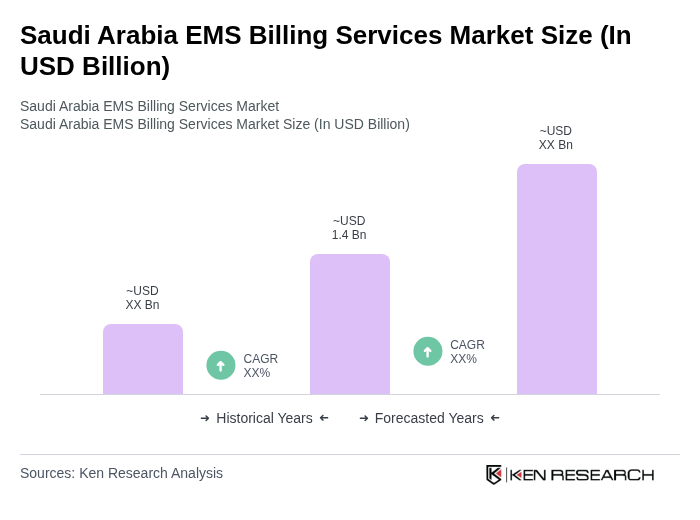
  • The Saudi Arabia EMS Billing Services Market is valued at approximately USD 1.4 billion, based on a five-year historical analysis of the broader emergency medical services and related billing markets in the country. This growth is primarily driven by the increasing demand for emergency medical services, reflected in the expansion of ambulance and pre-hospital care networks, advancements in healthcare technology and digital health (including e-health, telemedicine, and electronic claims platforms), and the rising number of private healthcare facilities and corporate healthcare groups in Saudi Arabia. The market is also supported by government initiatives under Vision 2030 aimed at improving healthcare infrastructure, increasing private sector participation, and enhancing revenue cycle efficiency across the health system.
  • Key cities dominating the market include Riyadh, Jeddah, and Dammam. Riyadh, as the capital and the largest healthcare hub, has a high concentration of tertiary hospitals, specialized centers, and private health systems, which drives substantial EMS utilization and associated billing volumes. Jeddah, being a major urban center on the Red Sea and a main gateway for pilgrims to the holy cities, records high emergency and ambulance activity, especially during peak pilgrimage seasons, increasing the need for robust EMS billing and claims management. Dammam and the broader Eastern Province benefit from strategic port and industrial activity, large corporate and oil-sector populations, and significant road traffic, supporting strong demand for EMS provision and related billing services.
  • In addition to mandatory cooperative health insurance requirements overseen by the Council of Health Insurance (CHI), the Saudi government has continued to strengthen health coverage and reimbursement frameworks to enhance access to emergency medical services and support more efficient claims processing. The Cooperative Health Insurance Law issued by Royal Decree No. M/10 and its implementing regulations under the Council of Health Insurance provide the binding framework for compulsory health insurance for residents, define insurer–provider reimbursement mechanisms, and set standards for electronic claims, coding, and billing compliance that directly impact EMS billing workflows. These measures aim to streamline the billing process and support timely reimbursements for EMS providers through standardized claim formats and growing adoption of outsourced and technology-enabled billing solutions.
Saudi Arabia EMS Billing Services Market Size

Saudi Arabia EMS Billing Services Market Segmentation

By Service Model:The service model segmentation includes In-house Billing Services, Outsourced Billing Services, and Hybrid Billing Models. In-house billing services are preferred by larger healthcare institutions and integrated delivery networks that have the financial and human resources to manage coding, claims submission, and denial management internally. Outsourced billing services are gaining traction among hospitals, clinics, and EMS operators seeking to reduce operational costs, access specialized billing expertise, improve collection rates, and keep pace with evolving payer rules without continually expanding internal teams. Hybrid models combine both approaches, with providers keeping strategic or high-complexity functions in-house while leveraging external vendors for volume processing, analytics, or specific payer segments, thereby allowing flexibility, scalability, and resilience in revenue cycle operations.
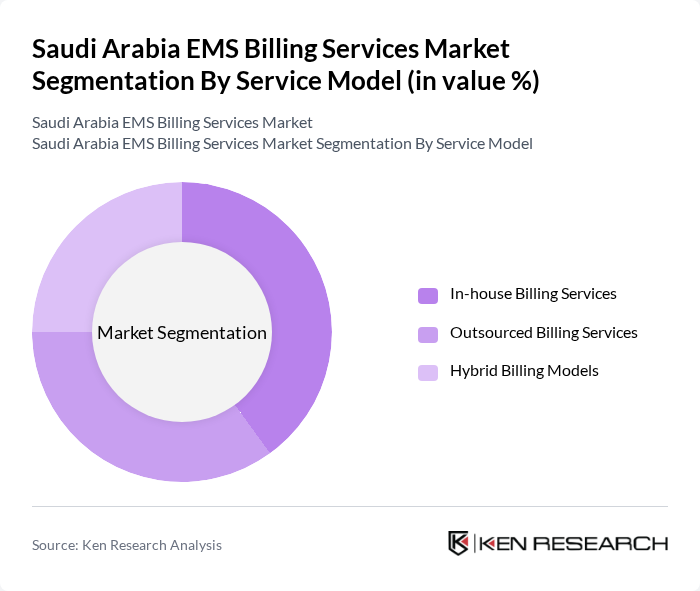
Saudi Arabia EMS Billing Services Market segmentation by Service Model.

By Provider Type:The provider type segmentation includes Public EMS Providers, Private EMS Operators, Hospital-based EMS, Clinic and Polyclinic-based EMS, and Others (NGOs, Industrial/Corporate EMS). Public EMS providers dominate due to government funding, centralized coordination, and nationwide coverage, with the Saudi Red Crescent Authority acting as the primary pre-hospital emergency care provider across urban and rural areas. Private EMS operators are expanding rapidly as part of the broader privatization and public–private partnership agenda, supporting premium ambulance services, inter-facility transfers, and corporate/industrial contracts to meet growing demand for high-quality, responsive care. Hospital-based EMS are integral to larger healthcare systems, providing emergency department support, critical care transport, and specialized transfer services, while clinics and polyclinics increasingly coordinate EMS for local catchment areas as part of integrated primary and secondary care models. Others, including NGOs and industrial/corporate EMS, play an important role in high-risk industrial sites, large campuses, and community initiatives, often working in coordination with public and private ambulance networks.
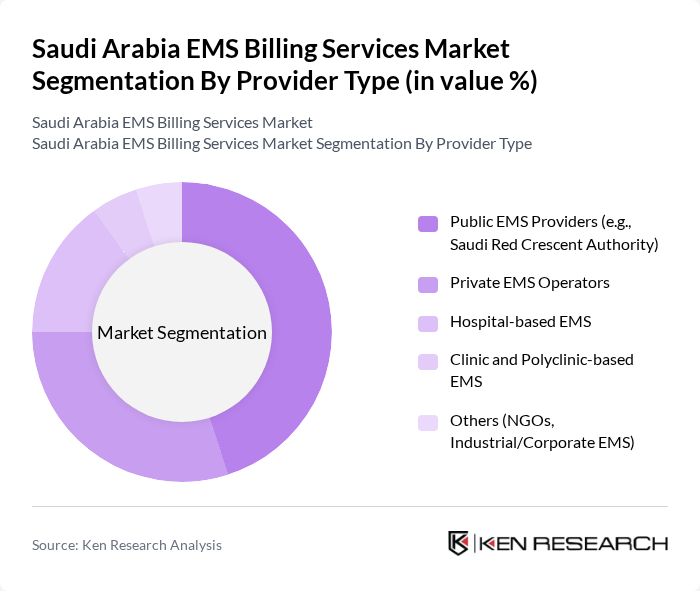
Saudi Arabia EMS Billing Services Market segmentation by Provider Type.

Saudi Arabia EMS Billing Services Market Competitive Landscape

The Saudi Arabia EMS Billing Services Market is characterized by a dynamic mix of regional and international players. Leading participants such as Saudi Red Crescent Authority, Kingdom of Saudi Arabia Ministry of Health (MOH) – EMS & Ambulance Services, Dr. Sulaiman Al Habib Medical Group – EMS & Ambulance Services, Saudi German Health – EMS & Ambulance Services, Dallah Health Company – EMS & Patient Transport Services, King Faisal Specialist Hospital & Research Centre – EMS & Critical Care Transport, International Medical Center (IMC) – Emergency & Ambulance Services, Mouwasat Medical Services – EMS & Ambulance Network, Al Hammadi Holding – Emergency & Ambulance Services, Saudi Aramco Medical Services – Industrial EMS & Medical Transport, Bupa Arabia – Health Insurance & EMS Billing Interfaces, Tawuniya (Company for Cooperative Insurance) – Health Insurance & EMS Claims, MedGulf – Health Insurance & EMS Reimbursement, Najm for Insurance Services – Motor Accident & EMS Coordination, Regional / International EMS Billing & RCM Vendors Active in KSA contribute to innovation, geographic expansion, and service delivery in this space.

Saudi Red Crescent Authority

1934

Riyadh, Saudi Arabia

Dr. Sulaiman Al Habib Medical Group

1995

Riyadh, Saudi Arabia

Saudi German Health

1988

Jeddah, Saudi Arabia

Dallah Health Company

1995

Riyadh, Saudi Arabia

International Medical Center (IMC)

2006

Jeddah, Saudi Arabia

Company

Establishment Year

Headquarters

Group Size (Large, Medium, or Small as per industry convention)

Annual EMS Billing Revenue (SAR / USD)

3-year Revenue CAGR

EBITDA Margin from EMS Billing Operations

Average Days Sales Outstanding (DSO)

First-pass Claim Acceptance Rate

Saudi Arabia EMS Billing Services Market Industry Analysis

Growth Drivers

  • Increasing Demand for Efficient Billing Solutions:The Saudi healthcare sector is projected to reach a value of SAR 300 billion in future, driven by a growing population and rising healthcare expenditures. This surge necessitates efficient billing solutions to streamline operations and reduce administrative costs. The demand for electronic medical services (EMS) billing is expected to increase as healthcare providers seek to enhance revenue cycle management, with an estimated 35% of hospitals adopting advanced billing systems in future.
  • Government Initiatives to Enhance Healthcare Services:The Saudi government has allocated SAR 200 billion for healthcare in its future budget, emphasizing the importance of improving healthcare services. Initiatives such as Vision 2030 aim to modernize healthcare infrastructure and promote digital transformation. These efforts are expected to drive the adoption of EMS billing services, as healthcare providers align with government standards and seek to improve service delivery and operational efficiency.
  • Rising Adoption of Digital Payment Systems:With over 80% of transactions in Saudi Arabia expected to be digital in future, the healthcare sector is increasingly adopting digital payment systems. This shift is driven by consumer preferences for convenience and security. As healthcare providers implement digital payment solutions, the demand for integrated EMS billing services will rise, facilitating seamless transactions and improving patient satisfaction, ultimately enhancing revenue collection processes.

Market Challenges

  • Regulatory Compliance Complexities:The EMS billing services market in Saudi Arabia faces significant challenges due to complex regulatory requirements. Healthcare providers must navigate various laws and standards, including the Saudi Health Information Exchange (SHIE) regulations. Non-compliance can result in penalties, impacting service delivery. In future, it is estimated that 45% of healthcare providers will struggle with compliance, hindering the growth of EMS billing services in the region.
  • Data Security Concerns:As the healthcare sector increasingly relies on digital solutions, data security has become a critical concern. In future, it is projected that cyberattacks on healthcare organizations will increase by 30%, leading to potential breaches of sensitive patient information. This risk poses a significant challenge for EMS billing service providers, as they must invest in robust security measures to protect data and maintain trust with healthcare providers and patients alike.

Saudi Arabia EMS Billing Services Market Future Outlook

The future of the EMS billing services market in Saudi Arabia appears promising, driven by technological advancements and government support. The integration of artificial intelligence and machine learning into billing processes is expected to enhance accuracy and efficiency, reducing operational costs. Additionally, as healthcare providers increasingly focus on patient-centric billing practices, the demand for customized solutions will grow. This evolving landscape presents significant opportunities for service providers to innovate and expand their offerings in the coming years.

Market Opportunities

  • Integration of AI and Machine Learning in Billing:The incorporation of AI and machine learning technologies into EMS billing services can streamline processes, reduce errors, and enhance decision-making. In future, it is anticipated that 25% of billing processes will utilize AI, leading to improved efficiency and cost savings for healthcare providers, ultimately transforming the billing landscape.
  • Expansion into Underserved Regions:There is a significant opportunity for EMS billing service providers to expand into underserved regions of Saudi Arabia, where healthcare infrastructure is still developing. By targeting these areas, providers can tap into a growing market, with an estimated 20% increase in demand for billing services expected as healthcare facilities are established and modernized in these regions.

Scope of the Report

SegmentSub-Segments
By Service Model

In-house Billing Services

Outsourced Billing Services

Hybrid Billing Models

By Provider Type

Public EMS Providers (e.g., Saudi Red Crescent Authority)

Private EMS Operators

Hospital-based EMS

Clinic and Polyclinic-based EMS

Others (NGOs, Industrial/Corporate EMS)

By Service Type

Ground Ambulance Billing

Air Ambulance Billing

Non-emergency Transport Billing

Emergency Medical Dispatch & Communication Billing

Mobile Health Unit Billing

By Technology

Cloud-based EMS Billing Platforms

On-premise EMS Billing Systems

Web-based / SaaS Solutions

Integrated RCM & Practice Management Suites

By Payer Type

Government Programs (e.g., public funding, social insurance)

Private Health Insurance

Corporate / Employer-sponsored Plans

Self-pay / Out-of-pocket

By End-User

Hospitals

Specialized Emergency & Trauma Centers

Private Clinics & Polyclinics

Government Health Departments & Municipalities

Others

By Region

Central Region (including Riyadh)

Western Region (including Jeddah, Makkah, Madinah)

Eastern Region (including Dammam, Al Khobar)

Northern Region

Southern Region

Key Target Audience

Investors and Venture Capitalist Firms

Government and Regulatory Bodies (e.g., Saudi Ministry of Health, Saudi Food and Drug Authority)

Healthcare Providers and Facilities

Insurance Companies and Payers

Billing and Revenue Cycle Management Companies

Healthcare Technology and Software Developers

Industry Associations and Organizations

Financial Institutions and Banks

Players Mentioned in the Report:

Saudi Red Crescent Authority

Kingdom of Saudi Arabia Ministry of Health (MOH) EMS & Ambulance Services

Dr. Sulaiman Al Habib Medical Group EMS & Ambulance Services

Saudi German Health EMS & Ambulance Services

Dallah Health Company EMS & Patient Transport Services

King Faisal Specialist Hospital & Research Centre EMS & Critical Care Transport

International Medical Center (IMC) Emergency & Ambulance Services

Mouwasat Medical Services EMS & Ambulance Network

Al Hammadi Holding Emergency & Ambulance Services

Saudi Aramco Medical Services Industrial EMS & Medical Transport

Bupa Arabia Health Insurance & EMS Billing Interfaces

Tawuniya (Company for Cooperative Insurance) Health Insurance & EMS Claims

MedGulf Health Insurance & EMS Reimbursement

Najm for Insurance Services Motor Accident & EMS Coordination

Regional / International EMS Billing & RCM Vendors Active in KSA

Table of Contents

Market Assessment Phase

1. Executive Summary and Approach


2. Saudi Arabia EMS Billing Services Market Overview

2.1 Key Insights and Strategic Recommendations

2.2 Saudi Arabia EMS Billing Services Market Overview

2.3 Definition and Scope

2.4 Evolution of Market Ecosystem

2.5 Timeline of Key Regulatory Milestones

2.6 Value Chain & Stakeholder Mapping

2.7 Business Cycle Analysis

2.8 Policy & Incentive Landscape


3. Saudi Arabia EMS Billing Services Market Analysis

3.1 Growth Drivers

3.1.1 Increasing demand for efficient billing solutions
3.1.2 Government initiatives to enhance healthcare services
3.1.3 Rising adoption of digital payment systems
3.1.4 Expansion of healthcare infrastructure

3.2 Market Challenges

3.2.1 Regulatory compliance complexities
3.2.2 High competition among service providers
3.2.3 Data security concerns
3.2.4 Limited awareness of EMS billing services

3.3 Market Opportunities

3.3.1 Integration of AI and machine learning in billing
3.3.2 Expansion into underserved regions
3.3.3 Partnerships with healthcare providers
3.3.4 Development of customized billing solutions

3.4 Market Trends

3.4.1 Shift towards cloud-based billing solutions
3.4.2 Increasing focus on patient-centric billing
3.4.3 Adoption of mobile billing applications
3.4.4 Growth of subscription-based billing models

3.5 Government Regulation

3.5.1 Implementation of healthcare billing standards
3.5.2 Data protection regulations
3.5.3 Licensing requirements for billing service providers
3.5.4 Incentives for digital transformation in healthcare

4. SWOT Analysis


5. Stakeholder Analysis


6. Porter's Five Forces Analysis


7. Saudi Arabia EMS Billing Services Market Size, 2019-2024

7.1 By Value

7.2 By Volume

7.3 By Average Selling Price


8. Saudi Arabia EMS Billing Services Market Segmentation

8.1 By Service Model

8.1.1 In-house Billing Services
8.1.2 Outsourced Billing Services
8.1.3 Hybrid Billing Models

8.2 By Provider Type

8.2.1 Public EMS Providers (e.g., Saudi Red Crescent Authority)
8.2.2 Private EMS Operators
8.2.3 Hospital-based EMS
8.2.4 Clinic and Polyclinic-based EMS
8.2.5 Others (NGOs, Industrial/Corporate EMS)

8.3 By Service Type

8.3.1 Ground Ambulance Billing
8.3.2 Air Ambulance Billing
8.3.3 Non-emergency Transport Billing
8.3.4 Emergency Medical Dispatch & Communication Billing
8.3.5 Mobile Health Unit Billing

8.4 By Technology

8.4.1 Cloud-based EMS Billing Platforms
8.4.2 On-premise EMS Billing Systems
8.4.3 Web-based / SaaS Solutions
8.4.4 Integrated RCM & Practice Management Suites

8.5 By Payer Type

8.5.1 Government Programs (e.g., public funding, social insurance)
8.5.2 Private Health Insurance
8.5.3 Corporate / Employer-sponsored Plans
8.5.4 Self-pay / Out-of-pocket

8.6 By End-User

8.6.1 Hospitals
8.6.2 Specialized Emergency & Trauma Centers
8.6.3 Private Clinics & Polyclinics
8.6.4 Government Health Departments & Municipalities
8.6.5 Others

8.7 By Region

8.7.1 Central Region (including Riyadh)
8.7.2 Western Region (including Jeddah, Makkah, Madinah)
8.7.3 Eastern Region (including Dammam, Al Khobar)
8.7.4 Northern Region
8.7.5 Southern Region

9. Saudi Arabia EMS Billing Services Market Competitive Analysis

9.1 Market Share of Key Players

9.2 Cross Comparison of Key Players

9.2.1 Company Name
9.2.2 Group Size (Large, Medium, or Small as per industry convention)
9.2.3 Annual EMS Billing Revenue (SAR / USD)
9.2.4 3-year Revenue CAGR
9.2.5 EBITDA Margin from EMS Billing Operations
9.2.6 Average Days Sales Outstanding (DSO)
9.2.7 First-pass Claim Acceptance Rate
9.2.8 Claim Denial Rate
9.2.9 Average Claim Reimbursement Turnaround Time
9.2.10 Cost-to-Collect Ratio
9.2.11 Customer Retention Rate
9.2.12 Number of EMS Provider Clients (Saudi Arabia)
9.2.13 Technology Adoption Level (Cloud / AI / Automation Index)

9.3 SWOT Analysis of Top Players

9.4 Pricing Analysis

9.5 Detailed Profile of Major Companies

9.5.1 Saudi Red Crescent Authority
9.5.2 Kingdom of Saudi Arabia Ministry of Health (MOH) – EMS & Ambulance Services
9.5.3 Dr. Sulaiman Al Habib Medical Group – EMS & Ambulance Services
9.5.4 Saudi German Health – EMS & Ambulance Services
9.5.5 Dallah Health Company – EMS & Patient Transport Services
9.5.6 King Faisal Specialist Hospital & Research Centre – EMS & Critical Care Transport
9.5.7 International Medical Center (IMC) – Emergency & Ambulance Services
9.5.8 Mouwasat Medical Services – EMS & Ambulance Network
9.5.9 Al Hammadi Holding – Emergency & Ambulance Services
9.5.10 Saudi Aramco Medical Services – Industrial EMS & Medical Transport
9.5.11 Bupa Arabia – Health Insurance & EMS Billing Interfaces
9.5.12 Tawuniya (Company for Cooperative Insurance) – Health Insurance & EMS Claims
9.5.13 MedGulf – Health Insurance & EMS Reimbursement
9.5.14 Najm for Insurance Services – Motor Accident & EMS Coordination
9.5.15 Regional / International EMS Billing & RCM Vendors Active in KSA

10. Saudi Arabia EMS Billing Services Market End-User Analysis

10.1 Procurement Behavior of Key Ministries

10.1.1 Budget Allocation Trends
10.1.2 Decision-Making Processes
10.1.3 Preferred Billing Solutions
10.1.4 Contracting Practices

10.2 Corporate Spend on Infrastructure & Energy

10.2.1 Investment Priorities
10.2.2 Spending Patterns
10.2.3 Key Drivers of Expenditure
10.2.4 Future Spending Projections

10.3 Pain Point Analysis by End-User Category

10.3.1 Common Billing Issues
10.3.2 Technology Gaps
10.3.3 Service Quality Concerns
10.3.4 Regulatory Compliance Challenges

10.4 User Readiness for Adoption

10.4.1 Awareness Levels
10.4.2 Training Needs
10.4.3 Technology Infrastructure
10.4.4 Adoption Barriers

10.5 Post-Deployment ROI and Use Case Expansion

10.5.1 ROI Measurement Techniques
10.5.2 Success Stories
10.5.3 Use Case Diversification
10.5.4 Long-term Value Creation

11. Saudi Arabia EMS Billing Services Market Future Size, 2025-2030

11.1 By Value

11.2 By Volume

11.3 By Average Selling Price


Go-To-Market Strategy Phase

1. Whitespace Analysis + Business Model Canvas

1.1 Market Gaps Identification

1.2 Business Model Components

1.3 Value Proposition Canvas

1.4 Revenue Streams

1.5 Cost Structure


2. Marketing and Positioning Recommendations

2.1 Branding Strategies

2.2 Product USPs

2.3 Target Audience Segmentation

2.4 Communication Strategies

2.5 Digital Marketing Approaches


3. Distribution Plan

3.1 Urban Retail Strategies

3.2 Rural NGO Tie-ups

3.3 Online Distribution Channels

3.4 Partnership Opportunities

3.5 Logistics and Supply Chain Management


4. Channel & Pricing Gaps

4.1 Underserved Routes

4.2 Pricing Bands Analysis

4.3 Competitor Pricing Strategies

4.4 Customer Willingness to Pay

4.5 Value-based Pricing Models


5. Unmet Demand & Latent Needs

5.1 Category Gaps

5.2 Consumer Segments Analysis

5.3 Emerging Trends and Needs

5.4 Future Demand Projections


6. Customer Relationship

6.1 Loyalty Programs

6.2 After-sales Service Strategies

6.3 Customer Feedback Mechanisms

6.4 Relationship Management Tools


7. Value Proposition

7.1 Sustainability Initiatives

7.2 Integrated Supply Chains

7.3 Customer-Centric Approaches

7.4 Competitive Differentiation


8. Key Activities

8.1 Regulatory Compliance

8.2 Branding Initiatives

8.3 Distribution Setup

8.4 Training and Development


9. Entry Strategy Evaluation

9.1 Domestic Market Entry Strategy

9.1.1 Product Mix Considerations
9.1.2 Pricing Band Strategies
9.1.3 Packaging Innovations

9.2 Export Entry Strategy

9.2.1 Target Countries Analysis
9.2.2 Compliance Roadmap

10. Entry Mode Assessment

10.1 Joint Ventures

10.2 Greenfield Investments

10.3 Mergers & Acquisitions

10.4 Distributor Model Evaluation


11. Capital and Timeline Estimation

11.1 Capital Requirements

11.2 Timelines for Implementation


12. Control vs Risk Trade-Off

12.1 Ownership Considerations

12.2 Partnership Dynamics


13. Profitability Outlook

13.1 Breakeven Analysis

13.2 Long-term Sustainability Strategies


14. Potential Partner List

14.1 Distributors

14.2 Joint Ventures

14.3 Acquisition Targets


15. Execution Roadmap

15.1 Phased Plan for Market Entry

15.1.1 Market Setup
15.1.2 Market Entry
15.1.3 Growth Acceleration
15.1.4 Scale & Stabilize

15.2 Key Activities and Milestones

15.2.1 Milestone Planning
15.2.2 Activity Tracking

Research Methodology

ApproachModellingSample

Phase 1: Approach1

Desk Research

  • Analysis of government reports on healthcare expenditure and EMS billing regulations in Saudi Arabia
  • Review of industry publications and white papers on EMS billing trends and technologies
  • Examination of statistical data from the Saudi Ministry of Health and relevant healthcare organizations

Primary Research

  • Interviews with billing managers at hospitals and EMS providers to understand operational challenges
  • Surveys with healthcare finance professionals to gauge billing practices and revenue cycle management
  • Field interviews with regulatory experts to discuss compliance and policy impacts on EMS billing

Validation & Triangulation

  • Cross-validation of findings through multiple data sources including government and industry reports
  • Triangulation of insights from primary interviews with secondary data trends
  • Sanity checks conducted through expert panel reviews comprising healthcare economists and billing specialists

Phase 2: Market Size Estimation1

Top-down Assessment

  • Estimation of total healthcare spending in Saudi Arabia as a basis for EMS billing market size
  • Segmentation of the market by service type, including emergency transport and non-emergency services
  • Incorporation of growth rates from healthcare sector forecasts and demographic trends

Bottom-up Modeling

  • Collection of billing data from leading EMS providers to establish average revenue per service
  • Analysis of service volume trends based on population health statistics and emergency call data
  • Calculation of market size based on service volume multiplied by average billing rates

Forecasting & Scenario Analysis

  • Multi-factor regression analysis incorporating factors such as population growth, urbanization, and healthcare access
  • Scenario modeling based on potential regulatory changes and technological advancements in billing systems
  • Development of baseline, optimistic, and pessimistic forecasts through 2030

Phase 3: CATI Sample Composition1

Scope Item/SegmentSample SizeTarget Respondent Profiles
Emergency Medical Services Providers120Billing Managers, Operations Directors
Healthcare Facilities (Hospitals & Clinics)100Finance Officers, Revenue Cycle Managers
Insurance Companies80Claims Adjusters, Underwriters
Regulatory Bodies60Policy Analysts, Compliance Officers
Healthcare Technology Providers90Product Managers, IT Directors

Frequently Asked Questions

What is the current value of the Saudi Arabia EMS Billing Services Market?

The Saudi Arabia EMS Billing Services Market is valued at approximately USD 1.4 billion, driven by increasing demand for emergency medical services and advancements in healthcare technology, including digital health solutions and electronic claims platforms.

What factors are driving the growth of EMS billing services in Saudi Arabia?

Which cities are the primary markets for EMS billing services in Saudi Arabia?

What are the main service models in the Saudi Arabia EMS Billing Services Market?

Why Buy From Us?

Refine Robust Result (RRR) Framework

What makes us stand out is that our consultants follow Robust, Refine and Result (RRR) methodology. Robust for clear definitions, approaches and sanity checking, Refine for differentiating respondents' facts and opinions, and Result for presenting data with story.

Our Reach Is Unmatched

We have set a benchmark in the industry by offering our clients with syndicated and customized market research reports featuring coverage of entire market as well as meticulous research and analyst insights.

Shifting the Research Paradigm

While we don't replace traditional research, we flip the method upside down. Our dual approach of Top Bottom & Bottom Top ensures quality deliverable by not just verifying company fundamentals but also looking at the sector and macroeconomic factors.

More Insights-Better Decisions

With one step in the future, our research team constantly tries to show you the bigger picture. We help with some of the tough questions you may encounter along the way: How is the industry positioned? Best marketing channel? KPI's of competitors? By aligning every element, we help maximize success.

Transparency and Trust

Our report gives you instant access to the answers and sources that other companies might choose to hide. We elaborate each steps of research methodology we have used and showcase you the sample size to earn your trust.

Round the Clock Support

If you need any support, we are here! We pride ourselves on universe strength, data quality, and quick, friendly, and professional service.

Why Clients Choose Us?

400000+
Reports in repository
150+
Consulting projects a year
100+
Analysts
8000+
Client Queries in 2022








