About the Report
Base Year 2024Saudi Arabia Generic Pharmaceuticals Market Overview
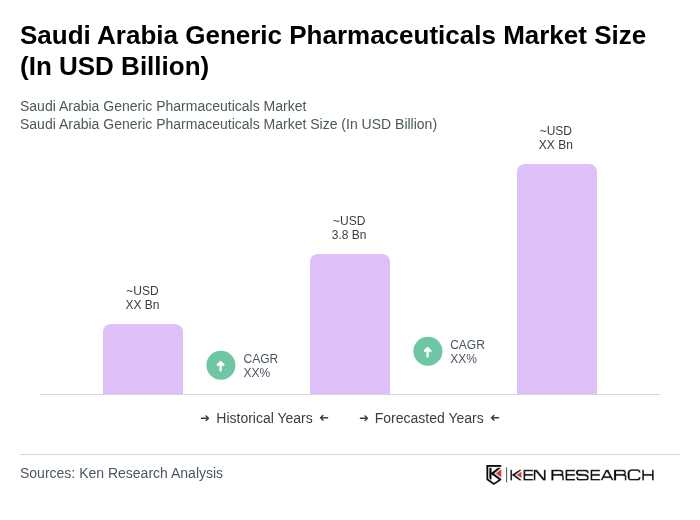
- The Saudi Arabia Generic Pharmaceuticals Market is valued at USD 3.8 billion, based on a five-year historical analysis. This growth is primarily driven by the increasing prevalence of chronic diseases such as diabetes, cardiovascular diseases, and obesity, rising healthcare expenditure, expanding local manufacturing capacity, and a growing emphasis on cost-effective medication options supported by strong government cost-containment policies. The market is also supported by government initiatives aimed at promoting the use of generics to enhance healthcare accessibility, including localization targets for pharmaceutical production and incentives for generic drug uptake.
- Key cities such as Riyadh, Jeddah, and Dammam dominate the market due to their advanced healthcare infrastructure, concentration of pharmaceutical companies, and higher population density. These urban centers serve as hubs for healthcare services and pharmaceutical distribution, facilitating easier access to generic medications for the population, and they host a significant proportion of the country’s hospitals, specialty centers, and SFDA-approved manufacturing facilities that supply both public and private sectors.
- The Saudi Food and Drug Authority (SFDA) requires that all generic pharmaceuticals demonstrate bioequivalence and therapeutic equivalence to reference (originator) products as part of the marketing authorization process, in line with the “SFDA Guideline for Bioequivalence Studies of Generic Drug Products” issued by the Saudi Food and Drug Authority – Drug Sector in 2010 and subsequent updates. These rules mandate stringent in vivo and/or in vitro bioequivalence studies, adherence to Good Clinical Practice (GCP) and Good Manufacturing Practice (GMP), and submission of comparative pharmacokinetic data before approval, thereby ensuring that generics are therapeutically equivalent to their branded counterparts and enhancing patient safety and confidence in generic medications.
Saudi Arabia Generic Pharmaceuticals Market Segmentation
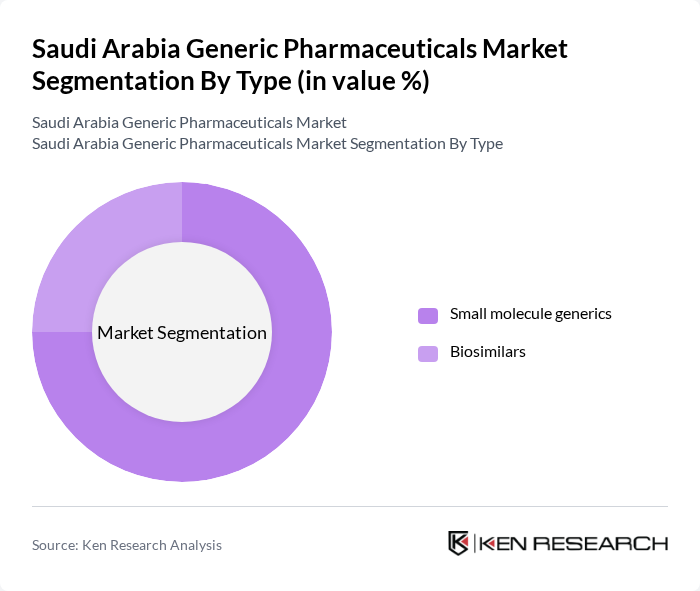
By Type:The market is segmented into two main types: small molecule generics and biosimilars. Small molecule generics dominate the market due to their widespread use in treating various conditions, including chronic diseases, and the fact that conventional (small-molecule) drugs still account for the majority of pharmaceutical volume in Saudi Arabia. The affordability and availability of these generics, combined with broad formulary inclusion in public and private payor systems, have led to increased consumer and prescriber acceptance and preference. Biosimilars, while growing, still represent a smaller segment as they require more complex manufacturing processes, more extensive comparability exercises, and specialized regulatory pathways, although SFDA is actively streamlining registration processes for biosimilars to support future growth.
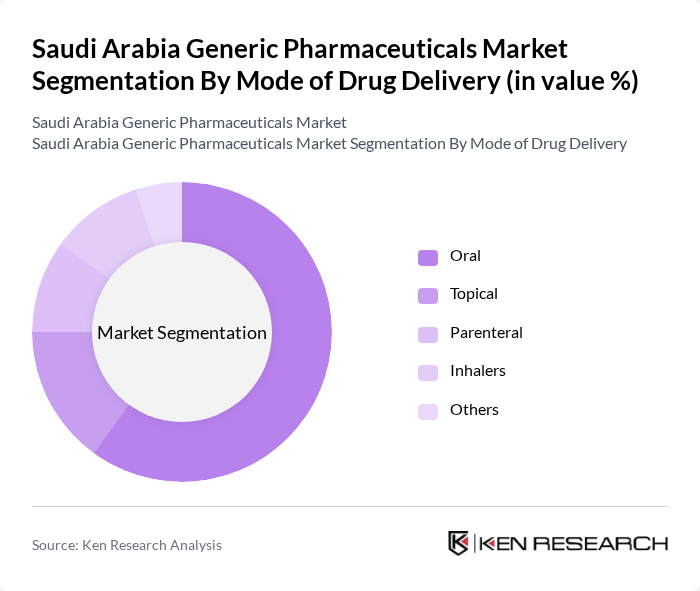
By Mode of Drug Delivery:The market is categorized into oral, topical, parenteral, inhalers, and others. Oral delivery is the most prevalent mode due to its convenience, patient compliance, and its dominant role in chronic disease management and primary care prescribing patterns. Topical and parenteral forms are also significant, particularly for dermatology, hospital-based therapies, and oncology where injectable generics and biosimilars are increasingly used. Inhalers are gaining traction, especially for respiratory conditions such as asthma and COPD, which are of growing concern in the Kingdom, while other delivery methods remain relevant in niche therapeutic areas and specialty care segments.
Saudi Arabia Generic Pharmaceuticals Market Competitive Landscape
The Saudi Arabia Generic Pharmaceuticals Market is characterized by a dynamic mix of regional and international players. Leading participants such as Saudi Pharmaceutical Industries and Medical Appliances Corporation (SPIMACO), Tabuk Pharmaceuticals Manufacturing Company, Jamjoom Pharma, Riyadh Pharma (Medical Appliances & Supplies Manufacturing Company), Sudair Pharma Company, AJA Pharmaceutical Industries, Jamjoom Pharmaceuticals Saudi Arabia, Gulf Pharmaceutical Industries (Julphar) – KSA operations, Hikma Pharmaceuticals – KSA operations, SPIMACO ADDWAEIH Co. subsidiaries, Tamer Group (pharmaceutical distribution & generics partnerships), Al-Dawaa Medical Services Co. (Al-Dawaa Pharmacies – private label generics), Nahdi Medical Company (Nahdi Pharmacies – generics and branded generics), Cigalah Group – pharmaceutical division, Others (emerging Saudi generic manufacturers and CDMOs) contribute to innovation, geographic expansion, and service delivery in this space.
Saudi Arabia Generic Pharmaceuticals Market Industry Analysis
Growth Drivers
- Increasing Prevalence of Chronic Diseases:The rise in chronic diseases such as diabetes and cardiovascular conditions is a significant growth driver for the generic pharmaceuticals market in Saudi Arabia. In future, it is estimated that over 8 million adults in Saudi Arabia will be living with diabetes, contributing to a healthcare burden that necessitates affordable medication options. This growing patient population is expected to increase the demand for generic drugs, which are more cost-effective than branded alternatives, thereby driving market growth.
- Government Initiatives to Promote Generic Drugs:The Saudi government has implemented various initiatives to encourage the use of generic medications, aiming to reduce healthcare costs. In future, the government plans to allocate approximately SAR 2 billion towards programs that support the production and distribution of generics. These initiatives include subsidies for local manufacturers and educational campaigns to raise awareness among healthcare providers and patients about the benefits of generics, further propelling market growth.
- Rising Healthcare Expenditure:Saudi Arabia's healthcare expenditure is projected to reach SAR 250 billion in future, reflecting a commitment to improving healthcare services. This increase in spending is expected to enhance access to medications, including generics, as the government seeks to provide affordable healthcare solutions. The growing budget will facilitate investments in healthcare infrastructure and services, ultimately benefiting the generic pharmaceuticals market by increasing availability and accessibility of these essential drugs.
Market Challenges
- Regulatory Hurdles:The regulatory environment in Saudi Arabia presents significant challenges for generic pharmaceutical companies. In future, the Saudi Food and Drug Authority (SFDA) is expected to enforce stricter compliance measures, which may delay the approval process for new generics. Companies may face increased costs associated with meeting these regulations, potentially hindering their ability to bring products to market quickly and efficiently, thus impacting overall market growth.
- Price Competition from Branded Pharmaceuticals:Intense price competition from established branded pharmaceuticals poses a challenge for generic drug manufacturers. In future, branded drugs are projected to account for approximately 65% of the total pharmaceutical market value in Saudi Arabia, making it difficult for generics to gain market share. This competition can lead to price wars, which may erode profit margins for generic companies and limit their ability to invest in research and development.
Saudi Arabia Generic Pharmaceuticals Market Future Outlook
The future of the generic pharmaceuticals market in Saudi Arabia appears promising, driven by increasing healthcare demands and supportive government policies. As the population ages and chronic diseases become more prevalent, the need for affordable medication will intensify. Additionally, advancements in digital health solutions and a focus on preventive healthcare are expected to reshape the market landscape, encouraging innovation and efficiency in drug delivery systems, ultimately benefiting consumers and healthcare providers alike.
Market Opportunities
- Growth in E-Pharmacy:The rise of e-pharmacy platforms in Saudi Arabia presents a significant opportunity for generic drug sales. With an estimated 35% increase in online pharmaceutical sales expected in future, companies can leverage digital channels to reach a broader audience, enhancing accessibility and convenience for consumers seeking affordable medications.
- Expansion of Export Markets:Saudi Arabia's strategic location and trade agreements provide opportunities for generic pharmaceutical companies to expand into international markets. In future, the government aims to increase pharmaceutical exports by 25%, allowing local manufacturers to tap into new revenue streams and diversify their market presence, thereby strengthening the overall industry.
Scope of the Report
| Segment | Sub-Segments |
|---|---|
| By Type | Small molecule generics Biosimilars |
| By Mode of Drug Delivery | Oral Topical Parenteral Inhalers Others |
| By Therapeutic Area | Central nervous system Cardiovascular Dermatology Genitourinary / Hormonal Respiratory Rheumatology Diabetes Oncology Others |
| By Distribution Channel | Hospital pharmacies Retail pharmacies Online pharmacies Others |
| By Region | Northern & Central Western Eastern Southern |
| By Product Formulation | Tablet Capsule Injection Others |
| By Market Segment | Prescription generics Over-the-counter (OTC) generics Branded generics |
Key Target Audience
Investors and Venture Capitalist Firms
Government and Regulatory Bodies (e.g., Saudi Food and Drug Authority)
Manufacturers and Producers
Distributors and Retailers
Pharmaceutical Wholesalers
Healthcare Providers and Institutions
Industry Associations (e.g., Saudi Pharmaceutical Society)
Financial Institutions
Players Mentioned in the Report:
Saudi Pharmaceutical Industries and Medical Appliances Corporation (SPIMACO)
Tabuk Pharmaceuticals Manufacturing Company
Jamjoom Pharma
Riyadh Pharma (Medical Appliances & Supplies Manufacturing Company)
Sudair Pharma Company
AJA Pharmaceutical Industries
Jamjoom Pharmaceuticals Saudi Arabia
Gulf Pharmaceutical Industries (Julphar) KSA operations
Hikma Pharmaceuticals KSA operations
SPIMACO ADDWAEIH Co. subsidiaries
Tamer Group (pharmaceutical distribution & generics partnerships)
Al-Dawaa Medical Services Co. (Al-Dawaa Pharmacies private label generics)
Nahdi Medical Company (Nahdi Pharmacies generics and branded generics)
Cigalah Group pharmaceutical division
Others (emerging Saudi generic manufacturers and CDMOs)
Table of Contents
Market Assessment Phase
1. Executive Summary and Approach
2. Saudi Arabia Generic Pharmaceuticals Market Overview
2.1 Key Insights and Strategic Recommendations
2.2 Saudi Arabia Generic Pharmaceuticals Market Overview
2.3 Definition and Scope
2.4 Evolution of Market Ecosystem
2.5 Timeline of Key Regulatory Milestones
2.6 Value Chain & Stakeholder Mapping
2.7 Business Cycle Analysis
2.8 Policy & Incentive Landscape
3. Saudi Arabia Generic Pharmaceuticals Market Analysis
3.1 Growth Drivers
3.1.1 Increasing prevalence of chronic diseases
3.1.2 Government initiatives to promote generic drugs
3.1.3 Rising healthcare expenditure
3.1.4 Expanding healthcare infrastructure
3.2 Market Challenges
3.2.1 Regulatory hurdles
3.2.2 Price competition from branded pharmaceuticals
3.2.3 Limited awareness among healthcare providers
3.2.4 Supply chain inefficiencies
3.3 Market Opportunities
3.3.1 Growth in e-pharmacy
3.3.2 Expansion of export markets
3.3.3 Development of biosimilars
3.3.4 Collaborations with international firms
3.4 Market Trends
3.4.1 Increasing adoption of digital health solutions
3.4.2 Focus on personalized medicine
3.4.3 Shift towards preventive healthcare
3.4.4 Rising demand for over-the-counter (OTC) generics
3.5 Government Regulation
3.5.1 Implementation of price control policies
3.5.2 Strengthening of regulatory frameworks
3.5.3 Promotion of local manufacturing
3.5.4 Enhanced quality assurance standards
4. SWOT Analysis
5. Stakeholder Analysis
6. Porter's Five Forces Analysis
7. Saudi Arabia Generic Pharmaceuticals Market Market Size, 2019-2024
7.1 By Value
7.2 By Volume
7.3 By Average Selling Price
8. Saudi Arabia Generic Pharmaceuticals Market Segmentation
8.1 By Type
8.1.1 Small molecule generics
8.1.2 Biosimilars
8.2 By Mode of Drug Delivery
8.2.1 Oral
8.2.2 Topical
8.2.3 Parenteral
8.2.4 Inhalers
8.2.5 Others
8.3 By Therapeutic Area
8.3.1 Central nervous system
8.3.2 Cardiovascular
8.3.3 Dermatology
8.3.4 Genitourinary / Hormonal
8.3.5 Respiratory
8.3.6 Rheumatology
8.3.7 Diabetes
8.3.8 Oncology
8.3.9 Others
8.4 By Distribution Channel
8.4.1 Hospital pharmacies
8.4.2 Retail pharmacies
8.4.3 Online pharmacies
8.4.4 Others
8.5 By Region
8.5.1 Northern & Central
8.5.2 Western
8.5.3 Eastern
8.5.4 Southern
8.6 By Product Formulation
8.6.1 Tablet
8.6.2 Capsule
8.6.3 Injection
8.6.4 Others
8.7 By Market Segment
8.7.1 Prescription generics
8.7.2 Over-the-counter (OTC) generics
8.7.3 Branded generics
9. Saudi Arabia Generic Pharmaceuticals Market Competitive Analysis
9.1 Market Share of Key Players
9.2 Cross Comparison of Key Players
9.2.1 Company name
9.2.2 Ownership and group type
9.2.3 Saudi Arabia generic revenues (latest year, USD million)
9.2.4 3-year revenue CAGR in Saudi generic portfolio (%)
9.2.5 EBITDA margin (%) – Saudi generics
9.2.6 R&D intensity (% of sales) – generics
9.2.7 SFDA-approved generic product count
9.2.8 Portfolio mix (small molecules vs biosimilars, %)
9.2.9 Hospital vs retail sales mix (%)
9.2.10 Average tender win rate with MOH and government entities (%)
9.2.11 Average price discount vs reference branded drug (%)
9.2.12 Export revenue share from Saudi-based manufacturing (%)
9.2.13 Manufacturing capacity utilization rate (%)
9.2.14 On?time in?full (OTIF) delivery rate (%)
9.2.15 Regulatory inspection findings per site (last 3 years)
9.2.16 Brand awareness index among prescribers and pharmacists
9.3 SWOT Analysis of Top Players
9.4 Pricing Analysis
9.5 Detailed Profile of Major Companies
9.5.1 Saudi Pharmaceutical Industries and Medical Appliances Corporation (SPIMACO)
9.5.2 Tabuk Pharmaceuticals Manufacturing Company
9.5.3 Jamjoom Pharma
9.5.4 Riyadh Pharma (Medical Appliances & Supplies Manufacturing Company)
9.5.5 Sudair Pharma Company
9.5.6 AJA Pharmaceutical Industries
9.5.7 Jamjoom Pharmaceuticals Saudi Arabia
9.5.8 Gulf Pharmaceutical Industries (Julphar) – KSA operations
9.5.9 Hikma Pharmaceuticals – KSA operations
9.5.10 SPIMACO ADDWAEIH Co. subsidiaries
9.5.11 Tamer Group (pharmaceutical distribution & generics partnerships)
9.5.12 Al-Dawaa Medical Services Co. (Al-Dawaa Pharmacies – private label generics)
9.5.13 Nahdi Medical Company (Nahdi Pharmacies – generics and branded generics)
9.5.14 Cigalah Group – pharmaceutical division
9.5.15 Others (emerging Saudi generic manufacturers and CDMOs)
10. Saudi Arabia Generic Pharmaceuticals Market End-User Analysis
10.1 Procurement Behavior of Key Ministries
10.1.1 Ministry of Health
10.1.2 Ministry of Defense
10.1.3 Ministry of Education
10.1.4 Ministry of Interior
10.1.5 Others
10.2 Corporate Spend on Infrastructure & Energy
10.2.1 Healthcare facilities
10.2.2 Pharmaceutical manufacturing
10.2.3 Research and development
10.2.4 Others
10.3 Pain Point Analysis by End-User Category
10.3.1 Hospitals
10.3.2 Pharmacies
10.3.3 Clinics
10.3.4 Others
10.4 User Readiness for Adoption
10.4.1 Healthcare professionals
10.4.2 Patients
10.4.3 Pharmacies
10.4.4 Others
10.5 Post-Deployment ROI and Use Case Expansion
10.5.1 Cost savings
10.5.2 Improved patient outcomes
10.5.3 Increased market share
10.5.4 Others
11. Saudi Arabia Generic Pharmaceuticals Market Future Size, 2025-2030
11.1 By Value
11.2 By Volume
11.3 By Average Selling Price
Go-To-Market Strategy Phase
1. Whitespace Analysis + Business Model Canvas
1.1 Market Gaps Identification
1.2 Business Model Development
2. Marketing and Positioning Recommendations
2.1 Branding Strategies
2.2 Product USPs
3. Distribution Plan
3.1 Urban Retail vs Rural NGO Tie-ups
4. Channel & Pricing Gaps
4.1 Underserved Routes
4.2 Pricing Bands
5. Unmet Demand & Latent Needs
5.1 Category Gaps
5.2 Consumer Segments
6. Customer Relationship
6.1 Loyalty Programs
6.2 After-sales Service
7. Value Proposition
7.1 Sustainability
7.2 Integrated Supply Chains
8. Key Activities
8.1 Regulatory Compliance
8.2 Branding
8.3 Distribution Setup
9. Entry Strategy Evaluation
9.1 Domestic Market Entry Strategy
9.1.1 Product Mix
9.1.2 Pricing Band
9.1.3 Packaging
9.2 Export Entry Strategy
9.2.1 Target Countries
9.2.2 Compliance Roadmap
10. Entry Mode Assessment
10.1 JV
10.2 Greenfield
10.3 M&A
10.4 Distributor Model
11. Capital and Timeline Estimation
11.1 Capital Requirements
11.2 Timelines
12. Control vs Risk Trade-Off
12.1 Ownership vs Partnerships
13. Profitability Outlook
13.1 Breakeven Analysis
13.2 Long-term Sustainability
14. Potential Partner List
14.1 Distributors
14.2 JVs
14.3 Acquisition Targets
15. Execution Roadmap
15.1 Phased Plan for Market Entry
15.1.1 Market Setup
15.1.2 Market Entry
15.1.3 Growth Acceleration
15.1.4 Scale & Stabilize
15.2 Key Activities and Milestones
15.2.1 Milestone Planning
15.2.2 Activity Tracking
Research Methodology
Phase 1: Approach1
Desk Research
- Analysis of market reports from Saudi Food and Drug Authority (SFDA) and Ministry of Health
- Review of industry publications and white papers on generic pharmaceuticals
- Examination of trade statistics and import/export data from Saudi Arabian customs
Primary Research
- Interviews with key opinion leaders in the pharmaceutical sector, including regulatory experts
- Surveys with pharmacists and healthcare professionals regarding generic drug usage
- Field interviews with executives from leading generic pharmaceutical manufacturers
Validation & Triangulation
- Cross-validation of findings through multiple data sources, including government and industry reports
- Triangulation of market trends with insights from healthcare professionals and industry experts
- Sanity checks through expert panel discussions and feedback sessions
Phase 2: Market Size Estimation1
Top-down Assessment
- Estimation of total pharmaceutical market size and share of generics based on national health expenditure
- Segmentation of the market by therapeutic categories and distribution channels
- Incorporation of demographic trends and healthcare access data in Saudi Arabia
Bottom-up Modeling
- Volume estimates based on sales data from pharmacies and hospitals
- Cost analysis of generic drugs compared to branded alternatives
- Calculation of market potential based on patient population and prescription trends
Forecasting & Scenario Analysis
- Multi-variable forecasting using historical growth rates and market drivers
- Scenario analysis based on regulatory changes and healthcare policy shifts
- Development of baseline, optimistic, and pessimistic market projections through 2030
Phase 3: CATI Sample Composition1
| Scope Item/Segment | Sample Size | Target Respondent Profiles |
|---|---|---|
| Pharmacy Sector Insights | 150 | Pharmacy Owners, Pharmacists |
| Healthcare Provider Perspectives | 100 | Doctors, Nurses, Healthcare Administrators |
| Regulatory Compliance Feedback | 60 | Regulatory Affairs Managers, Compliance Officers |
| Market Access and Pricing Strategies | 50 | Market Access Managers, Pricing Analysts |
| Consumer Attitudes Towards Generics | 120 | Patients, Caregivers, Health Insurance Representatives |
Frequently Asked Questions
What is the current value of the Saudi Arabia Generic Pharmaceuticals Market?
The Saudi Arabia Generic Pharmaceuticals Market is valued at approximately USD 3.8 billion, driven by factors such as the rising prevalence of chronic diseases, increasing healthcare expenditure, and government initiatives promoting the use of generics.
What are the main growth drivers for the Saudi Arabia Generic Pharmaceuticals Market?
Which cities dominate the Saudi Arabia Generic Pharmaceuticals Market?
What regulatory requirements must generic pharmaceuticals meet in Saudi Arabia?
Other Regional/Country Reports
Other Adjacent Reports
Mexico Branded Pharmaceuticals Market
New Zealand Pharmaceutical Manufacturing Market Report Size, Share, Growth Drivers, Trends, Opportunities & Forecast 2025–2030Asia Pacific Active Pharmaceutical Ingredients Market Outlook to 2030: Size, Share, Growth and TrendsBahrain Drug Delivery Systems Market
India E-Pharmacy Market Outlook to 2030Indonesia Chronic Disease Therapeutics Market
Middle East pharmaceutical packaging market size, share, growth drivers, trends, opportunities & forecast 2025–2030Egypt Contract Manufacturing Organization Market
Saudi Arabia Pharmaceutical Distribution Market Size, Share, Growth Drivers, Trends, Opportunities & Forecast 2025–2030Why Buy From Us?

What makes us stand out is that our consultants follow Robust, Refine and Result (RRR) methodology. Robust for clear definitions, approaches and sanity checking, Refine for differentiating respondents' facts and opinions, and Result for presenting data with story.

We have set a benchmark in the industry by offering our clients with syndicated and customized market research reports featuring coverage of entire market as well as meticulous research and analyst insights.

While we don't replace traditional research, we flip the method upside down. Our dual approach of Top Bottom & Bottom Top ensures quality deliverable by not just verifying company fundamentals but also looking at the sector and macroeconomic factors.

With one step in the future, our research team constantly tries to show you the bigger picture. We help with some of the tough questions you may encounter along the way: How is the industry positioned? Best marketing channel? KPI's of competitors? By aligning every element, we help maximize success.

Our report gives you instant access to the answers and sources that other companies might choose to hide. We elaborate each steps of research methodology we have used and showcase you the sample size to earn your trust.

If you need any support, we are here! We pride ourselves on universe strength, data quality, and quick, friendly, and professional service.