Region:Middle East
Author(s):Shubham
Product Code:KRAD2521
Pages:82
Published On:January 2026
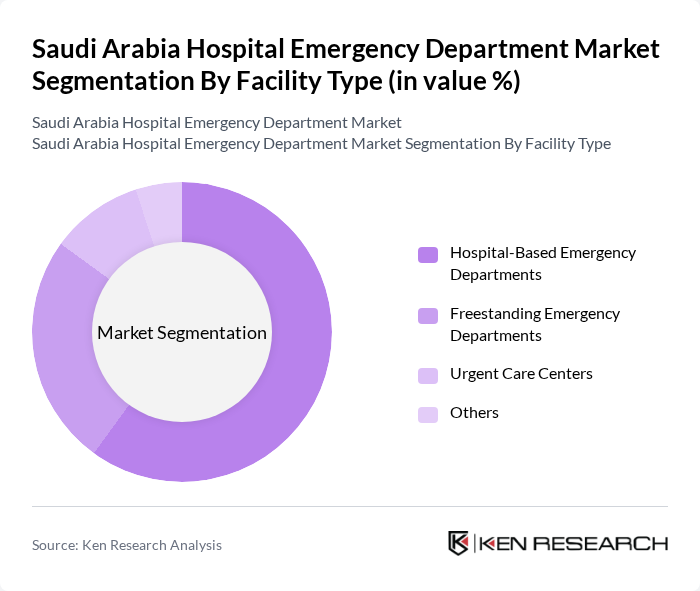
By Facility Type:The facility type segmentation includes Hospital-Based Emergency Departments, Freestanding Emergency Departments, Urgent Care Centers, and Others. Hospital-Based Emergency Departments are the most prevalent due to their integration with comprehensive hospital services, allowing for immediate access to specialized care and inpatient beds, particularly within large public and private hospitals and medical cities. Freestanding Emergency Departments are gaining traction, particularly in urban areas, as they offer convenience, extended hours, and reduced wait times, and are supported by growing investment in standalone and hybrid emergency facilities. Urgent Care Centers cater to non-life-threatening conditions, providing an alternative for patients seeking immediate care without the need for hospital admission, and are increasingly used to offload lower-acuity cases from hospital emergency departments.
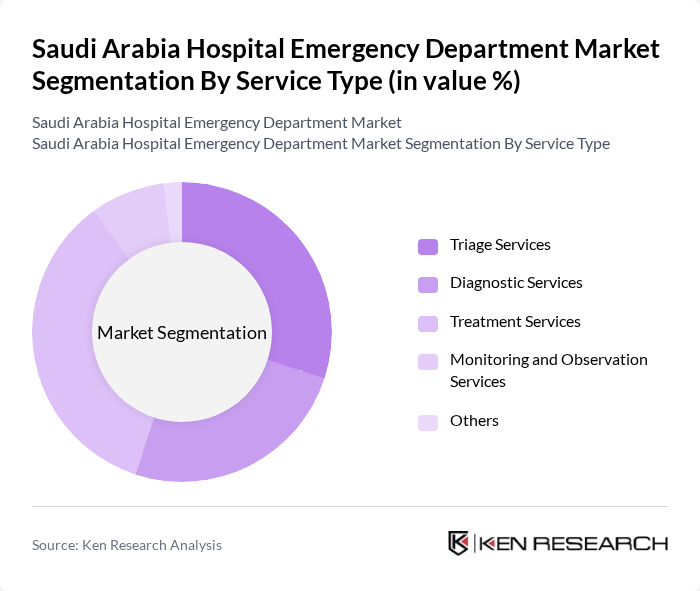
By Service Type:The service type segmentation encompasses Triage Services, Diagnostic Services, Treatment Services, Monitoring and Observation Services, and Others. Triage Services are critical in emergency departments, ensuring that patients are prioritized based on the severity of their conditions and increasingly supported by structured triage protocols and digital triage and patient-tracking tools. Diagnostic Services, including imaging and laboratory tests, are essential for accurate and timely treatment, with investments in point-of-care testing and integrated imaging and lab systems to accelerate decision-making in emergency settings. Treatment Services cover a wide range of medical interventions for trauma, acute exacerbations of chronic diseases, and other emergencies, while Monitoring and Observation Services are vital for patients requiring short-term stabilization and close supervision before admission or discharge. The demand for these services is driven by the increasing complexity of medical cases, higher prevalence of chronic and lifestyle-related conditions, and the need for efficient patient management and throughput in emergency departments.
The Saudi Arabia Hospital Emergency Department Market is characterized by a dynamic mix of regional and international players. Leading participants such as King Faisal Specialist Hospital & Research Centre, King Abdulaziz Medical City (National Guard Health Affairs), Dallah Health Company, Dr. Sulaiman Al Habib Medical Group, Saudi German Health, Mouwasat Medical Services, King Saud Medical City, King Fahd Medical City, Security Forces Hospital Program, King Khalid University Hospital, Al Hammadi Hospitals, Al-Moosa Specialist Hospital, International Medical Center (IMC), Jeddah, Saudi Aramco (Johns Hopkins Aramco Healthcare), Ministry of Health General Hospitals (Selected Key Facilities) contribute to innovation, geographic expansion, and service delivery in this space.
The future of the Saudi Arabia hospital emergency department market appears promising, driven by ongoing investments in healthcare infrastructure and technology. As the government continues to prioritize healthcare access, emergency departments are expected to evolve, integrating advanced technologies such as AI and telemedicine. Additionally, the focus on patient-centric care models will likely enhance service delivery, ensuring that emergency departments can meet the growing demands of the population effectively and efficiently.
| Segment | Sub-Segments |
|---|---|
| By Facility Type | Hospital-Based Emergency Departments Freestanding Emergency Departments Urgent Care Centers Others |
| By Service Type | Triage Services Diagnostic Services Treatment Services Monitoring and Observation Services Others |
| By Clinical Area | Trauma and Injury Care Cardiac and Stroke Emergencies Respiratory Emergencies Pediatric Emergencies Others |
| By Ownership / Provider Type | Public / Government Hospitals Private Hospitals and Health Systems Military and Security Forces Hospitals Others |
| By Patient Type | Adult Patients Pediatric Patients Geriatric Patients Others |
| By Technology Utilization | Conventional ED Setup AI-Enabled and Digitized EDs Tele-emergency and Virtual Care-Integrated EDs Others |
| By Payment / Funding Model | Government-Funded (Public Coverage) Private Insurance Self-Pay / Out-of-Pocket Others |
| By Region | Central Region (Including Riyadh) Western Region (Including Makkah & Madinah) Eastern Region Northern & Southern Regions |
| Scope Item/Segment | Sample Size | Target Respondent Profiles |
|---|---|---|
| Public Hospital Emergency Departments | 90 | Emergency Department Directors, Hospital Administrators |
| Private Hospital Emergency Services | 70 | Clinical Managers, Emergency Medicine Physicians |
| Emergency Care Patient Experience | 140 | Patients who visited emergency departments in the last year |
| Healthcare Policy Impact on Emergency Services | 50 | Healthcare Policy Makers, Health Economists |
| Emergency Medical Services (EMS) Operations | 60 | EMS Coordinators, Paramedics |
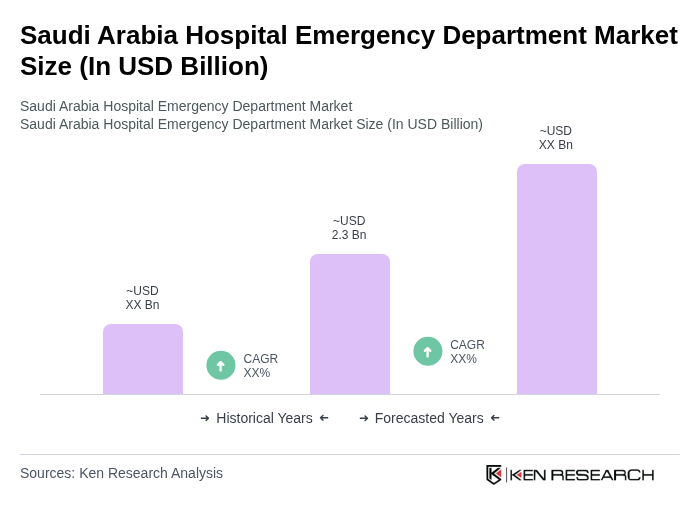
The Saudi Arabia Hospital Emergency Department Market is valued at approximately USD 2.3 billion, driven by factors such as population growth, rising chronic diseases, and increased demand for emergency medical services.

What makes us stand out is that our consultants follow Robust, Refine and Result (RRR) methodology. Robust for clear definitions, approaches and sanity checking, Refine for differentiating respondents' facts and opinions, and Result for presenting data with story.

We have set a benchmark in the industry by offering our clients with syndicated and customized market research reports featuring coverage of entire market as well as meticulous research and analyst insights.

While we don't replace traditional research, we flip the method upside down. Our dual approach of Top Bottom & Bottom Top ensures quality deliverable by not just verifying company fundamentals but also looking at the sector and macroeconomic factors.

With one step in the future, our research team constantly tries to show you the bigger picture. We help with some of the tough questions you may encounter along the way: How is the industry positioned? Best marketing channel? KPI's of competitors? By aligning every element, we help maximize success.

Our report gives you instant access to the answers and sources that other companies might choose to hide. We elaborate each steps of research methodology we have used and showcase you the sample size to earn your trust.

If you need any support, we are here! We pride ourselves on universe strength, data quality, and quick, friendly, and professional service.













