Region:Middle East
Author(s):Rebecca
Product Code:KRAB0835
Pages:82
Published On:December 2025
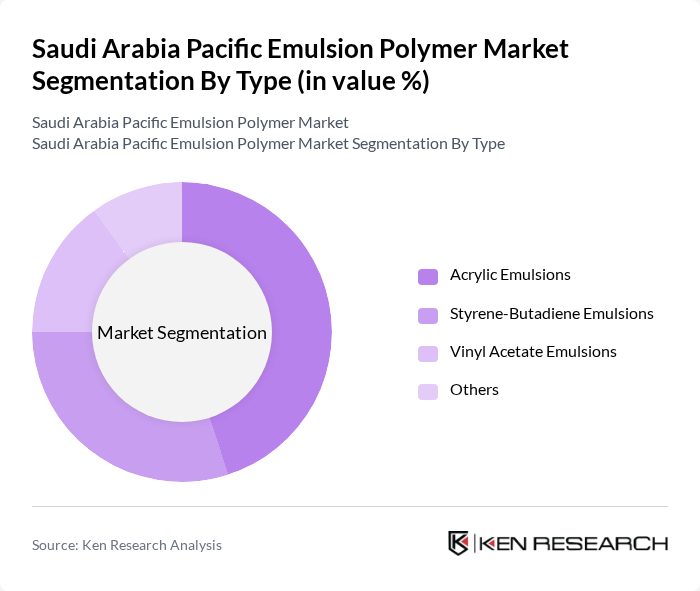
By Type:The market is segmented into various types of emulsion polymers, including acrylic emulsions, styrene-butadiene emulsions, vinyl acetate emulsions, and others, consistent with global and regional emulsion polymer classifications. Among these, acrylic emulsions are leading due to their versatility and superior performance in applications such as architectural paints, industrial coatings, waterproofing membranes, and construction sealants, as well as their low volatile organic compound (VOC) profiles. The demand for eco-friendly and high-performance products, including low-VOC and waterborne coatings meeting green building and environmental standards, is driving the growth of this segment as manufacturers and end users increasingly prefer sustainable options in construction, automotive refinishing, and packaging applications.
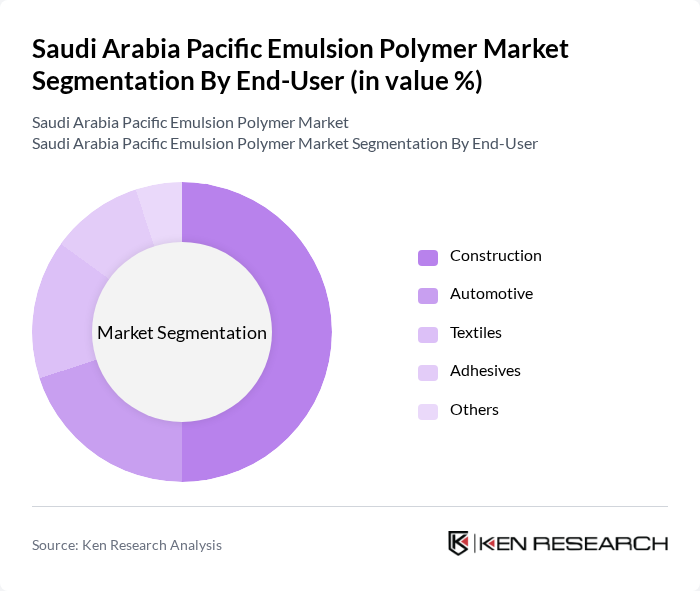
By End-User:The end-user segments include construction, automotive, textiles, adhesives, and others, reflecting the main consumption sectors for emulsion polymers in Saudi Arabia. The construction sector is the dominant end-user, driven by the increasing demand for high-performance paints, coatings, waterproofing systems, sealants, and tile adhesives in large-scale building, infrastructure, and real estate projects such as NEOM, Red Sea developments, and urban expansion in major cities. The growth in urbanization and infrastructure development, supported by Vision 2030 programs and sustained public and private investment in residential, commercial, and industrial assets, is significantly contributing to the expansion of this segment and boosting the use of waterborne, durable, and environmentally aligned emulsion polymer formulations.
The Saudi Arabia Pacific Emulsion Polymer Market is characterized by a dynamic mix of regional and international players. Leading participants such as BASF SE, Dow Chemical Company, Arkema S.A., Wacker Chemie AG, Celanese Corporation, Eastman Chemical Company, Omnova Solutions Inc., Synthomer plc, Trinseo S.A., H.B. Fuller Company, Solvay S.A., Momentive Performance Materials Inc., Ashland Global Holdings Inc., Kraton Corporation, Polynt-Reichhold Group contribute to innovation, geographic expansion, and service delivery in this space.
Emerging trends in the Saudi Arabian emulsion polymer market indicate a shift towards sustainable and eco-friendly products, driven by global sustainability initiatives. The anticipated growth in infrastructure projects under Vision 2030 will further enhance demand for advanced polymer applications, including low-VOC coatings and adhesives. While specific numeric data is not available, the overall market sentiment suggests a positive trajectory, with increasing investments in research and development expected to foster innovation in polymer technologies.
| Segment | Sub-Segments |
|---|---|
| By Type | Acrylic Emulsions Styrene-Butadiene Emulsions Vinyl Acetate Emulsions Others |
| By End-User | Construction Automotive Textiles Adhesives Others |
| By Application | Paints and Coatings Sealants Inks Others |
| By Distribution Channel | Direct Sales Distributors Online Sales Others |
| By Region | Central Region Eastern Region Western Region Southern Region |
| By Product Formulation | Water-Based Solvent-Based Others |
| By Customer Type | OEMs Retailers End Consumers Others |
| Scope Item/Segment | Sample Size | Target Respondent Profiles |
|---|---|---|
| Construction Sector Emulsion Usage | 120 | Project Managers, Procurement Officers |
| Automotive Coatings and Adhesives | 80 | Product Development Managers, Quality Assurance Heads |
| Paints and Coatings Manufacturers | 90 | Operations Managers, Technical Directors |
| Consumer Goods Packaging Applications | 70 | Supply Chain Managers, Marketing Directors |
| Research Institutions and Academia | 60 | Research Scientists, Academic Professors |
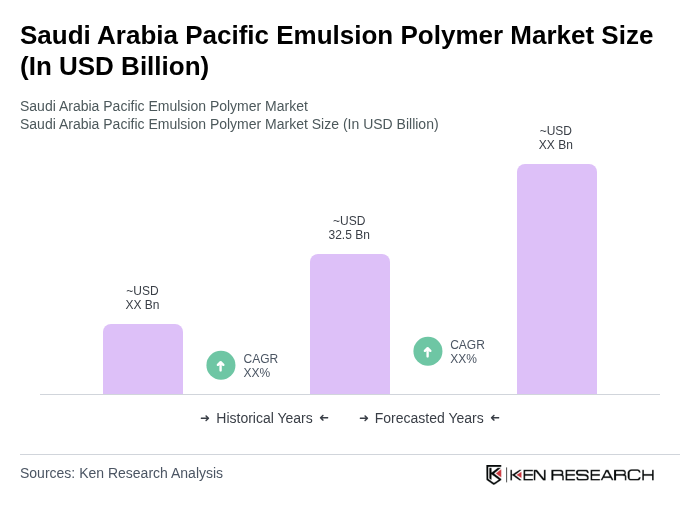
The Saudi Arabia Pacific Emulsion Polymer Market is valued at approximately USD 32.5 billion, driven by strong demand in sectors such as construction, textiles, packaging, and coatings, supported by local access to essential raw materials from the country's petrochemical base.

What makes us stand out is that our consultants follow Robust, Refine and Result (RRR) methodology. Robust for clear definitions, approaches and sanity checking, Refine for differentiating respondents' facts and opinions, and Result for presenting data with story.

We have set a benchmark in the industry by offering our clients with syndicated and customized market research reports featuring coverage of entire market as well as meticulous research and analyst insights.

While we don't replace traditional research, we flip the method upside down. Our dual approach of Top Bottom & Bottom Top ensures quality deliverable by not just verifying company fundamentals but also looking at the sector and macroeconomic factors.

With one step in the future, our research team constantly tries to show you the bigger picture. We help with some of the tough questions you may encounter along the way: How is the industry positioned? Best marketing channel? KPI's of competitors? By aligning every element, we help maximize success.

Our report gives you instant access to the answers and sources that other companies might choose to hide. We elaborate each steps of research methodology we have used and showcase you the sample size to earn your trust.

If you need any support, we are here! We pride ourselves on universe strength, data quality, and quick, friendly, and professional service.













