About the Report
Base Year 2024Switzerland Car Finance & Leasing Market Overview
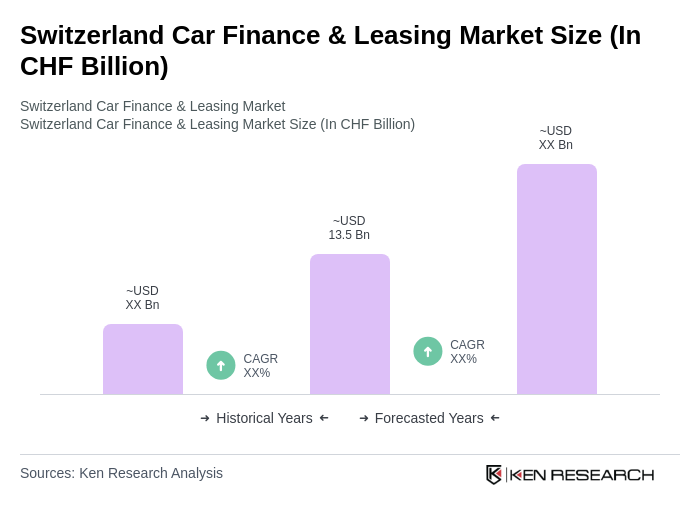
- The Switzerland Car Finance & Leasing Market is valued at CHF 13.5 billion, based on a five-year historical analysis. This growth is primarily driven by increasing consumer demand for vehicle access, with leasing remaining the preferred option due to flexibility, lower monthly payments, and the ability to regularly upgrade vehicles. Younger consumers, in particular, are fueling the rise in leasing activities, as they seek flexible payment solutions and avoid the long-term commitment of outright purchases .
- Key cities such as Zurich, Geneva, and Basel dominate the market, supported by robust economic conditions, high disposable incomes, and a dense network of financial institutions. These urban centers also show a pronounced trend toward electric and hybrid vehicles, reflecting both consumer preferences and the strategic focus of automotive dealerships on sustainable mobility .
- The Swiss government’s “Federal Act on the Promotion of Electric Mobility, 2023” issued by the Federal Council introduced targeted incentives for electric vehicle financing and leasing. This regulation requires financial institutions to offer preferential terms for electric and hybrid vehicles, including reduced interest rates and extended contract durations, to accelerate the national transition toward greener transportation solutions .
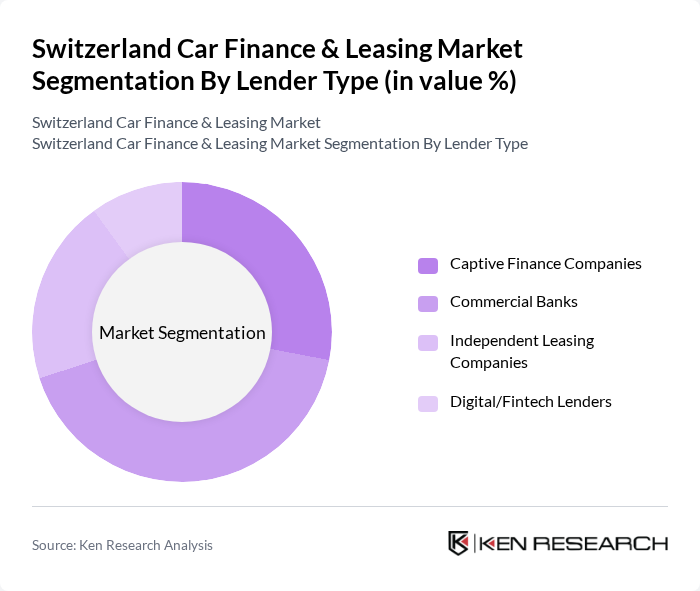
Switzerland Car Finance & Leasing Market Segmentation
By Lender Type:The lender type segmentation includes various financial institutions that provide car financing and leasing options. The primary subsegments are Captive Finance Companies, Commercial Banks, Independent Leasing Companies, and Digital/Fintech Lenders. Each of these subsegments plays a crucial role in catering to different consumer needs and preferences, with captive finance companies often offering tailored solutions for specific car brands, while digital lenders are gaining traction among tech-savvy consumers. Leasing remains the dominant model, with banks and captives offering bundled services such as maintenance and insurance .
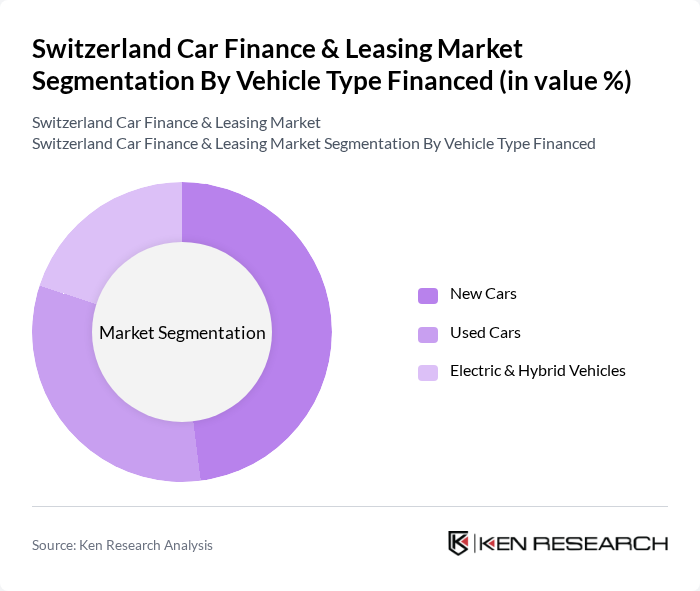
By Vehicle Type Financed:This segmentation focuses on the types of vehicles that are financed through leasing and loans. The subsegments include New Cars, Used Cars, and Electric & Hybrid Vehicles. The growing popularity of electric vehicles is reshaping consumer preferences, with a notable shift toward financing options that support sustainable transportation. New cars continue to dominate, but the used car segment remains significant due to affordability and supply chain constraints. Electric and hybrid vehicles are rapidly increasing their share, supported by government incentives and changing consumer attitudes .
Switzerland Car Finance & Leasing Market Competitive Landscape
The Switzerland Car Finance & Leasing Market is characterized by a dynamic mix of regional and international players. Leading participants such as AMAG Leasing AG, Cembra Money Bank AG, MultiLease AG, BMW Financial Services (Switzerland) AG, UBS Group AG, Credit Suisse Group AG, Raiffeisen Gruppe, Migros Bank AG, Zürcher Kantonalbank, Carvolution AG, gowago.ch AG, AXA Versicherungen AG, Baloise Group, Helvetia Versicherungen AG, Banque Cantonale Vaudoise contribute to innovation, geographic expansion, and service delivery in this space.
Switzerland Car Finance & Leasing Market Industry Analysis
Growth Drivers
- Increasing Consumer Demand for Flexible Financing Options:The Swiss car finance market is witnessing a surge in demand for flexible financing solutions, with approximately 60% of consumers preferring options that allow for lower monthly payments and varied terms. In future, the average loan amount for car financing is projected to reach CHF 32,000, reflecting a shift towards more adaptable financial products. This trend is driven by changing consumer preferences and the desire for financial flexibility amid economic uncertainties.
- Rise in Electric Vehicle Adoption:The adoption of electric vehicles (EVs) in Switzerland is accelerating, with sales expected to exceed 120,000 units in future, representing a 20% increase from previous periods. This growth is supported by government incentives, including tax breaks and subsidies, which are projected to total CHF 250 million in future. As consumers increasingly seek eco-friendly options, financing solutions tailored for EVs are becoming a significant growth driver in the car finance market.
- Expansion of Digital Financing Platforms:The digital transformation in the car finance sector is evident, with online financing applications increasing by 45% in future. By future, it is estimated that 75% of car financing transactions will occur through digital platforms, driven by consumer preference for convenience and speed. This shift is supported by advancements in technology, enabling financial institutions to streamline processes and enhance customer engagement, thereby boosting market growth.
Market Challenges
- Regulatory Compliance Complexities:The car finance sector in Switzerland faces significant regulatory challenges, with over 60 new regulations introduced in the past two years. Compliance with these regulations requires substantial investment in legal and operational frameworks, which can strain resources for financial institutions. In future, the cost of compliance is projected to reach CHF 180 million, impacting profitability and operational efficiency in the market.
- Economic Fluctuations Affecting Consumer Spending:Economic uncertainties, including inflation rates projected at 3% in future, are likely to impact consumer spending on car financing. As disposable incomes tighten, consumers may delay purchasing decisions, leading to a potential decline in financing applications. This economic environment poses a challenge for financial institutions, which must adapt their strategies to maintain market share amid fluctuating consumer confidence.
Switzerland Car Finance & Leasing Market Future Outlook
The future of the Switzerland car finance and leasing market appears promising, driven by technological advancements and evolving consumer preferences. As digital platforms continue to gain traction, financial institutions are expected to enhance their service offerings, focusing on user-friendly experiences. Additionally, the increasing emphasis on sustainability will likely lead to innovative financing solutions tailored for electric vehicles, aligning with government initiatives aimed at reducing carbon emissions and promoting green technologies.
Market Opportunities
- Growth in Corporate Leasing Solutions:The corporate leasing segment is anticipated to expand significantly, with an estimated increase of 18% in demand for fleet financing solutions in future. This growth is driven by businesses seeking cost-effective ways to manage transportation needs while minimizing capital expenditure, presenting a lucrative opportunity for financial institutions to tailor their offerings.
- Development of Green Financing Initiatives:The push for sustainability is creating opportunities for green financing initiatives, with an expected investment of CHF 120 million in future. Financial institutions can capitalize on this trend by offering specialized products for eco-friendly vehicles, appealing to environmentally conscious consumers and aligning with national sustainability goals.
Scope of the Report
| Segment | Sub-Segments |
|---|---|
| By Lender Type | Captive Finance Companies (e.g., AMAG Leasing, BMW Financial Services) Commercial Banks (e.g., UBS, Credit Suisse, Raiffeisen) Independent Leasing Companies (e.g., Cembra Money Bank, MultiLease) Digital/Fintech Lenders (e.g., Carvolution, gowago.ch) |
| By Vehicle Type Financed | New Cars Used Cars Electric & Hybrid Vehicles |
| By Lease/Finance Product | Operating Lease Financial Lease Hire Purchase Loan Financing |
| By End-User | Individual Consumers Small and Medium Enterprises (SMEs) Large Corporations Government & Public Sector |
| By Sales Channel | Direct (Dealerships, Captive Finance) Online Platforms Brokers |
| By Lease Duration | Short-term Leasing (?24 months) Long-term Leasing (>24 months) |
| By Region | Zurich Geneva Basel Bern Others |
Key Target Audience
Investors and Venture Capitalist Firms
Government and Regulatory Bodies (e.g., Federal Office of Transport, Swiss Financial Market Supervisory Authority)
Automobile Manufacturers
Leasing Companies
Financial Institutions (e.g., Banks, Credit Unions)
Insurance Companies
Automotive Trade Associations
Fleet Management Companies
Players Mentioned in the Report:
AMAG Leasing AG
Cembra Money Bank AG
MultiLease AG
BMW Financial Services (Switzerland) AG
UBS Group AG
Credit Suisse Group AG
Raiffeisen Gruppe
Migros Bank AG
Zurcher Kantonalbank
Carvolution AG
gowago.ch AG
AXA Versicherungen AG
Baloise Group
Helvetia Versicherungen AG
Banque Cantonale Vaudoise
Table of Contents
Market Assessment Phase
1. Executive Summary and Approach
2. Switzerland Car Finance & Leasing Market Overview
2.1 Key Insights and Strategic Recommendations
2.2 Switzerland Car Finance & Leasing Market Overview
2.3 Definition and Scope
2.4 Evolution of Market Ecosystem
2.5 Timeline of Key Regulatory Milestones
2.6 Value Chain & Stakeholder Mapping
2.7 Business Cycle Analysis
2.8 Policy & Incentive Landscape
3. Switzerland Car Finance & Leasing Market Analysis
3.1 Growth Drivers
3.1.1 Increasing consumer demand for flexible financing options
3.1.2 Rise in electric vehicle adoption
3.1.3 Expansion of digital financing platforms
3.1.4 Competitive interest rates and promotional offers
3.2 Market Challenges
3.2.1 Regulatory compliance complexities
3.2.2 Economic fluctuations affecting consumer spending
3.2.3 High competition among financial institutions
3.2.4 Limited awareness of financing options
3.3 Market Opportunities
3.3.1 Growth in corporate leasing solutions
3.3.2 Development of green financing initiatives
3.3.3 Partnerships with automotive manufacturers
3.3.4 Expansion into underserved regions
3.4 Market Trends
3.4.1 Shift towards online car financing solutions
3.4.2 Increasing focus on sustainability in financing
3.4.3 Rise of subscription-based car leasing models
3.4.4 Enhanced customer experience through technology
3.5 Government Regulation
3.5.1 Emission standards for financed vehicles
3.5.2 Consumer protection laws in financing
3.5.3 Tax incentives for electric vehicle financing
3.5.4 Regulations on interest rates and fees
4. SWOT Analysis
5. Stakeholder Analysis
6. Porter's Five Forces Analysis
7. Switzerland Car Finance & Leasing Market Market Size, 2019-2024
7.1 By Value
7.2 By Volume
7.3 By Average Selling Price
8. Switzerland Car Finance & Leasing Market Segmentation
8.1 By Lender Type
8.1.1 Captive Finance Companies (e.g., AMAG Leasing, BMW Financial Services)
8.1.2 Commercial Banks (e.g., UBS, Credit Suisse, Raiffeisen)
8.1.3 Independent Leasing Companies (e.g., Cembra Money Bank, MultiLease)
8.1.4 Digital/Fintech Lenders (e.g., Carvolution, gowago.ch)
8.2 By Vehicle Type Financed
8.2.1 New Cars
8.2.2 Used Cars
8.2.3 Electric & Hybrid Vehicles
8.3 By Lease/Finance Product
8.3.1 Operating Lease
8.3.2 Financial Lease
8.3.3 Hire Purchase
8.3.4 Loan Financing
8.4 By End-User
8.4.1 Individual Consumers
8.4.2 Small and Medium Enterprises (SMEs)
8.4.3 Large Corporations
8.4.4 Government & Public Sector
8.5 By Sales Channel
8.5.1 Direct (Dealerships, Captive Finance)
8.5.2 Online Platforms
8.5.3 Brokers
8.6 By Lease Duration
8.6.1 Short-term Leasing (?24 months)
8.6.2 Long-term Leasing (>24 months)
8.7 By Region
8.7.1 Zurich
8.7.2 Geneva
8.7.3 Basel
8.7.4 Bern
8.7.5 Others
9. Switzerland Car Finance & Leasing Market Competitive Analysis
9.1 Market Share of Key Players
9.2 Cross Comparison of Key Players
9.2.1 Company Name
9.2.2 Lender Type (Captive, Bank, Independent, Digital/Fintech)
9.2.3 Total Lease/Loan Portfolio (CHF millions)
9.2.4 Revenue Growth Rate (%)
9.2.5 Market Share (%)
9.2.6 Number of Contracts/Customers
9.2.7 Average Lease/Loan Duration (months)
9.2.8 Customer Acquisition Cost (CHF)
9.2.9 Customer Retention Rate (%)
9.2.10 Portfolio Diversification (by vehicle type, new/used, EV share)
9.2.11 Digitalization Index (online penetration, digital onboarding %)
9.2.12 Net Promoter Score (NPS)
9.3 SWOT Analysis of Top Players
9.4 Pricing Analysis
9.5 Detailed Profile of Major Companies
9.5.1 AMAG Leasing AG
9.5.2 Cembra Money Bank AG
9.5.3 MultiLease AG
9.5.4 BMW Financial Services (Switzerland) AG
9.5.5 UBS Group AG
9.5.6 Credit Suisse Group AG
9.5.7 Raiffeisen Gruppe
9.5.8 Migros Bank AG
9.5.9 Zürcher Kantonalbank
9.5.10 Carvolution AG
9.5.11 gowago.ch AG
9.5.12 AXA Versicherungen AG
9.5.13 Baloise Group
9.5.14 Helvetia Versicherungen AG
9.5.15 Banque Cantonale Vaudoise
10. Switzerland Car Finance & Leasing Market End-User Analysis
10.1 Procurement Behavior of Key Ministries
10.1.1 Budget Allocation for Vehicle Financing
10.1.2 Preference for Sustainable Vehicles
10.1.3 Evaluation Criteria for Financing Options
10.2 Corporate Spend on Infrastructure & Energy
10.2.1 Investment in Fleet Management Solutions
10.2.2 Budgeting for Electric Vehicle Integration
10.2.3 Financing for Corporate Mobility Solutions
10.3 Pain Point Analysis by End-User Category
10.3.1 High Financing Costs
10.3.2 Limited Availability of Flexible Options
10.3.3 Complexity in Understanding Terms
10.4 User Readiness for Adoption
10.4.1 Awareness of Financing Options
10.4.2 Comfort with Digital Platforms
10.4.3 Interest in Sustainable Financing
10.5 Post-Deployment ROI and Use Case Expansion
10.5.1 Evaluation of Cost Savings
10.5.2 Impact on Operational Efficiency
10.5.3 Opportunities for Fleet Expansion
11. Switzerland Car Finance & Leasing Market Future Size, 2025-2030
11.1 By Value
11.2 By Volume
11.3 By Average Selling Price
Go-To-Market Strategy Phase
1. Whitespace Analysis + Business Model Canvas
1.1 Identification of Market Gaps
1.2 Business Model Framework
1.3 Value Proposition Development
1.4 Revenue Streams Analysis
1.5 Cost Structure Evaluation
1.6 Key Partnerships Identification
1.7 Customer Segmentation
2. Marketing and Positioning Recommendations
2.1 Branding Strategies
2.2 Product USPs
2.3 Target Audience Identification
2.4 Communication Channels
2.5 Promotional Strategies
3. Distribution Plan
3.1 Urban Retail Strategies
3.2 Rural NGO Tie-ups
3.3 Online Distribution Channels
3.4 Partnerships with Dealerships
4. Channel & Pricing Gaps
4.1 Underserved Routes
4.2 Pricing Bands Analysis
4.3 Competitor Pricing Comparison
5. Unmet Demand & Latent Needs
5.1 Category Gaps Identification
5.2 Consumer Segments Analysis
5.3 Emerging Trends Exploration
6. Customer Relationship
6.1 Loyalty Programs Development
6.2 After-sales Service Strategies
6.3 Customer Feedback Mechanisms
7. Value Proposition
7.1 Sustainability Initiatives
7.2 Integrated Supply Chains
7.3 Customer-Centric Solutions
8. Key Activities
8.1 Regulatory Compliance
8.2 Branding Initiatives
8.3 Distribution Setup
9. Entry Strategy Evaluation
9.1 Domestic Market Entry Strategy
9.1.1 Product Mix Considerations
9.1.2 Pricing Band Strategy
9.1.3 Packaging Options
9.2 Export Entry Strategy
9.2.1 Target Countries Identification
9.2.2 Compliance Roadmap Development
10. Entry Mode Assessment
10.1 Joint Ventures
10.2 Greenfield Investments
10.3 Mergers & Acquisitions
10.4 Distributor Model Evaluation
11. Capital and Timeline Estimation
11.1 Capital Requirements Analysis
11.2 Timelines for Implementation
12. Control vs Risk Trade-Off
12.1 Ownership vs Partnerships
13. Profitability Outlook
13.1 Breakeven Analysis
13.2 Long-term Sustainability Strategies
14. Potential Partner List
14.1 Distributors Identification
14.2 Joint Ventures Opportunities
14.3 Acquisition Targets
15. Execution Roadmap
15.1 Phased Plan for Market Entry
15.1.1 Market Setup
15.1.2 Market Entry
15.1.3 Growth Acceleration
15.1.4 Scale & Stabilize
15.2 Key Activities and Milestones
15.2.1 Milestone Planning
15.2.2 Activity Tracking
Research Methodology
Phase 1: Approach1
Desk Research
- Analysis of industry reports from Swiss financial institutions and leasing companies
- Review of government publications and regulations related to car finance and leasing
- Examination of market trends and consumer behavior studies from automotive associations
Primary Research
- Interviews with financial analysts specializing in automotive finance
- Surveys conducted with car dealerships and leasing companies across Switzerland
- Focus groups with consumers to understand preferences in car financing options
Validation & Triangulation
- Cross-validation of findings through multiple data sources including financial reports and consumer surveys
- Triangulation of insights from industry experts and market data to ensure accuracy
- Sanity checks through expert panel reviews to confirm market assumptions
Phase 2: Market Size Estimation1
Top-down Assessment
- Estimation of total market size based on national automotive sales data and financing trends
- Segmentation of the market by vehicle type, financing method, and consumer demographics
- Incorporation of macroeconomic indicators such as GDP growth and consumer confidence indices
Bottom-up Modeling
- Collection of data from leading car finance and leasing companies on their portfolio sizes
- Analysis of average financing amounts and terms offered to consumers
- Calculation of market size based on the number of financed vehicles and average lease values
Forecasting & Scenario Analysis
- Development of forecasting models using historical data and market growth rates
- Scenario analysis based on potential regulatory changes and economic conditions
- Projections of market growth through 2030 under various economic scenarios
Phase 3: CATI Sample Composition1
| Scope Item/Segment | Sample Size | Target Respondent Profiles |
|---|---|---|
| Consumer Car Financing | 100 | Car Buyers, Financial Advisors |
| Leasing Company Insights | 60 | Leasing Managers, Financial Analysts |
| Dealership Financing Practices | 50 | Dealership Owners, Sales Managers |
| Consumer Preferences in Leasing | 80 | Leased Vehicle Users, Financial Advisors |
| Impact of Economic Factors | 40 | Economists, Market Analysts |
Frequently Asked Questions
What is the current value of the Switzerland Car Finance & Leasing Market?
The Switzerland Car Finance & Leasing Market is valued at CHF 13.5 billion, reflecting a significant growth trend driven by increasing consumer demand for flexible vehicle access and financing options, particularly among younger consumers.
What factors are driving the growth of car leasing in Switzerland?
Which cities are the primary markets for car finance and leasing in Switzerland?
How is the Swiss government promoting electric vehicle financing?
Other Adjacent Reports
Oman Automotive Insurance Market
Middle East Electric Vehicle Market Report Size, Share, Growth Drivers, Trends, Opportunities & Forecast 2025–2030Qatar Used Car Sales Market
UAE Fleet Management MarketUAE Consumer Credit MarketVietnam Digital Fintech Market
Kuwait Vehicle Maintenance Market
Indonesia Automotive Parts MarketJapan Sustainable Mobility Market
Malaysia Credit Scoring Market
Why Buy From Us?

What makes us stand out is that our consultants follow Robust, Refine and Result (RRR) methodology. Robust for clear definitions, approaches and sanity checking, Refine for differentiating respondents' facts and opinions, and Result for presenting data with story.

We have set a benchmark in the industry by offering our clients with syndicated and customized market research reports featuring coverage of entire market as well as meticulous research and analyst insights.

While we don't replace traditional research, we flip the method upside down. Our dual approach of Top Bottom & Bottom Top ensures quality deliverable by not just verifying company fundamentals but also looking at the sector and macroeconomic factors.

With one step in the future, our research team constantly tries to show you the bigger picture. We help with some of the tough questions you may encounter along the way: How is the industry positioned? Best marketing channel? KPI's of competitors? By aligning every element, we help maximize success.

Our report gives you instant access to the answers and sources that other companies might choose to hide. We elaborate each steps of research methodology we have used and showcase you the sample size to earn your trust.

If you need any support, we are here! We pride ourselves on universe strength, data quality, and quick, friendly, and professional service.