About the Report
Base Year 2024Kenya Car Finance & Leasing Market Overview
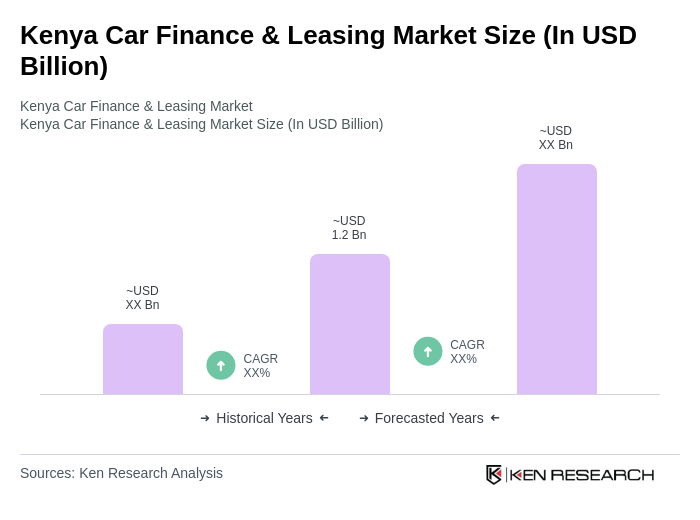
- The Kenya Car Finance & Leasing Market is valued at USD 1.2 billion, based on a five-year historical analysis. This growth is primarily driven by increasing urbanization, rising disposable incomes, and a growing middle class that seeks affordable vehicle financing options. The demand for both personal and commercial vehicles has surged, leading to a robust financing landscape that caters to diverse consumer needs.
- Nairobi, Mombasa, and Kisumu are the dominant cities in the Kenya Car Finance & Leasing Market. Nairobi, as the capital and largest city, serves as a financial hub with numerous banks and financial institutions offering competitive financing options. Mombasa, being a major port city, has a high demand for commercial vehicles, while Kisumu's growing population and economic activities contribute to the increasing need for personal and fleet financing.
- In 2023, the Kenyan government implemented a regulation aimed at promoting electric vehicle adoption by offering tax incentives and reduced registration fees for electric vehicles. This initiative is part of a broader strategy to enhance environmental sustainability and reduce carbon emissions in the transport sector, thereby encouraging consumers to consider electric vehicle financing options.
Kenya Car Finance & Leasing Market Segmentation
By Type:The market is segmented into various types of financing options, including personal car financing, commercial vehicle leasing, fleet leasing, electric vehicle financing, used car financing, new car financing, and others. Each of these segments caters to different consumer needs and preferences, reflecting the diverse landscape of vehicle financing in Kenya.
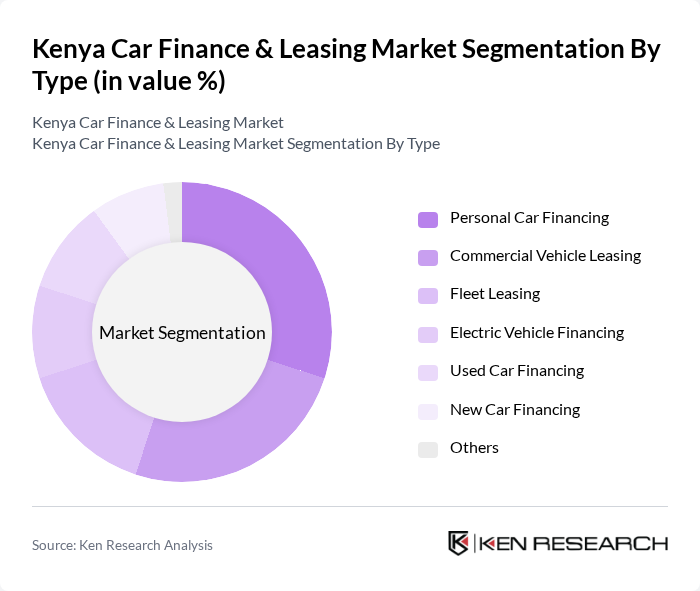
The personal car financing segment is currently dominating the market due to the increasing number of individuals seeking to own vehicles as a status symbol and for convenience. The rise in disposable incomes and the availability of flexible financing options have made it easier for consumers to access loans for personal vehicles. Additionally, the growing trend of online platforms for loan applications has further facilitated this segment's growth, making it more accessible to a wider audience.
By End-User:The market is segmented by end-users, including individual consumers, small and medium enterprises (SMEs), large corporations, and government agencies. Each end-user category has distinct financing needs and preferences, influencing the overall market dynamics.
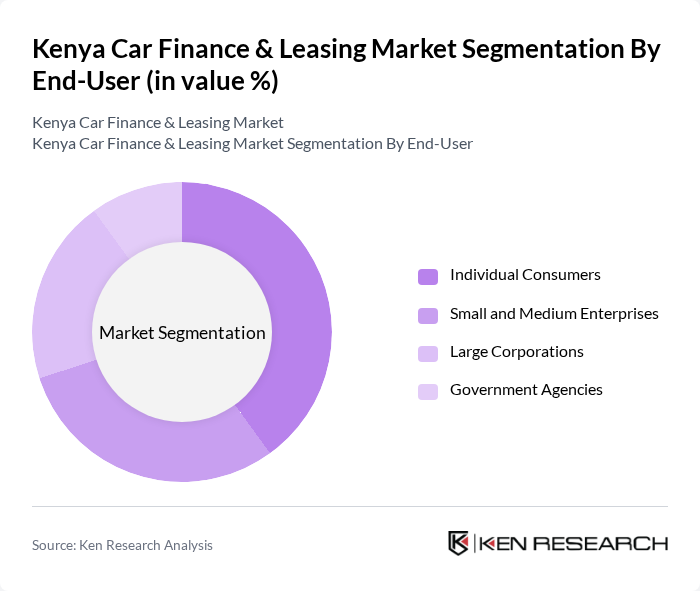
Individual consumers represent the largest segment in the end-user category, driven by the increasing desire for personal mobility and convenience. The rise of digital platforms has made it easier for individuals to access financing options tailored to their needs. Additionally, the growing middle class in Kenya is more inclined to invest in personal vehicles, further solidifying this segment's dominance in the market.
Kenya Car Finance & Leasing Market Competitive Landscape
The Kenya Car Finance & Leasing Market is characterized by a dynamic mix of regional and international players. Leading participants such as Kenya Commercial Bank, Cooperative Bank of Kenya, Stanbic Bank Kenya, NIC Bank, Standard Chartered Bank Kenya, Barclays Bank of Kenya, Car & General Ltd., CMC Motors Group, Toyota Kenya, Simba Corporation, AutoXpress, Dyer & Blair Investment Bank, UAP Old Mutual, Fina Bank, KCB Group contribute to innovation, geographic expansion, and service delivery in this space.
Kenya Car Finance & Leasing Market Industry Analysis
Growth Drivers
- Increasing Middle-Class Population:The middle-class population in Kenya is projected to reach 18 million in the future, up from 14 million in 2020, according to the Kenya National Bureau of Statistics. This demographic shift is driving demand for personal vehicles, as more individuals seek mobility solutions. The rise in disposable income, which is expected to increase by 5% annually, further supports the growth of car financing options tailored to this expanding consumer base.
- Expansion of Urban Infrastructure:Kenya's urban infrastructure is undergoing significant development, with the government allocating approximately $3 billion for road construction and improvement projects in the future. This expansion facilitates easier access to urban areas, increasing the necessity for personal vehicles. Improved transport networks are expected to enhance the attractiveness of car financing options, as consumers seek reliable transportation amidst growing urbanization.
- Rising Demand for Personal Vehicles:The demand for personal vehicles in Kenya is anticipated to grow, with vehicle registrations projected to reach 300,000 units in the future, up from 250,000 in 2020. This surge is driven by a combination of factors, including increased urbanization and a growing preference for personal mobility over public transport. Consequently, car finance and leasing services are becoming essential for consumers looking to acquire vehicles conveniently.
Market Challenges
- High Interest Rates:The average interest rate for car loans in Kenya is currently around 14%, significantly impacting affordability for potential buyers. This high cost of borrowing discourages many consumers from pursuing vehicle financing options. As the Central Bank of Kenya maintains a tight monetary policy to combat inflation, the high-interest environment is likely to persist, posing a challenge for the car finance market.
- Limited Access to Financing for Low-Income Individuals:Approximately 40% of Kenya's population lives below the poverty line, limiting access to financing options for low-income individuals. Many financial institutions require substantial collateral and credit history, which these individuals often lack. This barrier restricts a significant portion of the population from participating in the car finance market, hindering overall market growth.
Kenya Car Finance & Leasing Market Future Outlook
The Kenya car finance and leasing market is poised for transformative growth, driven by technological advancements and evolving consumer preferences. The shift towards digital financing solutions is expected to streamline the application process, making it more accessible. Additionally, the increasing popularity of electric vehicles will likely prompt financial institutions to develop tailored financing products, catering to environmentally conscious consumers. As urban infrastructure continues to improve, the demand for personal vehicles will remain robust, further stimulating market activity.
Market Opportunities
- Growth in Electric Vehicle Financing:With the Kenyan government aiming for 5% of all vehicles to be electric in the future, there is a significant opportunity for financial institutions to develop specialized financing products. This shift not only aligns with global sustainability trends but also attracts environmentally conscious consumers, potentially increasing market share for lenders focused on green financing solutions.
- Partnerships with Ride-Hailing Services:The rise of ride-hailing services in Kenya, which saw a 30% increase in user adoption in the future, presents a unique opportunity for car finance companies. By forming partnerships with these platforms, lenders can offer tailored financing solutions for drivers, enhancing vehicle acquisition while tapping into a growing market segment that prioritizes flexible vehicle ownership.
Scope of the Report
| Segment | Sub-Segments |
|---|---|
| By Type | Personal Car Financing Commercial Vehicle Leasing Fleet Leasing Electric Vehicle Financing Used Car Financing New Car Financing Others |
| By End-User | Individual Consumers Small and Medium Enterprises Large Corporations Government Agencies |
| By Sales Channel | Direct Sales Online Platforms Dealerships Brokers |
| By Financing Type | Lease Financing Loan Financing Hire Purchase |
| By Vehicle Type | Sedans SUVs Trucks Vans |
| By Duration of Financing | Short-term Financing Medium-term Financing Long-term Financing |
| By Region | Nairobi Mombasa Kisumu Eldoret Nakuru Others |
Key Target Audience
Investors and Venture Capitalist Firms
Government and Regulatory Bodies (e.g., Central Bank of Kenya, Kenya Revenue Authority)
Automobile Manufacturers and Producers
Car Dealerships and Distributors
Leasing Companies
Insurance Providers
Financial Institutions (e.g., Banks, Microfinance Institutions)
Automotive Industry Associations
Players Mentioned in the Report:
Kenya Commercial Bank
Cooperative Bank of Kenya
Stanbic Bank Kenya
NIC Bank
Standard Chartered Bank Kenya
Barclays Bank of Kenya
Car & General Ltd.
CMC Motors Group
Toyota Kenya
Simba Corporation
AutoXpress
Dyer & Blair Investment Bank
UAP Old Mutual
Fina Bank
KCB Group
Table of Contents
Market Assessment Phase
1. Executive Summary and Approach
2. Kenya Car Finance & Leasing Market Overview
2.1 Key Insights and Strategic Recommendations
2.2 Kenya Car Finance & Leasing Market Overview
2.3 Definition and Scope
2.4 Evolution of Market Ecosystem
2.5 Timeline of Key Regulatory Milestones
2.6 Value Chain & Stakeholder Mapping
2.7 Business Cycle Analysis
2.8 Policy & Incentive Landscape
3. Kenya Car Finance & Leasing Market Analysis
3.1 Growth Drivers
3.1.1 Increasing middle-class population
3.1.2 Expansion of urban infrastructure
3.1.3 Rising demand for personal vehicles
3.1.4 Growth of e-commerce and logistics sectors
3.2 Market Challenges
3.2.1 High interest rates
3.2.2 Limited access to financing for low-income individuals
3.2.3 Regulatory hurdles
3.2.4 Economic instability
3.3 Market Opportunities
3.3.1 Growth in electric vehicle financing
3.3.2 Partnerships with ride-hailing services
3.3.3 Expansion of leasing options for businesses
3.3.4 Government incentives for green vehicles
3.4 Market Trends
3.4.1 Shift towards digital financing solutions
3.4.2 Increasing popularity of short-term leasing
3.4.3 Rise of fleet management services
3.4.4 Focus on sustainability in vehicle financing
3.5 Government Regulation
3.5.1 Tax incentives for car leasing
3.5.2 Emission standards for financed vehicles
3.5.3 Licensing requirements for finance companies
3.5.4 Consumer protection laws in financing
4. SWOT Analysis
5. Stakeholder Analysis
6. Porter's Five Forces Analysis
7. Kenya Car Finance & Leasing Market Market Size, 2019-2024
7.1 By Value
7.2 By Volume
7.3 By Average Selling Price
8. Kenya Car Finance & Leasing Market Segmentation
8.1 By Type
8.1.1 Personal Car Financing
8.1.2 Commercial Vehicle Leasing
8.1.3 Fleet Leasing
8.1.4 Electric Vehicle Financing
8.1.5 Used Car Financing
8.1.6 New Car Financing
8.1.7 Others
8.2 By End-User
8.2.1 Individual Consumers
8.2.2 Small and Medium Enterprises
8.2.3 Large Corporations
8.2.4 Government Agencies
8.3 By Sales Channel
8.3.1 Direct Sales
8.3.2 Online Platforms
8.3.3 Dealerships
8.3.4 Brokers
8.4 By Financing Type
8.4.1 Lease Financing
8.4.2 Loan Financing
8.4.3 Hire Purchase
8.5 By Vehicle Type
8.5.1 Sedans
8.5.2 SUVs
8.5.3 Trucks
8.5.4 Vans
8.6 By Duration of Financing
8.6.1 Short-term Financing
8.6.2 Medium-term Financing
8.6.3 Long-term Financing
8.7 By Region
8.7.1 Nairobi
8.7.2 Mombasa
8.7.3 Kisumu
8.7.4 Eldoret
8.7.5 Nakuru
8.7.6 Others
9. Kenya Car Finance & Leasing Market Competitive Analysis
9.1 Market Share of Key Players
9.2 Cross Comparison of Key Players
9.2.1 Company Name
9.2.2 Group Size (Large, Medium, or Small as per industry convention)
9.2.3 Revenue Growth Rate
9.2.4 Customer Acquisition Cost
9.2.5 Market Penetration Rate
9.2.6 Customer Retention Rate
9.2.7 Average Loan Amount
9.2.8 Pricing Strategy
9.2.9 Portfolio Diversification
9.2.10 Operational Efficiency
9.3 SWOT Analysis of Top Players
9.4 Pricing Analysis
9.5 Detailed Profile of Major Companies
9.5.1 Kenya Commercial Bank
9.5.2 Cooperative Bank of Kenya
9.5.3 Stanbic Bank Kenya
9.5.4 NIC Bank
9.5.5 Standard Chartered Bank Kenya
9.5.6 Barclays Bank of Kenya
9.5.7 Car & General Ltd.
9.5.8 CMC Motors Group
9.5.9 Toyota Kenya
9.5.10 Simba Corporation
9.5.11 AutoXpress
9.5.12 Dyer & Blair Investment Bank
9.5.13 UAP Old Mutual
9.5.14 Fina Bank
9.5.15 KCB Group
10. Kenya Car Finance & Leasing Market End-User Analysis
10.1 Procurement Behavior of Key Ministries
10.1.1 Budget Allocation for Vehicle Procurement
10.1.2 Preference for Leasing vs. Buying
10.1.3 Evaluation Criteria for Financing Options
10.2 Corporate Spend on Infrastructure & Energy
10.2.1 Investment in Fleet Expansion
10.2.2 Budgeting for Vehicle Maintenance
10.2.3 Financing for Sustainable Vehicles
10.3 Pain Point Analysis by End-User Category
10.3.1 High Financing Costs
10.3.2 Limited Financing Options
10.3.3 Regulatory Compliance Challenges
10.4 User Readiness for Adoption
10.4.1 Awareness of Financing Options
10.4.2 Digital Literacy Levels
10.4.3 Trust in Financial Institutions
10.5 Post-Deployment ROI and Use Case Expansion
10.5.1 Measurement of Cost Savings
10.5.2 Expansion of Vehicle Use Cases
10.5.3 Long-term Financial Benefits
11. Kenya Car Finance & Leasing Market Future Size, 2025-2030
11.1 By Value
11.2 By Volume
11.3 By Average Selling Price
Go-To-Market Strategy Phase
1. Whitespace Analysis + Business Model Canvas
1.1 Market Gaps Identification
1.2 Value Proposition Development
1.3 Revenue Streams Analysis
1.4 Cost Structure Evaluation
1.5 Key Partnerships Exploration
1.6 Customer Segmentation
1.7 Channels of Distribution
2. Marketing and Positioning Recommendations
2.1 Branding Strategies
2.2 Product USPs
2.3 Target Market Identification
2.4 Communication Strategy
2.5 Digital Marketing Approaches
3. Distribution Plan
3.1 Urban Retail Strategies
3.2 Rural NGO Tie-ups
3.3 Online Distribution Channels
3.4 Partnerships with Local Dealers
4. Channel & Pricing Gaps
4.1 Underserved Routes
4.2 Pricing Bands Analysis
4.3 Competitor Pricing Comparison
5. Unmet Demand & Latent Needs
5.1 Category Gaps Identification
5.2 Consumer Segments Analysis
5.3 Emerging Trends Exploration
6. Customer Relationship
6.1 Loyalty Programs Development
6.2 After-sales Service Enhancements
6.3 Customer Feedback Mechanisms
7. Value Proposition
7.1 Sustainability Initiatives
7.2 Integrated Supply Chains
7.3 Customer-Centric Offerings
8. Key Activities
8.1 Regulatory Compliance
8.2 Branding Initiatives
8.3 Distribution Setup
9. Entry Strategy Evaluation
9.1 Domestic Market Entry Strategy
9.1.1 Product Mix Considerations
9.1.2 Pricing Band Strategy
9.1.3 Packaging Options
9.2 Export Entry Strategy
9.2.1 Target Countries Identification
9.2.2 Compliance Roadmap Development
10. Entry Mode Assessment
10.1 Joint Ventures
10.2 Greenfield Investments
10.3 Mergers & Acquisitions
10.4 Distributor Model Evaluation
11. Capital and Timeline Estimation
11.1 Capital Requirements Analysis
11.2 Timelines for Implementation
12. Control vs Risk Trade-Off
12.1 Ownership vs Partnerships
13. Profitability Outlook
13.1 Breakeven Analysis
13.2 Long-term Sustainability Strategies
14. Potential Partner List
14.1 Distributors Identification
14.2 Joint Ventures Opportunities
14.3 Acquisition Targets
15. Execution Roadmap
15.1 Phased Plan for Market Entry
15.1.1 Market Setup
15.1.2 Market Entry
15.1.3 Growth Acceleration
15.1.4 Scale & Stabilize
15.2 Key Activities and Milestones
15.2.1 Milestone Planning
15.2.2 Activity Tracking
Research Methodology
Phase 1: Approach1
Desk Research
- Analysis of government reports on vehicle financing and leasing regulations in Kenya
- Review of industry publications and market reports from financial institutions
- Examination of statistical data from the Kenya National Bureau of Statistics on vehicle ownership trends
Primary Research
- Interviews with financial analysts specializing in automotive financing
- Surveys with car dealerships to understand leasing practices and customer preferences
- Focus groups with consumers to gauge attitudes towards car finance options
Validation & Triangulation
- Cross-validation of findings through multiple data sources including trade associations
- Triangulation of insights from primary interviews with secondary data trends
- Sanity checks conducted through expert panel reviews comprising industry veterans
Phase 2: Market Size Estimation1
Top-down Assessment
- Estimation of total vehicle financing market size based on national vehicle sales data
- Segmentation of the market by vehicle type (new vs. used) and financing method (leasing vs. loans)
- Incorporation of macroeconomic indicators such as GDP growth and consumer credit availability
Bottom-up Modeling
- Collection of data from leading financial institutions on average loan amounts and terms
- Analysis of leasing contracts from major car leasing companies to determine average lease values
- Volume x average financing cost calculations to derive total market value
Forecasting & Scenario Analysis
- Multi-factor regression analysis incorporating economic growth, interest rates, and consumer behavior
- Scenario modeling based on potential regulatory changes affecting vehicle financing
- Development of baseline, optimistic, and pessimistic forecasts through 2028
Phase 3: CATI Sample Composition1
| Scope Item/Segment | Sample Size | Target Respondent Profiles |
|---|---|---|
| Consumer Car Financing | 150 | Individual Car Buyers, Financial Advisors |
| Corporate Fleet Leasing | 100 | Fleet Managers, Procurement Officers |
| Dealership Financing Options | 80 | Dealership Owners, Sales Managers |
| Banking Sector Insights | 70 | Bank Managers, Loan Officers |
| Consumer Attitudes towards Leasing | 90 | Potential Lessees, Financial Planners |
Frequently Asked Questions
What is the current value of the Kenya Car Finance & Leasing Market?
The Kenya Car Finance & Leasing Market is valued at approximately USD 1.2 billion, reflecting a robust growth driven by urbanization, rising disposable incomes, and an expanding middle class seeking affordable vehicle financing options.
Which cities dominate the Kenya Car Finance & Leasing Market?
What are the main types of financing options available in Kenya?
How is the Kenya Car Finance & Leasing Market segmented by end-users?
Other Adjacent Reports
Qatar Automotive Insurance Market
Japan Vehicle Manufacturing Market
Vietnam Used Car Sales Market
Middle East Electric Vehicle Market Report Size, Share, Growth Drivers, Trends, Opportunities & Forecast 2025–2030Egypt Ride-Hailing Services Market
UAE Fleet Management MarketIndonesia Automotive Parts MarketUAE Consumer Credit MarketUAE Personal Loan MarketMexico Transportation Infrastructure Market
Why Buy From Us?

What makes us stand out is that our consultants follow Robust, Refine and Result (RRR) methodology. Robust for clear definitions, approaches and sanity checking, Refine for differentiating respondents' facts and opinions, and Result for presenting data with story.

We have set a benchmark in the industry by offering our clients with syndicated and customized market research reports featuring coverage of entire market as well as meticulous research and analyst insights.

While we don't replace traditional research, we flip the method upside down. Our dual approach of Top Bottom & Bottom Top ensures quality deliverable by not just verifying company fundamentals but also looking at the sector and macroeconomic factors.

With one step in the future, our research team constantly tries to show you the bigger picture. We help with some of the tough questions you may encounter along the way: How is the industry positioned? Best marketing channel? KPI's of competitors? By aligning every element, we help maximize success.

Our report gives you instant access to the answers and sources that other companies might choose to hide. We elaborate each steps of research methodology we have used and showcase you the sample size to earn your trust.

If you need any support, we are here! We pride ourselves on universe strength, data quality, and quick, friendly, and professional service.