About the Report
Base Year 2024Thailand Acetylene Gas Market Overview
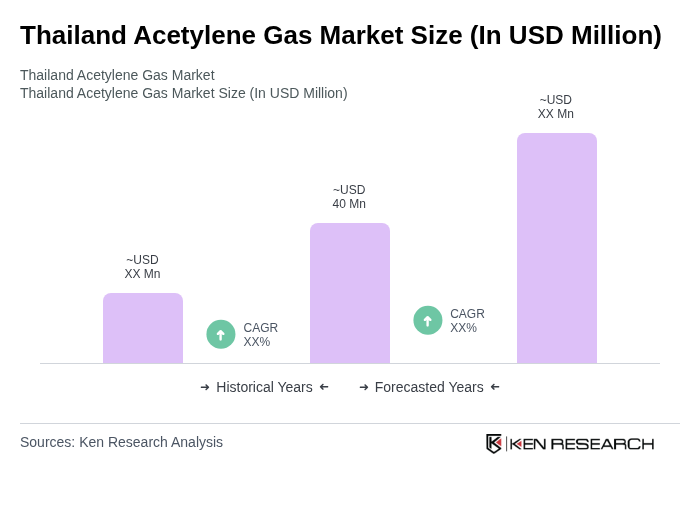
- The Thailand Acetylene Gas Market is valued at USD 40 million, based on a five-year historical analysis of Thailand’s industrial gases market and the product-wise revenue share of acetylene within the country’s industrial gases portfolio. This growth is primarily driven by the increasing demand for acetylene in various industrial applications, particularly in welding and cutting processes, as well as the expansion of the automotive, construction, and general manufacturing sectors. The market has seen a steady rise in consumption due to growing industrialization and urbanization in Thailand, supported by ongoing infrastructure development and steady expansion of metal fabrication and machinery industries.
- Key cities such as Bangkok, Chonburi, and Samut Prakan dominate the market due to their robust industrial bases and proximity to major manufacturing hubs. Bangkok, being the capital, serves as a central point for trade and commerce and concentrates a large share of Thailand’s industrial and service activity, while Chonburi and Samut Prakan host major industrial estates (including Eastern Seaboard and Map Ta Phut–linked supply chains) and numerous factories and industrial parks, which together support strong demand for industrial gases, including acetylene, in metalworking, shipbuilding, automotive, and electronics-related fabrication.
- In 2023, the Thai government strengthened regulations to enhance safety standards in the production, storage, and handling of compressed and dissolved gases, including acetylene gas. This includes mandatory compliance with requirements under the Hazardous Substances Act B.E. 2535 (1992) and its subsequent amendments, and the Ministerial Regulation Prescribing Type of Factory, Rules, Procedures and Conditions for Industrial Gas Production Factories B.E. 2558 (2015), issued by the Ministry of Industry, which set licensing, facility design, equipment, and inspection requirements for industrial gas plants. In practice, these rules require regular inspections of facilities, adherence to internationally aligned standards for pressure vessels and cylinders, emergency response planning, and worker safety training to minimize risks associated with gas leaks, fire, and explosion hazards in acetylene production, filling, and distribution operations.
Thailand Acetylene Gas Market Segmentation
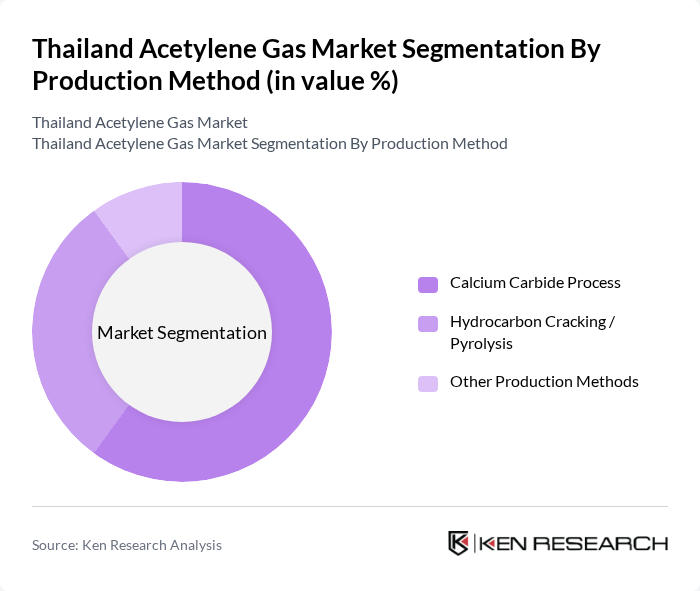
By Production Method:The production methods for acetylene gas include Calcium Carbide Process, Hydrocarbon Cracking / Pyrolysis, and Other Production Methods. The Calcium Carbide Process is the most widely used method in Thailand and across much of Asia due to its relatively simple technology, suitability for small and medium-scale plants, and cost-effectiveness where calcium carbide supply is established. Hydrocarbon cracking / pyrolysis, typically based on partial oxidation or cracking of hydrocarbons, is gaining traction in larger integrated petrochemical complexes because it can produce high-purity acetylene as a co-product along with other valuable chemicals, supporting downstream applications such as specialty chemicals and carbon black. Other production methods, including plasma and specialized on-site generation routes, are utilized for niche, high-purity, or research applications where tight quality control and localized supply are prioritized over volume.
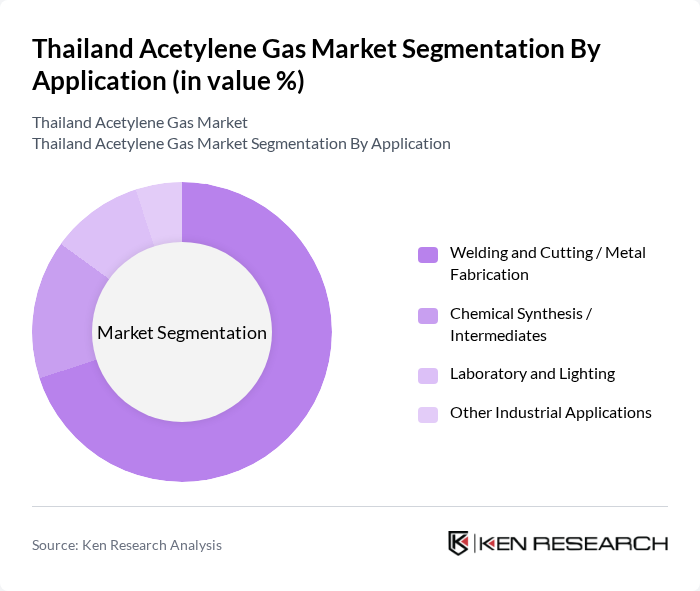
By Application:The applications of acetylene gas include Welding and Cutting / Metal Fabrication, Chemical Synthesis / Intermediates, Laboratory and Lighting, and Other Industrial Applications. The welding and cutting segment dominates the market because acetylene provides one of the highest flame temperatures among commercial fuel gases, making it widely preferred for oxy-acetylene cutting, brazing, and welding in construction, shipbuilding, metal fabrication, and equipment maintenance. Chemical synthesis / intermediates is a significant application area, where acetylene is used as a feedstock for specialty chemicals, solvent intermediates, and acetylene black for battery and electronics applications, supported by new investments such as the acetylene black facility in Rayong province. Laboratory and lighting applications, although smaller in volume, rely on high-purity acetylene for analytical instruments and legacy lighting systems, while other industrial applications include heat treatment, glass and jewelry work, and occasional use in agriculture and maintenance operations.
Thailand Acetylene Gas Market Competitive Landscape
The Thailand Acetylene Gas Market is characterized by a dynamic mix of regional and international players. Leading participants such as Thai Acetylene Co., Ltd., Siam Gas and Petrochemical Public Company Limited, Linde (Thailand) Public Company Limited, Air Products and Chemicals (Thailand) Ltd., Thai Industrial Gases Public Company Limited, Air Liquide (Thailand) Ltd., Gases and Equipment (Thailand) Co., Ltd., Sittipol Gas Co., Ltd., Siam Gas and Petrochemical Co., Ltd. (SGP Group), Local and Regional Acetylene Distributors contribute to innovation, geographic expansion, and service delivery in this space.
Thailand Acetylene Gas Market Industry Analysis
Growth Drivers
- Increasing Demand from Industrial Applications:The industrial sector in Thailand is projected to consume approximately 1.5 million tons of acetylene gas in future, driven by its extensive use in welding and cutting processes. The manufacturing output is expected to grow by 4.5% annually, bolstering the demand for acetylene. Additionally, the automotive and construction industries are significant contributors, with the automotive sector alone accounting for 30% of the total industrial gas consumption, highlighting the critical role of acetylene in these applications.
- Rising Investments in Chemical Manufacturing:Thailand's chemical manufacturing sector is anticipated to attract investments exceeding $2 billion in future, fostering the growth of acetylene gas production. The government’s focus on enhancing the chemical industry, which contributes around 20% to the national GDP, is pivotal. This investment surge is expected to increase production capacity by 15%, ensuring a steady supply of acetylene for various applications, including plastics and synthetic fibers, further driving market growth.
- Government Initiatives to Promote Gas Usage:The Thai government has implemented policies to promote the use of acetylene gas, with a target to increase its consumption by 10% in future. Initiatives include subsidies for industrial users and tax incentives for companies adopting acetylene in their processes. These measures are expected to enhance the market environment, encouraging businesses to transition to acetylene, which is seen as a cleaner alternative to other fuels, thus supporting sustainable industrial practices.
Market Challenges
- Fluctuating Raw Material Prices:The acetylene gas market in Thailand faces challenges due to volatile raw material prices, particularly for calcium carbide, which has seen price fluctuations of up to 20% in the past year. This instability affects production costs and profit margins for manufacturers. In future, the average price of calcium carbide is projected to be around $300 per ton, which could lead to increased operational costs and impact the overall market dynamics negatively.
- Stringent Environmental Regulations:The Thai government has introduced stringent environmental regulations aimed at reducing emissions from industrial processes, including acetylene production. Compliance costs are expected to rise, with estimates suggesting that companies may incur additional expenses of approximately $500,000 annually to meet these regulations. This could hinder the growth of the acetylene market as manufacturers may face challenges in balancing compliance with profitability, potentially leading to reduced production capacities.
Thailand Acetylene Gas Market Future Outlook
The future of the acetylene gas market in Thailand appears promising, driven by increasing industrial demand and government support for cleaner energy sources. As the country continues to invest in chemical manufacturing and infrastructure, the market is expected to adapt to emerging technologies that enhance production efficiency. Additionally, the shift towards sustainable practices will likely encourage innovation in acetylene applications, positioning the market for growth in both domestic and export opportunities, particularly in neighboring Southeast Asian countries.
Market Opportunities
- Growth in Emerging Economies:The rising demand for acetylene in neighboring countries, particularly in Vietnam and Myanmar, presents significant export opportunities. Thailand's strategic location and established production capabilities can facilitate exports, potentially increasing market share by 20% in the region in future, capitalizing on the growing industrial sectors in these emerging economies.
- Technological Advancements in Production:Innovations in acetylene production technology, such as more efficient synthesis methods, are expected to reduce production costs by up to 15%. This advancement will not only enhance profitability for manufacturers but also make acetylene more competitive against alternative fuels, thereby expanding its market presence and applications across various industries in Thailand.
Scope of the Report
| Segment | Sub-Segments |
|---|---|
| By Production Method | Calcium Carbide Process Hydrocarbon Cracking / Pyrolysis Other Production Methods |
| By Application | Welding and Cutting / Metal Fabrication Chemical Synthesis / Intermediates Laboratory and Lighting Other Industrial Applications |
| By End-Use Industry | Automotive and Aerospace Construction and Infrastructure General Manufacturing and Workshops Shipbuilding and Marine Other End-Use Industries |
| By Distribution Channel | Direct Company Sales Distributors and Traders Direct Import Other Channels |
| By Packaging / Supply Mode | Cylinders Bulk / On-site Supply Other Packaging Formats |
| By Region | Central Thailand Northern Thailand Southern Thailand Eastern Thailand |
Key Target Audience
Investors and Venture Capitalist Firms
Government and Regulatory Bodies (e.g., Ministry of Industry, Department of Industrial Works)
Manufacturers and Producers of Acetylene Gas
Distributors and Retailers of Industrial Gases
Petrochemical Companies
Construction and Welding Companies
Industry Associations (e.g., Thai Industrial Gas Association)
Financial Institutions and Banks
Players Mentioned in the Report:
Thai Acetylene Co., Ltd.
Siam Gas and Petrochemical Public Company Limited
Linde (Thailand) Public Company Limited
Air Products and Chemicals (Thailand) Ltd.
Thai Industrial Gases Public Company Limited
Air Liquide (Thailand) Ltd.
Gases and Equipment (Thailand) Co., Ltd.
Sittipol Gas Co., Ltd.
Siam Gas and Petrochemical Co., Ltd. (SGP Group)
Local and Regional Acetylene Distributors
Table of Contents
Market Assessment Phase
1. Executive Summary and Approach
2. Thailand Acetylene Gas Market Overview
2.1 Key Insights and Strategic Recommendations
2.2 Thailand Acetylene Gas Market Overview
2.3 Definition and Scope
2.4 Evolution of Market Ecosystem
2.5 Timeline of Key Regulatory Milestones
2.6 Value Chain & Stakeholder Mapping
2.7 Business Cycle Analysis
2.8 Policy & Incentive Landscape
3. Thailand Acetylene Gas Market Analysis
3.1 Growth Drivers
3.1.1 Increasing Demand from Industrial Applications
3.1.3 Rising Investments in Chemical Manufacturing
3.1.4 Government Initiatives to Promote Gas Usage
3.2 Market Challenges
3.2.1 Fluctuating Raw Material Prices
3.2.2 Stringent Environmental Regulations
3.2.3 Safety Concerns Related to Acetylene Storage
3.2.4 Competition from Alternative Fuel Sources
3.3 Market Opportunities
3.3.1 Growth in Emerging Economies
3.3.2 Technological Advancements in Production
3.3.3 Increasing Use in Pharmaceuticals
3.3.4 Export Potential to Neighboring Countries
3.4 Market Trends
3.4.1 Shift Towards Sustainable Production Methods
3.4.2 Increasing Automation in Manufacturing Processes
3.4.3 Rising Demand for Specialty Gases
3.4.4 Growth of E-commerce in Gas Distribution
3.5 Government Regulation
3.5.1 Safety Standards for Acetylene Handling
3.5.2 Emission Control Regulations
3.5.3 Licensing Requirements for Production Facilities
3.5.4 Import Tariffs on Acetylene Equipment
4. SWOT Analysis
5. Stakeholder Analysis
6. Porter's Five Forces Analysis
7. Thailand Acetylene Gas Market Market Size, 2019-2024
7.1 By Value
7.2 By Volume
7.3 By Average Selling Price
8. Thailand Acetylene Gas Market Segmentation
8.1 By Production Method
8.1.1 Calcium Carbide Process
8.1.2 Hydrocarbon Cracking / Pyrolysis
8.1.3 Other Production Methods
8.2 By Application
8.2.1 Welding and Cutting / Metal Fabrication
8.2.2 Chemical Synthesis / Intermediates
8.2.3 Laboratory and Lighting
8.2.4 Other Industrial Applications
8.3 By End-Use Industry
8.3.1 Automotive and Aerospace
8.3.2 Construction and Infrastructure
8.3.3 General Manufacturing and Workshops
8.3.4 Shipbuilding and Marine
8.3.5 Other End-Use Industries
8.4 By Distribution Channel
8.4.1 Direct Company Sales
8.4.2 Distributors and Traders
8.4.3 Direct Import
8.4.4 Other Channels
8.5 By Packaging / Supply Mode
8.5.1 Cylinders
8.5.2 Bulk / On-site Supply
8.5.3 Other Packaging Formats
8.6 By Region
8.6.1 Central Thailand
8.6.2 Northern Thailand
8.6.3 Southern Thailand
8.6.4 Eastern Thailand
9. Thailand Acetylene Gas Market Competitive Analysis
9.1 Market Share of Key Players
9.2 Cross Comparison of Key Players
9.2.1 Company Name
9.2.2 Group Size (Large, Medium, or Small as per industry convention)
9.2.3 Thailand Acetylene Revenue (USD Million)
9.2.4 3–5 Year Revenue CAGR (%) in Thailand
9.2.5 Thailand Acetylene Market Share (%)
9.2.6 EBITDA Margin (%) – Thailand Operations
9.2.7 Capacity Utilization Rate (%) – Acetylene
9.2.8 Average Realized Price (USD / m³ or kg)
9.2.9 Volume Sold (Thousand m³ or Tons per Year)
9.2.10 Capex Intensity (% of Revenue)
9.2.11 R&D / Innovation Spend (% of Revenue)
9.2.12 Customer Concentration (Top-10 % of Revenue)
9.2.13 Credit Profile / Leverage (Net Debt / EBITDA)
9.2.14 Export Sales Share (% of Acetylene Revenue)
9.3 SWOT Analysis of Top Players
9.4 Pricing Analysis
9.5 Detailed Profile of Major Companies
9.5.1 Thai Acetylene Co., Ltd.
9.5.2 Siam Gas and Petrochemical Public Company Limited
9.5.3 Linde (Thailand) Public Company Limited
9.5.4 Air Products and Chemicals (Thailand) Ltd.
9.5.5 Thai Industrial Gases Public Company Limited
9.5.6 Air Liquide (Thailand) Ltd.
9.5.7 Gases and Equipment (Thailand) Co., Ltd.
9.5.8 Sittipol Gas Co., Ltd.
9.5.9 Siam Gas and Petrochemical Co., Ltd. (SGP Group)
9.5.10 Local and Regional Acetylene Distributors
10. Thailand Acetylene Gas Market End-User Analysis
10.1 Procurement Behavior of Key Ministries
10.1.1 Government Procurement Policies
10.1.2 Budget Allocation for Gas Purchases
10.1.3 Supplier Selection Criteria
10.1.4 Contract Management Practices
10.2 Corporate Spend on Infrastructure & Energy
10.2.1 Investment Trends in Energy Infrastructure
10.2.2 Budgeting for Acetylene Usage
10.2.3 Cost-Benefit Analysis of Acetylene
10.2.4 Energy Efficiency Initiatives
10.3 Pain Point Analysis by End-User Category
10.3.1 Industrial Sector Challenges
10.3.2 Construction Sector Challenges
10.3.3 Regulatory Compliance Issues
10.3.4 Supply Chain Disruptions
10.4 User Readiness for Adoption
10.4.1 Awareness of Acetylene Benefits
10.4.2 Training and Skill Development Needs
10.4.3 Infrastructure Readiness
10.4.4 Financial Readiness
10.5 Post-Deployment ROI and Use Case Expansion
10.5.1 Measurement of ROI
10.5.2 Case Studies of Successful Deployments
10.5.3 Expansion Opportunities
10.5.4 Long-term Sustainability Considerations
11. Thailand Acetylene Gas Market Future Size, 2025-2030
11.1 By Value
11.2 By Volume
11.3 By Average Selling Price
Go-To-Market Strategy Phase
1. Whitespace Analysis + Business Model Canvas
1.1 Market Gaps Identification
1.2 Business Model Development
2. Marketing and Positioning Recommendations
2.1 Branding Strategies
2.2 Product USPs
3. Distribution Plan
3.1 Urban Retail Strategies
3.2 Rural NGO Tie-ups
4. Channel & Pricing Gaps
4.1 Underserved Routes
4.2 Pricing Bands Analysis
5. Unmet Demand & Latent Needs
5.1 Category Gaps
5.2 Consumer Segments
6. Customer Relationship
6.1 Loyalty Programs
6.2 After-sales Service
7. Value Proposition
7.1 Sustainability Initiatives
7.2 Integrated Supply Chains
8. Key Activities
8.1 Regulatory Compliance
8.2 Branding Efforts
8.3 Distribution Setup
9. Entry Strategy Evaluation
9.1 Domestic Market Entry Strategy
9.1.1 Product Mix Considerations
9.1.2 Pricing Band Strategy
9.1.3 Packaging Solutions
9.2 Export Entry Strategy
9.2.1 Target Countries Analysis
9.2.2 Compliance Roadmap
10. Entry Mode Assessment
10.1 JV Opportunities
10.2 Greenfield Investments
10.3 M&A Considerations
10.4 Distributor Model Evaluation
11. Capital and Timeline Estimation
11.1 Capital Requirements
11.2 Timelines for Implementation
12. Control vs Risk Trade-Off
12.1 Ownership Considerations
12.2 Partnerships Evaluation
13. Profitability Outlook
13.1 Breakeven Analysis
13.2 Long-term Sustainability Strategies
14. Potential Partner List
14.1 Distributors
14.2 JVs
14.3 Acquisition Targets
15. Execution Roadmap
15.1 Phased Plan for Market Entry
15.1.1 Market Setup
15.1.2 Market Entry
15.1.3 Growth Acceleration
15.1.4 Scale & Stabilize
15.2 Key Activities and Milestones
15.2.1 Milestone Planning
15.2.2 Activity Tracking
Research Methodology
Phase 1: Approach1
Desk Research
- Analysis of trade statistics from the Ministry of Commerce, Thailand
- Review of industry reports from the Thai Industrial Standards Institute (TISI)
- Examination of market trends and forecasts from academic journals and publications
Primary Research
- Interviews with key stakeholders in the acetylene gas supply chain, including manufacturers and distributors
- Surveys conducted with end-users in industries such as welding, chemical manufacturing, and pharmaceuticals
- Field visits to production facilities to gather insights on operational practices and market dynamics
Validation & Triangulation
- Cross-validation of findings through multiple data sources, including government publications and industry reports
- Triangulation of qualitative insights from interviews with quantitative data from market surveys
- Sanity checks performed by consulting with industry experts and analysts
Phase 2: Market Size Estimation1
Top-down Assessment
- Estimation of market size based on national consumption data and import/export statistics
- Segmentation of the market by application areas such as welding, chemical synthesis, and lighting
- Incorporation of macroeconomic indicators influencing demand, such as GDP growth and industrial output
Bottom-up Modeling
- Collection of production capacity data from major acetylene gas producers in Thailand
- Estimation of sales volumes based on historical data and current market trends
- Cost analysis of production processes to determine pricing strategies and profit margins
Forecasting & Scenario Analysis
- Development of forecasting models using historical growth rates and market drivers
- Scenario analysis based on potential regulatory changes and technological advancements
- Creation of best-case, worst-case, and most-likely scenarios for market growth through 2030
Phase 3: CATI Sample Composition1
| Scope Item/Segment | Sample Size | Target Respondent Profiles |
|---|---|---|
| Welding Industry Users | 120 | Welding Engineers, Procurement Managers |
| Chemical Manufacturing Sector | 90 | Production Managers, Chemical Engineers |
| Pharmaceutical Applications | 60 | Quality Control Managers, R&D Scientists |
| Construction and Infrastructure | 70 | Project Managers, Site Supervisors |
| Automotive Industry | 80 | Manufacturing Engineers, Supply Chain Coordinators |
Frequently Asked Questions
What is the current value of the Thailand Acetylene Gas Market?
The Thailand Acetylene Gas Market is valued at approximately USD 40 million, driven by increasing demand in industrial applications such as welding, cutting, and the expansion of sectors like automotive and construction.
What are the primary applications of acetylene gas in Thailand?
Which production method is most commonly used for acetylene gas in Thailand?
What are the key growth drivers for the Thailand Acetylene Gas Market?
Other Regional/Country Reports
Other Adjacent Reports
Philippines Chemical Intermediates Market
Malaysia Gas Cylinder Market
Why Buy From Us?

What makes us stand out is that our consultants follow Robust, Refine and Result (RRR) methodology. Robust for clear definitions, approaches and sanity checking, Refine for differentiating respondents' facts and opinions, and Result for presenting data with story.

We have set a benchmark in the industry by offering our clients with syndicated and customized market research reports featuring coverage of entire market as well as meticulous research and analyst insights.

While we don't replace traditional research, we flip the method upside down. Our dual approach of Top Bottom & Bottom Top ensures quality deliverable by not just verifying company fundamentals but also looking at the sector and macroeconomic factors.

With one step in the future, our research team constantly tries to show you the bigger picture. We help with some of the tough questions you may encounter along the way: How is the industry positioned? Best marketing channel? KPI's of competitors? By aligning every element, we help maximize success.

Our report gives you instant access to the answers and sources that other companies might choose to hide. We elaborate each steps of research methodology we have used and showcase you the sample size to earn your trust.

If you need any support, we are here! We pride ourselves on universe strength, data quality, and quick, friendly, and professional service.