About the Report
Base Year 2024Listen to the audio summary
US Ambulance Services Market Overview
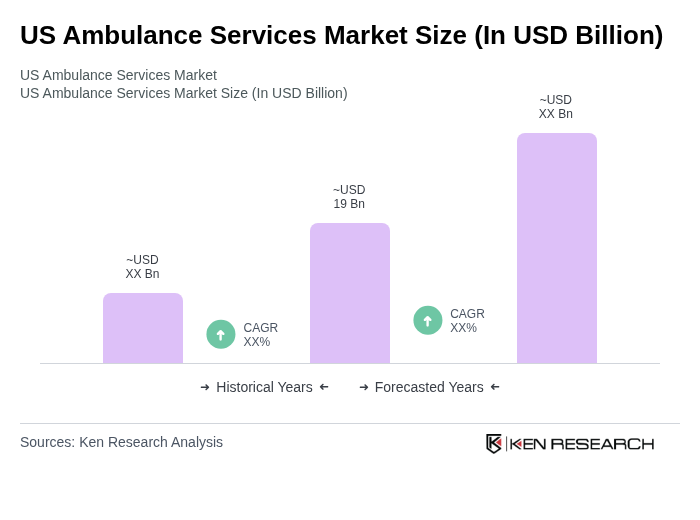
- The US Ambulance Services Market is valued at USD 19 billion, based on a five-year historical analysis. This growth is primarily driven by the increasing demand for emergency medical services, advancements in medical technology such as telemedicine integration and onboard medical equipment, and a growing aging population requiring urgent care. The rise in chronic diseases, favorable reimbursement policies, and the need for timely medical interventions have further propelled the market's expansion.
- Key players in this market include major metropolitan areas such as New York City, Los Angeles, and Chicago, which dominate due to their large populations and high demand for emergency services. Additionally, states with significant healthcare infrastructure and investment in emergency response systems, like Texas and Florida, also play a crucial role in the market's dynamics. Collaborative public-private partnerships and the expansion of advanced life support services further contribute to regional market leadership.
- The Emergency Medical Services Systems Act (Public Law 93-154), issued by the US Congress in 1973 and subsequently amended, provides a regulatory framework for EMS operations nationwide. This Act mandates minimum training standards for EMS personnel, sets operational protocols, and encourages the integration of advanced technologies in ambulance services to ensure timely and effective patient care. Compliance with these standards is overseen by the National Highway Traffic Safety Administration (NHTSA), which regularly updates EMS guidelines and requirements.
US Ambulance Services Market Segmentation
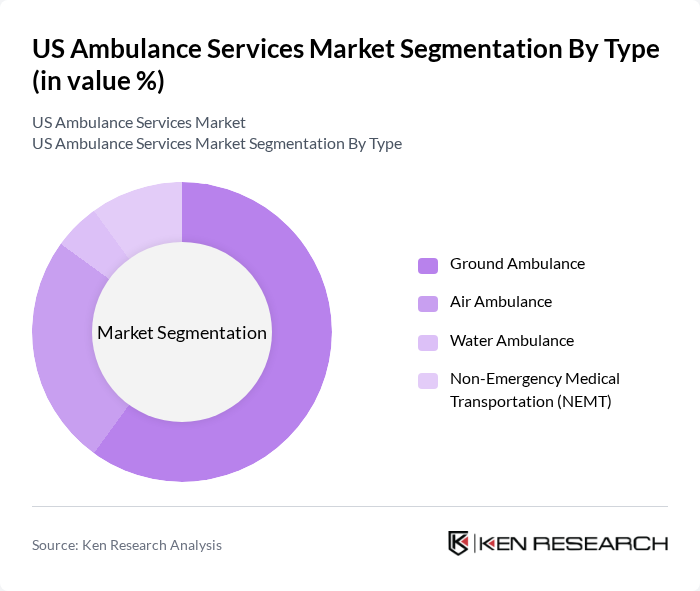
By Type:The ambulance services market can be segmented into Ground Ambulance, Air Ambulance, Water Ambulance, and Non-Emergency Medical Transportation (NEMT). Ground Ambulance is the most dominant segment, accounting for the majority of emergency medical responses due to its extensive availability and critical role in urban and rural areas. The increasing number of road traffic accidents and the need for immediate medical assistance have led to a higher demand for ground ambulance services. Air Ambulance services are expanding rapidly, especially in remote and underserved regions, driven by technological advancements and broader insurance coverage. Water Ambulance and NEMT segments serve specialized needs, including patient transfers in coastal areas and scheduled medical transport for non-urgent cases.
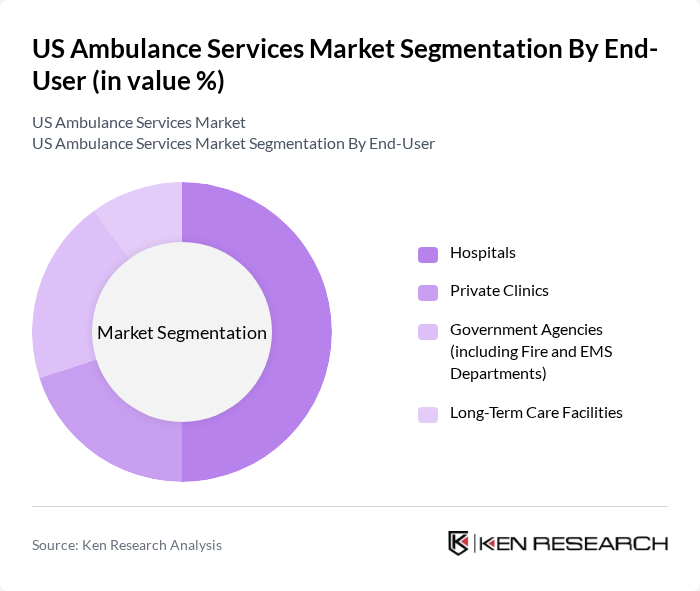
By End-User:The end-user segmentation includes Hospitals, Private Clinics, Government Agencies (including Fire and EMS Departments), and Long-Term Care Facilities. Hospitals are the leading end-users of ambulance services, requiring rapid patient transport for critical care and emergency admissions. The increasing number of healthcare facilities and the rising patient population contribute to the demand for ambulance services in hospitals. Government agencies, including municipal fire departments and EMS divisions, play a significant role in emergency response and disaster management, often collaborating with private providers to enhance service coverage. Private clinics and long-term care facilities utilize ambulance services for patient transfers and scheduled medical transport.
US Ambulance Services Market Competitive Landscape
The US Ambulance Services Market is characterized by a dynamic mix of regional and international players. Leading participants such as American Medical Response (AMR), Rural/Metro Corporation, Acadian Ambulance Service, Falck USA, MedStar Mobile Healthcare, Priority Ambulance, Global Medical Response (GMR), Lifeguard Ambulance Service, Air Methods Corporation, Metro West Ambulance, Care Ambulance Service, MedCare Ambulance, ProTransport-1, AMR Air Ambulance, PHI Air Medical contribute to innovation, geographic expansion, and service delivery in this space.
US Ambulance Services Market Industry Analysis
Growth Drivers
- Increasing Demand for Emergency Medical Services:The US ambulance services market is experiencing heightened demand, driven by an estimated 37 million emergency medical service calls annually. This figure is projected to rise as the population ages, with the number of individuals aged 65 and older expected to reach 80 million in future. Additionally, the prevalence of chronic diseases, such as heart disease affecting 6.2 million adults, further fuels the need for timely emergency medical response, thereby enhancing service demand.
- Technological Advancements in Ambulance Services:The integration of advanced technologies, such as telemedicine and real-time data analytics, is revolutionizing ambulance services. In future, the telemedicine market is projected to reach $55 billion, significantly impacting emergency response efficiency. Moreover, the adoption of GPS tracking and automated dispatch systems has improved response times, with studies indicating a reduction in average response time by 20%, enhancing patient outcomes and operational efficiency in the ambulance sector.
- Rising Healthcare Expenditure:The US healthcare expenditure is expected to reach $4.3 trillion in future, reflecting a 5.4% annual growth rate. This increase in spending is driving investments in emergency medical services, including ambulance operations. With more funds allocated to healthcare, ambulance services are likely to benefit from improved infrastructure, better equipment, and enhanced training programs for personnel, ultimately leading to improved service delivery and patient care.
Market Challenges
- High Operational Costs:The operational costs for ambulance services are escalating, with average annual expenses exceeding $500,000 per ambulance. Factors contributing to these costs include fuel prices, maintenance, and personnel salaries. Additionally, the need for advanced medical equipment and technology further strains budgets. As a result, many ambulance services struggle to maintain profitability while ensuring high-quality care, which poses a significant challenge to the industry.
- Shortage of Trained Personnel:The ambulance services sector is facing a critical shortage of trained personnel, with an estimated 20% vacancy rate for paramedics and EMTs nationwide. This shortage is exacerbated by the increasing demand for services and the aging workforce, with nearly 30% of current EMTs nearing retirement age. The lack of qualified personnel not only affects service delivery but also places additional strain on existing staff, leading to burnout and high turnover rates.
US Ambulance Services Market Future Outlook
The US ambulance services market is poised for significant transformation, driven by technological innovations and evolving patient care models. As telemedicine continues to expand, ambulance services will increasingly integrate remote consultation capabilities, enhancing pre-hospital care. Furthermore, the focus on sustainability will lead to the adoption of eco-friendly practices and electric vehicles, aligning with broader healthcare goals. These trends indicate a shift towards more efficient, patient-centered emergency services, ultimately improving health outcomes and operational effectiveness.
Market Opportunities
- Expansion of Telemedicine Services:The growing acceptance of telemedicine presents a unique opportunity for ambulance services to enhance patient care. By integrating telehealth capabilities, ambulance providers can offer immediate consultations during transport, improving decision-making and treatment protocols. This integration is expected to streamline operations and reduce unnecessary hospital visits, ultimately benefiting both patients and service providers.
- Partnerships with Healthcare Providers:Collaborations between ambulance services and healthcare providers can lead to improved patient outcomes and operational efficiencies. By forming strategic partnerships, ambulance services can access shared resources, training, and technology, enhancing service delivery. Such collaborations are anticipated to foster innovation and create a more integrated healthcare system, addressing the challenges of emergency medical response effectively.
Scope of the Report
| Segment | Sub-Segments |
|---|---|
| By Type | Ground Ambulance Air Ambulance Water Ambulance Non-Emergency Medical Transportation (NEMT) |
| By End-User | Hospitals Private Clinics Government Agencies (including Fire and EMS Departments) Long-Term Care Facilities |
| By Service Model | Public Ambulance Services Private Ambulance Services Volunteer/Community Ambulance Services Hybrid (Public-Private Partnerships) |
| By Vehicle Type | Basic Life Support (BLS) Ambulances Advanced Life Support (ALS) Ambulances Specialty Care Transport (SCT) Ambulances Critical Care Transport (CCT) Ambulances |
| By Geographic Coverage | Urban Areas Rural Areas Suburban Areas Remote/Frontier Areas |
| By Payment Model | Fee-for-Service Capitation Value-Based Care Insurance Reimbursement |
| By Technology Adoption | Traditional Dispatch Systems Computer-Aided Dispatch (CAD) Systems Telemedicine Integration Mobile Health (mHealth) Applications |
Key Target Audience
Investors and Venture Capitalist Firms
Government and Regulatory Bodies (e.g., Federal Emergency Management Agency, National Highway Traffic Safety Administration)
Ambulance Service Providers
Healthcare Systems and Hospitals
Insurance Companies
Emergency Medical Services (EMS) Agencies
Medical Equipment Manufacturers
Public Health Organizations
Players Mentioned in the Report:
American Medical Response (AMR)
Rural/Metro Corporation
Acadian Ambulance Service
Falck USA
MedStar Mobile Healthcare
Priority Ambulance
Global Medical Response (GMR)
Lifeguard Ambulance Service
Air Methods Corporation
Metro West Ambulance
Care Ambulance Service
MedCare Ambulance
ProTransport-1
AMR Air Ambulance
PHI Air Medical
Table of Contents
Market Assessment Phase
1. Executive Summary and Approach
2. US Ambulance Services Market Overview
2.1 Key Insights and Strategic Recommendations
2.2 US Ambulance Services Market Overview
2.3 Definition and Scope
2.4 Evolution of Market Ecosystem
2.5 Timeline of Key Regulatory Milestones
2.6 Value Chain & Stakeholder Mapping
2.7 Business Cycle Analysis
2.8 Policy & Incentive Landscape
3. US Ambulance Services Market Analysis
3.1 Growth Drivers
3.1.1 Increasing demand for emergency medical services
3.1.2 Technological advancements in ambulance services
3.1.3 Rising healthcare expenditure
3.1.4 Aging population and chronic disease prevalence
3.2 Market Challenges
3.2.1 High operational costs
3.2.2 Regulatory compliance issues
3.2.3 Shortage of trained personnel
3.2.4 Competition from alternative transport services
3.3 Market Opportunities
3.3.1 Expansion of telemedicine services
3.3.2 Partnerships with healthcare providers
3.3.3 Development of advanced ambulance technologies
3.3.4 Increased funding for emergency services
3.4 Market Trends
3.4.1 Integration of AI and data analytics
3.4.2 Shift towards patient-centered care
3.4.3 Growth of mobile health applications
3.4.4 Emphasis on sustainability in operations
3.5 Government Regulation
3.5.1 Medicare reimbursement policies
3.5.2 State-level licensing requirements
3.5.3 Compliance with the Emergency Medical Treatment and Labor Act (EMTALA)
3.5.4 Regulations on ambulance equipment standards
4. SWOT Analysis
5. Stakeholder Analysis
6. Porter's Five Forces Analysis
7. US Ambulance Services Market Market Size, 2019-2024
7.1 By Value
7.2 By Volume
7.3 By Average Selling Price
8. US Ambulance Services Market Segmentation
8.1 By Type
8.1.1 Ground Ambulance
8.1.2 Air Ambulance
8.1.3 Water Ambulance
8.1.4 Non-Emergency Medical Transportation (NEMT)
8.2 By End-User
8.2.1 Hospitals
8.2.2 Private Clinics
8.2.3 Government Agencies (including Fire and EMS Departments)
8.2.4 Long-Term Care Facilities
8.3 By Service Model
8.3.1 Public Ambulance Services
8.3.2 Private Ambulance Services
8.3.3 Volunteer/Community Ambulance Services
8.3.4 Hybrid (Public-Private Partnerships)
8.4 By Vehicle Type
8.4.1 Basic Life Support (BLS) Ambulances
8.4.2 Advanced Life Support (ALS) Ambulances
8.4.3 Specialty Care Transport (SCT) Ambulances
8.4.4 Critical Care Transport (CCT) Ambulances
8.5 By Geographic Coverage
8.5.1 Urban Areas
8.5.2 Rural Areas
8.5.3 Suburban Areas
8.5.4 Remote/Frontier Areas
8.6 By Payment Model
8.6.1 Fee-for-Service
8.6.2 Capitation
8.6.3 Value-Based Care
8.6.4 Insurance Reimbursement
8.7 By Technology Adoption
8.7.1 Traditional Dispatch Systems
8.7.2 Computer-Aided Dispatch (CAD) Systems
8.7.3 Telemedicine Integration
8.7.4 Mobile Health (mHealth) Applications
9. US Ambulance Services Market Competitive Analysis
9.1 Market Share of Key Players
9.2 Cross Comparison of Key Players
9.2.1 Company Name
9.2.2 Group Size (Large, Medium, or Small as per industry convention)
9.2.3 Revenue Growth Rate
9.2.4 Market Share (%)
9.2.5 Average Response Time (minutes)
9.2.6 Fleet Size
9.2.7 Fleet Utilization Rate (%)
9.2.8 Service Coverage Area (States/Regions)
9.2.9 Number of Annual Transports
9.2.10 Employee Training Hours per FTE
9.2.11 Compliance Rate with Federal/State Regulations (%)
9.2.12 Customer Satisfaction Score (NPS or equivalent)
9.2.13 Payer Mix (Medicare/Medicaid/Private/Other %)
9.2.14 Technology Adoption Level (e.g., CAD, telemedicine, ePCR)
9.3 SWOT Analysis of Top Players
9.4 Pricing Analysis
9.5 Detailed Profile of Major Companies
9.5.1 American Medical Response (AMR)
9.5.2 Rural/Metro Corporation
9.5.3 Acadian Ambulance Service
9.5.4 Falck USA
9.5.5 MedStar Mobile Healthcare
9.5.6 Priority Ambulance
9.5.7 Global Medical Response (GMR)
9.5.8 Lifeguard Ambulance Service
9.5.9 Air Methods Corporation
9.5.10 Metro West Ambulance
9.5.11 Care Ambulance Service
9.5.12 MedCare Ambulance
9.5.13 ProTransport-1
9.5.14 AMR Air Ambulance
9.5.15 PHI Air Medical
10. US Ambulance Services Market End-User Analysis
10.1 Procurement Behavior of Key Ministries
10.1.1 Budget Allocation for Emergency Services
10.1.2 Decision-Making Process for Ambulance Procurement
10.1.3 Evaluation Criteria for Service Providers
10.1.4 Contracting Procedures
10.2 Corporate Spend on Infrastructure & Energy
10.2.1 Investment in Ambulance Fleet Upgrades
10.2.2 Spending on Medical Equipment
10.2.3 Budget for Training and Development
10.2.4 Expenditure on Technology Integration
10.3 Pain Point Analysis by End-User Category
10.3.1 Delays in Response Times
10.3.2 Inadequate Equipment Availability
10.3.3 High Costs of Services
10.3.4 Lack of Trained Personnel
10.4 User Readiness for Adoption
10.4.1 Awareness of Available Services
10.4.2 Willingness to Pay for Services
10.4.3 Acceptance of New Technologies
10.4.4 Feedback Mechanisms
10.5 Post-Deployment ROI and Use Case Expansion
10.5.1 Measurement of Service Effectiveness
10.5.2 Cost-Benefit Analysis of Services
10.5.3 Expansion of Service Offerings
10.5.4 Long-Term Partnerships with Healthcare Providers
11. US Ambulance Services Market Future Size, 2025-2030
11.1 By Value
11.2 By Volume
11.3 By Average Selling Price
Go-To-Market Strategy Phase
1. Whitespace Analysis + Business Model Canvas
1.1 Market Gaps Identification
1.2 Business Model Development
2. Marketing and Positioning Recommendations
2.1 Branding Strategies
2.2 Product USPs
3. Distribution Plan
3.1 Urban Retail vs Rural NGO Tie-Ups
4. Channel & Pricing Gaps
4.1 Underserved Routes
4.2 Pricing Bands
5. Unmet Demand & Latent Needs
5.1 Category Gaps
5.2 Consumer Segments
6. Customer Relationship
6.1 Loyalty Programs
6.2 After-Sales Service
7. Value Proposition
7.1 Sustainability
7.2 Integrated Supply Chains
8. Key Activities
8.1 Regulatory Compliance
8.2 Branding
8.3 Distribution Setup
9. Entry Strategy Evaluation
9.1 Domestic Market Entry Strategy
9.1.1 Product Mix
9.1.2 Pricing Band
9.1.3 Packaging
9.2 Export Entry Strategy
9.2.1 Target Countries
9.2.2 Compliance Roadmap
10. Entry Mode Assessment
10.1 JV
10.2 Greenfield
10.3 M&A
10.4 Distributor Model
11. Capital and Timeline Estimation
11.1 Capital Requirements
11.2 Timelines
12. Control vs Risk Trade-Off
12.1 Ownership vs Partnerships
13. Profitability Outlook
13.1 Breakeven Analysis
13.2 Long-Term Sustainability
14. Potential Partner List
14.1 Distributors
14.2 JVs
14.3 Acquisition Targets
15. Execution Roadmap
15.1 Phased Plan for Market Entry
15.1.1 Market Setup
15.1.2 Market Entry
15.1.3 Growth Acceleration
15.1.4 Scale & Stabilize
15.2 Key Activities and Milestones
15.2.1 Activity Planning
15.2.2 Milestone Tracking
Research Methodology
Phase 1: Approach1
Desk Research
- Analysis of industry reports from the National Ambulance Association and other relevant bodies
- Review of government publications and healthcare regulations impacting ambulance services
- Examination of market trends through academic journals and healthcare market research studies
Primary Research
- Interviews with executives from leading ambulance service providers
- Surveys conducted with paramedics and emergency medical technicians (EMTs)
- Focus groups with healthcare administrators and hospital emergency department managers
Validation & Triangulation
- Cross-validation of findings through multiple data sources including industry publications and expert opinions
- Triangulation of data from primary interviews and secondary research to ensure consistency
- Sanity checks through expert panel reviews comprising industry veterans and analysts
Phase 2: Market Size Estimation1
Top-down Assessment
- Estimation of total market size based on national healthcare expenditure and emergency response budgets
- Segmentation of the market by service type, including ground and air ambulance services
- Incorporation of demographic data to assess demand in urban versus rural areas
Bottom-up Modeling
- Collection of operational data from ambulance service providers regarding fleet size and service frequency
- Cost analysis based on service pricing models and reimbursement rates from insurance providers
- Volume x cost calculations to derive revenue estimates for different service segments
Forecasting & Scenario Analysis
- Multi-factor regression analysis incorporating population growth, aging demographics, and healthcare access
- Scenario modeling based on potential changes in healthcare policy and emergency response protocols
- Development of baseline, optimistic, and pessimistic forecasts through 2030
Phase 3: CATI Sample Composition1
| Scope Item/Segment | Sample Size | Target Respondent Profiles |
|---|---|---|
| Ground Ambulance Services | 120 | Operations Managers, Fleet Supervisors |
| Air Ambulance Services | 60 | Flight Paramedics, Air Operations Directors |
| Emergency Medical Services (EMS) Coordination | 50 | EMS Coordinators, Hospital Liaison Officers |
| Ambulance Billing and Reimbursement | 40 | Billing Managers, Financial Analysts |
| Regulatory Compliance in Ambulance Services | 40 | Compliance Officers, Legal Advisors |
Frequently Asked Questions
What is the current value of the US Ambulance Services Market?
The US Ambulance Services Market is valued at approximately USD 19 billion, driven by increasing demand for emergency medical services, advancements in medical technology, and a growing aging population requiring urgent care.
What factors are driving the growth of the US Ambulance Services Market?
Who are the major players in the US Ambulance Services Market?
What types of ambulance services are available in the US?
Other Regional/Country Reports
Indonesia Ambulance Services Market
Malaysia Ambulance Services Market
APAC Ambulance Services Market
SEA Ambulance Services Market
Other Adjacent Reports
Singapore Non-Emergency Medical Transportation Market
Global Telemedicine Market Report Size, Share, Growth Drivers, Trends, Opportunities & Forecast 2025–2030India Healthcare IT Market Size, Share & Forecast, By Solution Type, Deployment Model & Customer Type, 2025-2032Asia Pacific Medical Equipment Market Outlook to 2030: Size, Share, Growth and TrendsSaudi Arabia Health Insurance Market Size, Share & Forecast, By Product Type, Customer Segment & Distribution Channel, 2026-2032Japan Hospital Services Market
Vietnam Home Healthcare Market Size, Share & Forecast, By Service Type, Care Setting & End User, 2025-2031South Korea Disaster Response Services Market
Why Buy From Us?

What makes us stand out is that our consultants follow Robust, Refine and Result (RRR) methodology. Robust for clear definitions, approaches and sanity checking, Refine for differentiating respondents' facts and opinions, and Result for presenting data with story.

We have set a benchmark in the industry by offering our clients with syndicated and customized market research reports featuring coverage of entire market as well as meticulous research and analyst insights.

While we don't replace traditional research, we flip the method upside down. Our dual approach of Top Bottom & Bottom Top ensures quality deliverable by not just verifying company fundamentals but also looking at the sector and macroeconomic factors.

With one step in the future, our research team constantly tries to show you the bigger picture. We help with some of the tough questions you may encounter along the way: How is the industry positioned? Best marketing channel? KPI's of competitors? By aligning every element, we help maximize success.

Our report gives you instant access to the answers and sources that other companies might choose to hide. We elaborate each steps of research methodology we have used and showcase you the sample size to earn your trust.

If you need any support, we are here! We pride ourselves on universe strength, data quality, and quick, friendly, and professional service.