About the Report
Base Year 2024US Vaccine Market Overview
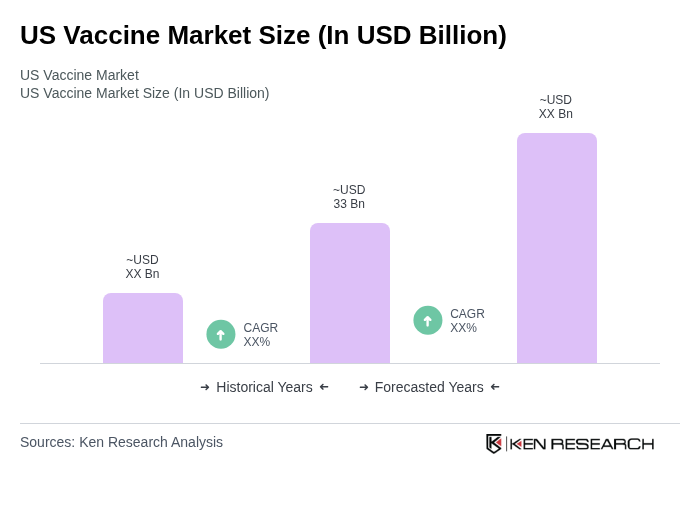
- The US Vaccine Market is valued at USD 33 billion, based on a five-year historical analysis. This growth is primarily driven by the increasing prevalence of infectious diseases such as influenza, hepatitis, HPV, and pneumonia, heightened public awareness regarding vaccination, and significant investments in research and development by pharmaceutical companies. The COVID-19 pandemic has further accelerated vaccine innovation and distribution, with mRNA technology and pandemic preparedness initiatives shaping a robust market landscape. Technological advancements, including artificial intelligence for vaccine development and the introduction of thermostable and needle-free vaccines, are further enhancing market growth .
- Key players in this market include major cities such as New York, Los Angeles, and Chicago, which dominate due to their large populations, advanced healthcare infrastructure, and significant public health initiatives. These urban centers serve as hubs for vaccine distribution and administration, supported by a network of healthcare providers and public health organizations .
- The Vaccines for Children (VFC) program, established under the Omnibus Budget Reconciliation Act of 1993 and administered by the Centers for Disease Control and Prevention (CDC), provides free vaccines to eligible children in the United States. The VFC program aims to increase vaccination rates among underserved populations, ensuring equitable access to essential vaccines and reducing the incidence of vaccine-preventable diseases. Providers enrolled in the VFC program must comply with CDC vaccine storage, handling, and reporting requirements .
US Vaccine Market Segmentation
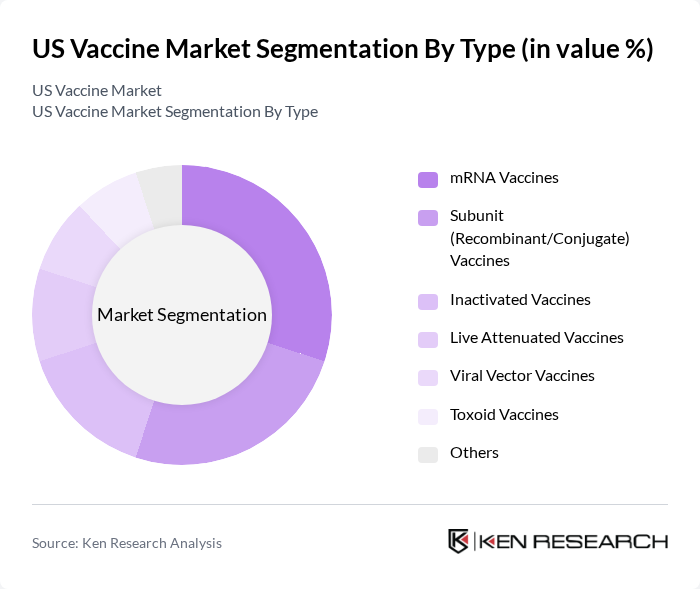
By Type:The vaccine market can be segmented into various types, including mRNA vaccines, subunit (recombinant/conjugate) vaccines, inactivated vaccines, live attenuated vaccines, viral vector vaccines, toxoid vaccines, and others. Among these, mRNA vaccines have gained significant traction due to their rapid development and effectiveness, particularly highlighted during the COVID-19 pandemic. The demand for inactivated and live attenuated vaccines remains strong, especially for routine immunizations. The mRNA type segment accounted for approximately 30% of the US vaccine market by value, while the recombinant/conjugate/subunit segment also held a dominant presence, driven by high adoption of vaccines such as Gardasil 9 .
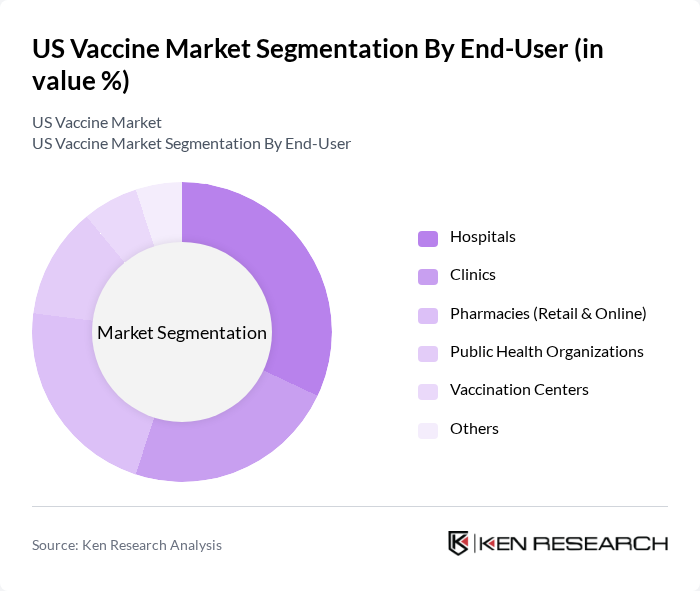
By End-User:The end-user segmentation includes hospitals, clinics, pharmacies (retail & online), public health organizations, vaccination centers, and others. Hospitals and clinics are the primary settings for vaccine administration, driven by their capacity to manage large patient volumes and provide comprehensive healthcare services. Pharmacies have also emerged as significant players, offering convenient access to vaccines for the general public. Government suppliers and hospital & retail pharmacies together account for the largest share of vaccine distribution channels in the US .
US Vaccine Market Competitive Landscape
The US Vaccine Market is characterized by a dynamic mix of regional and international players. Leading participants such as Pfizer Inc., Moderna, Inc., Johnson & Johnson (Janssen Pharmaceuticals), Merck & Co., Inc., GlaxoSmithKline plc, Sanofi S.A., AstraZeneca plc, Novavax, Inc., Gilead Sciences, Inc., Seqirus (CSL Limited), Emergent BioSolutions Inc., BioNTech SE, Dynavax Technologies Corporation, Vaxart, Inc., Bavarian Nordic A/S contribute to innovation, geographic expansion, and service delivery in this space.
US Vaccine Market Industry Analysis
Growth Drivers
- Increasing Vaccination Awareness:The US has seen a significant rise in vaccination awareness, with 80% of adults recognizing the importance of vaccines in preventing diseases. This awareness is bolstered by campaigns from organizations like the CDC, which allocated $1.5 billion for public health initiatives. Additionally, educational programs in schools have reached over 10 million students, fostering a culture of preventive healthcare that drives vaccine uptake and market growth.
- Government Initiatives and Funding:In future, the US government is projected to invest approximately $2 billion in vaccine research and development. This funding supports initiatives aimed at increasing vaccine accessibility and affordability, particularly in underserved communities. Programs like the Vaccines for Children program, which served over 10 million children, exemplify the government's commitment to enhancing public health through vaccination, thereby stimulating market growth.
- Technological Advancements in Vaccine Development:The US vaccine market is experiencing rapid technological advancements, particularly in mRNA technology, which has seen over $3 billion invested. This innovation has led to the development of more effective vaccines, reducing production times significantly. For instance, the time to develop a vaccine has decreased from several years to just months, enhancing the market's ability to respond to emerging infectious diseases effectively.
Market Challenges
- Vaccine Hesitancy:Vaccine hesitancy remains a significant challenge, with approximately 30% of adults expressing reluctance to receive vaccines due to misinformation and distrust. This hesitancy has been linked to a 15% decline in vaccination rates for routine immunizations. Addressing this issue is crucial for maintaining public health and ensuring the continued growth of the vaccine market in the US.
- Regulatory Hurdles:The vaccine market faces stringent regulatory hurdles, with the FDA requiring extensive clinical trials that can take up to 10 years before approval. In future, the average cost of bringing a new vaccine to market was estimated at $1.3 billion. These regulatory challenges can delay the introduction of innovative vaccines, impacting the overall growth and responsiveness of the market to public health needs.
US Vaccine Market Future Outlook
The US vaccine market is poised for significant evolution, driven by ongoing technological advancements and increased public health initiatives. As the focus shifts towards personalized medicine, the development of tailored vaccines is expected to gain traction. Furthermore, the integration of digital health technologies will enhance vaccine distribution and monitoring, ensuring better accessibility and compliance. These trends indicate a robust future for the vaccine market, with potential for improved health outcomes and expanded market reach.
Market Opportunities
- Expansion into Emerging Markets:The US vaccine market has substantial opportunities for expansion into emerging markets, where vaccination rates are lower. With a projected increase in demand for vaccines in regions like Southeast Asia, companies can leverage their expertise to capture new market share, potentially increasing revenues by billions in the coming years.
- Development of mRNA Vaccines:The ongoing development of mRNA vaccines presents a lucrative opportunity, with the market for mRNA technology expected to reach $10 billion. This innovative approach not only enhances vaccine efficacy but also allows for rapid adaptation to new pathogens, positioning companies to lead in a dynamic healthcare landscape.
Scope of the Report
| Segment | Sub-Segments |
|---|---|
| By Type | mRNA Vaccines Subunit (Recombinant/Conjugate) Vaccines Inactivated Vaccines Live Attenuated Vaccines Viral Vector Vaccines Toxoid Vaccines Others |
| By End-User | Hospitals Clinics Pharmacies (Retail & Online) Public Health Organizations Vaccination Centers Others |
| By Age Group | Pediatric Adult Geriatric Others |
| By Disease Targeted | Viral Diseases Bacterial Diseases Cancer Vaccines Allergy Vaccines Others |
| By Administration Route | Parenteral (Intramuscular/Subcutaneous) Oral Intranasal Others |
| By Distribution Channel | Government Suppliers Direct Sales Distributors Pharmacies (Retail & Online) Others |
| By Policy Support | Subsidies Tax Incentives Public Health Campaigns Others |
Key Target Audience
Investors and Venture Capitalist Firms
Government and Regulatory Bodies (e.g., Food and Drug Administration, Centers for Disease Control and Prevention)
Manufacturers and Producers
Distributors and Retailers
Pharmaceutical Research Organizations
Public Health Agencies
Health Insurance Companies
Biotechnology Firms
Players Mentioned in the Report:
Pfizer Inc.
Moderna, Inc.
Johnson & Johnson (Janssen Pharmaceuticals)
Merck & Co., Inc.
GlaxoSmithKline plc
Sanofi S.A.
AstraZeneca plc
Novavax, Inc.
Gilead Sciences, Inc.
Seqirus (CSL Limited)
Emergent BioSolutions Inc.
BioNTech SE
Dynavax Technologies Corporation
Vaxart, Inc.
Bavarian Nordic A/S
Table of Contents
Market Assessment Phase
1. Executive Summary and Approach
2. US Vaccine Market Overview
2.1 Key Insights and Strategic Recommendations
2.2 US Vaccine Market Overview
2.3 Definition and Scope
2.4 Evolution of Market Ecosystem
2.5 Timeline of Key Regulatory Milestones
2.6 Value Chain & Stakeholder Mapping
2.7 Business Cycle Analysis
2.8 Policy & Incentive Landscape
3. US Vaccine Market Analysis
3.1 Growth Drivers
3.1.1 Increasing Vaccination Awareness
3.1.2 Government Initiatives and Funding
3.1.3 Technological Advancements in Vaccine Development
3.1.4 Rising Incidence of Infectious Diseases
3.2 Market Challenges
3.2.1 Vaccine Hesitancy
3.2.2 Regulatory Hurdles
3.2.3 Supply Chain Disruptions
3.2.4 High Research and Development Costs
3.3 Market Opportunities
3.3.1 Expansion into Emerging Markets
3.3.2 Development of mRNA Vaccines
3.3.3 Partnerships with Healthcare Providers
3.3.4 Increased Focus on Preventive Healthcare
3.4 Market Trends
3.4.1 Personalized Vaccines
3.4.2 Digital Health Integration
3.4.3 Growth of Vaccine Portfolios
3.4.4 Enhanced Cold Chain Logistics
3.5 Government Regulation
3.5.1 FDA Approval Processes
3.5.2 Vaccine Safety Monitoring
3.5.3 Public Health Mandates
3.5.4 Funding for Vaccine Research
4. SWOT Analysis
5. Stakeholder Analysis
6. Porter's Five Forces Analysis
7. US Vaccine Market Market Size, 2019-2024
7.1 By Value
7.2 By Volume
7.3 By Average Selling Price
8. US Vaccine Market Segmentation
8.1 By Type
8.1.1 mRNA Vaccines
8.1.2 Subunit (Recombinant/Conjugate) Vaccines
8.1.3 Inactivated Vaccines
8.1.4 Live Attenuated Vaccines
8.1.5 Viral Vector Vaccines
8.1.6 Toxoid Vaccines
8.1.7 Others
8.2 By End-User
8.2.1 Hospitals
8.2.2 Clinics
8.2.3 Pharmacies (Retail & Online)
8.2.4 Public Health Organizations
8.2.5 Vaccination Centers
8.2.6 Others
8.3 By Age Group
8.3.1 Pediatric
8.3.2 Adult
8.3.3 Geriatric
8.3.4 Others
8.4 By Disease Targeted
8.4.1 Viral Diseases
8.4.2 Bacterial Diseases
8.4.3 Cancer Vaccines
8.4.4 Allergy Vaccines
8.4.5 Others
8.5 By Administration Route
8.5.1 Parenteral (Intramuscular/Subcutaneous)
8.5.2 Oral
8.5.3 Intranasal
8.5.4 Others
8.6 By Distribution Channel
8.6.1 Government Suppliers
8.6.2 Direct Sales
8.6.3 Distributors
8.6.4 Pharmacies (Retail & Online)
8.6.5 Others
8.7 By Policy Support
8.7.1 Subsidies
8.7.2 Tax Incentives
8.7.3 Public Health Campaigns
8.7.4 Others
9. US Vaccine Market Competitive Analysis
9.1 Market Share of Key Players
9.2 Cross Comparison of Key Players
9.2.1 Company Name
9.2.2 Group Size (Large, Medium, or Small as per industry convention)
9.2.3 US Vaccine Revenue (USD, Most Recent Year)
9.2.4 Revenue Growth Rate (3-Year CAGR)
9.2.5 Market Penetration Rate (US Market Share %)
9.2.6 R&D Investment as % of Revenue
9.2.7 Number of Approved Vaccines (US FDA)
9.2.8 Pipeline Vaccine Candidates
9.2.9 Distribution Network Reach (US States Covered)
9.2.10 Strategic Partnerships/Alliances
9.2.11 Brand Recognition Index
9.2.12 Pricing Strategy
9.3 SWOT Analysis of Top Players
9.4 Pricing Analysis
9.5 Detailed Profile of Major Companies
9.5.1 Pfizer Inc.
9.5.2 Moderna, Inc.
9.5.3 Johnson & Johnson (Janssen Pharmaceuticals)
9.5.4 Merck & Co., Inc.
9.5.5 GlaxoSmithKline plc
9.5.6 Sanofi S.A.
9.5.7 AstraZeneca plc
9.5.8 Novavax, Inc.
9.5.9 Gilead Sciences, Inc.
9.5.10 Seqirus (CSL Limited)
9.5.11 Emergent BioSolutions Inc.
9.5.12 BioNTech SE
9.5.13 Dynavax Technologies Corporation
9.5.14 Vaxart, Inc.
9.5.15 Bavarian Nordic A/S
10. US Vaccine Market End-User Analysis
10.1 Procurement Behavior of Key Ministries
10.1.1 Federal Health Agencies
10.1.2 State Health Departments
10.1.3 Local Health Authorities
10.1.4 Non-Governmental Organizations
10.2 Corporate Spend on Infrastructure & Energy
10.2.1 Investment in Vaccine Storage Facilities
10.2.2 Funding for Distribution Networks
10.2.3 Budget Allocation for Public Health Initiatives
10.2.4 Others
10.3 Pain Point Analysis by End-User Category
10.3.1 Access to Vaccines
10.3.2 Affordability Issues
10.3.3 Awareness and Education Gaps
10.3.4 Others
10.4 User Readiness for Adoption
10.4.1 Healthcare Provider Preparedness
10.4.2 Patient Acceptance Levels
10.4.3 Infrastructure Readiness
10.4.4 Others
10.5 Post-Deployment ROI and Use Case Expansion
10.5.1 Cost Savings from Preventive Care
10.5.2 Increased Patient Throughput
10.5.3 Expansion of Vaccine Offerings
10.5.4 Others
11. US Vaccine Market Future Size, 2025-2030
11.1 By Value
11.2 By Volume
11.3 By Average Selling Price
Go-To-Market Strategy Phase
1. Whitespace Analysis + Business Model Canvas
1.1 Market Gaps Identification
1.2 Business Model Framework
2. Marketing and Positioning Recommendations
2.1 Branding Strategies
2.2 Product USPs
3. Distribution Plan
3.1 Urban Retail Strategies
3.2 Rural NGO Tie-ups
4. Channel & Pricing Gaps
4.1 Underserved Routes
4.2 Pricing Bands
5. Unmet Demand & Latent Needs
5.1 Category Gaps
5.2 Consumer Segments
6. Customer Relationship
6.1 Loyalty Programs
6.2 After-sales Service
7. Value Proposition
7.1 Sustainability
7.2 Integrated Supply Chains
8. Key Activities
8.1 Regulatory Compliance
8.2 Branding
8.3 Distribution Setup
9. Entry Strategy Evaluation
9.1 Domestic Market Entry Strategy
9.1.1 Product Mix
9.1.2 Pricing Band
9.1.3 Packaging
9.2 Export Entry Strategy
9.2.1 Target Countries
9.2.2 Compliance Roadmap
10. Entry Mode Assessment
10.1 Joint Ventures
10.2 Greenfield Investments
10.3 Mergers & Acquisitions
10.4 Distributor Model
11. Capital and Timeline Estimation
11.1 Capital Requirements
11.2 Timelines
12. Control vs Risk Trade-Off
12.1 Ownership vs Partnerships
13. Profitability Outlook
13.1 Breakeven Analysis
13.2 Long-term Sustainability
14. Potential Partner List
14.1 Distributors
14.2 Joint Ventures
14.3 Acquisition Targets
15. Execution Roadmap
15.1 Phased Plan for Market Entry
15.1.1 Market Setup
15.1.2 Market Entry
15.1.3 Growth Acceleration
15.1.4 Scale & Stabilize
15.2 Key Activities and Milestones
15.2.1 Milestone Planning
15.2.2 Activity Tracking
Research Methodology
Phase 1: Approach1
Desk Research
- Analysis of CDC and FDA reports on vaccine distribution and uptake
- Review of market reports from health organizations and industry associations
- Examination of published academic studies on vaccine efficacy and public perception
Primary Research
- Interviews with healthcare professionals, including pharmacists and physicians
- Surveys targeting vaccine manufacturers and distributors
- Focus groups with patients to understand attitudes towards vaccination
Validation & Triangulation
- Cross-validation of data from multiple health agencies and market reports
- Triangulation of findings from primary interviews and secondary data sources
- Sanity checks through expert panels comprising epidemiologists and market analysts
Phase 2: Market Size Estimation1
Top-down Assessment
- Estimation of total vaccine market size based on national immunization programs
- Segmentation by vaccine type (e.g., pediatric, adult, travel vaccines)
- Incorporation of government health initiatives and funding allocations
Bottom-up Modeling
- Volume estimates based on historical vaccination rates and demographic data
- Cost analysis of vaccine production and distribution from leading manufacturers
- Calculation of market size using unit price multiplied by projected volumes
Forecasting & Scenario Analysis
- Multi-factor regression analysis incorporating factors like disease outbreaks and public health campaigns
- Scenario modeling based on potential changes in healthcare policy and vaccine mandates
- Baseline, optimistic, and pessimistic projections through 2030
Phase 3: CATI Sample Composition1
| Scope Item/Segment | Sample Size | Target Respondent Profiles |
|---|---|---|
| Pediatric Vaccination Programs | 120 | Pediatricians, Family Physicians |
| Adult Immunization Clinics | 100 | Nurse Practitioners, Immunization Coordinators |
| Travel Vaccine Providers | 80 | Travel Health Specialists, Pharmacists |
| Public Health Campaigns | 70 | Public Health Officials, Community Health Workers |
| Vaccine Distribution Networks | 90 | Supply Chain Managers, Logistics Coordinators |
Frequently Asked Questions
What is the current value of the US vaccine market?
The US vaccine market is valued at approximately USD 33 billion, driven by the rising prevalence of infectious diseases, increased public awareness of vaccination, and significant investments in research and development by pharmaceutical companies.
What factors are driving growth in the US vaccine market?
What are the main types of vaccines in the US market?
Who are the key players in the US vaccine market?
Other Regional/Country Reports
Indonesia Vaccine Market
Malaysia Vaccine Market
Other Adjacent Reports
Brazil Immunization Services Market
Japan Cold Chain Logistics Market Size, Share & Forecast, By Service Type, Mode of Transport & End-Use Industry, 2025–2032KSA healthcare it market size, share, growth drivers, trends, opportunities & forecast 2025–2030Vietnam Diagnostic Testing Market
Asia Pacific Clinical Trials Market Size, Share & Forecast, By Phase, Study Design & Therapeutic Area, 2025-2032South Africa Public Health Services Market
Oman Medical Devices Market Size, Share & Forecast, By Product Type, Care Setting & End User, 2025-2032South Africa Infectious Disease Treatment Market
Why Buy From Us?

What makes us stand out is that our consultants follow Robust, Refine and Result (RRR) methodology. Robust for clear definitions, approaches and sanity checking, Refine for differentiating respondents' facts and opinions, and Result for presenting data with story.

We have set a benchmark in the industry by offering our clients with syndicated and customized market research reports featuring coverage of entire market as well as meticulous research and analyst insights.

While we don't replace traditional research, we flip the method upside down. Our dual approach of Top Bottom & Bottom Top ensures quality deliverable by not just verifying company fundamentals but also looking at the sector and macroeconomic factors.

With one step in the future, our research team constantly tries to show you the bigger picture. We help with some of the tough questions you may encounter along the way: How is the industry positioned? Best marketing channel? KPI's of competitors? By aligning every element, we help maximize success.

Our report gives you instant access to the answers and sources that other companies might choose to hide. We elaborate each steps of research methodology we have used and showcase you the sample size to earn your trust.

If you need any support, we are here! We pride ourselves on universe strength, data quality, and quick, friendly, and professional service.