USA Mixed Reality Headset Market Report Size Share Growth Drivers Trends Opportunities & Forecast 2025–2030

USA mixed reality headset market at $1B, fueled by metaverse and 5G. Key players: Meta, Microsoft, Apple.

Region:North America

Author(s):Geetanshi

Product Code:KRAE0612

Pages:95

Published On:December 2025
About the Report

Base Year 2024

USA Mixed Reality Headset Market Overview

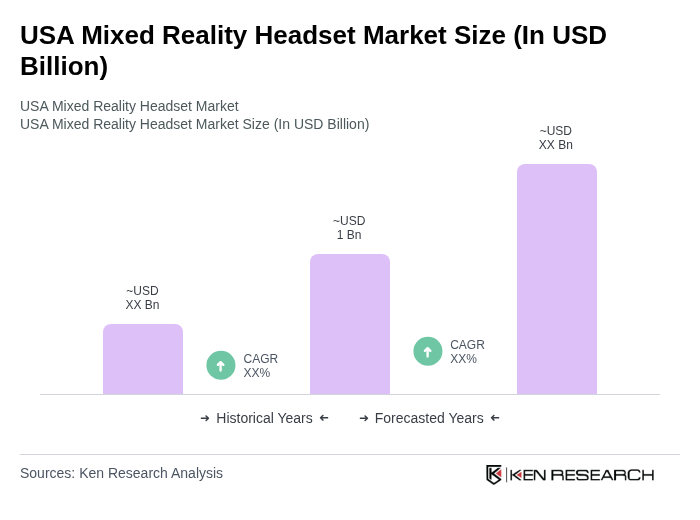
  • The USA Mixed Reality Headset Market is valued at USD 1 billion, based on recent analysis. The market gains momentum from the emergence of the metaverse, escalating demand for immersive gaming experiences, and the proliferation of 5G and IoT technologies that enhance headset performance and interconnectivity. Additionally, enterprise digital transformation and AI-powered tracking systems further catalyze adoption across diverse sectors.
  • Key players in this market include Meta Platforms, Microsoft, Apple, Magic Leap, Google, HTC, Samsung, Valve, Dell, and Vuzix. These companies play a significant role in driving growth and maintaining high standards in mixed reality innovation through hardware innovation, integrated platforms, and enterprise-grade solutions.
  • In 2024, the U.S. Army's Integrated Visual Augmentation System (IVAS) is transitioning from Microsoft to defense firm Anduril under a USD 22 billion mixed-reality headset program, aiming to enhance soldier situational awareness and AI-enabled capabilities.
USA Mixed Reality Headset Market Size

USA Mixed Reality Headset Market Segmentation

By Type:The mixed reality headset market is segmented into various types, including Augmented Reality Headsets, Virtual Reality Headsets, Mixed Reality Headsets, and Others. Among these, Augmented Reality Headsets are gaining significant traction due to their applications in gaming, education, and industrial training. The demand for immersive experiences in gaming and training environments is driving the growth of this segment, as users seek more interactive and engaging content.
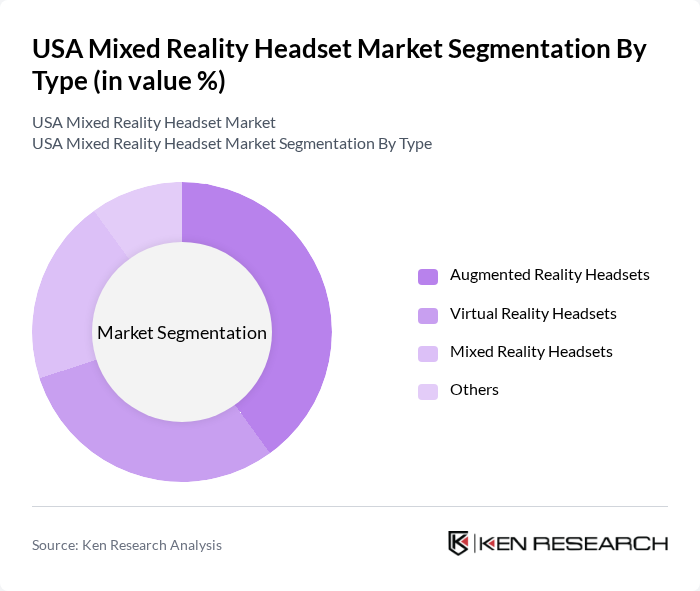
USA Mixed Reality Headset Market segmentation by Type.

By End-User:The end-user segmentation includes Gaming, Education, Healthcare, Corporate Training, and Others. The Gaming segment is the most dominant, driven by the increasing popularity of immersive gaming experiences. As gaming technology evolves, players are increasingly seeking headsets that provide enhanced realism and interactivity, leading to a surge in demand for mixed reality headsets tailored for gaming applications.
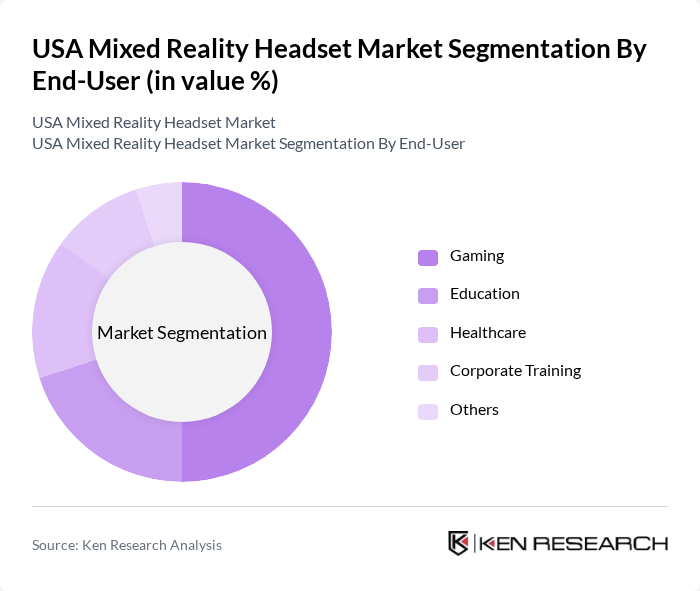
USA Mixed Reality Headset Market segmentation by End-User.

USA Mixed Reality Headset Market Competitive Landscape

The USA Mixed Reality Headset Market is characterized by a dynamic mix of regional and international players. Leading participants such as Microsoft, Oculus (Meta Platforms, Inc.), Sony Interactive Entertainment, HTC Corporation, Magic Leap, Varjo Technologies, Pimax, Lenovo, Samsung Electronics, Google, VIVE, Apple Inc., Snap Inc., Nreal, and Pico Interactive contribute to innovation, geographic expansion, and service delivery in this space.

Microsoft

1975

Redmond, Washington, USA

Meta Platforms, Inc. (Oculus)

2004

Menlo Park, California, USA

Sony Interactive Entertainment

1993

San Mateo, California, USA

HTC Corporation

1997

New Taipei City, Taiwan

Magic Leap

2010

Plantation, Florida, USA

Company

Establishment Year

Headquarters

Group Size (Large, Medium, or Small as per industry convention)

Revenue Growth Rate

Market Penetration Rate

Customer Retention Rate

Average Selling Price

Pricing Strategy

USA Mixed Reality Headset Market Industry Analysis

Growth Drivers

  • Increasing Demand for Immersive Experiences:The USA mixed reality headset market is driven by a growing consumer preference for immersive experiences, particularly in entertainment and gaming. In future, the entertainment sector is projected to generate approximately $800 billion, with a significant portion attributed to virtual and augmented reality experiences. This demand is further fueled by advancements in technology, which enhance user engagement and satisfaction, leading to increased sales of mixed reality headsets.
  • Advancements in Hardware Technology:Continuous improvements in hardware technology are propelling the mixed reality headset market forward. In future, the average processing power of headsets is expected to reach 8 teraflops, significantly enhancing graphics and performance. Additionally, the introduction of lightweight materials and ergonomic designs is making headsets more comfortable for extended use, thereby attracting a broader audience and increasing adoption rates across various demographics.
  • Expanding Applications in Various Industries:The versatility of mixed reality headsets is leading to their adoption across multiple sectors, including healthcare, education, and real estate. In future, the healthcare sector alone is anticipated to invest over $1.5 billion in mixed reality applications for training and patient care. This diversification of applications not only broadens the market base but also enhances the technology's perceived value, driving further growth in headset sales.

Market Challenges

  • High Cost of Advanced Headsets:One of the significant barriers to widespread adoption of mixed reality headsets is their high cost. In future, premium headsets are expected to retail for around $1,200, which limits accessibility for average consumers. This price point can deter potential buyers, particularly in a market where budget-friendly alternatives are available, thus hindering overall market growth and limiting the user base.
  • Limited Content Availability:The success of mixed reality headsets heavily relies on the availability of engaging content. As of future, it is estimated that only 30% of consumers find sufficient content to justify their purchase. This scarcity of high-quality applications and experiences can lead to consumer dissatisfaction and reduced interest in the technology, posing a challenge for manufacturers and developers aiming to expand their market reach.

USA Mixed Reality Headset Market Future Outlook

The future of the USA mixed reality headset market appears promising, driven by technological advancements and increasing consumer interest. As companies invest in developing more user-friendly interfaces and integrating artificial intelligence, the overall user experience is expected to improve significantly. Furthermore, the rise of social and collaborative experiences will likely enhance engagement, making mixed reality more appealing. This evolution will pave the way for broader adoption across various sectors, including education and healthcare, where immersive technologies can provide substantial benefits.

Market Opportunities

  • Growth in Enterprise Applications:The enterprise sector presents a significant opportunity for mixed reality headsets, with projected investments exceeding $2 billion in future. Companies are increasingly utilizing these technologies for training, remote collaboration, and design visualization, which can enhance productivity and reduce costs, making this a lucrative market segment for headset manufacturers.
  • Potential in Education and Training Sectors:The education sector is poised for substantial growth in mixed reality applications, with an estimated investment of $1 billion in future. Schools and universities are adopting these technologies to create immersive learning environments, which can improve student engagement and retention. This trend represents a significant opportunity for headset developers to cater to educational institutions seeking innovative teaching tools.

Scope of the Report

SegmentSub-Segments
By Type

Augmented Reality Headsets

Virtual Reality Headsets

Mixed Reality Headsets

Others

By End-User

Gaming

Education

Healthcare

Corporate Training

Others

By Application

Entertainment

Industrial Training

Remote Collaboration

Simulation and Modeling

Others

By Distribution Channel

Online Retail

Offline Retail

Direct Sales

Others

By Region

Northeast

Midwest

South

West

By Price Range

Budget

Mid-Range

Premium

Others

By Brand

Established Brands

Emerging Brands

Private Labels

Others

Key Target Audience

Investors and Venture Capitalist Firms

Government and Regulatory Bodies (e.g., Federal Communications Commission, National Institute of Standards and Technology)

Manufacturers and Producers

Distributors and Retailers

Telecommunications Companies

Healthcare Providers and Institutions

Defense and Military Agencies (e.g., Department of Defense)

Technology Providers and Software Developers

Players Mentioned in the Report:

Microsoft

Oculus (Meta Platforms, Inc.)

Sony Interactive Entertainment

HTC Corporation

Magic Leap

Varjo Technologies

Pimax

Lenovo

Samsung Electronics

Google

VIVE

Apple Inc.

Snap Inc.

Nreal

Pico Interactive

Table of Contents

Market Assessment Phase

1. Executive Summary and Approach


2. USA Mixed Reality Headset Market Overview

2.1 Key Insights and Strategic Recommendations

2.2 USA Mixed Reality Headset Market Overview

2.3 Definition and Scope

2.4 Evolution of Market Ecosystem

2.5 Timeline of Key Regulatory Milestones

2.6 Value Chain & Stakeholder Mapping

2.7 Business Cycle Analysis

2.8 Policy & Incentive Landscape


3. USA Mixed Reality Headset Market Analysis

3.1 Growth Drivers

3.1.1 Increasing demand for immersive experiences
3.1.2 Advancements in hardware technology
3.1.3 Expanding applications in various industries
3.1.4 Rising consumer interest in gaming and entertainment

3.2 Market Challenges

3.2.1 High cost of advanced headsets
3.2.2 Limited content availability
3.2.3 Technical issues and user experience concerns
3.2.4 Competition from alternative technologies

3.3 Market Opportunities

3.3.1 Growth in enterprise applications
3.3.2 Potential in education and training sectors
3.3.3 Collaborations with software developers
3.3.4 Expansion into healthcare applications

3.4 Market Trends

3.4.1 Increasing integration of AI in mixed reality
3.4.2 Rise of social and collaborative experiences
3.4.3 Focus on user-friendly interfaces
3.4.4 Growth of standalone headsets

3.5 Government Regulation

3.5.1 Data privacy regulations impacting user data
3.5.2 Safety standards for hardware
3.5.3 Intellectual property laws affecting content
3.5.4 Compliance with accessibility standards

4. SWOT Analysis


5. Stakeholder Analysis


6. Porter's Five Forces Analysis


7. USA Mixed Reality Headset Market Market Size, 2019-2024

7.1 By Value

7.2 By Volume

7.3 By Average Selling Price


8. USA Mixed Reality Headset Market Segmentation

8.1 By Type

8.1.1 Augmented Reality Headsets
8.1.2 Virtual Reality Headsets
8.1.3 Mixed Reality Headsets
8.1.4 Others

8.2 By End-User

8.2.1 Gaming
8.2.2 Education
8.2.3 Healthcare
8.2.4 Corporate Training
8.2.5 Others

8.3 By Application

8.3.1 Entertainment
8.3.2 Industrial Training
8.3.3 Remote Collaboration
8.3.4 Simulation and Modeling
8.3.5 Others

8.4 By Distribution Channel

8.4.1 Online Retail
8.4.2 Offline Retail
8.4.3 Direct Sales
8.4.4 Others

8.5 By Region

8.5.1 Northeast
8.5.2 Midwest
8.5.3 South
8.5.4 West

8.6 By Price Range

8.6.1 Budget
8.6.2 Mid-Range
8.6.3 Premium
8.6.4 Others

8.7 By Brand

8.7.1 Established Brands
8.7.2 Emerging Brands
8.7.3 Private Labels
8.7.4 Others

9. USA Mixed Reality Headset Market Competitive Analysis

9.1 Market Share of Key Players

9.2 Cross Comparison of Key Players

9.2.1 Company Name
9.2.2 Group Size (Large, Medium, or Small as per industry convention)
9.2.3 Revenue Growth Rate
9.2.4 Market Penetration Rate
9.2.5 Customer Retention Rate
9.2.6 Average Selling Price
9.2.7 Pricing Strategy
9.2.8 Product Innovation Rate
9.2.9 Distribution Efficiency
9.2.10 Brand Recognition Score

9.3 SWOT Analysis of Top Players

9.4 Pricing Analysis

9.5 Detailed Profile of Major Companies

9.5.1 Microsoft
9.5.2 Oculus (Meta Platforms, Inc.)
9.5.3 Sony Interactive Entertainment
9.5.4 HTC Corporation
9.5.5 Magic Leap
9.5.6 Varjo Technologies
9.5.7 Pimax
9.5.8 Lenovo
9.5.9 Samsung Electronics
9.5.10 Google
9.5.11 VIVE
9.5.12 Apple Inc.
9.5.13 Snap Inc.
9.5.14 Nreal
9.5.15 Pico Interactive

10. USA Mixed Reality Headset Market End-User Analysis

10.1 Procurement Behavior of Key Ministries

10.1.1 Government procurement processes
10.1.2 Budget allocation for technology
10.1.3 Evaluation criteria for procurement
10.1.4 Adoption timelines

10.2 Corporate Spend on Infrastructure & Energy

10.2.1 Investment trends in technology
10.2.2 Budgeting for mixed reality solutions
10.2.3 Cost-benefit analysis
10.2.4 Long-term financial commitments

10.3 Pain Point Analysis by End-User Category

10.3.1 Challenges faced by gamers
10.3.2 Issues in corporate training
10.3.3 Barriers in healthcare applications
10.3.4 Limitations in educational use

10.4 User Readiness for Adoption

10.4.1 Awareness of mixed reality technology
10.4.2 Training and support needs
10.4.3 User experience expectations
10.4.4 Feedback mechanisms

10.5 Post-Deployment ROI and Use Case Expansion

10.5.1 Measuring ROI in gaming
10.5.2 Evaluating training effectiveness
10.5.3 Expanding use cases in healthcare
10.5.4 Long-term benefits analysis

11. USA Mixed Reality Headset Market Future Size, 2025-2030

11.1 By Value

11.2 By Volume

11.3 By Average Selling Price


Go-To-Market Strategy Phase

1. Whitespace Analysis + Business Model Canvas

1.1 Market gaps identification

1.2 Business model development


2. Marketing and Positioning Recommendations

2.1 Branding strategies

2.2 Product USPs


3. Distribution Plan

3.1 Urban retail vs rural NGO tie-ups


4. Channel & Pricing Gaps

4.1 Underserved routes

4.2 Pricing bands


5. Unmet Demand & Latent Needs

5.1 Category gaps

5.2 Consumer segments


6. Customer Relationship

6.1 Loyalty programs

6.2 After-sales service


7. Value Proposition

7.1 Sustainability

7.2 Integrated supply chains


8. Key Activities

8.1 Regulatory compliance

8.2 Branding

8.3 Distribution setup


9. Entry Strategy Evaluation

9.1 Domestic Market Entry Strategy

9.1.1 Product mix
9.1.2 Pricing band
9.1.3 Packaging

9.2 Export Entry Strategy

9.2.1 Target countries
9.2.2 Compliance roadmap

10. Entry Mode Assessment

10.1 JV

10.2 Greenfield

10.3 M&A

10.4 Distributor Model


11. Capital and Timeline Estimation

11.1 Capital requirements

11.2 Timelines


12. Control vs Risk Trade-Off

12.1 Ownership vs Partnerships


13. Profitability Outlook

13.1 Breakeven analysis

13.2 Long-term sustainability


14. Potential Partner List

14.1 Distributors

14.2 JVs

14.3 Acquisition targets


15. Execution Roadmap

15.1 Phased Plan for Market Entry

15.1.1 Market Setup
15.1.2 Market Entry
15.1.3 Growth Acceleration
15.1.4 Scale & Stabilize

15.2 Key Activities and Milestones

15.2.1 Milestone tracking
15.2.2 Activity scheduling

Research Methodology

ApproachModellingSample

Phase 1: Approach1

Desk Research

  • Market reports from industry associations and research firms focusing on mixed reality technologies
  • Analysis of consumer electronics sales data from government and trade publications
  • Review of academic papers and white papers on mixed reality applications and trends

Primary Research

  • Interviews with product managers at leading mixed reality headset manufacturers
  • Surveys with end-users in gaming, education, and enterprise sectors
  • Focus groups with technology enthusiasts and early adopters of mixed reality devices

Validation & Triangulation

  • Cross-validation of findings through multiple data sources including sales figures and user feedback
  • Triangulation of insights from industry experts, market analysts, and consumer surveys
  • Sanity checks through expert panel discussions and feedback loops

Phase 2: Market Size Estimation1

Top-down Assessment

  • Estimation of total addressable market (TAM) based on overall consumer electronics market size
  • Segmentation by application areas such as gaming, training, and healthcare
  • Incorporation of growth rates from related technology sectors like AR and VR

Bottom-up Modeling

  • Volume estimates based on unit sales data from major mixed reality headset vendors
  • Pricing analysis to determine average selling prices across different headset models
  • Calculation of market size using unit sales multiplied by average selling price

Forecasting & Scenario Analysis

  • Multi-variable forecasting using trends in consumer adoption and technological advancements
  • Scenario analysis based on potential regulatory impacts and market disruptions
  • Development of baseline, optimistic, and pessimistic market growth scenarios through 2030

Phase 3: CATI Sample Composition1

Scope Item/SegmentSample SizeTarget Respondent Profiles
Gaming Sector Users150Gamers, Game Developers, Retail Managers
Enterprise Training Programs100HR Managers, Training Coordinators, IT Directors
Healthcare Applications80Medical Professionals, Healthcare Administrators
Education Sector Implementations70Educators, School Administrators, Technology Coordinators
Consumer Electronics Retailers90Store Managers, Sales Representatives, Product Specialists

Frequently Asked Questions

What is the current value of the USA Mixed Reality Headset Market?

The USA Mixed Reality Headset Market is currently valued at approximately USD 1 billion. This valuation reflects the growing interest in immersive technologies, driven by advancements in the metaverse, gaming, and enhanced connectivity through 5G and IoT technologies.

Who are the key players in the USA Mixed Reality Headset Market?

What are the main types of mixed reality headsets available?

Which sectors are driving the demand for mixed reality headsets?

Other Regional/Country Reports

Why Buy From Us?

Refine Robust Result (RRR) Framework

What makes us stand out is that our consultants follow Robust, Refine and Result (RRR) methodology. Robust for clear definitions, approaches and sanity checking, Refine for differentiating respondents' facts and opinions, and Result for presenting data with story.

Our Reach Is Unmatched

We have set a benchmark in the industry by offering our clients with syndicated and customized market research reports featuring coverage of entire market as well as meticulous research and analyst insights.

Shifting the Research Paradigm

While we don't replace traditional research, we flip the method upside down. Our dual approach of Top Bottom & Bottom Top ensures quality deliverable by not just verifying company fundamentals but also looking at the sector and macroeconomic factors.

More Insights-Better Decisions

With one step in the future, our research team constantly tries to show you the bigger picture. We help with some of the tough questions you may encounter along the way: How is the industry positioned? Best marketing channel? KPI's of competitors? By aligning every element, we help maximize success.

Transparency and Trust

Our report gives you instant access to the answers and sources that other companies might choose to hide. We elaborate each steps of research methodology we have used and showcase you the sample size to earn your trust.

Round the Clock Support

If you need any support, we are here! We pride ourselves on universe strength, data quality, and quick, friendly, and professional service.

Why Clients Choose Us?

400000+
Reports in repository
150+
Consulting projects a year
100+
Analysts
8000+
Client Queries in 2022








