Vietnam Graphics Card Market Report Size Share Growth Drivers Trends Opportunities & Forecast 2025–2030

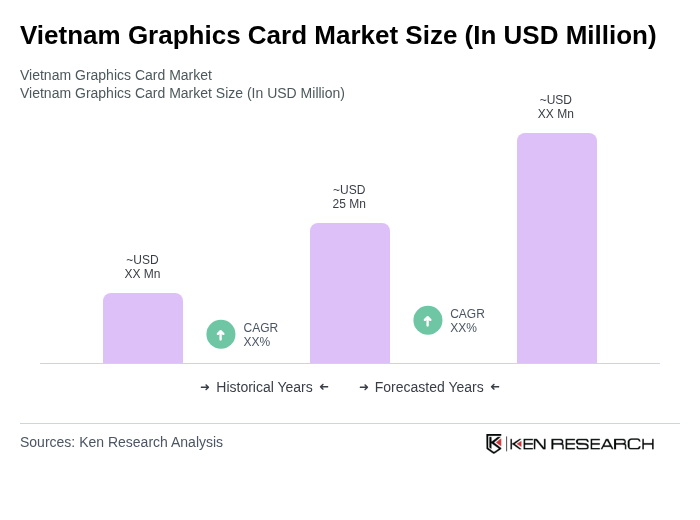
Vietnam graphics card market, valued at USD 25 million, grows due to rising gaming culture, cryptocurrency mining, and e-sports expansion amid digital economy advancements.

Region:Asia

Author(s):Rebecca

Product Code:KRAA6427

Pages:88

Published On:January 2026
About the Report

Base Year 2024

Vietnam Graphics Card Market Overview

  • The Vietnam Graphics Card Market is valued at USD 25 million, based on a five-year historical analysis. This growth is primarily driven by the increasing demand for high-performance computing in gaming, content creation, and artificial intelligence applications. The rise in e-sports and gaming culture, coupled with the expansion of the digital economy, widespread smartphone adoption, and 5G connectivity rollout has significantly contributed to the market's expansion.
  • Key cities such as Ho Chi Minh City and Hanoi dominate the market due to their robust technology infrastructure, high population density, and a growing number of tech-savvy consumers. These urban centers are also home to numerous gaming cafes and tech retailers, which further stimulate demand for graphics cards.
  • The National Energy Efficiency Program for Electronic and IT Products, 2020 issued by the Ministry of Industry and Trade requires graphics cards and related computing devices to meet minimum energy performance standards (MEPS) for power consumption, with compliance verified through mandatory labeling and testing for products above 75W TDP thresholds sold in commercial and consumer channels.
Vietnam Graphics Card Market Size

Vietnam Graphics Card Market Segmentation

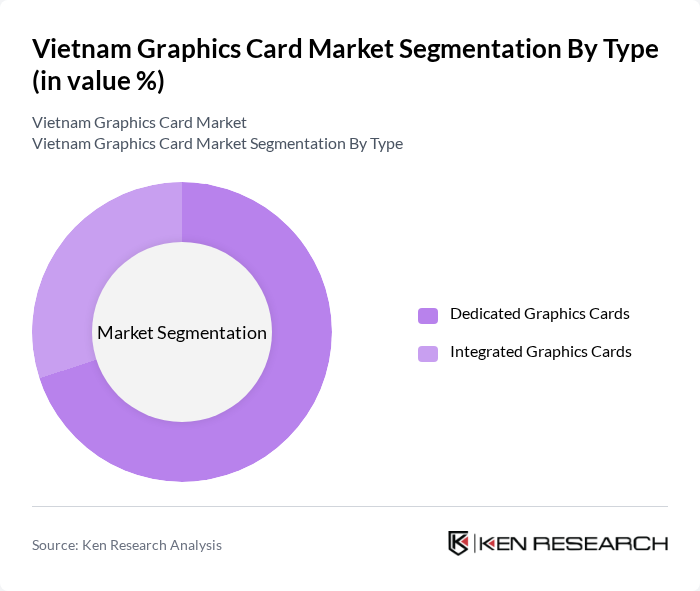
By Type:The market is segmented into dedicated graphics cards and integrated graphics cards. Dedicated graphics cards are preferred by gaming enthusiasts and professionals due to their superior performance and capabilities. Integrated graphics cards, while less powerful, are often sufficient for casual users and are commonly found in laptops and budget desktops.
Vietnam Graphics Card Market segmentation by Type.

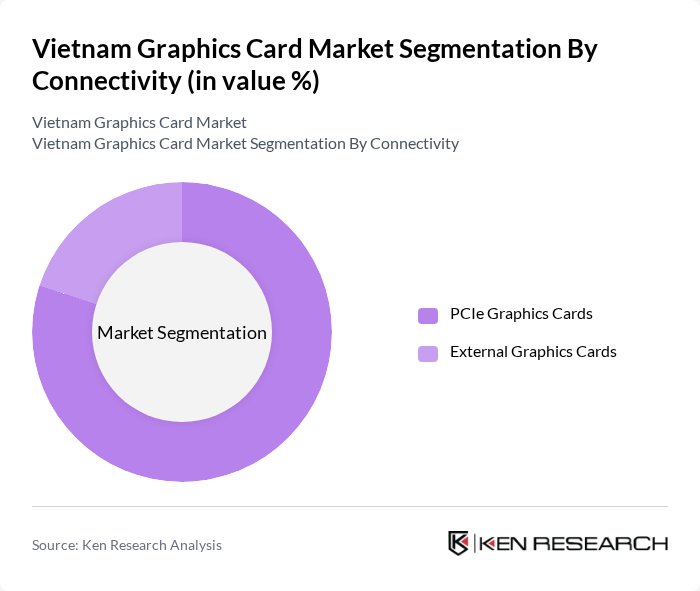
By Connectivity:The connectivity segment includes PCIe graphics cards and external graphics cards. PCIe graphics cards dominate the market due to their high performance and compatibility with most modern motherboards. External graphics cards are gaining traction among users who require portability and flexibility, particularly in gaming laptops and mobile workstations.
Vietnam Graphics Card Market segmentation by Connectivity.

Vietnam Graphics Card Market Competitive Landscape

The Vietnam Graphics Card Market is characterized by a dynamic mix of regional and international players. Leading participants such as NVIDIA Corporation, AMD (Advanced Micro Devices, Inc.), ASUS (ASUSTeK Computer Inc.), MSI (Micro-Star International Co., Ltd.), Gigabyte Technology Co., Ltd., EVGA Corporation, Zotac, Palit Microsystems, Sapphire Technology, XFX, Inno3D, Colorful Technology, PNY Technologies, Biostar, Gainward contribute to innovation, geographic expansion, and service delivery in this space.

NVIDIA Corporation

1993

Santa Clara, California, USA

AMD (Advanced Micro Devices, Inc.)

1969

Santa Clara, California, USA

ASUS (ASUSTeK Computer Inc.)

1989

Taipei, Taiwan

MSI (Micro-Star International Co., Ltd.)

1986

New Taipei City, Taiwan

Gigabyte Technology Co., Ltd.

1986

New Taipei City, Taiwan

Company

Establishment Year

Headquarters

Market Share (%)

Revenue Growth Rate (CAGR %)

EBITDA Margin (%)

Market Penetration Rate (%)

R&D Investment as % of Revenue

Customer Acquisition Cost (CAC)

Vietnam Graphics Card Market Industry Analysis

Growth Drivers

  • Increasing Demand for Gaming:The gaming industry in Vietnam is projected to reach a value of approximately $1.5 billion in future, driven by a growing population of over 98 million, with 60% under 30 years old. This demographic shift fuels demand for high-performance graphics cards, as gamers seek enhanced experiences. Additionally, the number of gamers in Vietnam is expected to exceed 32 million, further propelling the need for advanced graphics technology to support immersive gameplay and high-resolution graphics.
  • Rise in Cryptocurrency Mining Activities:Vietnam's cryptocurrency market has seen significant growth, with an estimated 1.6 million active cryptocurrency users in future. The demand for graphics cards in mining operations is substantial, as high-performance GPUs are essential for efficient mining. The estimated revenue from cryptocurrency mining in Vietnam could reach $500 million in future, highlighting the critical role of graphics cards in this burgeoning sector and driving market growth.
  • Expansion of eSports and Gaming Tournaments:The eSports industry in Vietnam is rapidly expanding, with revenues projected to reach $210 million in future. Major tournaments attract thousands of participants and viewers, creating a robust ecosystem for gaming. This growth drives demand for high-quality graphics cards, as competitive gamers require superior performance for optimal gameplay. The increasing popularity of eSports is expected to further stimulate the graphics card market, as sponsors and investors pour resources into this lucrative sector.

Market Challenges

  • Supply Chain Disruptions:The Vietnam graphics card market faces significant supply chain challenges, exacerbated by global semiconductor shortages. In future, the average lead time for graphics card components increased by 30%, impacting production schedules. These disruptions have led to inventory shortages, causing delays in product availability and increased prices. As a result, manufacturers struggle to meet the rising demand, hindering market growth and affecting consumer access to high-performance graphics solutions.
  • High Import Tariffs and Taxes:Vietnam imposes import tariffs on electronic components, including graphics cards, which can reach up to 20%. This regulatory environment increases the cost of imported graphics cards, making them less accessible to consumers and businesses. In future, the total tax burden on imported electronics is projected to exceed $300 million, further complicating market dynamics. These financial barriers can stifle competition and limit the growth potential of the graphics card market in Vietnam.

Vietnam Graphics Card Market Future Outlook

The Vietnam graphics card market is poised for significant evolution, driven by technological advancements and changing consumer preferences. The integration of artificial intelligence in graphics processing is expected to enhance performance and efficiency, while the shift towards cloud gaming solutions will redefine how consumers access gaming experiences. Additionally, the growing popularity of virtual and augmented reality applications will create new demand for high-performance graphics cards, ensuring a dynamic and competitive landscape in the coming years.

Market Opportunities

  • Development of Local Assembly Plants:Establishing local assembly plants for graphics cards could significantly reduce import costs and lead times. With Vietnam's strategic location and growing manufacturing capabilities, this opportunity could enhance market competitiveness and foster innovation, potentially creating thousands of jobs in the tech sector.
  • Partnerships with Gaming Companies:Collaborating with local gaming companies can create tailored graphics solutions that meet specific market needs. Such partnerships could drive innovation and enhance product offerings, positioning companies to capture a larger share of the rapidly growing gaming market in Vietnam, which is expected to expand significantly in the next few years.

Scope of the Report

SegmentSub-Segments
By Type

Dedicated Graphics Cards

Integrated Graphics Cards

By Connectivity

PCIe Graphics Cards

External Graphics Cards

By End-User

Gaming Enthusiasts

Professionals

Casual Users

By Application

Gaming

Content Creation and Multimedia Editing

Virtual Reality (VR) and Augmented Reality (AR)

AI and Machine Learning

By Region

Northern Vietnam

Southern Vietnam

Central Vietnam

Key Target Audience

Investors and Venture Capitalist Firms

Government and Regulatory Bodies (e.g., Ministry of Industry and Trade, Ministry of Information and Communications)

Manufacturers and Producers

Distributors and Retailers

Gaming and E-sports Organizations

Technology Providers

Industry Associations (e.g., Vietnam Electronics Industries Association)

Financial Institutions

Players Mentioned in the Report:

NVIDIA Corporation

AMD (Advanced Micro Devices, Inc.)

ASUS (ASUSTeK Computer Inc.)

MSI (Micro-Star International Co., Ltd.)

Gigabyte Technology Co., Ltd.

EVGA Corporation

Zotac

Palit Microsystems

Sapphire Technology

XFX

Inno3D

Colorful Technology

PNY Technologies

Biostar

Gainward

Table of Contents

Market Assessment Phase

1. Executive Summary and Approach


2. Vietnam Graphics Card Market Overview

2.1 Key Insights and Strategic Recommendations

2.2 Vietnam Graphics Card Market Overview

2.3 Definition and Scope

2.4 Evolution of Market Ecosystem

2.5 Timeline of Key Regulatory Milestones

2.6 Value Chain & Stakeholder Mapping

2.7 Business Cycle Analysis

2.8 Policy & Incentive Landscape


3. Vietnam Graphics Card Market Analysis

3.1 Growth Drivers

3.1.1 Increasing demand for gaming and high-performance computing
3.1.2 Rise in cryptocurrency mining activities
3.1.3 Expansion of eSports and gaming tournaments
3.1.4 Growth in digital content creation and streaming

3.2 Market Challenges

3.2.1 Supply chain disruptions
3.2.2 High import tariffs and taxes
3.2.3 Rapid technological advancements
3.2.4 Limited local manufacturing capabilities

3.3 Market Opportunities

3.3.1 Development of local assembly plants
3.3.2 Partnerships with gaming companies
3.3.3 Introduction of eco-friendly graphics cards
3.3.4 Expansion into rural markets

3.4 Market Trends

3.4.1 Increasing integration of AI in graphics processing
3.4.2 Shift towards cloud gaming solutions
3.4.3 Growing popularity of VR and AR applications
3.4.4 Enhanced focus on energy efficiency

3.5 Government Regulation

3.5.1 Import regulations on electronic components
3.5.2 Environmental compliance standards
3.5.3 Tax incentives for local manufacturing
3.5.4 Consumer protection laws related to electronics

4. SWOT Analysis


5. Stakeholder Analysis


6. Porter's Five Forces Analysis


7. Vietnam Graphics Card Market Market Size, 2019-2024

7.1 By Value

7.2 By Volume

7.3 By Average Selling Price


8. Vietnam Graphics Card Market Segmentation

8.1 By Type

8.1.1 Dedicated Graphics Cards
8.1.2 Integrated Graphics Cards

8.2 By Connectivity

8.2.1 PCIe Graphics Cards
8.2.2 External Graphics Cards

8.3 By End-User

8.3.1 Gaming Enthusiasts
8.3.2 Professionals
8.3.3 Casual Users

8.4 By Application

8.4.1 Gaming
8.4.2 Content Creation and Multimedia Editing
8.4.3 Virtual Reality (VR) and Augmented Reality (AR)
8.4.4 AI and Machine Learning

8.5 By Region

8.5.1 Northern Vietnam
8.5.2 Southern Vietnam
8.5.3 Central Vietnam

9. Vietnam Graphics Card Market Competitive Analysis

9.1 Market Share of Key Players

9.2 Cross Comparison of Key Players

9.2.1 Company Name
9.2.2 Market Share (%)
9.2.3 Revenue Growth Rate (CAGR %)
9.2.4 EBITDA Margin (%)
9.2.5 Market Penetration Rate (%)
9.2.6 R&D Investment as % of Revenue
9.2.7 Customer Acquisition Cost (CAC)
9.2.8 Net Promoter Score (NPS)
9.2.9 Patent Portfolio Size
9.2.10 Distribution Network Coverage (%)

9.3 SWOT Analysis of Top Players

9.4 Pricing Analysis

9.5 Detailed Profile of Major Companies

9.5.1 NVIDIA Corporation
9.5.2 AMD (Advanced Micro Devices, Inc.)
9.5.3 ASUS (ASUSTeK Computer Inc.)
9.5.4 MSI (Micro-Star International Co., Ltd.)
9.5.5 Gigabyte Technology Co., Ltd.
9.5.6 EVGA Corporation
9.5.7 Zotac
9.5.8 Palit Microsystems
9.5.9 Sapphire Technology
9.5.10 XFX
9.5.11 Inno3D
9.5.12 Colorful Technology
9.5.13 PNY Technologies
9.5.14 Biostar
9.5.15 Gainward

10. Vietnam Graphics Card Market End-User Analysis

10.1 Procurement Behavior of Key Ministries

10.1.1 Budget Allocation Trends
10.1.2 Procurement Processes
10.1.3 Preferred Suppliers
10.1.4 Compliance Requirements

10.2 Corporate Spend on Infrastructure & Energy

10.2.1 Investment Trends in IT Infrastructure
10.2.2 Spending on Graphics Solutions
10.2.3 Budgeting for Upgrades

10.3 Pain Point Analysis by End-User Category

10.3.1 Performance Limitations
10.3.2 Cost Constraints
10.3.3 Availability of Latest Technology

10.4 User Readiness for Adoption

10.4.1 Awareness of New Technologies
10.4.2 Training and Support Needs

10.5 Post-Deployment ROI and Use Case Expansion

10.5.1 Measurement of ROI
10.5.2 Expansion into New Use Cases

11. Vietnam Graphics Card Market Future Size, 2025-2030

11.1 By Value

11.2 By Volume

11.3 By Average Selling Price


Go-To-Market Strategy Phase

1. Whitespace Analysis + Business Model Canvas

1.1 Market Gaps Identification

1.2 Business Model Development


2. Marketing and Positioning Recommendations

2.1 Branding Strategies

2.2 Product USPs


3. Distribution Plan

3.1 Urban Retail Strategies

3.2 Rural NGO Tie-ups


4. Channel & Pricing Gaps

4.1 Underserved Routes

4.2 Pricing Bands Analysis


5. Unmet Demand & Latent Needs

5.1 Category Gaps

5.2 Consumer Segments


6. Customer Relationship

6.1 Loyalty Programs

6.2 After-sales Service


7. Value Proposition

7.1 Sustainability Initiatives

7.2 Integrated Supply Chains


8. Key Activities

8.1 Regulatory Compliance

8.2 Branding Efforts

8.3 Distribution Setup


9. Entry Strategy Evaluation

9.1 Domestic Market Entry Strategy

9.1.1 Product Mix Considerations
9.1.2 Pricing Band Strategy
9.1.3 Packaging Approaches

9.2 Export Entry Strategy

9.2.1 Target Countries
9.2.2 Compliance Roadmap

10. Entry Mode Assessment

10.1 Joint Ventures

10.2 Greenfield Investments

10.3 Mergers & Acquisitions

10.4 Distributor Model


11. Capital and Timeline Estimation

11.1 Capital Requirements

11.2 Timelines for Market Entry


12. Control vs Risk Trade-Off

12.1 Ownership Considerations

12.2 Partnerships Evaluation


13. Profitability Outlook

13.1 Breakeven Analysis

13.2 Long-term Sustainability


14. Potential Partner List

14.1 Distributors

14.2 Joint Ventures

14.3 Acquisition Targets


15. Execution Roadmap

15.1 Phased Plan for Market Entry

15.1.1 Market Setup
15.1.2 Market Entry
15.1.3 Growth Acceleration
15.1.4 Scale & Stabilize

15.2 Key Activities and Milestones

15.2.1 Milestone Planning

Research Methodology

ApproachModellingSample

Phase 1: Approach1

Desk Research

  • Analysis of market reports from industry associations and government publications
  • Review of online sales data from major e-commerce platforms in Vietnam
  • Examination of consumer behavior studies and technology adoption reports

Primary Research

  • Interviews with key stakeholders in the graphics card supply chain, including manufacturers and distributors
  • Surveys targeting end-users, such as gamers and professionals in graphic design
  • Focus group discussions with tech enthusiasts to gather insights on preferences and trends

Validation & Triangulation

  • Cross-validation of findings with sales data from leading retailers and distributors
  • Triangulation of consumer insights with expert opinions from industry analysts
  • Sanity checks through feedback from technology forums and online communities

Phase 2: Market Size Estimation1

Top-down Assessment

  • Estimation of total market size based on national electronics sales data
  • Segmentation by product type, including gaming, professional, and integrated graphics cards
  • Incorporation of growth rates from related sectors, such as gaming and digital content creation

Bottom-up Modeling

  • Collection of sales volume data from major graphics card retailers in Vietnam
  • Analysis of pricing trends across different graphics card segments
  • Estimation of market share for leading brands based on sales data and consumer surveys

Forecasting & Scenario Analysis

  • Multi-factor regression analysis incorporating gaming industry growth and technological advancements
  • Scenario modeling based on potential regulatory changes and import tariffs
  • Development of baseline, optimistic, and pessimistic forecasts through 2028

Phase 3: CATI Sample Composition1

Scope Item/SegmentSample SizeTarget Respondent Profiles
Gaming Graphics Card Users120Casual Gamers, Professional Gamers
Graphic Design Professionals100Freelancers, Agency Designers
IT Hardware Retailers80Store Managers, Sales Representatives
Online Marketplace Sellers70E-commerce Managers, Product Listing Specialists
Tech Enthusiasts and Influencers60Bloggers, YouTubers, Social Media Influencers

Frequently Asked Questions

What is the current value of the Vietnam Graphics Card Market?

The Vietnam Graphics Card Market is valued at approximately USD 25 million, reflecting a five-year historical analysis. This growth is driven by increasing demand for high-performance computing in gaming, content creation, and artificial intelligence applications.

Which cities are the main hubs for the graphics card market in Vietnam?

What are the main types of graphics cards available in Vietnam?

How does connectivity impact the graphics card market in Vietnam?

Other Adjacent Reports

Kuwait Gaming Hardware Market

UAE Cloud Gaming Market Report Size Share Growth Drivers Trends Opportunities & Forecast 2025–2030

Malaysia eSports Market

Indonesia Cryptocurrency Mining Market

KSA Artificial Intelligence Hardware Market

Belgium High-Performance Computing Market

UAE Semiconductor Market Outlook to 2030Global Virtual Reality MarketAPAC augmented reality market Size, Share, Growth Drivers, Trends, Opportunities & Forecast 2025–2030

UAE Computer Components Market

Why Buy From Us?

Refine Robust Result (RRR) Framework

What makes us stand out is that our consultants follow Robust, Refine and Result (RRR) methodology. Robust for clear definitions, approaches and sanity checking, Refine for differentiating respondents' facts and opinions, and Result for presenting data with story.

Our Reach Is Unmatched

We have set a benchmark in the industry by offering our clients with syndicated and customized market research reports featuring coverage of entire market as well as meticulous research and analyst insights.

Shifting the Research Paradigm

While we don't replace traditional research, we flip the method upside down. Our dual approach of Top Bottom & Bottom Top ensures quality deliverable by not just verifying company fundamentals but also looking at the sector and macroeconomic factors.

More Insights-Better Decisions

With one step in the future, our research team constantly tries to show you the bigger picture. We help with some of the tough questions you may encounter along the way: How is the industry positioned? Best marketing channel? KPI's of competitors? By aligning every element, we help maximize success.

Transparency and Trust

Our report gives you instant access to the answers and sources that other companies might choose to hide. We elaborate each steps of research methodology we have used and showcase you the sample size to earn your trust.

Round the Clock Support

If you need any support, we are here! We pride ourselves on universe strength, data quality, and quick, friendly, and professional service.

Why Clients Choose Us?

400000+
Reports in repository
150+
Consulting projects a year
100+
Analysts
8000+
Client Queries in 2022








