Vietnam Modular Construction Market Report Size Share Growth Drivers Trends Opportunities & Forecast 2025–2030

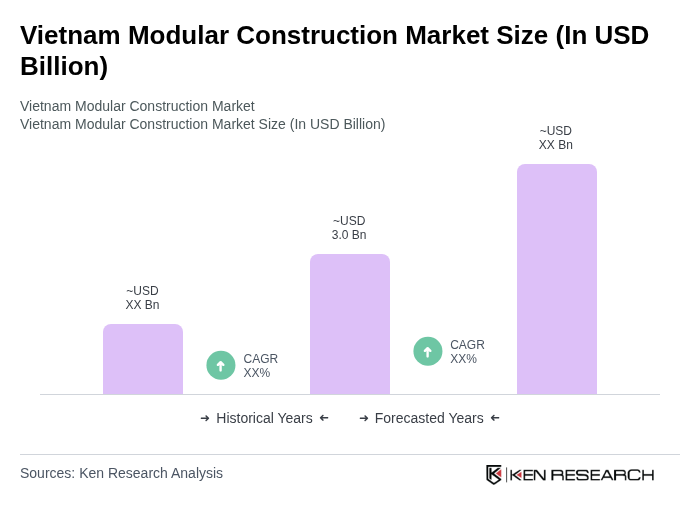
Vietnam modular construction market, valued at USD 3.0 billion, is growing due to rapid urbanization, social housing needs, and prefabricated solutions in key cities like Ho Chi Minh City and Hanoi.

Region:Asia

Author(s):Rebecca

Product Code:KRAB2041

Pages:88

Published On:January 2026
About the Report

Base Year 2024

Vietnam Modular Construction Market Overview

  • The Vietnam Modular Construction Market is valued at USD 3.0 billion, based on a five-year historical analysis of the broader prefabricated buildings and prefabricated house markets, where modular construction represents a leading share by product type. This growth is primarily driven by rapid urbanization, increasing demand for affordable and social housing, and government initiatives promoting industrialized, time-efficient building methods. The market has seen a significant rise in modular and other prefabricated building projects, which offer cost-effective, faster project delivery and better quality control to meet the growing residential, industrial park, and tourism infrastructure needs.
  • Key cities such as Ho Chi Minh City and Hanoi dominate the market due to their high population density, concentration of economic activities, and ongoing urban development projects. Ho Chi Minh City, in particular, accounts for the largest share of construction and prefabricated building activity in Vietnam, supported by extensive foreign direct investment, industrial parks, logistics hubs, and large-scale mixed-use and housing developments. These urban centers are experiencing a surge in demand for residential, commercial, and worker dormitory projects, making them pivotal in the modular construction landscape and reinforcing their market dominance.
  • In 2023, the Vietnamese government strengthened the policy framework supporting industrialized and prefabricated construction through implementation of the National Housing Development Strategy and social housing programs under Resolution 11/NQ-CP and subsequent decisions of the Prime Minister. These instruments, overseen by the Ministry of Construction, encourage the use of prefabricated and modular solutions for social and worker housing, including streamlined permitting, land allocation priorities, and access to preferential credit for compliant projects. The initiative is part of a broader strategy to enhance construction productivity, accelerate delivery of one million social housing units, and reduce environmental impacts through factory-based production and more efficient resource use, thereby fostering a more sustainable urban development framework.
Vietnam Modular Construction Market Size

Vietnam Modular Construction Market Segmentation

By Construction Method:The construction method segmentation includes various approaches to modular construction, each with unique characteristics and applications. The subsegments are Volumetric Modular Buildings, Panelized & Componentized Systems, Hybrid Modular Systems, and Other Prefabricated Types. Modular buildings account for the leading share of Vietnam’s prefabricated buildings market by product type, reflecting strong adoption of volumetric and other modular formats for social housing, worker dormitories, and fast-track commercial projects. Volumetric Modular Buildings are gaining traction due to their high degree of factory completion, predictable quality, and speed of assembly, making them a preferred choice for residential, education, healthcare, and hospitality developments that require rapid deployment.
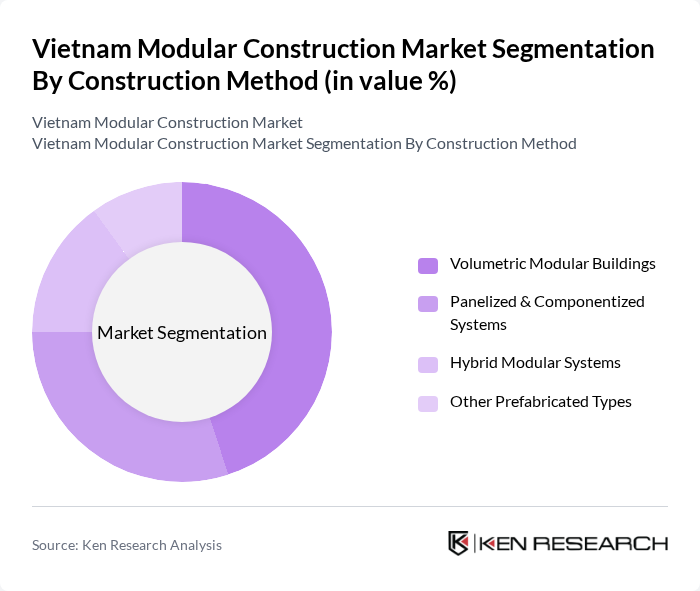
Vietnam Modular Construction Market segmentation by Construction Method.

By Application:The application segmentation encompasses various sectors where modular construction is utilized, including Residential, Commercial, Industrial & Logistics, Social Infrastructure, and Others. Residential applications, especially social and affordable housing, currently account for the largest share of Vietnam’s prefabricated and modular building demand, reflecting the government’s target of delivering around one million social housing units and addressing an affordable housing deficit. This demand is driven by population growth, urban migration, and the need to shorten construction timelines in major cities, making residential projects a focal point for modular construction initiatives, followed by commercial buildings and worker accommodations in industrial parks.
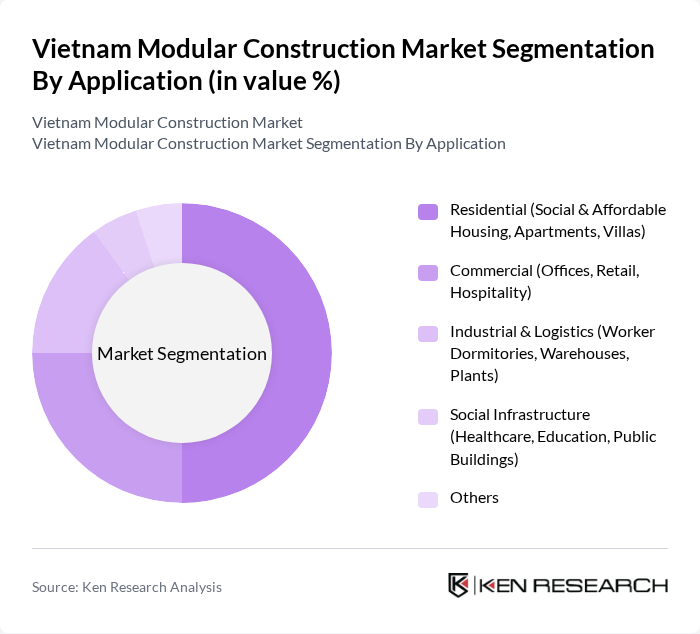
Vietnam Modular Construction Market segmentation by Application.

Vietnam Modular Construction Market Competitive Landscape

The Vietnam Modular Construction Market is characterized by a dynamic mix of regional and international players. Leading participants such as Coteccons Construction Joint Stock Company, Hoa Binh Construction Group Joint Stock Company, Delta Construction Group, Unicons Investment Construction Company Limited, BCG Land Joint Stock Company, Vinhomes Joint Stock Company (Vingroup), Nam Long Investment Corporation, An Phat Holdings / An Phat High-Tech Industrial Park, ATAD Steel Structure Corporation, BMB Steel, Ricons Construction Investment JSC, Phuc Khang Corporation, Cienco4 Group, Viettel Construction Joint Stock Corporation, Other Emerging Modular & Prefabricated Building Providers contribute to innovation, geographic expansion, and service delivery in this space.

Coteccons Construction Joint Stock Company

2004

Ho Chi Minh City

Hoa Binh Construction Group Joint Stock Company

1987

Ho Chi Minh City

Delta Construction Group

1993

Hanoi

Unicons Investment Construction Company Limited

2006

Ho Chi Minh City

BCG Land Joint Stock Company

2018

Ho Chi Minh City

Company

Establishment Year

Headquarters

Group Size (Large, Medium, or Small as per industry convention)

Vietnam Modular Construction Revenue (USD Million)

Modular Revenue CAGR (3–5 Years)

Order Backlog in Modular Projects (USD Million / Number of Units)

Market Share in Vietnam Modular Construction (%)

Average Project Size (Value and Built-up Area)

Vietnam Modular Construction Market Industry Analysis

Growth Drivers

  • Increasing Urbanization:Vietnam's urban population is projected to reach 40% by future, up from 37% in 2020, according to the World Bank. This rapid urbanization drives the demand for efficient housing solutions, particularly in cities like Ho Chi Minh City and Hanoi. The need for quick, cost-effective construction methods aligns with modular construction's capabilities, making it a preferred choice for urban developers aiming to meet housing demands while minimizing construction time and costs.
  • Demand for Affordable Housing:The Vietnamese government aims to build 1 million affordable housing units by future, as reported by the Ministry of Construction. With a significant portion of the population earning less than $350 per month, the demand for affordable housing is critical. Modular construction offers a viable solution, providing cost-effective and efficient building methods that can help meet this urgent housing need while adhering to budget constraints.
  • Government Initiatives for Infrastructure Development:The Vietnamese government allocated approximately $25 billion for infrastructure projects in future, focusing on urban development and housing. This investment supports modular construction as a strategic approach to expedite project timelines and reduce costs. By promoting public-private partnerships, the government encourages the adoption of modular techniques, enhancing the overall efficiency of infrastructure development across the nation.

Market Challenges

  • High Initial Investment Costs:The upfront costs associated with modular construction can be significant, often exceeding traditional building methods by 10-15%. This financial barrier can deter potential investors and developers, particularly in a market where budget constraints are prevalent. As a result, many stakeholders remain hesitant to adopt modular solutions, despite their long-term cost benefits and efficiency in construction timelines.
  • Limited Awareness and Acceptance:Despite the advantages of modular construction, awareness remains low among developers and consumers in Vietnam. A survey by the Vietnam National Construction Association indicated that only 35% of construction firms are familiar with modular techniques. This lack of knowledge can hinder market growth, as potential users may prefer traditional methods due to perceived risks and uncertainties associated with new construction technologies.

Vietnam Modular Construction Market Future Outlook

The future of the Vietnam modular construction market appears promising, driven by increasing urbanization and government support for infrastructure development. As awareness of modular techniques grows, more developers are likely to adopt these methods, leading to enhanced efficiency and reduced construction times. Additionally, the integration of smart building technologies and sustainable practices will further propel the market, aligning with global trends towards eco-friendly construction and innovative design solutions.

Market Opportunities

  • Technological Advancements:The rise of advanced manufacturing technologies, such as 3D printing and robotics, presents significant opportunities for the modular construction sector. These innovations can streamline production processes, reduce costs, and enhance the quality of modular units, making them more appealing to developers and investors looking for efficient building solutions.
  • Partnerships with Local Governments:Collaborating with local governments can unlock funding and support for modular construction projects. By aligning with government initiatives aimed at affordable housing and infrastructure development, companies can gain access to resources and incentives that facilitate project execution, ultimately driving market growth and expanding their operational footprint.

Scope of the Report

SegmentSub-Segments
By Construction Method

Volumetric Modular Buildings

Panelized & Componentized Systems

Hybrid Modular Systems

Other Prefabricated Types

By Application

Residential (Social & Affordable Housing, Apartments, Villas)

Commercial (Offices, Retail, Hospitality)

Industrial & Logistics (Worker Dormitories, Warehouses, Plants)

Social Infrastructure (Healthcare, Education, Public Buildings)

Others

By End-User

Real Estate Developers

EPC & General Contractors

Industrial Park & Manufacturing Operators

Government & Public Agencies

Others

By Region

Northern Vietnam

Southern Vietnam

Central Vietnam

By Ownership / Market Structure

Organized Players

Unorganized / Informal Players

By Investment Source

Domestic Private Investments

Foreign Direct Investments (FDI)

Public-Private Partnerships (PPP)

Government Budget & Grants

By Level of Prefabrication

Fully Volumetric Modular

Partial / Component Prefabrication

On-site Assembly with Prefab Elements

Key Target Audience

Investors and Venture Capitalist Firms

Government and Regulatory Bodies (e.g., Ministry of Construction, Ministry of Planning and Investment)

Manufacturers and Producers of Modular Construction Materials

Construction and Engineering Firms

Real Estate Developers

Architectural and Design Firms

Industry Associations (e.g., Vietnam Association of Construction Contractors)

Financial Institutions and Banks

Players Mentioned in the Report:

Coteccons Construction Joint Stock Company

Hoa Binh Construction Group Joint Stock Company

Delta Construction Group

Unicons Investment Construction Company Limited

BCG Land Joint Stock Company

Vinhomes Joint Stock Company (Vingroup)

Nam Long Investment Corporation

An Phat Holdings / An Phat High-Tech Industrial Park

ATAD Steel Structure Corporation

BMB Steel

Ricons Construction Investment JSC

Phuc Khang Corporation

Cienco4 Group

Viettel Construction Joint Stock Corporation

Other Emerging Modular & Prefabricated Building Providers

Table of Contents

Market Assessment Phase

1. Executive Summary and Approach


2. Vietnam Modular Construction Market Overview

2.1 Key Insights and Strategic Recommendations

2.2 Vietnam Modular Construction Market Overview

2.3 Definition and Scope

2.4 Evolution of Market Ecosystem

2.5 Timeline of Key Regulatory Milestones

2.6 Value Chain & Stakeholder Mapping

2.7 Business Cycle Analysis

2.8 Policy & Incentive Landscape


3. Vietnam Modular Construction Market Analysis

3.1 Growth Drivers

3.1.1 Increasing Urbanization
3.1.2 Demand for Affordable Housing
3.1.3 Government Initiatives for Infrastructure Development
3.1.4 Sustainability and Environmental Concerns

3.2 Market Challenges

3.2.1 High Initial Investment Costs
3.2.2 Limited Awareness and Acceptance
3.2.3 Regulatory Hurdles
3.2.4 Supply Chain Disruptions

3.3 Market Opportunities

3.3.1 Technological Advancements
3.3.2 Expansion into Rural Areas
3.3.3 Partnerships with Local Governments
3.3.4 Export Potential to Neighboring Countries

3.4 Market Trends

3.4.1 Prefabrication and Modularization
3.4.2 Smart Building Technologies
3.4.3 Green Building Practices
3.4.4 Increased Focus on Safety Standards

3.5 Government Regulation

3.5.1 Building Code Revisions
3.5.2 Incentives for Sustainable Construction
3.5.3 Zoning Law Adjustments
3.5.4 Quality Assurance Regulations

4. SWOT Analysis


5. Stakeholder Analysis


6. Porter's Five Forces Analysis


7. Vietnam Modular Construction Market Market Size, 2019-2024

7.1 By Value

7.2 By Volume

7.3 By Average Selling Price


8. Vietnam Modular Construction Market Segmentation

8.1 By Construction Method

8.1.1 Volumetric Modular Buildings
8.1.2 Panelized & Componentized Systems
8.1.3 Hybrid Modular Systems
8.1.4 Other Prefabricated Types

8.2 By Application

8.2.1 Residential (Social & Affordable Housing, Apartments, Villas)
8.2.2 Commercial (Offices, Retail, Hospitality)
8.2.3 Industrial & Logistics (Worker Dormitories, Warehouses, Plants)
8.2.4 Social Infrastructure (Healthcare, Education, Public Buildings)
8.2.5 Others

8.3 By End-User

8.3.1 Real Estate Developers
8.3.2 EPC & General Contractors
8.3.3 Industrial Park & Manufacturing Operators
8.3.4 Government & Public Agencies
8.3.5 Others

8.4 By Region

8.4.1 Northern Vietnam
8.4.2 Southern Vietnam
8.4.3 Central Vietnam

8.5 By Ownership / Market Structure

8.5.1 Organized Players
8.5.2 Unorganized / Informal Players

8.6 By Investment Source

8.6.1 Domestic Private Investments
8.6.2 Foreign Direct Investments (FDI)
8.6.3 Public-Private Partnerships (PPP)
8.6.4 Government Budget & Grants

8.7 By Level of Prefabrication

8.7.1 Fully Volumetric Modular
8.7.2 Partial / Component Prefabrication
8.7.3 On-site Assembly with Prefab Elements

9. Vietnam Modular Construction Market Competitive Analysis

9.1 Market Share of Key Players

9.2 Cross Comparison of Key Players

9.2.1 Company Name
9.2.2 Group Size (Large, Medium, or Small as per industry convention)
9.2.3 Vietnam Modular Construction Revenue (USD Million)
9.2.4 Modular Revenue CAGR (3–5 Years)
9.2.5 Order Backlog in Modular Projects (USD Million / Number of Units)
9.2.6 Market Share in Vietnam Modular Construction (%)
9.2.7 Average Project Size (Value and Built-up Area)
9.2.8 Average Project Completion Time (Months) vs Conventional
9.2.9 EBITDA Margin from Modular Projects (%)
9.2.10 Return on Invested Capital (ROIC) – Modular Business (%)
9.2.11 Bid Win Rate for Modular Tenders (%)
9.2.12 Capacity Utilization of Modular Production Facilities (%)
9.2.13 R&D / Technology Spend as % of Modular Revenue
9.2.14 Health, Safety & Quality Compliance Metrics

9.3 SWOT Analysis of Top Players

9.4 Pricing Analysis

9.5 Detailed Profile of Major Companies

9.5.1 Coteccons Construction Joint Stock Company
9.5.2 Hoa Binh Construction Group Joint Stock Company
9.5.3 Delta Construction Group
9.5.4 Unicons Investment Construction Company Limited
9.5.5 BCG Land Joint Stock Company
9.5.6 Vinhomes Joint Stock Company (Vingroup)
9.5.7 Nam Long Investment Corporation
9.5.8 An Phat Holdings / An Phat High-Tech Industrial Park
9.5.9 ATAD Steel Structure Corporation
9.5.10 BMB Steel
9.5.11 Ricons Construction Investment JSC
9.5.12 Phuc Khang Corporation
9.5.13 Cienco4 Group
9.5.14 Viettel Construction Joint Stock Corporation
9.5.15 Other Emerging Modular & Prefabricated Building Providers

10. Vietnam Modular Construction Market End-User Analysis

10.1 Procurement Behavior of Key Ministries

10.1.1 Ministry of Construction
10.1.2 Ministry of Transport
10.1.3 Ministry of Education and Training
10.1.4 Ministry of Health

10.2 Corporate Spend on Infrastructure & Energy

10.2.1 Corporate Investments in Modular Solutions
10.2.2 Budget Allocations for Infrastructure Projects

10.3 Pain Point Analysis by End-User Category

10.3.1 Residential Sector Challenges
10.3.2 Commercial Sector Challenges
10.3.3 Industrial Sector Challenges

10.4 User Readiness for Adoption

10.4.1 Awareness Levels
10.4.2 Training and Support Needs

10.5 Post-Deployment ROI and Use Case Expansion

10.5.1 ROI Measurement Techniques
10.5.2 Case Studies of Successful Implementations

11. Vietnam Modular Construction Market Future Size, 2025-2030

11.1 By Value

11.2 By Volume

11.3 By Average Selling Price


Go-To-Market Strategy Phase

1. Whitespace Analysis + Business Model Canvas

1.1 Market Gaps Identification

1.2 Business Model Development


2. Marketing and Positioning Recommendations

2.1 Branding Strategies

2.2 Product USPs


3. Distribution Plan

3.1 Urban Retail Strategies

3.2 Rural NGO Tie-ups


4. Channel & Pricing Gaps

4.1 Underserved Routes

4.2 Pricing Bands


5. Unmet Demand & Latent Needs

5.1 Category Gaps

5.2 Consumer Segments


6. Customer Relationship

6.1 Loyalty Programs

6.2 After-sales Service


7. Value Proposition

7.1 Sustainability Initiatives

7.2 Integrated Supply Chains


8. Key Activities

8.1 Regulatory Compliance

8.2 Branding Efforts

8.3 Distribution Setup


9. Entry Strategy Evaluation

9.1 Domestic Market Entry Strategy

9.1.1 Product Mix Considerations
9.1.2 Pricing Band Strategy
9.1.3 Packaging Options

9.2 Export Entry Strategy

9.2.1 Target Countries
9.2.2 Compliance Roadmap

10. Entry Mode Assessment

10.1 Joint Ventures

10.2 Greenfield Investments

10.3 Mergers & Acquisitions

10.4 Distributor Model


11. Capital and Timeline Estimation

11.1 Capital Requirements

11.2 Timelines for Implementation


12. Control vs Risk Trade-Off

12.1 Ownership Considerations

12.2 Partnerships Evaluation


13. Profitability Outlook

13.1 Breakeven Analysis

13.2 Long-term Sustainability


14. Potential Partner List

14.1 Distributors

14.2 Joint Ventures

14.3 Acquisition Targets


15. Execution Roadmap

15.1 Phased Plan for Market Entry

15.1.1 Market Setup
15.1.2 Market Entry
15.1.3 Growth Acceleration
15.1.4 Scale & Stabilize

15.2 Key Activities and Milestones

15.2.1 Milestone Planning
15.2.2 Activity Tracking

Research Methodology

ApproachModellingSample

Phase 1: Approach1

Desk Research

  • Analysis of industry reports from government bodies and trade associations in Vietnam
  • Review of market trends and forecasts from reputable construction and real estate publications
  • Examination of regulatory frameworks and policies affecting modular construction in Vietnam

Primary Research

  • Interviews with key stakeholders including architects, contractors, and developers involved in modular construction
  • Surveys targeting project managers and procurement officers in the construction sector
  • Field visits to ongoing modular construction sites to gather firsthand insights

Validation & Triangulation

  • Cross-validation of data through multiple sources including industry reports and expert opinions
  • Triangulation of findings from desk research and primary interviews to ensure consistency
  • Sanity checks conducted through expert panel reviews comprising industry veterans

Phase 2: Market Size Estimation1

Top-down Assessment

  • Estimation of the modular construction market size based on national construction expenditure data
  • Segmentation of the market by residential, commercial, and industrial applications
  • Incorporation of government initiatives promoting sustainable building practices

Bottom-up Modeling

  • Collection of project-level data from leading modular construction firms in Vietnam
  • Estimation of average project costs and timelines for modular construction projects
  • Volume and value analysis based on completed projects and ongoing contracts

Forecasting & Scenario Analysis

  • Development of growth projections based on historical data and emerging trends in construction technology
  • Scenario modeling considering economic factors, regulatory changes, and market demand shifts
  • Creation of baseline, optimistic, and pessimistic forecasts through 2030

Phase 3: CATI Sample Composition1

Scope Item/SegmentSample SizeTarget Respondent Profiles
Residential Modular Projects100Architects, Home Builders, Project Managers
Commercial Modular Developments80Real Estate Developers, Construction Managers
Industrial Modular Solutions70Facility Managers, Operations Directors
Government Infrastructure Projects60Public Sector Officials, Urban Planners
Sustainable Building Initiatives90Sustainability Consultants, Environmental Engineers

Frequently Asked Questions

What is the current value of the Vietnam Modular Construction Market?

The Vietnam Modular Construction Market is valued at approximately USD 3.0 billion, reflecting significant growth driven by urbanization, demand for affordable housing, and government initiatives promoting efficient building methods.

What factors are driving the growth of modular construction in Vietnam?

Which cities are leading in the Vietnam Modular Construction Market?

What are the main applications of modular construction in Vietnam?

Other Adjacent Reports

UAE Saudiarabia Prefabricated Buildings Market

Kuwait Affordable Housing Market

Mexico Urban Infrastructure Market

India Construction Materials Market Outlook to 2030

Japan Steel Structure Market

Thailand Sustainable Building Market

Mexico Real Estate Development Market

South Africa Industrial Park Development Market

South Korea Logistics Infrastructure Market

US Commercial Construction Market

Why Buy From Us?

Refine Robust Result (RRR) Framework

What makes us stand out is that our consultants follow Robust, Refine and Result (RRR) methodology. Robust for clear definitions, approaches and sanity checking, Refine for differentiating respondents' facts and opinions, and Result for presenting data with story.

Our Reach Is Unmatched

We have set a benchmark in the industry by offering our clients with syndicated and customized market research reports featuring coverage of entire market as well as meticulous research and analyst insights.

Shifting the Research Paradigm

While we don't replace traditional research, we flip the method upside down. Our dual approach of Top Bottom & Bottom Top ensures quality deliverable by not just verifying company fundamentals but also looking at the sector and macroeconomic factors.

More Insights-Better Decisions

With one step in the future, our research team constantly tries to show you the bigger picture. We help with some of the tough questions you may encounter along the way: How is the industry positioned? Best marketing channel? KPI's of competitors? By aligning every element, we help maximize success.

Transparency and Trust

Our report gives you instant access to the answers and sources that other companies might choose to hide. We elaborate each steps of research methodology we have used and showcase you the sample size to earn your trust.

Round the Clock Support

If you need any support, we are here! We pride ourselves on universe strength, data quality, and quick, friendly, and professional service.

Why Clients Choose Us?

400000+
Reports in repository
150+
Consulting projects a year
100+
Analysts
8000+
Client Queries in 2022








