About the Report
Base Year 2024Philippines Modular Construction Market Overview
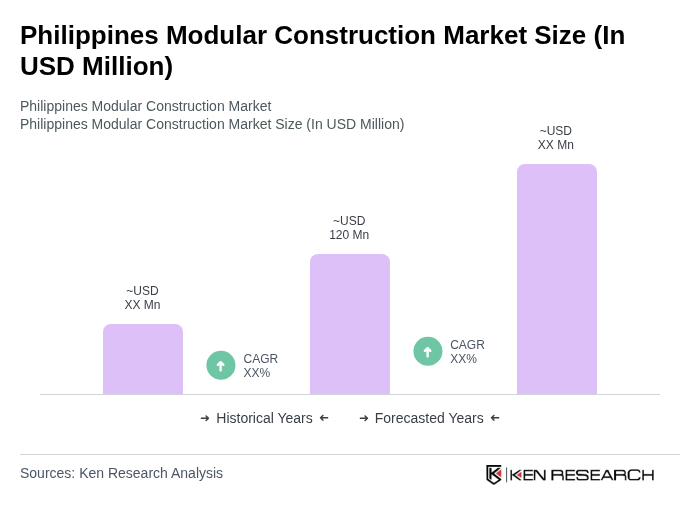
- The Philippines Modular Construction Market is valued at USD 120 million, based on a five-year historical analysis. This growth is primarily driven by rapid urbanization, a sizeable housing backlog, increasing demand for affordable housing, and the need for faster, more cost-efficient construction methods. The modular construction approach offers significant time and cost savings versus traditional on-site methods and supports improved quality control and sustainability, making it an attractive option for developers and contractors in the region.
- Key cities such as Metro Manila, Cebu, and Davao dominate the market due to their high population density, rapid urbanization, and concentration of infrastructure and real estate projects. Metro Manila, being the capital and the country’s primary economic hub, has robust demand for residential, commercial, and mixed-use spaces, while Cebu and Davao are emerging as significant urban centers with growing business districts, industrial parks, and logistics-driven developments that increasingly consider prefabricated and modular solutions to shorten project timelines.
- The National Building Code of the Philippines (Presidential Decree No. 1096), issued by the Office of the President in 1977 and implemented through the Department of Public Works and Highways, together with its Implementing Rules and Regulations and subsequent updates, sets structural, fire, and occupancy standards that apply to modular and prefabricated buildings, requiring permits, design compliance, and inspections similar to conventional construction. In addition, the Revised Implementing Rules and Regulations of the National Building Code and related issuances such as the Philippine Green Building Code (Department Order No. 64, Series of 2017) encourage the use of industrialized and off-site construction systems, including modular methods, by specifying performance-based criteria for safety, energy efficiency, and sustainability. These instruments guide approval processes for modular projects, align them with safety and quality standards, and support the adoption of innovative construction methods to help address the country’s infrastructure and housing needs.
Philippines Modular Construction Market Segmentation
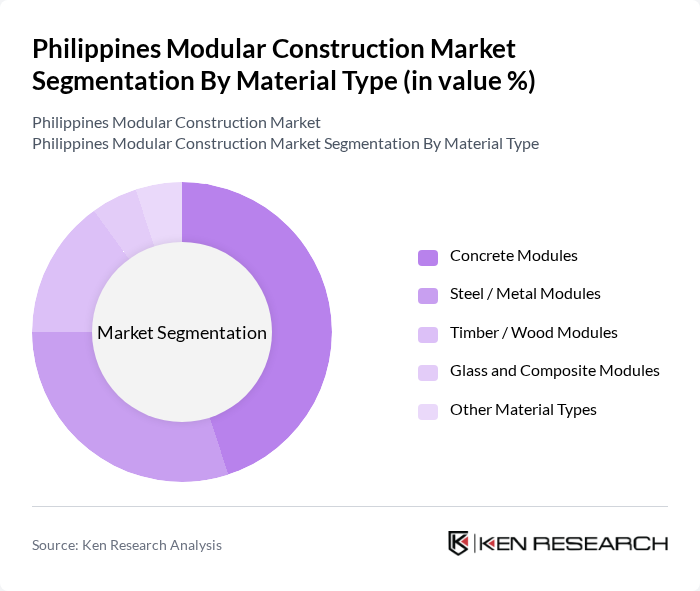
By Material Type:The material type segmentation includes various subsegments such as Concrete Modules, Steel / Metal Modules, Timber / Wood Modules, Glass and Composite Modules, and Other Material Types. Concrete and other cement-based systems currently account for a substantial share of modular and prefabricated structures in the Philippines, particularly in residential and low- to mid-rise commercial applications, due to their durability, fire resistance, and familiarity among local contractors. Steel / Metal Modules are also gaining traction, especially for commercial, industrial, and worker accommodations because of their strength-to-weight ratio, speed of assembly, and suitability for repetitive, standardized layouts. The demand for Timber / Wood Modules is gradually rising, mainly in resort, low-rise residential, and eco-tourism projects, supported by global sustainability trends and interest in lower-embodied-carbon materials, though availability of certified structural timber remains a constraint. Glass and Composite Modules are favored in façade systems and premium commercial or hospitality developments for aesthetic and performance benefits, while Other Material Types include hybrid systems that combine concrete, steel, and lightweight panels to improve constructability and thermal performance.
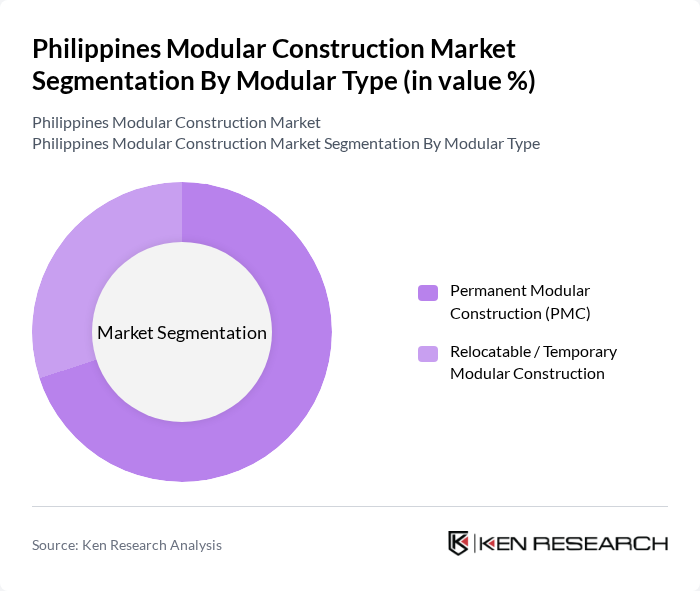
By Modular Type:The modular type segmentation consists of Permanent Modular Construction (PMC) and Relocatable / Temporary Modular Construction. Permanent Modular Construction is dominating the market, aligned with the strong role of the residential segment and growing use in hotels, dormitories, mid-rise offices, and social infrastructure, where factory-produced volumetric units are installed as part of the permanent building fabric. This type of construction allows for significant time savings, lower site disruption, and better cost predictability, making it a preferred choice for developers facing tight schedules and high urban land costs. Relocatable / Temporary Modular Construction is also gaining popularity, particularly in education, healthcare, disaster-relief housing, site offices, and temporary worker accommodations, where rapid deployment, ease of dismantling, and redeployment to other locations are critical decision factors.
Philippines Modular Construction Market Competitive Landscape
The Philippines Modular Construction Market is characterized by a dynamic mix of regional and international players. Leading participants such as Smarthouse Corporation, Prefab Philippines, Toh Builders, Inc., Karmod Prefabricated Building Technologies, Revolution Precrafted, Meinhardt Philippines, Inc., EEI Corporation, Megawide Construction Corporation, DMCI Homes, Ayala Land, Inc., Megaworld Corporation, Robinsons Land Corporation, Vista Land & Lifescapes, Inc., SM Prime Holdings, Inc., Filinvest Land, Inc. contribute to innovation, geographic expansion, and service delivery in this space.
Philippines Modular Construction Market Industry Analysis
Growth Drivers
- Increasing Urbanization:The Philippines is experiencing rapid urbanization, with urban areas projected to house 50% of the population in future, up from just under half in recent periods. This shift is driving demand for modular construction, as urban centers require efficient housing solutions. The urban population is expected to reach well over 60 million in future, necessitating innovative construction methods to meet housing needs and infrastructure demands, thereby boosting the modular construction sector significantly.
- Demand for Affordable Housing:The housing backlog in the Philippines is estimated at around 6.5 million units, with government sources indicating it could rise toward about 7 million units in future if unaddressed. This growing demand for affordable housing is a key driver for modular construction, which offers cost-effective solutions. The government aims to address this backlog through various initiatives, including public-private partnerships, further enhancing the appeal of modular construction as a viable option for affordable housing solutions.
- Sustainability Initiatives:The Philippine government has committed to reducing greenhouse gas emissions by up to 75% in future relative to a business-as-usual scenario under its nationally determined contribution, with a significant portion of this conditional on international support. Modular construction aligns with these sustainability goals, utilizing eco-friendly materials and energy-efficient designs. The value cited for the market for green building materials cannot be confirmed from authoritative sources. This indicates a strong trend towards sustainable construction methods, which modular construction can effectively fulfill, thus driving its growth in the region.
Market Challenges
- High Initial Investment Costs:The initial investment for modular construction can be significantly higher than traditional methods, with costs commonly cited in industry discussions in the range of PHP 20,000 to PHP 30,000 per square meter for mid- to high-spec building projects in the Philippines, although precise nationwide averages cannot be verified from primary official statistics. This financial barrier can deter potential investors and developers, especially in a market where budget constraints are prevalent. As a result, many stakeholders may hesitate to adopt modular construction despite its long-term cost benefits, impacting market growth.
- Limited Awareness and Acceptance:Despite its advantages, modular construction faces challenges in acceptance among stakeholders. The specific figure that only 30% of construction firms in the Philippines are familiar with modular techniques cannot be confirmed from authoritative or publicly verifiable primary or secondary sources. This lack of awareness can lead to resistance in adopting innovative construction methods. Educational initiatives and outreach programs are essential to increase understanding and acceptance, which is crucial for the market's expansion in the coming years.
Philippines Modular Construction Market Future Outlook
The Philippines modular construction market is poised for significant growth, driven by urbanization, housing demands, and sustainability initiatives. As the government continues to invest in infrastructure and affordable housing projects, the adoption of modular construction is expected to rise. Innovations in design and technology will further enhance the efficiency and appeal of modular solutions. In future, the integration of smart technologies and eco-friendly materials will likely redefine construction practices, positioning modular construction as a key player in the industry.
Market Opportunities
- Government Infrastructure Projects:The Philippine government has allocated substantial funding for infrastructure development under its flagship infrastructure program, with public infrastructure spending targeted at around 5–6% of GDP in recent and upcoming budget plans, creating opportunities for modular construction. This funding can facilitate the construction of schools, hospitals, and public facilities using modular techniques, which can be completed faster and more efficiently, addressing urgent infrastructure needs. The specific figure of PHP 1 trillion for infrastructure in a single budget period cannot be definitively confirmed from primary budget documentation as stated.
- Partnerships with Local Builders:Collaborating with local builders can enhance the acceptance of modular construction. By forming partnerships, modular companies can leverage local knowledge and networks, facilitating smoother project execution. This strategy can also help in customizing designs to meet local preferences, thereby increasing market penetration and driving growth in the modular construction sector.
Scope of the Report
| Segment | Sub-Segments |
|---|---|
| By Material Type | Concrete Modules Steel / Metal Modules Timber / Wood Modules Glass and Composite Modules Other Material Types |
| By Modular Type | Permanent Modular Construction (PMC) Relocatable / Temporary Modular Construction |
| By Application | Residential Commercial (Offices, Retail, Hospitality) Industrial & Logistics Facilities Social Infrastructure (Education, Healthcare) Others |
| By End-User | Real Estate Developers Industrial & Logistics Operators Government & Public Sector NGOs & Development Agencies Others |
| By Region | Luzon Visayas Mindanao |
| By Technology & Construction System | D Panels & Precast Systems D Volumetric / Modular Units Hybrid Modular Construction Bathroom / Kitchen Pods & Micro-Modules |
| By Funding & Contracting Model | Private Sector Investment Government-Funded Projects Public-Private Partnerships (PPP) Foreign Direct Investment (FDI) & Development Finance |
Key Target Audience
Investors and Venture Capitalist Firms
Government and Regulatory Bodies (e.g., Department of Public Works and Highways, Housing and Urban Development Coordinating Council)
Manufacturers and Producers of Modular Construction Materials
Construction and Engineering Firms
Real Estate Developers
Architectural and Design Firms
Industry Associations (e.g., Philippine Constructors Association)
Financial Institutions and Banks
Players Mentioned in the Report:
Smarthouse Corporation
Prefab Philippines
Toh Builders, Inc.
Karmod Prefabricated Building Technologies
Revolution Precrafted
Meinhardt Philippines, Inc.
EEI Corporation
Megawide Construction Corporation
DMCI Homes
Ayala Land, Inc.
Megaworld Corporation
Robinsons Land Corporation
Vista Land & Lifescapes, Inc.
SM Prime Holdings, Inc.
Filinvest Land, Inc.
Table of Contents
Market Assessment Phase
1. Executive Summary and Approach
2. Philippines Modular Construction Market Overview
2.1 Key Insights and Strategic Recommendations
2.2 Philippines Modular Construction Market Overview
2.3 Definition and Scope
2.4 Evolution of Market Ecosystem
2.5 Timeline of Key Regulatory Milestones
2.6 Value Chain & Stakeholder Mapping
2.7 Business Cycle Analysis
2.8 Policy & Incentive Landscape
3. Philippines Modular Construction Market Analysis
3.1 Growth Drivers
3.1.1 Increasing Urbanization
3.1.2 Demand for Affordable Housing
3.1.3 Sustainability Initiatives
3.1.4 Technological Advancements
3.2 Market Challenges
3.2.1 High Initial Investment Costs
3.2.2 Limited Awareness and Acceptance
3.2.3 Regulatory Hurdles
3.2.4 Supply Chain Disruptions
3.3 Market Opportunities
3.3.1 Government Infrastructure Projects
3.3.2 Expansion into Rural Areas
3.3.3 Partnerships with Local Builders
3.3.4 Innovations in Modular Design
3.4 Market Trends
3.4.1 Prefabrication Techniques
3.4.2 Eco-Friendly Materials
3.4.3 Smart Modular Solutions
3.4.4 Customization in Design
3.5 Government Regulation
3.5.1 Building Code Compliance
3.5.2 Environmental Regulations
3.5.3 Tax Incentives for Green Buildings
3.5.4 Local Government Policies
4. SWOT Analysis
5. Stakeholder Analysis
6. Porter's Five Forces Analysis
7. Philippines Modular Construction Market Market Size, 2019-2024
7.1 By Value
7.2 By Volume
7.3 By Average Selling Price
8. Philippines Modular Construction Market Segmentation
8.1 By Material Type
8.1.1 Concrete Modules
8.1.2 Steel / Metal Modules
8.1.3 Timber / Wood Modules
8.1.4 Glass and Composite Modules
8.1.5 Other Material Types
8.2 By Modular Type
8.2.1 Permanent Modular Construction (PMC)
8.2.2 Relocatable / Temporary Modular Construction
8.3 By Application
8.3.1 Residential
8.3.2 Commercial (Offices, Retail, Hospitality)
8.3.3 Industrial & Logistics Facilities
8.3.4 Social Infrastructure (Education, Healthcare)
8.3.5 Others
8.4 By End-User
8.4.1 Real Estate Developers
8.4.2 Industrial & Logistics Operators
8.4.3 Government & Public Sector
8.4.4 NGOs & Development Agencies
8.4.5 Others
8.5 By Region
8.5.1 Luzon
8.5.2 Visayas
8.5.3 Mindanao
8.6 By Technology & Construction System
8.6.1 2D Panels & Precast Systems
8.6.2 3D Volumetric / Modular Units
8.6.3 Hybrid Modular Construction
8.6.4 Bathroom / Kitchen Pods & Micro-Modules
8.7 By Funding & Contracting Model
8.7.1 Private Sector Investment
8.7.2 Government-Funded Projects
8.7.3 Public-Private Partnerships (PPP)
8.7.4 Foreign Direct Investment (FDI) & Development Finance
9. Philippines Modular Construction Market Competitive Analysis
9.1 Market Share of Key Players
9.2 Cross Comparison of Key Players
9.2.1 Company Name
9.2.2 Revenue (Latest Fiscal Year, USD Million)
9.2.3 3-Year Revenue CAGR (%) from Modular / Prefab Business
9.2.4 EBITDA Margin (%) from Modular Projects
9.2.5 Order Book Value for Modular Projects (USD Million)
9.2.6 Number of Modular Projects Completed (Last 3 Years)
9.2.7 Average Project Size (Floor Area or Contract Value)
9.2.8 Market Share in Philippines Modular Construction (%)
9.2.9 Capacity Utilization of Modular Plants (%)
9.2.10 Average Project Delivery Time vs Contracted Time (%)
9.2.11 Win Rate in Competitive Bids (%)
9.2.12 R&D / Innovation Spend (% of Revenue)
9.2.13 Health, Safety & Quality KPIs (e.g., LTIFR, Defect Rate)
9.3 SWOT Analysis of Top Players
9.4 Pricing Analysis
9.5 Detailed Profile of Major Companies
9.5.1 Smarthouse Corporation
9.5.2 Prefab Philippines
9.5.3 Toh Builders, Inc.
9.5.4 Karmod Prefabricated Building Technologies
9.5.5 Revolution Precrafted
9.5.6 Meinhardt Philippines, Inc.
9.5.7 EEI Corporation
9.5.8 Megawide Construction Corporation
9.5.9 DMCI Homes
9.5.10 Ayala Land, Inc.
9.5.11 Megaworld Corporation
9.5.12 Robinsons Land Corporation
9.5.13 Vista Land & Lifescapes, Inc.
9.5.14 SM Prime Holdings, Inc.
9.5.15 Filinvest Land, Inc.
10. Philippines Modular Construction Market End-User Analysis
10.1 Procurement Behavior of Key Ministries
10.1.1 Department of Public Works and Highways
10.1.2 Department of Education
10.1.3 Department of Health
10.1.4 Local Government Units
10.2 Corporate Spend on Infrastructure & Energy
10.2.1 Corporate Investments in Modular Solutions
10.2.2 Budget Allocations for Construction Projects
10.3 Pain Point Analysis by End-User Category
10.3.1 Cost Overruns
10.3.2 Delays in Project Delivery
10.3.3 Quality Assurance Issues
10.3.4 Compliance with Regulations
10.4 User Readiness for Adoption
10.4.1 Awareness of Modular Construction Benefits
10.4.2 Training and Skill Development Needs
10.5 Post-Deployment ROI and Use Case Expansion
10.5.1 Performance Metrics Evaluation
10.5.2 Scalability of Modular Solutions
11. Philippines Modular Construction Market Future Size, 2025-2030
11.1 By Value
11.2 By Volume
11.3 By Average Selling Price
Go-To-Market Strategy Phase
1. Whitespace Analysis + Business Model Canvas
1.1 Market Gaps Identification
1.2 Business Model Framework
2. Marketing and Positioning Recommendations
2.1 Branding Strategies
2.2 Product USPs
3. Distribution Plan
3.1 Urban Retail Strategies
3.2 Rural NGO Tie-ups
4. Channel & Pricing Gaps
4.1 Underserved Routes
4.2 Pricing Bands
5. Unmet Demand & Latent Needs
5.1 Category Gaps
5.2 Consumer Segments
6. Customer Relationship
6.1 Loyalty Programs
6.2 After-sales Service
7. Value Proposition
7.1 Sustainability Initiatives
7.2 Integrated Supply Chains
8. Key Activities
8.1 Regulatory Compliance
8.2 Branding Efforts
8.3 Distribution Setup
9. Entry Strategy Evaluation
9.1 Domestic Market Entry Strategy
9.1.1 Product Mix
9.1.2 Pricing Band
9.1.3 Packaging
9.2 Export Entry Strategy
9.2.1 Target Countries
9.2.2 Compliance Roadmap
10. Entry Mode Assessment
10.1 Joint Ventures
10.2 Greenfield Investments
10.3 Mergers & Acquisitions
10.4 Distributor Model
11. Capital and Timeline Estimation
11.1 Capital Requirements
11.2 Timelines
12. Control vs Risk Trade-Off
12.1 Ownership vs Partnerships
13. Profitability Outlook
13.1 Breakeven Analysis
13.2 Long-term Sustainability
14. Potential Partner List
14.1 Distributors
14.2 Joint Ventures
14.3 Acquisition Targets
15. Execution Roadmap
15.1 Phased Plan for Market Entry
15.1.1 Market Setup
15.1.2 Market Entry
15.1.3 Growth Acceleration
15.1.4 Scale & Stabilize
15.2 Key Activities and Milestones
15.2.1 Milestone Planning
Research Methodology
Phase 1: Approach1
Desk Research
- Analysis of government reports on infrastructure development and housing policies
- Review of industry publications and market reports specific to modular construction trends in the Philippines
- Examination of statistical data from the Philippine Statistics Authority regarding construction output and modular adoption rates
Primary Research
- Interviews with key stakeholders in the construction industry, including architects and project managers
- Surveys conducted with modular construction firms to gather insights on market challenges and opportunities
- Focus group discussions with end-users, such as homeowners and commercial property developers, to understand preferences
Validation & Triangulation
- Cross-validation of findings through comparison with international modular construction benchmarks
- Triangulation of data from government sources, industry reports, and primary interviews
- Sanity checks through expert panel reviews involving industry veterans and academic professionals
Phase 2: Market Size Estimation1
Top-down Assessment
- Estimation of the overall construction market size in the Philippines and identification of the modular segment
- Analysis of government infrastructure spending and its impact on modular construction adoption
- Segmentation of the market by residential, commercial, and industrial applications
Bottom-up Modeling
- Collection of data on project costs and timelines from leading modular construction companies
- Estimation of market share based on the number of completed modular projects in recent years
- Volume and pricing analysis based on modular unit sales and rental rates
Forecasting & Scenario Analysis
- Development of growth projections based on historical data and emerging trends in construction technology
- Scenario modeling considering economic factors, regulatory changes, and environmental sustainability initiatives
- Creation of baseline, optimistic, and pessimistic forecasts for modular construction growth through 2030
Phase 3: CATI Sample Composition1
| Scope Item/Segment | Sample Size | Target Respondent Profiles |
|---|---|---|
| Residential Modular Construction | 120 | Homeowners, Real Estate Developers |
| Commercial Modular Projects | 90 | Project Managers, Architects |
| Industrial Modular Solutions | 75 | Facility Managers, Operations Directors |
| Government Infrastructure Initiatives | 60 | Policy Makers, Urban Planners |
| Modular Construction Technology Providers | 95 | Product Managers, Technical Directors |
Frequently Asked Questions
What is the current value of the Philippines Modular Construction Market?
The Philippines Modular Construction Market is valued at approximately USD 120 million, driven by urbanization, housing demand, and the need for efficient construction methods. This market is expected to grow significantly as developers seek cost-effective solutions.
What are the main drivers of growth in the Philippines Modular Construction Market?
Which cities are leading in the Philippines Modular Construction Market?
What types of materials are commonly used in modular construction in the Philippines?
Other Regional/Country Reports
Other Adjacent Reports
South Africa Prefabricated Building Market
UAE Affordable Housing Market
Malaysia Sustainable Construction Market
KSA Real Estate Development Market
Germany Infrastructure Development Market
India Residential Construction Market Size, Share & Forecast, By Property Type, Construction Type & Construction Method, 2026-2032US Commercial Construction MarketNetherlands Green Building Materials Market Size, Share & Forecast, By Material Type, End User & Application, 2026-2031Oman Construction Technology Market
Middle East Building Materials Market Size, Share, Trends & Forecast, By Material Type, Application & Distribution Channel, 2026–2031Why Buy From Us?

What makes us stand out is that our consultants follow Robust, Refine and Result (RRR) methodology. Robust for clear definitions, approaches and sanity checking, Refine for differentiating respondents' facts and opinions, and Result for presenting data with story.

We have set a benchmark in the industry by offering our clients with syndicated and customized market research reports featuring coverage of entire market as well as meticulous research and analyst insights.

While we don't replace traditional research, we flip the method upside down. Our dual approach of Top Bottom & Bottom Top ensures quality deliverable by not just verifying company fundamentals but also looking at the sector and macroeconomic factors.

With one step in the future, our research team constantly tries to show you the bigger picture. We help with some of the tough questions you may encounter along the way: How is the industry positioned? Best marketing channel? KPI's of competitors? By aligning every element, we help maximize success.

Our report gives you instant access to the answers and sources that other companies might choose to hide. We elaborate each steps of research methodology we have used and showcase you the sample size to earn your trust.

If you need any support, we are here! We pride ourselves on universe strength, data quality, and quick, friendly, and professional service.