About the Report
Base Year 2024Oman Modular Construction Market Overview
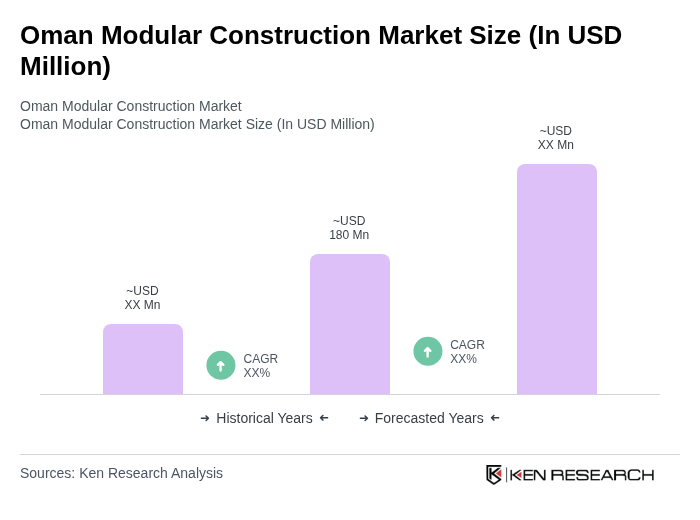
- The Oman Modular Construction Market is valued at USD 180 million, based on a five-year historical analysis and its share within the broader Oman construction sector and the Middle East and Africa modular construction market. This growth is primarily driven by the increasing demand for efficient construction methods, rapid project delivery requirements, and government initiatives under Oman Vision 2040 aimed at enhancing infrastructure development and optimizing public spending. The modular construction approach offers significant advantages in terms of time savings, cost efficiency, improved quality control, and reduced on-site disruption, making it an attractive option for residential, commercial, industrial, and social infrastructure projects.
- Key cities such as Muscat and Salalah dominate the Oman Modular Construction Market due to their rapid urban development, concentration of population, and significant investment in housing, logistics, tourism, and industrial infrastructure projects. Muscat accounts for the largest share of overall construction activity in Oman, with sizable public and private projects, while Salalah and the surrounding Dhofar region are benefitting from major logistics, port, and green-hydrogen related investments, supporting demand for faster, scalable building solutions where modular methods are increasingly considered.
- In recent years, the Omani government has strengthened the policy framework for sustainable and higher?efficiency building practices, which indirectly supports the adoption of modular and prefabricated techniques in public projects. The key binding instrument is the Oman Energy Efficiency and Renewable Energy Program for Buildings issued by the Authority for Public Services Regulation (APSR) and aligned with the Oman National Energy Strategy 2040, which introduces minimum energy?performance and building?envelope requirements, encourages off?site prefabricated components to improve thermal performance, and ties compliance to design approvals and utility connections for government and large commercial buildings. These measures, together with green-building requirements in government tenders, are part of a broader strategy to modernize the construction industry, reduce lifecycle emissions, and support alignment with regional and global sustainability goals.
Oman Modular Construction Market Segmentation
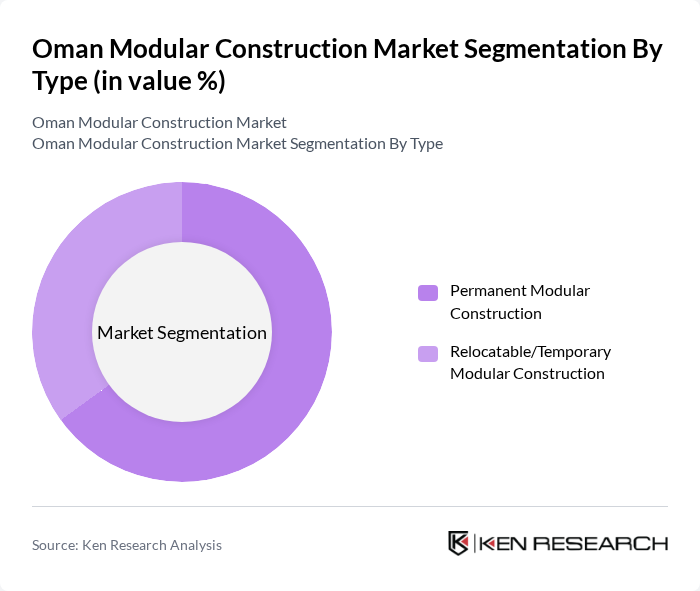
By Type:The market is segmented into Permanent Modular Construction and Relocatable/Temporary Modular Construction, consistent with global modular construction classifications. Permanent Modular Construction is gaining traction in Oman for residential, hospitality, healthcare, and office applications due to its durability, ability to meet building codes, and suitability for long-term use, while Relocatable/Temporary Modular Construction is favored for workforce accommodation, site offices, schools, and temporary facilities requiring flexibility and quick deployment in response to project cycles and remote?site needs.
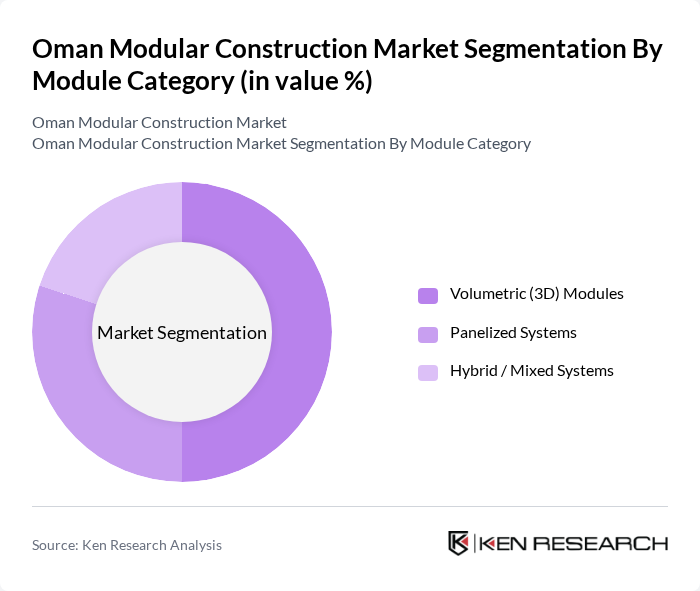
By Module Category:The market is categorized into Volumetric (3D) Modules, Panelized Systems, and Hybrid/Mixed Systems, mirroring prevailing technologies in the global and regional modular construction industry. Volumetric (3D) modules are leading the market due to their high degree of off?site completion, which significantly compresses project schedules and reduces on?site labor requirements, making them attractive for hotels, student housing, worker camps, and healthcare buildings, while panelized systems are preferred where design versatility, ease of transport, and on?site assembly flexibility are important, including low? to mid?rise residential and mixed?use projects. Hybrid/mixed systems that combine volumetric units with panelized or conventional elements are emerging as a practical solution for complex or architecturally demanding buildings.
Oman Modular Construction Market Competitive Landscape
The Oman Modular Construction Market is characterized by a dynamic mix of regional and international players, with modular projects typically integrated into broader engineering, procurement, and construction activities. Leading participants such as Al Jazeera Steel Products Co. SAOG, Al Mufeed Engineering, Al Shanfari Group, Al Sulaimi Group, Gulf Modular International, Muscat Overseas Group, Oasis Trading and Contracting Company LLC, Oman Shapoorji Company LLC, Sarooj Construction Company LLC, TAV Construction, Larsen & Toubro (Oman operations), Galfar Engineering & Contracting SAOG, CCC (Consolidated Contractors Company – Oman), Bahwan Engineering Company, and HBK Construction (regional presence relevant to Oman projects) contribute to innovation, geographic expansion, and service delivery in this space through steel fabrication, pre?engineered buildings, prefabricated camps, and modularized building solutions aligned with Oman’s infrastructure and industrial project pipeline.
Oman Modular Construction Market Industry Analysis
Growth Drivers
- Increasing Demand for Sustainable Construction:The global shift towards sustainability is reflected in Oman, where the construction sector is increasingly adopting eco-friendly practices. In future, the Omani government aims to reduce carbon emissions by 20%, promoting modular construction as a viable solution. This method minimizes waste and energy consumption, aligning with the country's Vision 2040 goals, which emphasize sustainable urban development and environmental conservation, thus driving demand for modular solutions.
- Government Initiatives Promoting Modular Construction:The Omani government has introduced several initiatives to encourage modular construction, including the establishment of a dedicated task force in future. This task force aims to streamline regulations and provide financial incentives, such as tax breaks for companies adopting modular techniques. With a projected investment of OMR 500 million in infrastructure projects by future, these initiatives are expected to significantly boost the modular construction market in Oman.
- Cost Efficiency and Reduced Construction Time:Modular construction offers significant cost savings and efficiency, with projects typically completed 30% faster than traditional methods. In Oman, where labor costs have risen by 15% over the past two years, the appeal of modular solutions is growing. The average cost of modular units is estimated at OMR 200 per square meter, making it an attractive option for developers looking to optimize budgets while maintaining quality and speed in construction.
Market Challenges
- Limited Awareness and Understanding of Modular Construction:Despite its benefits, modular construction faces challenges due to limited awareness among stakeholders. A future survey indicated that only 40% of construction firms in Oman are familiar with modular techniques. This lack of understanding can hinder adoption rates, as potential clients may prefer traditional methods they are more comfortable with, impacting the overall growth of the modular construction market.
- Regulatory Hurdles and Compliance Issues:The regulatory landscape in Oman presents challenges for modular construction. In future, the government is expected to implement stricter building codes, which may complicate the approval process for modular projects. Compliance with these evolving regulations can lead to delays and increased costs, discouraging developers from pursuing modular options, thus stifling market growth in the region.
Oman Modular Construction Market Future Outlook
The future of the modular construction market in Oman appears promising, driven by increasing urbanization and a growing emphasis on sustainable building practices. As the government continues to invest in infrastructure and promote innovative construction methods, the adoption of modular solutions is likely to rise. Additionally, advancements in technology, such as the integration of smart building systems, will further enhance the efficiency and appeal of modular construction, positioning it as a key player in the Omani construction landscape.
Market Opportunities
- Expansion in Urban Areas:Rapid urbanization in Oman, with a projected population increase of 10% in future, presents significant opportunities for modular construction. As cities expand, the demand for quick, efficient housing solutions will rise, making modular construction an ideal choice for meeting the needs of growing urban populations.
- Collaboration with Local Governments:Collaborating with local governments can unlock new projects and funding opportunities. With OMR 300 million allocated for public housing initiatives in future, partnerships with government entities can facilitate the implementation of modular solutions, enhancing community infrastructure while promoting sustainable development.
Scope of the Report
| Segment | Sub-Segments |
|---|---|
| By Type | Permanent Modular Construction Relocatable/Temporary Modular Construction |
| By Module Category | Volumetric (3D) Modules Panelized Systems Hybrid / Mixed Systems |
| By Material | Steel Concrete Wood Other Materials (Aluminum, Composites, etc.) |
| By End-User | Residential Commercial Industrial & Logistics Healthcare Education Others (Government, Defense, Hospitality) |
| By Application | Housing (Apartments, Villas, Workforce Accommodation) Offices & Retail Spaces Social Infrastructure (Schools, Hospitals, Clinics) Site Facilities (Site Offices, Labor Camps) Infrastructure Support Buildings (Substations, Control Rooms, etc.) |
| By Construction Method | Fully Off-site Modular Partially Off-site / Prefabricated (Hybrid) Modular Retrofit / Extension |
| By Investment Source | Public Sector Private Sector Public–Private Partnerships (PPP) Foreign Direct Investment (FDI) |
Key Target Audience
Investors and Venture Capitalist Firms
Government and Regulatory Bodies (e.g., Ministry of Housing and Urban Planning, Public Authority for Housing Welfare)
Manufacturers and Producers of Modular Construction Materials
Construction and Engineering Firms
Real Estate Developers
Architectural and Design Firms
Infrastructure Development Agencies
Financial Institutions and Banks
Players Mentioned in the Report:
Al Jazeera Steel Products Co. SAOG
Al Mufeed Engineering
Al Shanfari Group
Al Sulaimi Group
Gulf Modular International
Muscat Overseas Group
Oasis Trading and Contracting Company LLC
Oman Shapoorji Company LLC
Sarooj Construction Company LLC
TAV Construction
Larsen & Toubro (Oman operations)
Galfar Engineering & Contracting SAOG
CCC (Consolidated Contractors Company Oman)
Bahwan Engineering Company
HBK Construction (regional presence relevant to Oman projects)
Table of Contents
Market Assessment Phase
1. Executive Summary and Approach
2. Oman Modular Construction Market Overview
2.1 Key Insights and Strategic Recommendations
2.2 Oman Modular Construction Market Overview
2.3 Definition and Scope
2.4 Evolution of Market Ecosystem
2.5 Timeline of Key Regulatory Milestones
2.6 Value Chain & Stakeholder Mapping
2.7 Business Cycle Analysis
2.8 Policy & Incentive Landscape
3. Oman Modular Construction Market Analysis
3.1 Growth Drivers
3.1.1 Increasing demand for sustainable construction
3.1.2 Government initiatives promoting modular construction
3.1.3 Cost efficiency and reduced construction time
3.1.4 Technological advancements in modular building techniques
3.2 Market Challenges
3.2.1 Limited awareness and understanding of modular construction
3.2.2 Regulatory hurdles and compliance issues
3.2.3 Supply chain disruptions
3.2.4 Competition from traditional construction methods
3.3 Market Opportunities
3.3.1 Expansion in urban areas
3.3.2 Collaboration with local governments
3.3.3 Adoption of smart building technologies
3.3.4 Export potential to neighboring regions
3.4 Market Trends
3.4.1 Increasing use of prefabricated materials
3.4.2 Focus on energy-efficient designs
3.4.3 Rise of modular housing solutions
3.4.4 Integration of IoT in construction processes
3.5 Government Regulation
3.5.1 Building codes promoting modular construction
3.5.2 Incentives for sustainable building practices
3.5.3 Regulations on construction waste management
3.5.4 Standards for safety and quality assurance
4. SWOT Analysis
5. Stakeholder Analysis
6. Porter's Five Forces Analysis
7. Oman Modular Construction Market Market Size, 2019-2024
7.1 By Value
7.2 By Volume
7.3 By Average Selling Price
8. Oman Modular Construction Market Segmentation
8.1 By Type
8.1.1 Permanent Modular Construction
8.1.2 Relocatable/Temporary Modular Construction
8.2 By Module Category
8.2.1 Volumetric (3D) Modules
8.2.2 Panelized Systems
8.2.3 Hybrid / Mixed Systems
8.3 By Material
8.3.1 Steel
8.3.2 Concrete
8.3.3 Wood
8.3.4 Other Materials (Aluminum, Composites, etc.)
8.4 By End-User
8.4.1 Residential
8.4.2 Commercial
8.4.3 Industrial & Logistics
8.4.4 Healthcare
8.4.5 Education
8.4.6 Others (Government, Defense, Hospitality)
8.5 By Application
8.5.1 Housing (Apartments, Villas, Workforce Accommodation)
8.5.2 Offices & Retail Spaces
8.5.3 Social Infrastructure (Schools, Hospitals, Clinics)
8.5.4 Site Facilities (Site Offices, Labor Camps)
8.5.5 Infrastructure Support Buildings (Substations, Control Rooms, etc.)
8.6 By Construction Method
8.6.1 Fully Off-site Modular
8.6.2 Partially Off-site / Prefabricated (Hybrid)
8.6.3 Modular Retrofit / Extension
8.7 By Investment Source
8.7.1 Public Sector
8.7.2 Private Sector
8.7.3 Public–Private Partnerships (PPP)
8.7.4 Foreign Direct Investment (FDI)
9. Oman Modular Construction Market Competitive Analysis
9.1 Market Share of Key Players
9.2 Cross Comparison of Key Players
9.2.1 Company Name
9.2.2 Group Size (Large, Medium, or Small as per industry convention)
9.2.3 Oman Modular Construction Revenue (USD Million)
9.2.4 3-year Revenue CAGR in Oman Modular Construction (%)
9.2.5 Order Backlog / Project Pipeline (Number of Modules or USD Million)
9.2.6 Market Share in Oman Modular Construction (%)
9.2.7 Average Project Completion Time (Days from Award to Handover)
9.2.8 EBITDA Margin from Modular Projects (%)
9.2.9 Return on Invested Capital (ROIC) – Modular Business (%)
9.2.10 Capacity Utilization of Modular Facilities (%)
9.2.11 Average Selling Price per Square Meter of Modular Built-up Area (USD/sq.m)
9.2.12 Win Rate in Tenders / Bids (%)
9.2.13 Customer Satisfaction / Net Promoter Score (NPS)
9.3 SWOT Analysis of Top Players
9.4 Pricing Analysis
9.5 Detailed Profile of Major Companies
9.5.1 Al Jazeera Steel Products Co. SAOG
9.5.2 Al Mufeed Engineering
9.5.3 Al Shanfari Group
9.5.4 Al Sulaimi Group
9.5.5 Gulf Modular International
9.5.6 Muscat Overseas Group
9.5.7 Oasis Trading and Contracting Company LLC
9.5.8 Oman Shapoorji Company LLC
9.5.9 Sarooj Construction Company LLC
9.5.10 TAV Construction
9.5.11 Larsen & Toubro (Oman operations)
9.5.12 Galfar Engineering & Contracting SAOG
9.5.13 CCC (Consolidated Contractors Company – Oman)
9.5.14 Bahwan Engineering Company
9.5.15 HBK Construction (regional presence relevant to Oman projects)
10. Oman Modular Construction Market End-User Analysis
10.1 Procurement Behavior of Key Ministries
10.1.1 Ministry of Housing
10.1.2 Ministry of Transport
10.1.3 Ministry of Health
10.1.4 Ministry of Education
10.2 Corporate Spend on Infrastructure & Energy
10.2.1 Corporate Investments in Modular Solutions
10.2.2 Budget Allocations for Construction Projects
10.3 Pain Point Analysis by End-User Category
10.3.1 Residential Sector Challenges
10.3.2 Commercial Sector Challenges
10.3.3 Industrial Sector Challenges
10.4 User Readiness for Adoption
10.4.1 Awareness Levels
10.4.2 Training and Support Needs
10.5 Post-Deployment ROI and Use Case Expansion
10.5.1 ROI Measurement Techniques
10.5.2 Case Studies of Successful Implementations
11. Oman Modular Construction Market Future Size, 2025-2030
11.1 By Value
11.2 By Volume
11.3 By Average Selling Price
Go-To-Market Strategy Phase
1. Whitespace Analysis + Business Model Canvas
1.1 Market Gaps Identification
1.2 Business Model Development
2. Marketing and Positioning Recommendations
2.1 Branding Strategies
2.2 Product USPs
3. Distribution Plan
3.1 Urban Retail vs Rural NGO Tie-ups
4. Channel & Pricing Gaps
4.1 Underserved Routes
4.2 Pricing Bands
5. Unmet Demand & Latent Needs
5.1 Category Gaps
5.2 Consumer Segments
6. Customer Relationship
6.1 Loyalty Programs
6.2 After-sales Service
7. Value Proposition
7.1 Sustainability
7.2 Integrated Supply Chains
8. Key Activities
8.1 Regulatory Compliance
8.2 Branding
8.3 Distribution Setup
9. Entry Strategy Evaluation
9.1 Domestic Market Entry Strategy
9.1.1 Product Mix
9.1.2 Pricing Band
9.1.3 Packaging
9.2 Export Entry Strategy
9.2.1 Target Countries
9.2.2 Compliance Roadmap
10. Entry Mode Assessment
10.1 Joint Ventures
10.2 Greenfield Investments
10.3 Mergers & Acquisitions
10.4 Distributor Model
11. Capital and Timeline Estimation
11.1 Capital Requirements
11.2 Timelines
12. Control vs Risk Trade-Off
12.1 Ownership vs Partnerships
13. Profitability Outlook
13.1 Breakeven Analysis
13.2 Long-term Sustainability
14. Potential Partner List
14.1 Distributors
14.2 Joint Ventures
14.3 Acquisition Targets
15. Execution Roadmap
15.1 Phased Plan for Market Entry
15.1.1 Market Setup
15.1.2 Market Entry
15.1.3 Growth Acceleration
15.1.4 Scale & Stabilize
15.2 Key Activities and Milestones
15.2.1 Milestone Planning
15.2.2 Activity Tracking
Research Methodology
Phase 1: Approach1
Desk Research
- Analysis of government publications and reports on construction regulations in Oman
- Review of industry reports from construction associations and trade bodies
- Examination of market trends and forecasts from reputable market research databases
Primary Research
- Interviews with key stakeholders in the modular construction sector, including architects and engineers
- Surveys conducted with construction project managers and developers in Oman
- Field visits to ongoing modular construction projects to gather firsthand insights
Validation & Triangulation
- Cross-validation of data through multiple sources, including government and industry reports
- Triangulation of findings from primary interviews with secondary data insights
- Sanity checks through expert panel discussions with industry veterans
Phase 2: Market Size Estimation1
Top-down Assessment
- Estimation of the overall construction market size in Oman and its growth rate
- Segmentation of the modular construction market by residential, commercial, and industrial sectors
- Incorporation of government initiatives promoting sustainable construction practices
Bottom-up Modeling
- Collection of data on modular construction projects completed in the last five years
- Estimation of average project costs and timelines based on historical data
- Analysis of material and labor costs specific to modular construction in Oman
Forecasting & Scenario Analysis
- Development of growth scenarios based on economic indicators and construction trends
- Scenario modeling considering potential regulatory changes and market disruptions
- Projections for modular construction adoption rates through 2030
Phase 3: CATI Sample Composition1
| Scope Item/Segment | Sample Size | Target Respondent Profiles |
|---|---|---|
| Residential Modular Projects | 95 | Architects, Home Builders |
| Commercial Modular Developments | 85 | Project Managers, Real Estate Developers |
| Industrial Modular Construction | 65 | Construction Engineers, Facility Managers |
| Government Infrastructure Projects | 55 | Public Sector Officials, Urban Planners |
| Modular Construction Technology Providers | 45 | Product Managers, Technology Developers |
Frequently Asked Questions
What is the current value of the Oman Modular Construction Market?
The Oman Modular Construction Market is valued at approximately USD 180 million, reflecting its growth within the broader construction sector in Oman and the Middle East and Africa region, driven by demand for efficient construction methods and government initiatives.
What are the key drivers of growth in the Oman Modular Construction Market?
Which cities are leading in the Oman Modular Construction Market?
What types of modular construction are prevalent in Oman?
Other Regional/Country Reports
Other Adjacent Reports
Qatar Prefabricated Building Market
South Africa Sustainable Construction Market
Europe Residential Construction MarketUS Commercial Construction MarketDammam Industrial Construction MarketKuwait Infrastructure Development Market
Brazil Steel Fabrication Market
Belgium Energy Efficient Building Market
UAE Green Building MarketUAE Smart Building MarketWhy Buy From Us?

What makes us stand out is that our consultants follow Robust, Refine and Result (RRR) methodology. Robust for clear definitions, approaches and sanity checking, Refine for differentiating respondents' facts and opinions, and Result for presenting data with story.

We have set a benchmark in the industry by offering our clients with syndicated and customized market research reports featuring coverage of entire market as well as meticulous research and analyst insights.

While we don't replace traditional research, we flip the method upside down. Our dual approach of Top Bottom & Bottom Top ensures quality deliverable by not just verifying company fundamentals but also looking at the sector and macroeconomic factors.

With one step in the future, our research team constantly tries to show you the bigger picture. We help with some of the tough questions you may encounter along the way: How is the industry positioned? Best marketing channel? KPI's of competitors? By aligning every element, we help maximize success.

Our report gives you instant access to the answers and sources that other companies might choose to hide. We elaborate each steps of research methodology we have used and showcase you the sample size to earn your trust.

If you need any support, we are here! We pride ourselves on universe strength, data quality, and quick, friendly, and professional service.