About the Report
Base Year 2024Listen to the audio summary
Australia Contact Lenses Market Overview
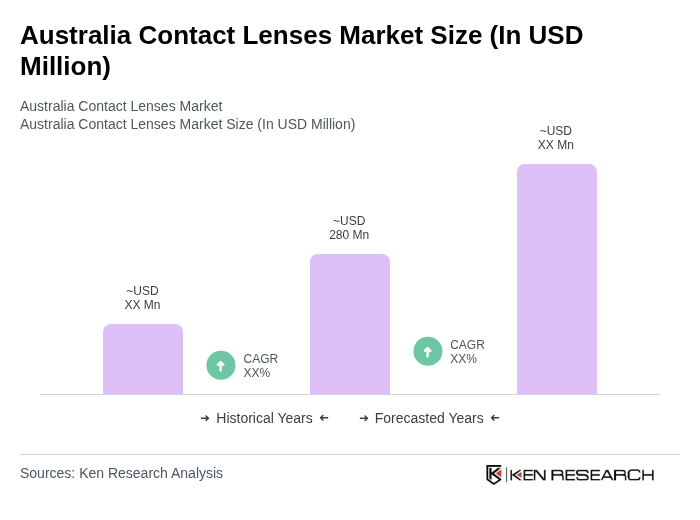
- The Australia Contact Lenses Market is valued at USD 280 million, based on a five-year historical analysis. This growth is primarily driven by increasing awareness of eye health, the rising prevalence of myopia affecting approximately 1 in 5 Australians, and advancements in lens technology. The market has seen a shift towards more comfortable and innovative lens options, including daily disposable and premium lenses, catering to a diverse consumer base increasingly prioritizing hygiene, comfort, and convenience.
- Key cities such as Sydney, Melbourne, and Brisbane dominate the market due to their large populations and higher disposable incomes. New South Wales emerged as the largest regional market in 2024, with the Sydney metropolitan area accounting for a significant portion of Australia's total population. These urban centers also have a concentration of eye care professionals and optical retailers, facilitating greater access to contact lenses and related services.
- The Therapeutic Goods Administration (TGA) regulates contact lenses in Australia under the Therapeutic Goods Act 1989, requiring all contact lenses sold in the country to meet specific safety, quality, and performance standards. This regulatory framework aims to protect consumers and ensure that only safe and effective products are available in the market, thereby enhancing public trust in contact lens usage and maintaining product integrity across the supply chain.
Australia Contact Lenses Market Segmentation
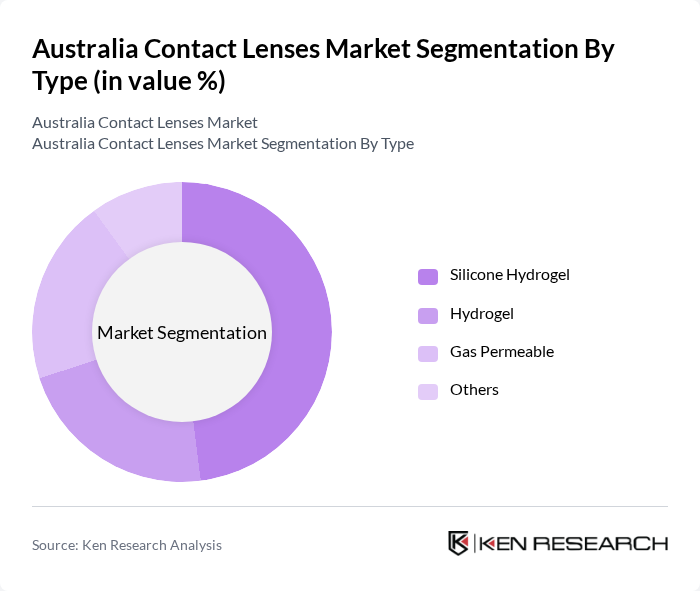
By Type:The contact lenses market can be segmented into various material types, including silicone hydrogel, hydrogel, and gas permeable lenses. Silicone hydrogel emerged as the largest revenue-generating material segment in 2024, driven by superior oxygen permeability and comfort characteristics. Soft contact lenses remain the most popular due to their comfort and ease of use, appealing to a wide range of consumers. Gas permeable lenses are also gaining traction, particularly among those with specific vision correction needs. Specialty lenses cater to niche markets, while advanced designs are preferred for certain medical conditions.
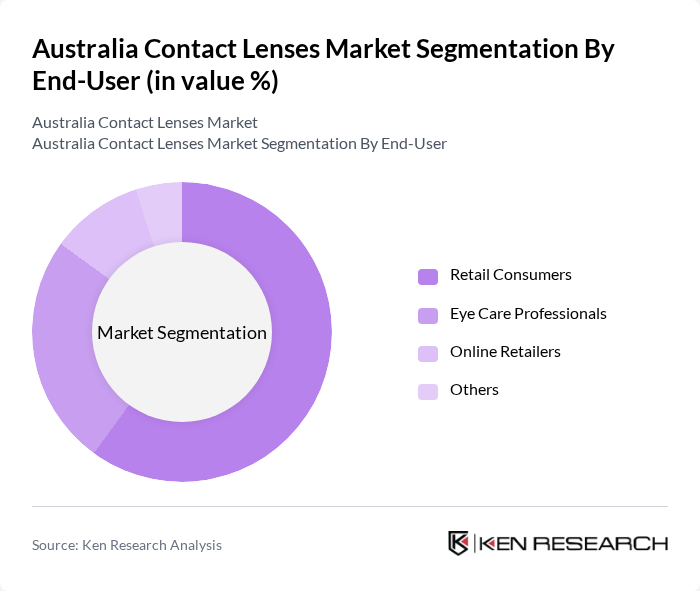
By End-User:The end-user segmentation includes retail consumers, eye care professionals, online retailers, and others. Retail consumers represent the largest segment, driven by the increasing trend of self-purchase and convenience. Eye care professionals play a crucial role in recommending and fitting lenses, while online retailers are gaining popularity due to the ease of access and competitive pricing. The market is also seeing growth in other segments, including institutional buyers and hospital clinics.
Australia Contact Lenses Market Competitive Landscape
The Australia Contact Lenses Market is characterized by a dynamic mix of regional and international players. Leading participants such as CooperVision Australia, Johnson & Johnson Australia, Bausch & Lomb (Australia) Pty Ltd, Alcon Laboratories (Australia) Pty Ltd, Menicon Australia Pty Ltd, SAS ONE PTY LTD, Capricornia Contact Lens Pty Ltd, Gelflex Australia, ColourVUE Australia, and Contact Lens Centre Australia contribute to innovation, geographic expansion, and service delivery in this space.
Australia Contact Lenses Market Industry Analysis
Growth Drivers
- Increasing Prevalence of Vision Disorders:The Australian Bureau of Statistics reported that approximately 1.5 million Australians experience vision impairment, with projections indicating a rise to 2.8 million in future. This growing prevalence of vision disorders drives demand for corrective solutions, including contact lenses. The aging population, which is expected to reach 25% of the total population in future, further exacerbates this trend, as older individuals are more likely to require vision correction.
- Rising Demand for Cosmetic Contact Lenses:The cosmetic contact lens segment is witnessing significant growth, with the market valued at AUD 160 million in future. This demand is fueled by increasing consumer interest in fashion and aesthetics, particularly among younger demographics. The Australian market is projected to see a 20% increase in sales of colored and decorative lenses in future, driven by social media influence and celebrity endorsements, enhancing the appeal of cosmetic lenses.
- Technological Advancements in Lens Materials:Innovations in lens technology, such as the development of silicone hydrogel materials, have improved comfort and oxygen permeability. The market for advanced contact lenses is expected to grow significantly, with a projected increase of 15% in sales of high-performance lenses in future. These advancements not only enhance user experience but also expand the range of options available, catering to diverse consumer needs and preferences.
Market Challenges
- High Competition from Alternative Vision Correction Methods:The contact lens market faces stiff competition from alternatives like eyeglasses and surgical procedures, such as LASIK. In future, the eyeglass market in Australia was valued at AUD 1.3 billion, overshadowing contact lenses, which were valued at AUD 650 million. This competition poses a challenge for contact lens manufacturers to differentiate their products and capture a larger market share.
- Regulatory Hurdles in Product Approvals:The Therapeutic Goods Administration (TGA) in Australia imposes stringent regulations on medical devices, including contact lenses. The approval process can take up to 18 months, delaying product launches and innovation. In future, over 30% of new product applications faced delays due to regulatory compliance issues, hindering market growth and limiting the introduction of innovative lens technologies.
Australia Contact Lenses Market Future Outlook
The Australia contact lenses market is poised for significant growth, driven by increasing awareness of vision health and the rising prevalence of vision disorders. As the population ages, the demand for corrective lenses will likely escalate, particularly for daily disposable and specialty lenses. Additionally, the integration of digital health technologies and the trend towards eco-friendly products will shape consumer preferences, creating a dynamic market landscape. Companies that adapt to these trends will be well-positioned for success in the evolving market.
Market Opportunities
- Expansion of Product Offerings in Specialty Lenses:There is a growing opportunity for manufacturers to develop specialty lenses, such as those for astigmatism and presbyopia. With an estimated 1.3 million Australians affected by these conditions, the demand for tailored solutions is expected to rise, presenting a lucrative market segment for innovation and targeted marketing strategies.
- Increasing Adoption of Smart Contact Lenses:The emergence of smart contact lenses, which can monitor health metrics, presents a unique opportunity. With the global smart lens market projected to reach AUD 1.2 billion in future, Australian companies can capitalize on this trend by investing in research and development, potentially transforming the contact lens landscape and enhancing consumer engagement.
Scope of the Report
| Segment | Sub-Segments |
|---|---|
| By Type | Soft Contact Lenses Rigid Gas Permeable Lenses Specialty Lenses Scleral Lenses Others |
| By End-User | Retail Consumers Eye Care Professionals Online Retailers Others |
| By Distribution Channel | Optical Stores E-commerce Platforms Hospitals and Clinics Others |
| By Material | Hydrogel Lenses Silicone Hydrogel Lenses Rigid Gas Permeable Materials Others |
| By Age Group | Children Adults Seniors Others |
| By Usage Frequency | Daily Disposable Bi-weekly Monthly Others |
| By Geographic Region | New South Wales Victoria Queensland Western Australia Others |
Key Target Audience
Investors and Venture Capitalist Firms
Government and Regulatory Bodies (e.g., Therapeutic Goods Administration, Australian Competition and Consumer Commission)
Manufacturers and Producers
Distributors and Retailers
Optometrists and Eye Care Professionals
Health Insurance Providers
Industry Associations (e.g., Optometry Australia)
Financial Institutions
Players Mentioned in the Report:
Johnson & Johnson Vision Care
CooperVision
Bausch + Lomb
Alcon
Menicon
Opti-Free
Acuvue
Vision Direct
Specsavers
OcuSoft
Eyeconic
ClearLab
MyEyeDr
1-800 Contacts
Lens.com
Table of Contents
Market Assessment Phase
1. Executive Summary and Approach
2. Australia Contact Lenses Market Overview
2.1 Key Insights and Strategic Recommendations
2.2 Australia Contact Lenses Market Overview
2.3 Definition and Scope
2.4 Evolution of Market Ecosystem
2.5 Timeline of Key Regulatory Milestones
2.6 Value Chain & Stakeholder Mapping
2.7 Business Cycle Analysis
2.8 Policy & Incentive Landscape
3. Australia Contact Lenses Market Analysis
3.1 Growth Drivers
3.1.1 Increasing prevalence of vision disorders
3.1.2 Rising demand for cosmetic contact lenses
3.1.3 Technological advancements in lens materials
3.1.4 Growth in online retail channels
3.2 Market Challenges
3.2.1 High competition from alternative vision correction methods
3.2.2 Regulatory hurdles in product approvals
3.2.3 Consumer awareness and education gaps
3.2.4 Price sensitivity among consumers
3.3 Market Opportunities
3.3.1 Expansion of product offerings in specialty lenses
3.3.2 Growth in the aging population
3.3.3 Increasing adoption of smart contact lenses
3.3.4 Collaborations with eye care professionals
3.4 Market Trends
3.4.1 Shift towards daily disposable lenses
3.4.2 Rise in eco-friendly and sustainable products
3.4.3 Integration of digital health technologies
3.4.4 Customization and personalization of lenses
3.5 Government Regulation
3.5.1 Therapeutic Goods Administration (TGA) regulations
3.5.2 Standards for contact lens manufacturing
3.5.3 Advertising and marketing regulations
3.5.4 Import and export regulations for medical devices
4. SWOT Analysis
5. Stakeholder Analysis
6. Porter's Five Forces Analysis
7. Australia Contact Lenses Market Market Size, 2019-2024
7.1 By Value
7.2 By Volume
7.3 By Average Selling Price
8. Australia Contact Lenses Market Segmentation
8.1 By Type
8.1.1 Soft Contact Lenses
8.1.2 Rigid Gas Permeable Lenses
8.1.3 Specialty Lenses
8.1.4 Scleral Lenses
8.1.5 Others
8.2 By End-User
8.2.1 Retail Consumers
8.2.2 Eye Care Professionals
8.2.3 Online Retailers
8.2.4 Others
8.3 By Distribution Channel
8.3.1 Optical Stores
8.3.2 E-commerce Platforms
8.3.3 Hospitals and Clinics
8.3.4 Others
8.4 By Material
8.4.1 Hydrogel Lenses
8.4.2 Silicone Hydrogel Lenses
8.4.3 Rigid Gas Permeable Materials
8.4.4 Others
8.5 By Age Group
8.5.1 Children
8.5.2 Adults
8.5.3 Seniors
8.5.4 Others
8.6 By Usage Frequency
8.6.1 Daily Disposable
8.6.2 Bi-weekly
8.6.3 Monthly
8.6.4 Others
8.7 By Geographic Region
8.7.1 New South Wales
8.7.2 Victoria
8.7.3 Queensland
8.7.4 Western Australia
8.7.5 Others
9. Australia Contact Lenses Market Competitive Analysis
9.1 Market Share of Key Players
9.2 Cross Comparison of Key Players
9.2.1 Company Name
9.2.2 Group Size (Large, Medium, or Small as per industry convention)
9.2.3 Revenue Growth Rate
9.2.4 Market Penetration Rate
9.2.5 Customer Retention Rate
9.2.6 Pricing Strategy
9.2.7 Product Innovation Rate
9.2.8 Distribution Network Efficiency
9.2.9 Brand Recognition Score
9.2.10 Customer Satisfaction Index
9.3 SWOT Analysis of Top Players
9.4 Pricing Analysis
9.5 Detailed Profile of Major Companies
9.5.1 Johnson & Johnson Vision Care
9.5.2 CooperVision
9.5.3 Bausch + Lomb
9.5.4 Alcon
9.5.5 Menicon
9.5.6 Opti-Free
9.5.7 Acuvue
9.5.8 Vision Direct
9.5.9 Specsavers
9.5.10 OcuSoft
9.5.11 Eyeconic
9.5.12 ClearLab
9.5.13 MyEyeDr
9.5.14 1-800 Contacts
9.5.15 Lens.com
10. Australia Contact Lenses Market End-User Analysis
10.1 Procurement Behavior of Key Ministries
10.1.1 Government procurement policies
10.1.2 Budget allocation for eye care
10.1.3 Supplier selection criteria
10.1.4 Contract management practices
10.2 Corporate Spend on Infrastructure & Energy
10.2.1 Investment in eye care facilities
10.2.2 Spending on technology upgrades
10.2.3 Budget for employee eye health programs
10.2.4 Others
10.3 Pain Point Analysis by End-User Category
10.3.1 Accessibility of products
10.3.2 Affordability issues
10.3.3 Quality concerns
10.3.4 Others
10.4 User Readiness for Adoption
10.4.1 Awareness of contact lens options
10.4.2 Willingness to switch from glasses
10.4.3 Availability of fitting services
10.4.4 Others
10.5 Post-Deployment ROI and Use Case Expansion
10.5.1 Evaluation of lens performance
10.5.2 User feedback collection
10.5.3 Opportunities for product upgrades
10.5.4 Others
11. Australia Contact Lenses Market Future Size, 2025-2030
11.1 By Value
11.2 By Volume
11.3 By Average Selling Price
Go-To-Market Strategy Phase
1. Whitespace Analysis + Business Model Canvas
1.1 Market gaps identification
1.2 Value proposition development
1.3 Revenue model exploration
1.4 Customer segmentation analysis
1.5 Competitive landscape overview
2. Marketing and Positioning Recommendations
2.1 Branding strategies
2.2 Product USPs
2.3 Target audience identification
2.4 Communication strategies
2.5 Digital marketing tactics
3. Distribution Plan
3.1 Urban retail strategies
3.2 Rural NGO tie-ups
3.3 Online distribution channels
3.4 Partnerships with healthcare providers
3.5 Logistics and supply chain management
4. Channel & Pricing Gaps
4.1 Underserved routes
4.2 Pricing bands analysis
4.3 Competitor pricing strategies
4.4 Consumer price sensitivity
4.5 Recommendations for pricing adjustments
5. Unmet Demand & Latent Needs
5.1 Category gaps identification
5.2 Consumer segments analysis
5.3 Product development opportunities
5.4 Market entry strategies
5.5 Future trends forecasting
6. Customer Relationship
6.1 Loyalty programs
6.2 After-sales service enhancements
6.3 Customer feedback mechanisms
6.4 Community engagement initiatives
6.5 Relationship management strategies
7. Value Proposition
7.1 Sustainability initiatives
7.2 Integrated supply chains
7.3 Customer-centric product offerings
7.4 Innovation in product design
7.5 Brand differentiation strategies
8. Key Activities
8.1 Regulatory compliance
8.2 Branding efforts
8.3 Distribution setup
8.4 Marketing campaigns
8.5 Performance monitoring
9. Entry Strategy Evaluation
9.1 Domestic Market Entry Strategy
9.1.1 Product mix considerations
9.1.2 Pricing band analysis
9.1.3 Packaging strategies
9.2 Export Entry Strategy
9.2.1 Target countries identification
9.2.2 Compliance roadmap development
10. Entry Mode Assessment
10.1 Joint Ventures
10.2 Greenfield investments
10.3 Mergers & Acquisitions
10.4 Distributor Model
10.5 Risk assessment
11. Capital and Timeline Estimation
11.1 Capital requirements analysis
11.2 Timelines for market entry
11.3 Resource allocation strategies
11.4 Financial projections
11.5 Contingency planning
12. Control vs Risk Trade-Off
12.1 Ownership considerations
12.2 Partnership dynamics
12.3 Risk management strategies
12.4 Control mechanisms
12.5 Long-term sustainability planning
13. Profitability Outlook
13.1 Breakeven analysis
13.2 Long-term sustainability strategies
13.3 Profit margin optimization
13.4 Revenue growth strategies
13.5 Financial health monitoring
14. Potential Partner List
14.1 Distributors
14.2 Joint Ventures
14.3 Acquisition targets
14.4 Strategic alliances
14.5 Partnership evaluation criteria
15. Execution Roadmap
15.1 Phased Plan for Market Entry
15.1.1 Market Setup
15.1.2 Market Entry
15.1.3 Growth Acceleration
15.1.4 Scale & Stabilize
15.2 Key Activities and Milestones
15.2.1 Activity planning
15.2.2 Milestone tracking
15.2.3 Performance evaluation
15.2.4 Resource allocation
15.2.5 Risk assessment
Research Methodology
Phase 1: Approach1
Desk Research
- Analysis of industry reports from Australian health authorities and optical associations
- Review of market trends and consumer behavior studies published by academic institutions
- Examination of sales data from major contact lens retailers and distributors in Australia
Primary Research
- Interviews with optometrists and eye care professionals to gather insights on consumer preferences
- Surveys targeting contact lens users to understand usage patterns and brand loyalty
- Focus groups with potential consumers to explore perceptions and attitudes towards contact lenses
Validation & Triangulation
- Cross-validation of findings through comparison with international market data
- Triangulation of insights from primary interviews and secondary data sources
- Sanity checks conducted through expert panel reviews comprising industry veterans
Phase 2: Market Size Estimation1
Top-down Assessment
- Estimation of total market size based on national health expenditure on vision care
- Segmentation of the market by product type, including daily disposables and extended wear lenses
- Incorporation of demographic data to assess potential market growth among different age groups
Bottom-up Modeling
- Collection of sales volume data from leading contact lens manufacturers operating in Australia
- Analysis of pricing strategies and average selling prices across different product categories
- Calculation of market size based on unit sales multiplied by average prices
Forecasting & Scenario Analysis
- Development of growth projections based on historical sales data and market trends
- Scenario analysis considering factors such as technological advancements and regulatory changes
- Creation of multiple forecasts (baseline, optimistic, and pessimistic) through 2030
Phase 3: CATI Sample Composition1
| Scope Item/Segment | Sample Size | Target Respondent Profiles |
|---|---|---|
| Optometrist Insights | 100 | Optometrists, Eye Care Specialists |
| Contact Lens User Surveys | 120 | Current Contact Lens Users, Potential Users |
| Retailer Feedback | 80 | Retail Managers, Optical Store Owners |
| Market Trend Analysis | 60 | Market Analysts, Industry Experts |
| Consumer Focus Groups | 50 | General Consumers, Young Adults |
Frequently Asked Questions
What is the current value of the Australia Contact Lenses Market?
The Australia Contact Lenses Market is valued at approximately USD 280 million, reflecting a five-year historical analysis. This growth is attributed to increased awareness of eye health and advancements in lens technology, particularly in comfort and hygiene.
What factors are driving the growth of the contact lenses market in Australia?
Which cities dominate the Australia Contact Lenses Market?
What types of contact lenses are available in the Australian market?
Other Regional/Country Reports
Other Adjacent Reports
Malaysia Eyeglasses Market
Oman Sunglasses MarketMexico Contact Lens Care Market
Global Ophthalmic Devices Market Size Share Growth Drivers Trends Opportunities & Forecast 2025–2030Indonesia Refractive Surgery Market
Philippines Vision Care Products Market
Kuwait eye health supplements market size, share, growth drivers, trends, opportunities & forecast 2025–2030Kuwait Optical Retail Market
China Smart Wearables Market Ophthalmic Pharmaceuticals MarketWhy Buy From Us?

What makes us stand out is that our consultants follow Robust, Refine and Result (RRR) methodology. Robust for clear definitions, approaches and sanity checking, Refine for differentiating respondents' facts and opinions, and Result for presenting data with story.

We have set a benchmark in the industry by offering our clients with syndicated and customized market research reports featuring coverage of entire market as well as meticulous research and analyst insights.

While we don't replace traditional research, we flip the method upside down. Our dual approach of Top Bottom & Bottom Top ensures quality deliverable by not just verifying company fundamentals but also looking at the sector and macroeconomic factors.

With one step in the future, our research team constantly tries to show you the bigger picture. We help with some of the tough questions you may encounter along the way: How is the industry positioned? Best marketing channel? KPI's of competitors? By aligning every element, we help maximize success.

Our report gives you instant access to the answers and sources that other companies might choose to hide. We elaborate each steps of research methodology we have used and showcase you the sample size to earn your trust.

If you need any support, we are here! We pride ourselves on universe strength, data quality, and quick, friendly, and professional service.