About the Report
Base Year 2024Kuwait Contact Lenses Market Overview
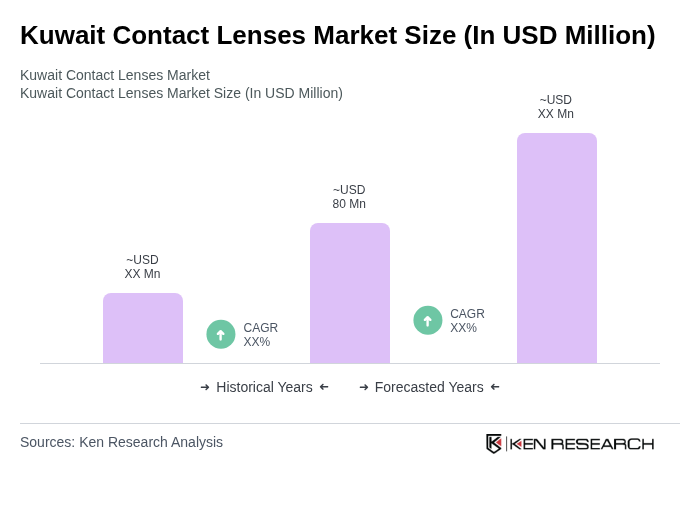
- The Kuwait Contact Lenses Market is valued at USD 80 million, based on a five-year historical analysis. This growth is primarily driven by increasing awareness of eye health, a rise in myopia cases, growing adoption of contact lenses for cosmetic purposes, and the growing preference for contact lenses over traditional eyewear. The market has seen a significant shift towards innovative products, including daily disposables and specialty lenses, catering to diverse consumer needs.
- Kuwait City is the dominant hub in the market, attributed to its high population density and concentration of healthcare facilities. The urban lifestyle and increasing disposable income among residents have led to a higher demand for contact lenses. Additionally, the presence of leading optical retailers and eye care professionals in the city further strengthens its market position.
- The Ministerial Resolution No. 404 of 2012 issued by the Ministry of Health mandates that all contact lenses sold in the country must be registered and meet specific safety, quality, and biocompatibility standards prior to market entry. This regulation requires manufacturers and importers to submit technical dossiers including material composition, oxygen permeability thresholds, and clinical performance data for approval, ensuring compliance through periodic inspections and post-market surveillance.
Kuwait Contact Lenses Market Segmentation
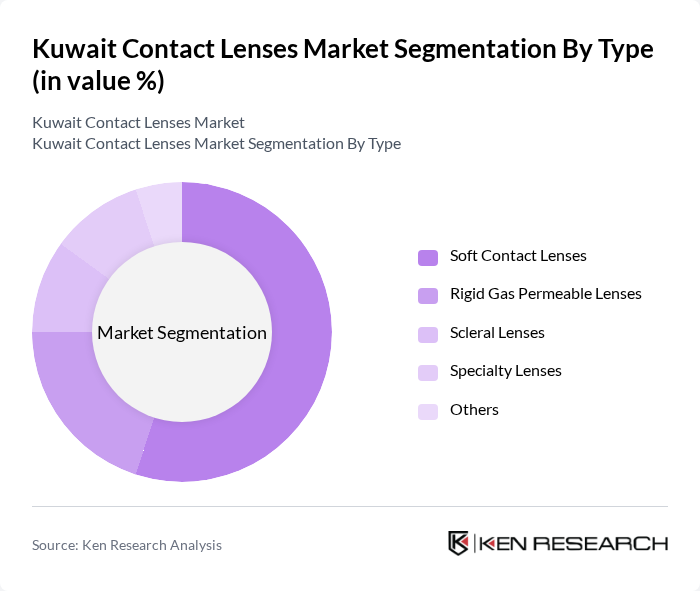
By Type:The market is segmented into various types of contact lenses, including Soft Contact Lenses, Rigid Gas Permeable Lenses, Scleral Lenses, Specialty Lenses, and Others. Among these, Soft Contact Lenses dominate the market due to their comfort and convenience, appealing to a wide range of consumers, with silicone hydrogel variants leading due to enhanced oxygen permeability. The increasing trend of daily disposable lenses is also contributing to the growth of this segment, as they offer ease of use and reduced maintenance.
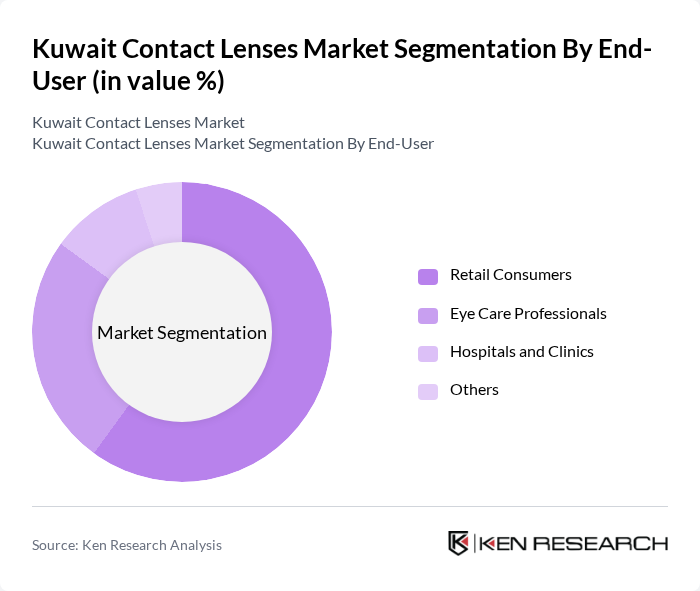
By End-User:The end-user segmentation includes Retail Consumers, Eye Care Professionals, Hospitals and Clinics, and Others. Retail Consumers represent the largest segment, driven by the increasing number of individuals opting for contact lenses for vision correction and cosmetic purposes. The growing trend of online shopping has also facilitated access to a wider range of products, further boosting this segment's growth.
Kuwait Contact Lenses Market Competitive Landscape
The Kuwait Contact Lenses Market is characterized by a dynamic mix of regional and international players. Leading participants such as Alcon, Johnson & Johnson Vision, Bausch + Lomb, CooperVision, Hoya Corporation, Menicon Co., Ltd., EssilorLuxottica, Carl Zeiss AG, SynergEyes, Vision Source, Acuvue, Opti-Free, Biofinity, Air Optix, Dailies contribute to innovation, geographic expansion, and service delivery in this space.
Kuwait Contact Lenses Market Industry Analysis
Growth Drivers
- Increasing Prevalence of Vision Disorders:The World Health Organization reported that approximately 1.5 million people in Kuwait suffer from vision disorders, with a significant rise in myopia and presbyopia cases. This growing prevalence is driving demand for corrective lenses, including contact lenses. As the population ages, the number of individuals requiring vision correction is expected to increase, further propelling the market. The healthcare sector's focus on eye health awareness is also contributing to this trend.
- Rising Awareness About Eye Health:In recent years, Kuwait has seen a surge in public health campaigns aimed at promoting eye health. According to the Ministry of Health, over 60% of the population is now aware of the importance of regular eye check-ups. This increased awareness is leading to higher demand for vision correction solutions, including contact lenses. Educational initiatives and partnerships with healthcare providers are crucial in fostering this awareness, ultimately benefiting the contact lens market.
- Technological Advancements in Lens Manufacturing:The contact lens manufacturing sector in Kuwait is experiencing significant technological advancements, with innovations such as silicone hydrogel materials and advanced manufacturing techniques. These developments have led to the production of more comfortable and breathable lenses. The introduction of smart contact lenses, which can monitor health metrics, is also gaining traction. As a result, consumers are increasingly opting for technologically advanced lenses, driving market growth and enhancing user experience.
Market Challenges
- High Cost of Premium Lenses:The premium segment of contact lenses, which includes specialized and advanced lenses, often comes with a high price tag. In Kuwait, the average cost of premium lenses can reach up to KWD 50 per box, making them less accessible to a significant portion of the population. This high cost can deter potential customers from purchasing premium products, limiting market growth. Economic factors, such as inflation and fluctuating disposable incomes, further exacerbate this challenge.
- Limited Availability of Specialized Products:Despite the growing demand for specialized contact lenses, their availability in Kuwait remains limited. Many retailers focus on standard lenses, leaving a gap in the market for specialized options such as toric or multifocal lenses. According to industry reports, only 30% of optical shops in Kuwait offer a full range of specialized lenses. This limited availability can hinder consumer choice and restrict market growth, as customers may turn to alternative vision correction methods.
Kuwait Contact Lenses Market Future Outlook
The future of the Kuwait contact lenses market appears promising, driven by increasing consumer awareness and technological innovations. As the population ages and the prevalence of vision disorders rises, demand for contact lenses is expected to grow. Additionally, the expansion of e-commerce platforms will facilitate easier access to a wider range of products. Companies are likely to invest in research and development to create more advanced and comfortable lenses, catering to the evolving needs of consumers in Kuwait.
Market Opportunities
- Expansion of E-commerce Platforms:The rise of e-commerce in Kuwait presents a significant opportunity for the contact lenses market. With online sales projected to increase by 20% in the future, companies can reach a broader audience. This shift allows consumers to conveniently purchase lenses from home, enhancing market accessibility and potentially increasing sales volumes.
- Increasing Demand for Daily Disposable Lenses:Daily disposable lenses are gaining popularity among consumers due to their convenience and hygiene benefits. The market for these lenses is expected to grow, with sales projected to reach KWD 10 million in the future. This trend reflects changing consumer preferences, providing manufacturers with an opportunity to expand their product offerings in this segment.
Scope of the Report
| Segment | Sub-Segments |
|---|---|
| By Type | Soft Contact Lenses Rigid Gas Permeable Lenses Scleral Lenses Specialty Lenses Others |
| By End-User | Retail Consumers Eye Care Professionals Hospitals and Clinics Others |
| By Distribution Channel | Online Retail Optical Stores Pharmacies Hospitals Others |
| By Material | Hydrogel Lenses Silicone Hydrogel Lenses Rigid Gas Permeable Materials Others |
| By Usage Duration | Daily Disposable Lenses Bi-weekly Lenses Monthly Lenses Others |
| By Age Group | Children Adults Seniors Others |
| By Geographic Distribution | Urban Areas Rural Areas Others |
Key Target Audience
Investors and Venture Capitalist Firms
Government and Regulatory Bodies (e.g., Ministry of Health, Kuwait Municipality)
Manufacturers and Producers
Distributors and Retailers
Optometrists and Ophthalmologists
Health Insurance Providers
Industry Associations (e.g., Kuwait Optical Association)
Pharmaceutical Companies
Players Mentioned in the Report:
Alcon
Johnson & Johnson Vision
Bausch + Lomb
CooperVision
Hoya Corporation
Menicon Co., Ltd.
EssilorLuxottica
Carl Zeiss AG
SynergEyes
Vision Source
Acuvue
Opti-Free
Biofinity
Air Optix
Dailies
Table of Contents
Market Assessment Phase
1. Executive Summary and Approach
2. Kuwait Contact Lenses Market Overview
2.1 Key Insights and Strategic Recommendations
2.2 Kuwait Contact Lenses Market Overview
2.3 Definition and Scope
2.4 Evolution of Market Ecosystem
2.5 Timeline of Key Regulatory Milestones
2.6 Value Chain & Stakeholder Mapping
2.7 Business Cycle Analysis
2.8 Policy & Incentive Landscape
3. Kuwait Contact Lenses Market Analysis
3.1 Growth Drivers
3.1.1 Increasing prevalence of vision disorders
3.1.2 Rising awareness about eye health
3.1.3 Technological advancements in lens manufacturing
3.1.4 Growth in the cosmetic contact lenses segment
3.2 Market Challenges
3.2.1 High cost of premium lenses
3.2.2 Limited availability of specialized products
3.2.3 Stringent regulatory requirements
3.2.4 Competition from alternative vision correction methods
3.3 Market Opportunities
3.3.1 Expansion of e-commerce platforms
3.3.2 Increasing demand for daily disposable lenses
3.3.3 Growth in the aging population
3.3.4 Rising disposable income among consumers
3.4 Market Trends
3.4.1 Shift towards sustainable and eco-friendly products
3.4.2 Increasing customization of contact lenses
3.4.3 Growth in online sales channels
3.4.4 Rising popularity of colored and decorative lenses
3.5 Government Regulation
3.5.1 Compliance with health and safety standards
3.5.2 Licensing requirements for manufacturers
3.5.3 Import regulations for foreign products
3.5.4 Advertising restrictions on medical devices
4. SWOT Analysis
5. Stakeholder Analysis
6. Porter's Five Forces Analysis
7. Kuwait Contact Lenses Market Market Size, 2019-2024
7.1 By Value
7.2 By Volume
7.3 By Average Selling Price
8. Kuwait Contact Lenses Market Segmentation
8.1 By Type
8.1.1 Soft Contact Lenses
8.1.2 Rigid Gas Permeable Lenses
8.1.3 Scleral Lenses
8.1.4 Specialty Lenses
8.1.5 Others
8.2 By End-User
8.2.1 Retail Consumers
8.2.2 Eye Care Professionals
8.2.3 Hospitals and Clinics
8.2.4 Others
8.3 By Distribution Channel
8.3.1 Online Retail
8.3.2 Optical Stores
8.3.3 Pharmacies
8.3.4 Hospitals
8.3.5 Others
8.4 By Material
8.4.1 Hydrogel Lenses
8.4.2 Silicone Hydrogel Lenses
8.4.3 Rigid Gas Permeable Materials
8.4.4 Others
8.5 By Usage Duration
8.5.1 Daily Disposable Lenses
8.5.2 Bi-weekly Lenses
8.5.3 Monthly Lenses
8.5.4 Others
8.6 By Age Group
8.6.1 Children
8.6.2 Adults
8.6.3 Seniors
8.6.4 Others
8.7 By Geographic Distribution
8.7.1 Urban Areas
8.7.2 Rural Areas
8.7.3 Others
9. Kuwait Contact Lenses Market Competitive Analysis
9.1 Market Share of Key Players
9.2 Cross Comparison of Key Players
9.2.1 Company Name
9.2.2 Group Size (Large, Medium, or Small as per industry convention)
9.2.3 Revenue Growth Rate
9.2.4 Market Penetration Rate
9.2.5 Customer Retention Rate
9.2.6 Product Diversification Index
9.2.7 Pricing Strategy
9.2.8 Distribution Efficiency
9.2.9 Brand Recognition Score
9.2.10 Customer Satisfaction Index
9.3 SWOT Analysis of Top Players
9.4 Pricing Analysis
9.5 Detailed Profile of Major Companies
9.5.1 Alcon
9.5.2 Johnson & Johnson Vision
9.5.3 Bausch + Lomb
9.5.4 CooperVision
9.5.5 Hoya Corporation
9.5.6 Menicon Co., Ltd.
9.5.7 EssilorLuxottica
9.5.8 Carl Zeiss AG
9.5.9 SynergEyes
9.5.10 Vision Source
9.5.11 Acuvue
9.5.12 Opti-Free
9.5.13 Biofinity
9.5.14 Air Optix
9.5.15 Dailies
10. Kuwait Contact Lenses Market End-User Analysis
10.1 Procurement Behavior of Key Ministries
10.1.1 Government procurement policies
10.1.2 Budget allocation for eye care
10.1.3 Supplier selection criteria
10.1.4 Contract management practices
10.2 Corporate Spend on Infrastructure & Energy
10.2.1 Investment in healthcare infrastructure
10.2.2 Spending on eye care services
10.2.3 Budget for employee health programs
10.2.4 Others
10.3 Pain Point Analysis by End-User Category
10.3.1 Accessibility of products
10.3.2 Affordability issues
10.3.3 Quality concerns
10.3.4 Others
10.4 User Readiness for Adoption
10.4.1 Awareness of contact lens benefits
10.4.2 Availability of fitting services
10.4.3 Education on lens care
10.4.4 Others
10.5 Post-Deployment ROI and Use Case Expansion
10.5.1 Evaluation of lens performance
10.5.2 User feedback collection
10.5.3 Opportunities for product upgrades
10.5.4 Others
11. Kuwait Contact Lenses Market Future Size, 2025-2030
11.1 By Value
11.2 By Volume
11.3 By Average Selling Price
Go-To-Market Strategy Phase
1. Whitespace Analysis + Business Model Canvas
1.1 Market gaps identification
1.2 Value proposition development
1.3 Revenue model exploration
1.4 Customer segmentation analysis
1.5 Competitive landscape overview
1.6 Key partnerships identification
1.7 Risk assessment
2. Marketing and Positioning Recommendations
2.1 Branding strategies
2.2 Product USPs
2.3 Target audience definition
2.4 Marketing channels selection
2.5 Messaging framework
2.6 Campaign planning
2.7 Performance metrics
3. Distribution Plan
3.1 Urban retail vs rural NGO tie-ups
3.2 Distribution channel optimization
3.3 Logistics and supply chain management
3.4 Partnership opportunities
3.5 Inventory management strategies
3.6 Customer service integration
3.7 Performance tracking
4. Channel & Pricing Gaps
4.1 Underserved routes
4.2 Pricing bands
4.3 Competitor pricing analysis
4.4 Value-based pricing strategies
4.5 Discount and promotion strategies
4.6 Price elasticity assessment
4.7 Customer feedback on pricing
5. Unmet Demand & Latent Needs
5.1 Category gaps
5.2 Consumer segments
5.3 Product feature requests
5.4 Service improvement areas
5.5 Market entry barriers
5.6 Future trends anticipation
5.7 Innovation opportunities
6. Customer Relationship
6.1 Loyalty programs
6.2 After-sales service
6.3 Customer engagement strategies
6.4 Feedback loops
6.5 Community building initiatives
6.6 Customer education programs
6.7 Performance evaluation
7. Value Proposition
7.1 Sustainability
7.2 Integrated supply chains
7.3 Unique selling points
7.4 Customer-centric approach
7.5 Competitive advantages
7.6 Market differentiation strategies
7.7 Value delivery mechanisms
8. Key Activities
8.1 Regulatory compliance
8.2 Branding
8.3 Distribution setup
8.4 Marketing execution
8.5 Customer support establishment
8.6 Performance monitoring
8.7 Continuous improvement processes
9. Entry Strategy Evaluation
9.1 Domestic Market Entry Strategy
9.1.1 Product mix
9.1.2 Pricing band
9.1.3 Packaging
9.2 Export Entry Strategy
9.2.1 Target countries
9.2.2 Compliance roadmap
10. Entry Mode Assessment
10.1 JV
10.2 Greenfield
10.3 M&A
10.4 Distributor Model
11. Capital and Timeline Estimation
11.1 Capital requirements
11.2 Timelines
12. Control vs Risk Trade-Off
12.1 Ownership vs Partnerships
13. Profitability Outlook
13.1 Breakeven analysis
13.2 Long-term sustainability
14. Potential Partner List
14.1 Distributors
14.2 JVs
14.3 Acquisition targets
15. Execution Roadmap
15.1 Phased Plan for Market Entry
15.1.1 Market Setup
15.1.2 Market Entry
15.1.3 Growth Acceleration
15.1.4 Scale & Stabilize
15.2 Key Activities and Milestones
15.2.1 Activity planning
15.2.2 Milestone tracking
Research Methodology
Phase 1: Approach1
Desk Research
- Analysis of market reports from industry associations and health organizations in Kuwait
- Review of published articles and journals focusing on contact lens usage trends and demographics
- Examination of government health statistics and regulations related to eye care and contact lenses
Primary Research
- Interviews with ophthalmologists and optometrists to gather insights on prescription trends
- Surveys conducted with consumers to understand preferences and purchasing behavior
- Focus groups with contact lens users to discuss experiences and brand perceptions
Validation & Triangulation
- Cross-validation of findings through multiple data sources, including sales data and consumer feedback
- Triangulation of insights from healthcare professionals and market analysts
- Sanity checks through expert panel reviews to ensure data reliability and relevance
Phase 2: Market Size Estimation1
Top-down Assessment
- Estimation of total market size based on national healthcare expenditure on vision care
- Segmentation of the market by product type, including daily disposables, bi-weekly, and monthly lenses
- Incorporation of demographic data to assess potential market growth among different age groups
Bottom-up Modeling
- Collection of sales data from leading optical retailers and online platforms
- Estimation of average selling prices for various types of contact lenses
- Volume calculations based on consumer purchasing patterns and frequency of lens replacement
Forecasting & Scenario Analysis
- Multi-factor regression analysis incorporating factors such as population growth and increasing awareness of eye health
- Scenario modeling based on potential changes in healthcare policies and consumer behavior trends
- Development of baseline, optimistic, and pessimistic forecasts through 2030
Phase 3: CATI Sample Composition1
| Scope Item/Segment | Sample Size | Target Respondent Profiles |
|---|---|---|
| Ophthalmologist Insights | 50 | Ophthalmologists, Optometrists |
| Consumer Preferences | 120 | Contact Lens Users, Potential Users |
| Retailer Feedback | 30 | Optical Retail Managers, Store Owners |
| Market Analysts | 20 | Healthcare Market Analysts, Industry Experts |
| Focus Group Discussions | 40 | Contact Lens Users, Eye Care Advocates |
Frequently Asked Questions
What is the current value of the Kuwait Contact Lenses Market?
The Kuwait Contact Lenses Market is valued at approximately USD 80 million, reflecting a significant growth trend driven by increasing awareness of eye health and a rise in myopia cases among the population.
What factors are driving the growth of the contact lenses market in Kuwait?
Which type of contact lenses dominates the Kuwait market?
Who are the primary end-users of contact lenses in Kuwait?
Other Regional/Country Reports
Other Adjacent Reports
Egypt Vision Care Products Market
Kuwait Contact Lens Solutions Market
South Korea Refractive Surgery Market
Egypt Optical Retail Market
Kuwait eye health supplements market size, share, growth drivers, trends, opportunities & forecast 2025–2030 Ophthalmic Pharmaceuticals MarketEgypt Laser Eye Treatment Market
South Africa Optometric Services Market
Why Buy From Us?

What makes us stand out is that our consultants follow Robust, Refine and Result (RRR) methodology. Robust for clear definitions, approaches and sanity checking, Refine for differentiating respondents' facts and opinions, and Result for presenting data with story.

We have set a benchmark in the industry by offering our clients with syndicated and customized market research reports featuring coverage of entire market as well as meticulous research and analyst insights.

While we don't replace traditional research, we flip the method upside down. Our dual approach of Top Bottom & Bottom Top ensures quality deliverable by not just verifying company fundamentals but also looking at the sector and macroeconomic factors.

With one step in the future, our research team constantly tries to show you the bigger picture. We help with some of the tough questions you may encounter along the way: How is the industry positioned? Best marketing channel? KPI's of competitors? By aligning every element, we help maximize success.

Our report gives you instant access to the answers and sources that other companies might choose to hide. We elaborate each steps of research methodology we have used and showcase you the sample size to earn your trust.

If you need any support, we are here! We pride ourselves on universe strength, data quality, and quick, friendly, and professional service.