About the Report
Base Year 2024Australia Off Road Vehicle Market Overview
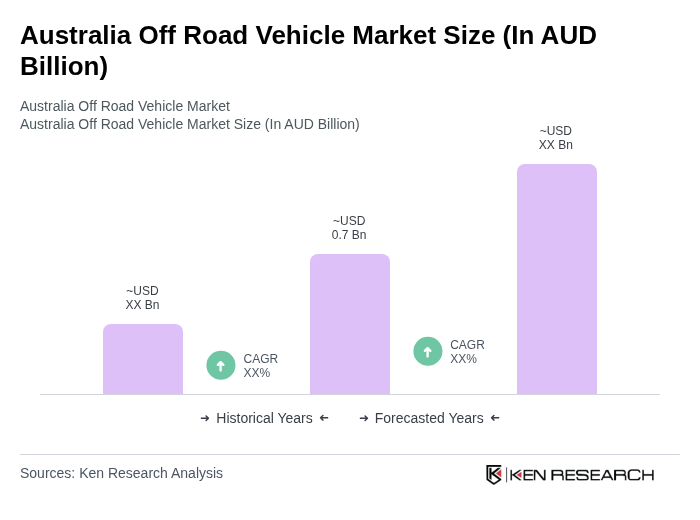
- The Australia Off Road Vehicle Market is valued at approximately AUD 0.7 billion, based on a five-year historical analysis of national and regional off-road vehicle and ATV/UTV sales and revenue data. This growth is primarily driven by increasing consumer interest in outdoor recreational activities, the popularity of four-wheel drive touring and camping, and a continued rise in domestic adventure tourism across remote regions. The demand for off-road vehicles, particularly in remote and rugged terrains, has surged as more Australians seek to explore national parks, outback tracks, and coastal trails using purpose-built 4WDs, ATVs, UTVs, and off-road motorcycles.
- Key regions dominating the market include New South Wales and Queensland, where large rural areas, extensive road networks, and favorable climates encourage off-road activities, agriculture use, and regional tourism. The popularity of off-road events, organized trail rides, and recreational parks in these states, alongside strong 4WD and ATV usage in farming and station operations, further enhances market growth, making them pivotal locations for manufacturers, dealers, and rental operators.
- In 2023, the Australian government implemented stricter regulations on emissions for non-road and off-road engines, including those used in certain off-road vehicles and equipment, by aligning national requirements with the Euro Stage V standards under the Non-road Spark Ignition Engine Emissions Determination 2019 administered by the Department of Climate Change, Energy, the Environment and Water. This regulatory framework sets limits on exhaust and evaporative emissions for new imported or manufactured engines, driving OEMs and importers to adopt cleaner technologies, improve fuel efficiency, and expand low-emission and electric off-road vehicle offerings in the Australian market.
Australia Off Road Vehicle Market Segmentation
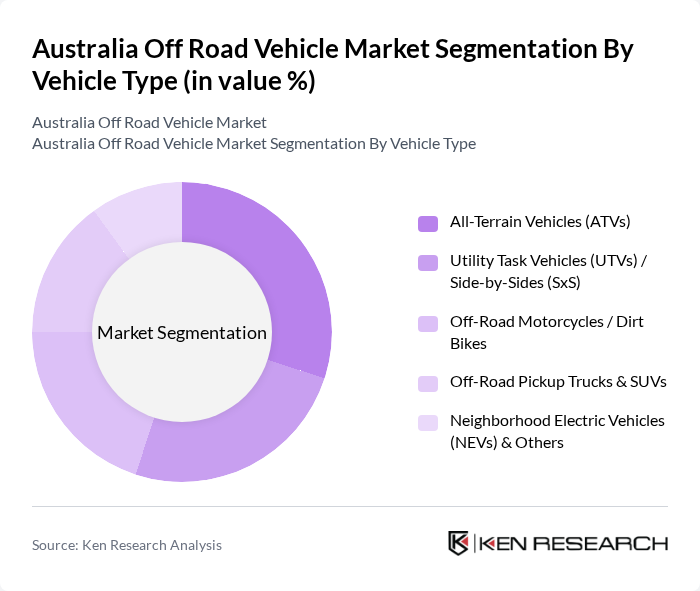
By Vehicle Type:The vehicle type segmentation includes All-Terrain Vehicles (ATVs), Utility Task Vehicles (UTVs) / Side-by-Sides (SxS), Off-Road Motorcycles / Dirt Bikes, Off-Road Pickup Trucks & SUVs, and Neighborhood Electric Vehicles (NEVs) & Others. The ATV segment is widely used due to its versatility and suitability for varied terrains in agriculture, recreation, and land management, while UTVs are increasingly favored for their higher payload capacity, passenger space, and safety features in both agricultural and recreational applications. Off-road motorcycles and dirt bikes remain important for sports, trail riding, and enduro events, whereas off-road pickup trucks and SUVs dominate long-distance touring and 4WD adventure segments, with NEVs and other specialty vehicles emerging slowly in gated communities, resorts, and controlled environments.
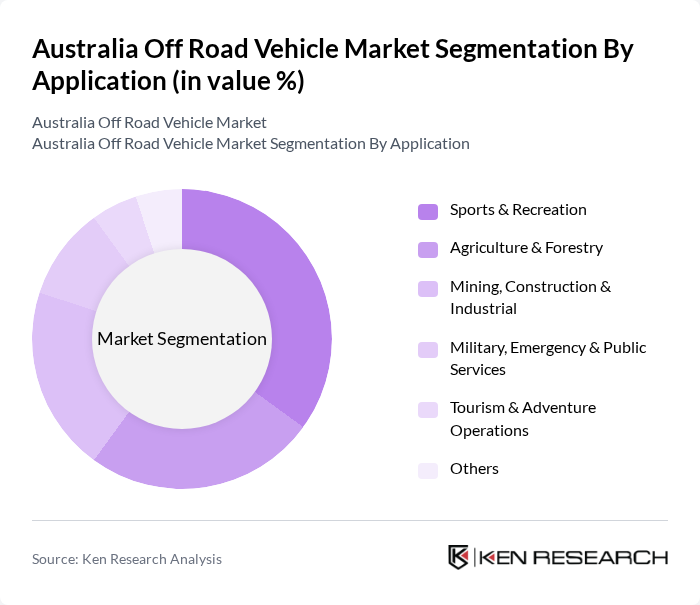
By Application:The application segmentation encompasses Sports & Recreation, Agriculture & Forestry, Mining, Construction & Industrial, Military, Emergency & Public Services, Tourism & Adventure Operations, and Others. The sports and recreation segment is the largest, supported by strong participation in off-road motorcycling, 4WD touring, and recreational ATV/UTV riding, alongside growth in organized off-road events and clubs. The agriculture and forestry segment benefits from the utility of off-road vehicles in farming operations, station work, and plantation management, where ATVs and UTVs are used for mustering, fencing, spraying, and general on-farm transport, while mining and construction rely on robust off-road platforms for site access, inspection, and support operations in remote locations. Government, defense, and emergency services applications continue to leverage off-road vehicles for search and rescue, disaster response, and patrol duties, and tourism and adventure operators integrate 4WDs, ATVs, and UTVs into guided tours, rental fleets, and experiential travel products.
Australia Off Road Vehicle Market Competitive Landscape
The Australia Off Road Vehicle Market is characterized by a dynamic mix of regional and international players. Leading participants such as Polaris Inc., Yamaha Motor Australia Pty Ltd, Honda Australia Motorcycle & Power Equipment Pty Ltd, BRP (Can-Am Off-Road) Australia, Kawasaki Motors Pty Ltd (Australia), Arctic Cat (Textron Off Road), Suzuki Australia Pty Ltd, John Deere Limited (Australia & New Zealand), KTM Australia Pty Ltd, CFMOTO Australia, Mahindra Automotive Australia Pty Ltd, Segway Powersports Australia, ODES UTVs Australia, LDV Australia (SAIC Motor), Isuzu UTE Australia contribute to innovation, geographic expansion, and service delivery in this space.
Australia Off Road Vehicle Market Industry Analysis
Growth Drivers
- Increasing Popularity of Outdoor Recreational Activities:The Australian outdoor recreation sector has seen significant growth, with over 13 million Australians participating in activities such as camping and off-roading in future. This trend is supported by a 16% increase in domestic tourism spending, reaching AUD 110 billion, as more individuals seek adventure and leisure experiences. The rise in outdoor activities directly correlates with the demand for off-road vehicles, as consumers invest in vehicles that enhance their recreational pursuits.
- Rising Disposable Income Among Consumers:In future, Australia's average disposable income is projected to reach AUD 1,250 per week, reflecting a 4% increase from the previous year. This rise in disposable income allows consumers to allocate more funds towards leisure activities, including the purchase of off-road vehicles. As financial stability improves, consumers are more willing to invest in high-quality vehicles that cater to their adventurous lifestyles, driving market growth in the off-road vehicle sector.
- Expansion of Off-Road Trails and Parks:The Australian government has committed AUD 60 million to expand off-road trails and parks by future, enhancing access to natural landscapes for off-road enthusiasts. This initiative aims to create over 1,200 kilometers of new trails, promoting off-road activities and increasing the demand for off-road vehicles. As more trails become available, the appeal of off-roading grows, encouraging consumers to invest in vehicles designed for rugged terrains and outdoor exploration.
Market Challenges
- Stringent Environmental Regulations:Australia has implemented strict environmental regulations that impact the off-road vehicle market. The National Environment Protection Council has set emission standards that require off-road vehicles to meet specific criteria by future. Compliance with these regulations can increase manufacturing costs, potentially leading to higher retail prices for consumers. This challenge may deter some buyers, particularly those with limited budgets, affecting overall market growth.
- High Initial Purchase Costs:The average cost of off-road vehicles in Australia ranges from AUD 35,000 to AUD 85,000, which can be a significant financial burden for many consumers. With rising living costs and economic uncertainty, potential buyers may hesitate to make such a large investment. This challenge is compounded by limited financing options, making it difficult for consumers to afford these vehicles, thereby restricting market expansion and accessibility.
Australia Off Road Vehicle Market Future Outlook
The future of the Australia off-road vehicle market appears promising, driven by increasing consumer interest in outdoor activities and technological advancements. As manufacturers focus on developing eco-friendly and electric off-road vehicles, the market is likely to attract environmentally conscious consumers. Additionally, partnerships with tourism and adventure companies can enhance market visibility and accessibility, creating new avenues for growth. The combination of these trends suggests a dynamic and evolving landscape for off-road vehicles in Australia.
Market Opportunities
- Growth in Eco-Friendly Off-Road Vehicles:The demand for eco-friendly off-road vehicles is on the rise, with a projected market value of AUD 600 million by future. This growth is driven by increasing consumer awareness of environmental issues and a shift towards sustainable transportation options. Manufacturers that invest in green technologies can capitalize on this trend, appealing to a broader audience and enhancing their market share.
- Expansion into Urban Markets:Urban areas in Australia are witnessing a growing interest in off-road vehicles, with sales in metropolitan regions increasing by 25% in future. This trend presents an opportunity for manufacturers to target urban consumers seeking versatile vehicles for both city driving and outdoor adventures. By developing models that cater to urban lifestyles, companies can tap into this emerging market segment and drive sales growth.
Scope of the Report
| Segment | Sub-Segments |
|---|---|
| By Vehicle Type | All-Terrain Vehicles (ATVs) Utility Task Vehicles (UTVs) / Side-by-Sides (SxS) Off-Road Motorcycles / Dirt Bikes Off-Road Pickup Trucks & SUVs Neighborhood Electric Vehicles (NEVs) & Others |
| By Application | Sports & Recreation Agriculture & Forestry Mining, Construction & Industrial Military, Emergency & Public Services Tourism & Adventure Operations Others |
| By Propulsion / Engine Type | Internal Combustion Engine (ICE) Hybrid Battery Electric Others |
| By Displacement (CC) – ATV & Motorcycle | Below 400 CC –800 CC Above 800 CC |
| By Seating / Payload Configuration | Single-Seat –3 Seat Multi-Seat & Crew Cab High-Payload Utility |
| By Price Band | Entry / Budget Mid-Range Premium Performance / Luxury |
| By Region | New South Wales Victoria & Tasmania Queensland Western Australia South Australia Northern Territory Australian Capital Territory (ACT) |
Key Target Audience
Investors and Venture Capitalist Firms
Government and Regulatory Bodies (e.g., Department of Infrastructure, Transport, Regional Development and Communications)
Manufacturers and Producers
Distributors and Retailers
Automotive Aftermarket Suppliers
Tourism and Adventure Travel Companies
Environmental and Conservation Organizations
Insurance Companies and Risk Assessment Firms
Players Mentioned in the Report:
Polaris Inc.
Yamaha Motor Australia Pty Ltd
Honda Australia Motorcycle & Power Equipment Pty Ltd
BRP (Can-Am Off-Road) Australia
Kawasaki Motors Pty Ltd (Australia)
Arctic Cat (Textron Off Road)
Suzuki Australia Pty Ltd
John Deere Limited (Australia & New Zealand)
KTM Australia Pty Ltd
CFMOTO Australia
Mahindra Automotive Australia Pty Ltd
Segway Powersports Australia
ODES UTVs Australia
LDV Australia (SAIC Motor)
Isuzu UTE Australia
Table of Contents
Market Assessment Phase
1. Executive Summary and Approach
2. Australia Off Road Vehicle Market Overview
2.1 Key Insights and Strategic Recommendations
2.2 Australia Off Road Vehicle Market Overview
2.3 Definition and Scope
2.4 Evolution of Market Ecosystem
2.5 Timeline of Key Regulatory Milestones
2.6 Value Chain & Stakeholder Mapping
2.7 Business Cycle Analysis
2.8 Policy & Incentive Landscape
3. Australia Off Road Vehicle Market Analysis
3.1 Growth Drivers
3.1.1 Increasing popularity of outdoor recreational activities
3.1.2 Rising disposable income among consumers
3.1.3 Expansion of off-road trails and parks
3.1.4 Technological advancements in vehicle performance
3.2 Market Challenges
3.2.1 Stringent environmental regulations
3.2.2 High initial purchase costs
3.2.3 Limited availability of financing options
3.2.4 Competition from alternative recreational vehicles
3.3 Market Opportunities
3.3.1 Growth in eco-friendly off-road vehicles
3.3.2 Expansion into urban markets
3.3.3 Development of electric off-road vehicles
3.3.4 Partnerships with tourism and adventure companies
3.4 Market Trends
3.4.1 Increasing customization options for consumers
3.4.2 Rise of online sales channels
3.4.3 Focus on safety features and technology
3.4.4 Growth of off-road vehicle clubs and communities
3.5 Government Regulation
3.5.1 Emission standards for off-road vehicles
3.5.2 Safety regulations for vehicle manufacturing
3.5.3 Licensing requirements for off-road vehicle use
3.5.4 Land use regulations for off-road trails
4. SWOT Analysis
5. Stakeholder Analysis
6. Porter's Five Forces Analysis
7. Australia Off Road Vehicle Market Market Size, 2019-2024
7.1 By Value
7.2 By Volume
7.3 By Average Selling Price
8. Australia Off Road Vehicle Market Segmentation
8.1 By Vehicle Type
8.1.1 All-Terrain Vehicles (ATVs)
8.1.2 Utility Task Vehicles (UTVs) / Side-by-Sides (SxS)
8.1.3 Off-Road Motorcycles / Dirt Bikes
8.1.4 Off-Road Pickup Trucks & SUVs
8.1.5 Neighborhood Electric Vehicles (NEVs) & Others
8.2 By Application
8.2.1 Sports & Recreation
8.2.2 Agriculture & Forestry
8.2.3 Mining, Construction & Industrial
8.2.4 Military, Emergency & Public Services
8.2.5 Tourism & Adventure Operations
8.2.6 Others
8.3 By Propulsion / Engine Type
8.3.1 Internal Combustion Engine (ICE)
8.3.2 Hybrid
8.3.3 Battery Electric
8.3.4 Others
8.4 By Displacement (CC) – ATV & Motorcycle
8.4.1 Below 400 CC
8.4.2 400–800 CC
8.4.3 Above 800 CC
8.5 By Seating / Payload Configuration
8.5.1 Single-Seat
8.5.2 2–3 Seat
8.5.3 Multi-Seat & Crew Cab
8.5.4 High-Payload Utility
8.6 By Price Band
8.6.1 Entry / Budget
8.6.2 Mid-Range
8.6.3 Premium
8.6.4 Performance / Luxury
8.7 By Region
8.7.1 New South Wales
8.7.2 Victoria & Tasmania
8.7.3 Queensland
8.7.4 Western Australia
8.7.5 South Australia
8.7.6 Northern Territory
8.7.7 Australian Capital Territory (ACT)
9. Australia Off Road Vehicle Market Competitive Analysis
9.1 Market Share of Key Players
9.2 Cross Comparison of Key Players
9.2.1 Company Name
9.2.2 Group Size (by global off-road revenue)
9.2.3 Australia Off-Road Vehicle Revenue (AUD, latest year)
9.2.4 3-Year Australia Revenue CAGR (%)
9.2.5 Off-Road Vehicle Market Share in Australia (%)
9.2.6 Average Realized ASP in Australia (AUD/unit)
9.2.7 EBITDA Margin – Off-Road Segment (%)
9.2.8 Dealer & Service Network Coverage (no. of outlets)
9.2.9 Unit Sales Mix by Vehicle Type (ATV / UTV / Others)
9.2.10 R&D Intensity (% of revenue)
9.2.11 CAPEX Intensity (% of revenue)
9.2.12 Digital & E-commerce Penetration (% of retail sales)
9.2.13 Customer Retention / Repeat Purchase Rate (%)
9.2.14 Net Promoter Score (NPS)
9.2.15 Warranty Claim Rate (% of units sold)
9.3 SWOT Analysis of Top Players
9.4 Pricing Analysis
9.5 Detailed Profile of Major Companies
9.5.1 Polaris Inc.
9.5.2 Yamaha Motor Australia Pty Ltd
9.5.3 Honda Australia Motorcycle & Power Equipment Pty Ltd
9.5.4 BRP (Can-Am Off-Road) Australia
9.5.5 Kawasaki Motors Pty Ltd (Australia)
9.5.6 Arctic Cat (Textron Off Road)
9.5.7 Suzuki Australia Pty Ltd
9.5.8 John Deere Limited (Australia & New Zealand)
9.5.9 KTM Australia Pty Ltd
9.5.10 CFMOTO Australia
9.5.11 Mahindra Automotive Australia Pty Ltd
9.5.12 Segway Powersports Australia
9.5.13 ODES UTVs Australia
9.5.14 LDV Australia (SAIC Motor)
9.5.15 Isuzu UTE Australia
10. Australia Off Road Vehicle Market End-User Analysis
10.1 Procurement Behavior of Key Ministries
10.1.1 Government procurement policies
10.1.2 Budget allocation for off-road vehicles
10.1.3 Decision-making processes
10.1.4 Supplier evaluation criteria
10.2 Corporate Spend on Infrastructure & Energy
10.2.1 Investment trends in off-road vehicles
10.2.2 Budgeting for maintenance and upgrades
10.2.3 Impact of economic conditions on spending
10.3 Pain Point Analysis by End-User Category
10.3.1 Challenges faced by recreational users
10.3.2 Issues for commercial users
10.3.3 Government agency concerns
10.4 User Readiness for Adoption
10.4.1 Awareness of off-road vehicle options
10.4.2 Willingness to invest in off-road vehicles
10.4.3 Training and support needs
10.5 Post-Deployment ROI and Use Case Expansion
10.5.1 Measuring ROI for recreational users
10.5.2 ROI considerations for commercial users
10.5.3 Future use case expansions
11. Australia Off Road Vehicle Market Future Size, 2025-2030
11.1 By Value
11.2 By Volume
11.3 By Average Selling Price
Go-To-Market Strategy Phase
1. Whitespace Analysis + Business Model Canvas
1.1 Market gaps and opportunities
1.2 Business model components
2. Marketing and Positioning Recommendations
2.1 Branding strategies
2.2 Product USPs
3. Distribution Plan
3.1 Urban retail vs rural NGO tie-ups
4. Channel & Pricing Gaps
4.1 Underserved routes
4.2 Pricing bands
5. Unmet Demand & Latent Needs
5.1 Category gaps
5.2 Consumer segments
6. Customer Relationship
6.1 Loyalty programs
6.2 After-sales service
7. Value Proposition
7.1 Sustainability
7.2 Integrated supply chains
8. Key Activities
8.1 Regulatory compliance
8.2 Branding
8.3 Distribution setup
9. Entry Strategy Evaluation
9.1 Domestic Market Entry Strategy
9.1.1 Product mix
9.1.2 Pricing band
9.1.3 Packaging
9.2 Export Entry Strategy
9.2.1 Target countries
9.2.2 Compliance roadmap
10. Entry Mode Assessment
10.1 JV, Greenfield, M&A, Distributor Model
11. Capital and Timeline Estimation
11.1 Capital requirements
11.2 Timelines
12. Control vs Risk Trade-Off
12.1 Ownership vs Partnerships
13. Profitability Outlook
13.1 Breakeven analysis
13.2 Long-term sustainability
14. Potential Partner List
14.1 Distributors
14.2 JVs
14.3 Acquisition targets
15. Execution Roadmap
15.1 Phased Plan for Market Entry
15.1.1 Market Setup
15.1.2 Market Entry
15.1.3 Growth Acceleration
15.1.4 Scale & Stabilize
15.2 Key Activities and Milestones
15.2.1 Milestone tracking
15.2.2 Activity scheduling
Research Methodology
Phase 1: Approach1
Desk Research
- Analysis of industry reports from Australian automotive and off-road vehicle associations
- Review of government publications on off-road vehicle regulations and safety standards
- Examination of market trends through academic journals and trade publications focused on off-road vehicles
Primary Research
- Interviews with manufacturers and distributors of off-road vehicles in Australia
- Surveys targeting end-users, including recreational and professional off-road vehicle operators
- Focus groups with enthusiasts and industry experts to gather qualitative insights
Validation & Triangulation
- Cross-validation of data through multiple sources, including sales data and consumer feedback
- Triangulation of findings from primary interviews and secondary data sources
- Sanity checks conducted through expert panel reviews and industry roundtables
Phase 2: Market Size Estimation1
Top-down Assessment
- Estimation of market size based on national vehicle registration statistics and growth rates
- Segmentation of the market by vehicle type, including ATVs, UTVs, and dirt bikes
- Incorporation of trends in outdoor recreational activities and tourism impacting off-road vehicle sales
Bottom-up Modeling
- Collection of sales data from leading off-road vehicle manufacturers and dealers
- Estimation of average selling prices and unit sales across different vehicle categories
- Analysis of aftermarket sales, including parts and accessories for off-road vehicles
Forecasting & Scenario Analysis
- Multi-factor regression analysis incorporating economic indicators and consumer spending trends
- Scenario modeling based on potential regulatory changes and environmental considerations
- Development of baseline, optimistic, and pessimistic forecasts through 2030
Phase 3: CATI Sample Composition1
| Scope Item/Segment | Sample Size | Target Respondent Profiles |
|---|---|---|
| Recreational Off-Road Vehicle Users | 140 | Outdoor Enthusiasts, Hobbyists |
| Commercial Off-Road Vehicle Operators | 100 | Construction Managers, Agricultural Operators |
| Dealers and Distributors | 80 | Sales Managers, Product Specialists |
| Aftermarket Parts Retailers | 70 | Store Owners, Inventory Managers |
| Industry Experts and Analysts | 50 | Market Analysts, Consultants |
Frequently Asked Questions
What is the current value of the Australia Off Road Vehicle Market?
The Australia Off Road Vehicle Market is valued at approximately AUD 0.7 billion, driven by increasing consumer interest in outdoor recreational activities and adventure tourism, particularly in remote regions of the country.
Which regions in Australia dominate the Off Road Vehicle Market?
What types of vehicles are included in the Australia Off Road Vehicle Market?
What are the main applications of off-road vehicles in Australia?
Other Regional/Country Reports
Other Adjacent Reports
Germany Outdoor Recreation Equipment Market
Indonesia Automotive Parts MarketSingapore Emission Control Technology Market
Why Buy From Us?

What makes us stand out is that our consultants follow Robust, Refine and Result (RRR) methodology. Robust for clear definitions, approaches and sanity checking, Refine for differentiating respondents' facts and opinions, and Result for presenting data with story.

We have set a benchmark in the industry by offering our clients with syndicated and customized market research reports featuring coverage of entire market as well as meticulous research and analyst insights.

While we don't replace traditional research, we flip the method upside down. Our dual approach of Top Bottom & Bottom Top ensures quality deliverable by not just verifying company fundamentals but also looking at the sector and macroeconomic factors.

With one step in the future, our research team constantly tries to show you the bigger picture. We help with some of the tough questions you may encounter along the way: How is the industry positioned? Best marketing channel? KPI's of competitors? By aligning every element, we help maximize success.

Our report gives you instant access to the answers and sources that other companies might choose to hide. We elaborate each steps of research methodology we have used and showcase you the sample size to earn your trust.

If you need any support, we are here! We pride ourselves on universe strength, data quality, and quick, friendly, and professional service.