About the Report
Base Year 2024Brazil Digital Health Insurance Platforms Market Overview
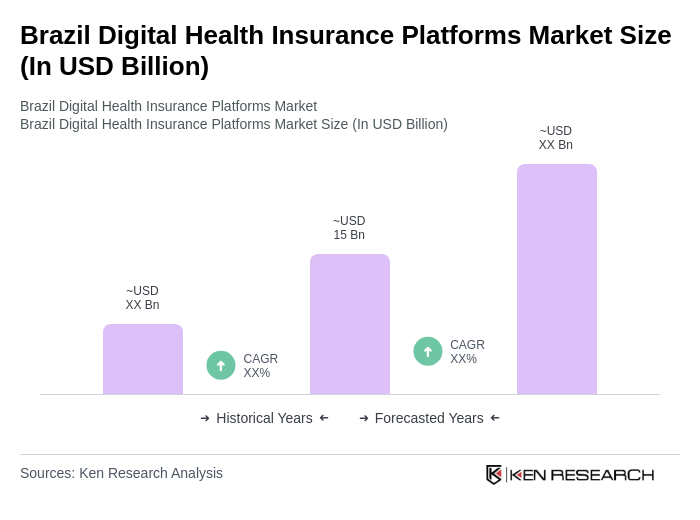
- The Brazil Digital Health Insurance Platforms Market is valued at USD 15 billion, based on a five-year historical analysis. This expansion is primarily driven by the rapid adoption of digital health solutions, rising healthcare costs, and increased awareness of health insurance among the population. The integration of technology in health insurance is enabling enhanced customer engagement, streamlined claims processing, and improved access to healthcare services, which are key factors fueling market growth. Additionally, the proliferation of smartphones and internet connectivity has accelerated the use of digital platforms for policy management and telemedicine consultations, further supporting market expansion.
- Key cities such as São Paulo, Rio de Janeiro, and Brasília continue to lead the market due to their large populations, advanced healthcare infrastructure, and the presence of major insurance companies. These urban centers are distinguished by higher disposable incomes, robust digital connectivity, and a strong demand for innovative health solutions, making them critical hubs for the growth of digital health insurance platforms.
- In 2023, the Brazilian government enacted the Resolution No. 2,314/2023 issued by the National Supplementary Health Agency (ANS), mandating that all health insurance providers must include telemedicine services in their coverage. This regulation requires insurers to offer remote medical consultations, digital prescriptions, and telemonitoring as part of their health plans. The measure aims to expand healthcare access, particularly in remote and underserved regions, and to foster the adoption of digital health technologies, thereby improving health outcomes nationwide.
Brazil Digital Health Insurance Platforms Market Segmentation
By Type:
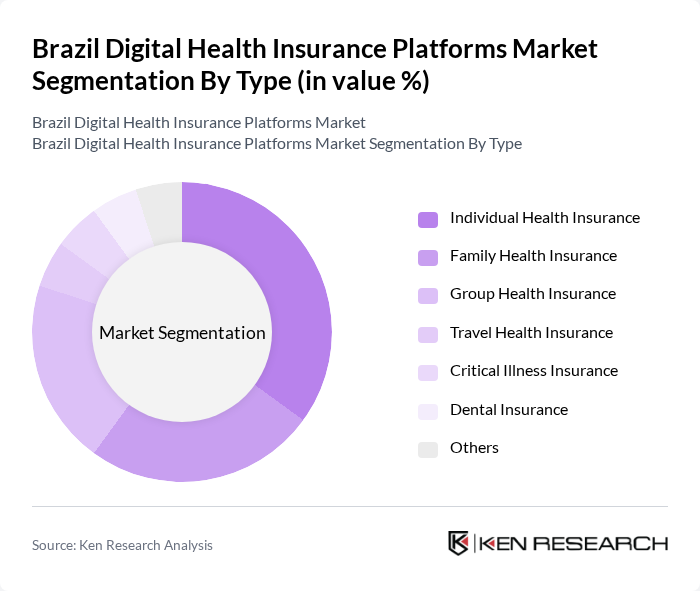
The market is segmented into Individual Health Insurance, Family Health Insurance, Group Health Insurance, Travel Health Insurance, Critical Illness Insurance, Dental Insurance, and Others. Individual Health Insurance remains the leading subsegment, supported by the growing number of self-employed professionals and heightened awareness of personal health management. Family Health Insurance is gaining momentum as families seek comprehensive coverage, while Group Health Insurance is increasingly adopted by corporates to provide employee benefits. Travel and Critical Illness Insurance address specific needs for frequent travelers and those seeking protection against major health risks. Dental Insurance continues to be relevant due to increased demand for oral healthcare.
By End-User:
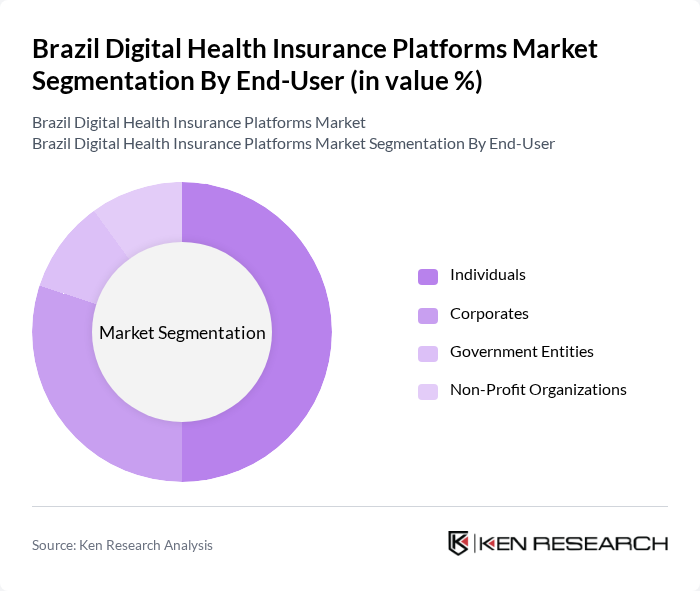
End-user segmentation includes Individuals, Corporates, Government Entities, and Non-Profit Organizations. Individuals constitute the largest segment, reflecting the rising preference for personal health insurance plans. Corporates are increasingly investing in Group Health Insurance to attract and retain talent, while Government Entities focus on extending coverage to underserved populations. Non-Profit Organizations play an important role in promoting insurance awareness and facilitating access, especially in rural and low-income areas.
Brazil Digital Health Insurance Platforms Market Competitive Landscape
The Brazil Digital Health Insurance Platforms Market is characterized by a dynamic mix of regional and international players. Leading participants such as Amil Saúde S.A., Bradesco Saúde S.A., Hapvida Participações e Administração S.A., Unimed do Brasil, SulAmérica S.A., Grupo NotreDame Intermédica, Porto Seguro S.A., Allianz Saúde S.A., Omint Saúde S.A., Prevent Senior, Caixa Seguradora S.A., Odontoprev S.A., Doctoralia, Zenklub, Conexa Saúde, Saúde iD, Dasa S.A., Teladoc Health, Inc., Grupo Sabin, AMHE Med Assistência contribute to innovation, geographic expansion, and service delivery in this space.
Brazil Digital Health Insurance Platforms Market Industry Analysis
Growth Drivers
- Increasing Smartphone Penetration:Brazil has seen a significant rise in smartphone usage, with over 200 million mobile cellular subscriptions reported by the World Bank, which is consistent with a high penetration rate given Brazil's population size. The World Bank reported that mobile phone subscriptions reached 0.93 per capita, indicating a strong foundation for digital health solutions. This increase facilitates access to digital health insurance platforms, allowing users to manage their health services conveniently. This trend is expected to continue, driving user engagement and platform adoption.
- Rising Healthcare Costs:Brazil's healthcare expenditure has been on the rise, reaching approximately USD 160 billion in total health expenditure according to the World Bank and OECD. The Brazilian government has also reported a steady increase in healthcare costs, prompting a shift towards digital health insurance platforms that offer competitive pricing and tailored services. This trend is expected to drive demand for innovative digital solutions in the healthcare sector.
- Demand for Personalized Health Services:The Brazilian population is increasingly seeking personalized health services, with a reported 60% of consumers preferring tailored health solutions. This demand is driven by a growing awareness of individual health needs and the benefits of customized care. Digital health insurance platforms are responding by offering personalized plans and services, which are projected to enhance user satisfaction and retention. This trend is supported by the rise of health tech innovations in Brazil, fostering a more consumer-centric approach.
Market Challenges
- Regulatory Compliance Issues:The Brazilian digital health insurance market faces significant regulatory challenges, with over 50 laws and regulations governing health data and insurance practices. Compliance with these regulations can be complex and costly for digital platforms. The National Health Surveillance Agency (ANVISA) has stringent requirements that can hinder the rapid deployment of new services. This regulatory landscape poses a barrier to entry for new players and can limit innovation within the sector.
- Data Privacy Concerns:Data privacy remains a critical challenge in Brazil, especially with the implementation of the General Data Protection Law (LGPD). Companies must ensure compliance with strict data handling and protection standards, which can be resource-intensive. A survey indicated that 70% of consumers are concerned about how their health data is used, which can deter them from adopting digital health solutions. This concern necessitates robust data security measures from platforms to build consumer trust.
Brazil Digital Health Insurance Platforms Market Future Outlook
The future of Brazil's digital health insurance platforms is poised for significant transformation, driven by technological advancements and evolving consumer preferences. As telemedicine continues to gain traction, platforms will increasingly integrate AI and machine learning to enhance service delivery and personalization. Additionally, the focus on mental health services is expected to expand, reflecting societal shifts towards holistic health approaches. These trends will likely create a more dynamic and responsive market landscape, fostering innovation and improved health outcomes for consumers.
Market Opportunities
- Expansion into Underserved Regions:There is a significant opportunity for digital health insurance platforms to expand into Brazil's underserved regions, where access to healthcare is limited. Approximately 30% of the population in rural areas lacks adequate health insurance. By targeting these regions, platforms can tap into a growing market and improve healthcare access, potentially increasing their user base and revenue streams.
- Partnerships with Healthcare Providers:Collaborating with local healthcare providers presents a valuable opportunity for digital health platforms. By forming strategic partnerships, platforms can enhance service offerings and improve patient outcomes. Over 40% of healthcare providers expressed interest in integrating digital solutions, indicating a readiness for collaboration that can drive mutual growth and innovation in the sector.
Scope of the Report
| Segment | Sub-Segments |
|---|---|
| By Type | Individual Health Insurance Family Health Insurance Group Health Insurance Travel Health Insurance Critical Illness Insurance Dental Insurance Others |
| By End-User | Individuals Corporates Government Entities Non-Profit Organizations |
| By Distribution Channel | Direct Sales Online Platforms Insurance Brokers Agents |
| By Payment Model | Fee-for-Service Capitation Pay-for-Performance |
| By Coverage Type | Comprehensive Coverage Basic Coverage Supplemental Coverage |
| By Technology Integration | Mobile Applications Web Portals AI-driven Solutions |
| By Policy Duration | Short-Term Policies Long-Term Policies Lifetime Policies |
| By Demographics | Age Group (Children, Adults, Seniors) Income Level (Low, Middle, High) Urban vs Rural |
Key Target Audience
Investors and Venture Capitalist Firms
Government and Regulatory Bodies (e.g., Agência Nacional de Saúde Suplementar, Ministério da Saúde)
Health Insurance Providers
Digital Health Technology Developers
Healthcare Service Providers
Telemedicine Platforms
Health Data Management Companies
Insurance Brokers and Agents
Players Mentioned in the Report:
Amil Saude S.A.
Bradesco Saude S.A.
Hapvida Participacoes e Administracao S.A.
Unimed do Brasil
SulAmerica S.A.
Grupo NotreDame Intermedica
Porto Seguro S.A.
Allianz Saude S.A.
Omint Saude S.A.
Prevent Senior
Caixa Seguradora S.A.
Odontoprev S.A.
Doctoralia
Zenklub
Conexa Saude
Saude iD
Dasa S.A.
Teladoc Health, Inc.
Grupo Sabin
AMHE Med Assistencia
Table of Contents
Market Assessment Phase
1. Executive Summary and Approach
2. Brazil Digital Health Insurance Platforms Market Overview
2.1 Key Insights and Strategic Recommendations
2.2 Brazil Digital Health Insurance Platforms Market Overview
2.3 Definition and Scope
2.4 Evolution of Market Ecosystem
2.5 Timeline of Key Regulatory Milestones
2.6 Value Chain & Stakeholder Mapping
2.7 Business Cycle Analysis
2.8 Policy & Incentive Landscape
3. Brazil Digital Health Insurance Platforms Market Analysis
3.1 Growth Drivers
3.1.1 Increasing smartphone penetration
3.1.2 Rising healthcare costs
3.1.3 Demand for personalized health services
3.1.4 Government initiatives for digital health
3.2 Market Challenges
3.2.1 Regulatory compliance issues
3.2.2 Data privacy concerns
3.2.3 High competition among platforms
3.2.4 Limited internet access in rural areas
3.3 Market Opportunities
3.3.1 Expansion into underserved regions
3.3.2 Partnerships with healthcare providers
3.3.3 Integration of AI and machine learning
3.3.4 Development of tailored insurance products
3.4 Market Trends
3.4.1 Shift towards telemedicine
3.4.2 Increased focus on mental health services
3.4.3 Growth of wearable health technology
3.4.4 Rise of subscription-based health services
3.5 Government Regulation
3.5.1 Implementation of data protection laws
3.5.2 Licensing requirements for digital platforms
3.5.3 Regulations on telehealth services
3.5.4 Incentives for digital health innovation
4. SWOT Analysis
5. Stakeholder Analysis
6. Porter's Five Forces Analysis
7. Brazil Digital Health Insurance Platforms Market Market Size, 2019-2024
7.1 By Value
7.2 By Volume
7.3 By Average Selling Price
8. Brazil Digital Health Insurance Platforms Market Segmentation
8.1 By Type
8.1.1 Individual Health Insurance
8.1.2 Family Health Insurance
8.1.3 Group Health Insurance
8.1.4 Travel Health Insurance
8.1.5 Critical Illness Insurance
8.1.6 Dental Insurance
8.1.7 Others
8.2 By End-User
8.2.1 Individuals
8.2.2 Corporates
8.2.3 Government Entities
8.2.4 Non-Profit Organizations
8.3 By Distribution Channel
8.3.1 Direct Sales
8.3.2 Online Platforms
8.3.3 Insurance Brokers
8.3.4 Agents
8.4 By Payment Model
8.4.1 Fee-for-Service
8.4.2 Capitation
8.4.3 Pay-for-Performance
8.5 By Coverage Type
8.5.1 Comprehensive Coverage
8.5.2 Basic Coverage
8.5.3 Supplemental Coverage
8.6 By Technology Integration
8.6.1 Mobile Applications
8.6.2 Web Portals
8.6.3 AI-driven Solutions
8.7 By Policy Duration
8.7.1 Short-Term Policies
8.7.2 Long-Term Policies
8.7.3 Lifetime Policies
8.8 By Demographics
8.8.1 Age Group (Children, Adults, Seniors)
8.8.2 Income Level (Low, Middle, High)
8.8.3 Urban vs Rural
9. Brazil Digital Health Insurance Platforms Market Competitive Analysis
9.1 Market Share of Key Players
9.2 KPIs for Cross Comparison of Key Players
9.2.1 Company Name
9.2.2 Group Size (Large, Medium, Small)
9.2.3 Customer Acquisition Cost (CAC)
9.2.4 Customer Retention Rate
9.2.5 Average Revenue Per User (ARPU)
9.2.6 Pricing Strategy
9.2.7 Market Penetration Rate
9.2.8 Claim Settlement Ratio
9.2.9 Digital Engagement Metrics (e.g., app downloads, active users, online service utilization)
9.2.10 Customer Satisfaction Score (NPS or equivalent)
9.2.11 Regulatory Compliance Score
9.2.12 Telemedicine Adoption Rate
9.2.13 Product Portfolio Breadth
9.2.14 Geographic Coverage
9.3 SWOT Analysis of Top Players
9.4 Pricing Analysis
9.5 Detailed Profile of Major Companies
9.5.1 Amil Saúde S.A.
9.5.2 Bradesco Saúde S.A.
9.5.3 Hapvida Participações e Administração S.A.
9.5.4 Unimed do Brasil
9.5.5 SulAmérica S.A.
9.5.6 Grupo NotreDame Intermédica
9.5.7 Porto Seguro S.A.
9.5.8 Allianz Saúde S.A.
9.5.9 Omint Saúde S.A.
9.5.10 Prevent Senior
9.5.11 Caixa Seguradora S.A.
9.5.12 Odontoprev S.A.
9.5.13 Doctoralia
9.5.14 Zenklub
9.5.15 Conexa Saúde
9.5.16 Saúde iD
9.5.17 Dasa S.A.
9.5.18 Teladoc Health, Inc.
9.5.19 Grupo Sabin
9.5.20 AMHE Med Assistência
10. Brazil Digital Health Insurance Platforms Market End-User Analysis
10.1 Procurement Behavior of Key Ministries
10.1.1 Health Ministry Procurement Trends
10.1.2 Budget Allocation for Digital Health
10.1.3 Evaluation Criteria for Digital Platforms
10.2 Corporate Spend on Infrastructure & Energy
10.2.1 Investment in Digital Health Solutions
10.2.2 Budgeting for Employee Health Programs
10.2.3 Trends in Corporate Health Spending
10.3 Pain Point Analysis by End-User Category
10.3.1 Individual Users
10.3.2 Small Businesses
10.3.3 Corporates
10.4 User Readiness for Adoption
10.4.1 Awareness of Digital Health Solutions
10.4.2 Training and Support Needs
10.4.3 Technology Acceptance Levels
10.5 Post-Deployment ROI and Use Case Expansion
10.5.1 Measuring ROI from Digital Health Platforms
10.5.2 Use Case Expansion Opportunities
10.5.3 Long-term Benefits Realization
11. Brazil Digital Health Insurance Platforms Market Future Size, 2025-2030
11.1 By Value
11.2 By Volume
11.3 By Average Selling Price
Go-To-Market Strategy Phase
1. Whitespace Analysis + Business Model Canvas
1.1 Market Gaps Identification
1.2 Business Model Framework
2. Marketing and Positioning Recommendations
2.1 Branding Strategies
2.2 Product USPs
3. Distribution Plan
3.1 Urban Retail Strategies
3.2 Rural NGO Tie-ups
4. Channel & Pricing Gaps
4.1 Underserved Routes
4.2 Pricing Bands Analysis
5. Unmet Demand & Latent Needs
5.1 Category Gaps
5.2 Consumer Segments
6. Customer Relationship
6.1 Loyalty Programs
6.2 After-sales Service
7. Value Proposition
7.1 Sustainability Initiatives
7.2 Integrated Supply Chains
8. Key Activities
8.1 Regulatory Compliance
8.2 Branding Efforts
8.3 Distribution Setup
9. Entry Strategy Evaluation
9.1 Domestic Market Entry Strategy
9.1.1 Product Mix Considerations
9.1.2 Pricing Band Strategy
9.1.3 Packaging Options
9.2 Export Entry Strategy
9.2.1 Target Countries
9.2.2 Compliance Roadmap
10. Entry Mode Assessment
10.1 Joint Ventures
10.2 Greenfield Investments
10.3 Mergers & Acquisitions
10.4 Distributor Model
11. Capital and Timeline Estimation
11.1 Capital Requirements
11.2 Timelines for Implementation
12. Control vs Risk Trade-Off
12.1 Ownership Considerations
12.2 Partnerships Evaluation
13. Profitability Outlook
13.1 Breakeven Analysis
13.2 Long-term Sustainability
14. Potential Partner List
14.1 Distributors
14.2 Joint Ventures
14.3 Acquisition Targets
15. Execution Roadmap
15.1 Phased Plan for Market Entry
15.1.1 Market Setup
15.1.2 Market Entry
15.1.3 Growth Acceleration
15.1.4 Scale & Stabilize
15.2 Key Activities and Milestones
15.2.1 Activity Planning
15.2.2 Milestone Tracking
Research Methodology
Phase 1: Approach1
Desk Research
- Analysis of government reports on digital health initiatives in Brazil
- Review of industry publications and white papers on health insurance trends
- Examination of market reports from health technology associations and regulatory bodies
Primary Research
- Interviews with executives from leading digital health insurance platforms
- Surveys targeting healthcare providers and insurance brokers
- Focus groups with consumers to understand preferences and pain points
Validation & Triangulation
- Cross-validation of findings with multiple data sources, including market reports and expert opinions
- Triangulation of qualitative insights from interviews with quantitative data from surveys
- Sanity checks through expert panel reviews comprising industry veterans
Phase 2: Market Size Estimation1
Top-down Assessment
- Estimation of total addressable market based on national healthcare expenditure
- Segmentation of the market by demographics, insurance types, and digital adoption rates
- Incorporation of government health policies promoting digital health solutions
Bottom-up Modeling
- Data collection from digital health insurance providers on user acquisition and retention rates
- Cost analysis of digital platform development and operational expenses
- Revenue projections based on subscription models and service fees
Forecasting & Scenario Analysis
- Multi-factor regression analysis incorporating economic indicators and healthcare trends
- Scenario modeling based on potential regulatory changes and technological advancements
- Development of baseline, optimistic, and pessimistic forecasts through 2030
Phase 3: CATI Sample Composition1
| Scope Item/Segment | Sample Size | Target Respondent Profiles |
|---|---|---|
| Digital Health Insurance Users | 120 | Policyholders, Health Insurance Customers |
| Healthcare Providers | 90 | Doctors, Clinic Administrators |
| Insurance Brokers | 60 | Insurance Agents, Financial Advisors |
| Regulatory Bodies | 40 | Health Policy Makers, Compliance Officers |
| Technology Developers in Health Sector | 50 | CTOs, Product Managers |
Frequently Asked Questions
What is the current value of the Brazil Digital Health Insurance Platforms Market?
The Brazil Digital Health Insurance Platforms Market is valued at approximately USD 15 billion, driven by the rapid adoption of digital health solutions, rising healthcare costs, and increased awareness of health insurance among the population.
What factors are driving the growth of digital health insurance in Brazil?
Which cities are leading the Brazil Digital Health Insurance Platforms Market?
What recent regulations have impacted the digital health insurance market in Brazil?
Other Regional/Country Reports
Indonesia Digital Health Insurance Platforms Market
Other Adjacent Reports
Mexico Telemedicine Services Market
GCC Health Data Analytics Market Size, Share, Growth Drivers, Trends, Opportunities & Forecast 2025–2030South Korea Insurtech Solutions Market
New Zealand Digital Therapeutics Market Size Share Growth Drivers Trends Opportunities & Forecast 2025–2030Global electronic health records market report size, share, growth drivers, trends, opportunities & forecast 2025–2030UAE Wearable Health Technology Market
Thailand Mobile Health Applications Market
GCC Healthcare Cybersecurity Market Size, Share, Growth Drivers, Trends, Opportunities & Forecast 2025–2030Mexico Pharmaceutical E-commerce Market
UAE Remote Patient Monitoring Market Size, Share, Growth Drivers, Trends, Opportunities & Forecast 2025–2030Why Buy From Us?

What makes us stand out is that our consultants follow Robust, Refine and Result (RRR) methodology. Robust for clear definitions, approaches and sanity checking, Refine for differentiating respondents' facts and opinions, and Result for presenting data with story.

We have set a benchmark in the industry by offering our clients with syndicated and customized market research reports featuring coverage of entire market as well as meticulous research and analyst insights.

While we don't replace traditional research, we flip the method upside down. Our dual approach of Top Bottom & Bottom Top ensures quality deliverable by not just verifying company fundamentals but also looking at the sector and macroeconomic factors.

With one step in the future, our research team constantly tries to show you the bigger picture. We help with some of the tough questions you may encounter along the way: How is the industry positioned? Best marketing channel? KPI's of competitors? By aligning every element, we help maximize success.

Our report gives you instant access to the answers and sources that other companies might choose to hide. We elaborate each steps of research methodology we have used and showcase you the sample size to earn your trust.

If you need any support, we are here! We pride ourselves on universe strength, data quality, and quick, friendly, and professional service.