CHAPTER 1 - MARKET SUMMARY
Market Overview
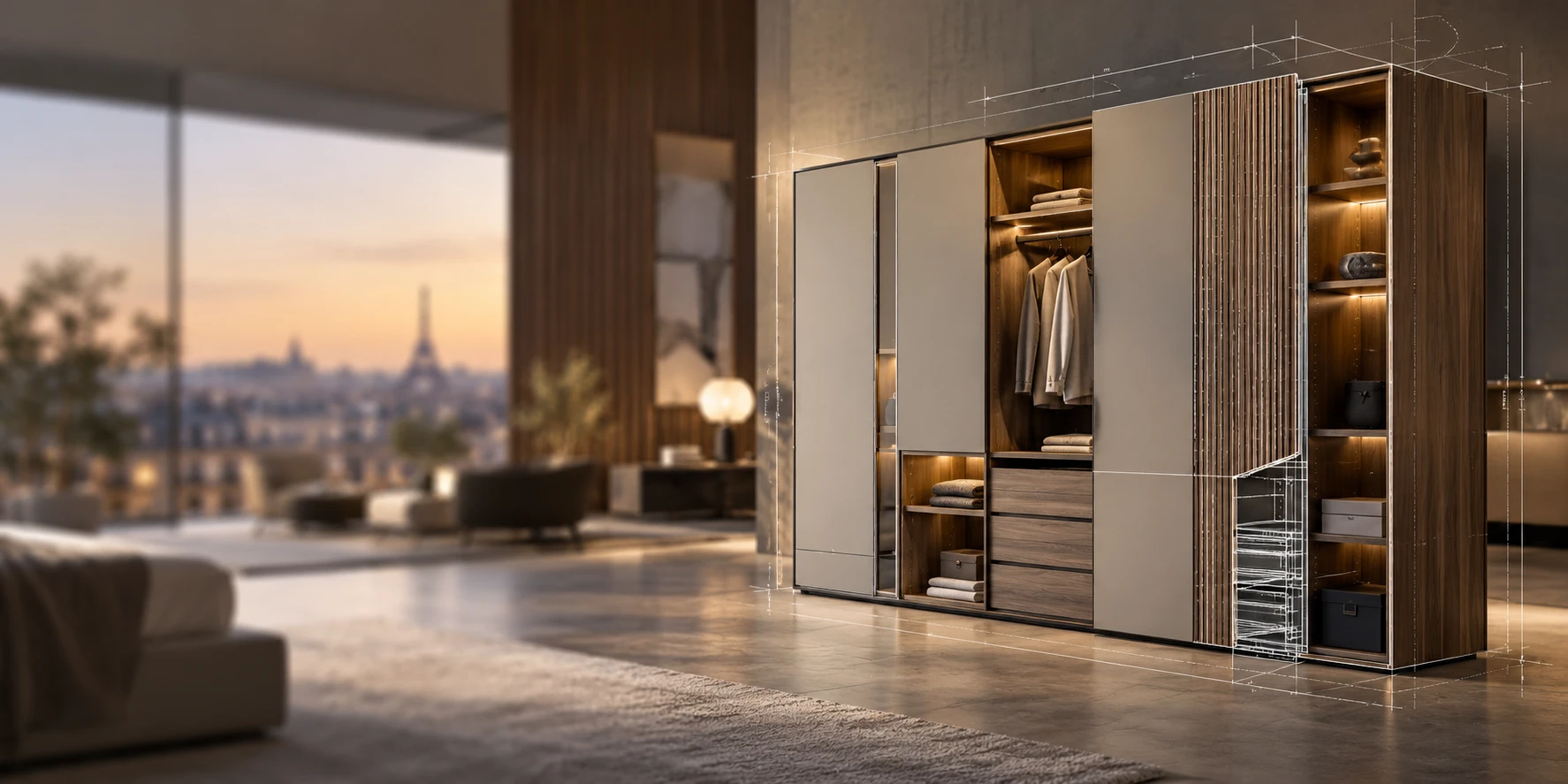
The France Furniture and Modular Interiors Market combines retail furniture, fitted room systems, professional furniture and modular interior components sold to households, businesses and institutions. Demand is structurally tied to 38.4 million dwellings in 2025, of which 82.5% are primary residences. This installed base supports replacement, renovation and space-optimization spending even when new construction slows.
Île-de-France is the principal commercial hub because it concentrates corporate headquarters, premium residential demand, design studios and contract procurement. In 2024, 32% of employees in Île-de-France teleworked regularly, the highest regional rate in France, sustaining recurring office reconfiguration, acoustic zoning and home-office demand rather than a one-time pandemic spike.
Market Value
USD 18,218 million
2025
Dominant Region
Île-de-France
Dominant Segment
Modular Storage and Partition Systems
fastest growing
Total Number of Players
4,650
Future Outlook
The market is projected to advance from USD 18,218 Mn in 2025 to USD 24,300 Mn by 2031, implying a forecast CAGR of 4.92%. Growth will be led by fitted kitchens, made-to-measure storage, demountable partitions and workplace reconfiguration. The recovery is expected to be gradual because the market enters the forecast period after three years of contraction, but 2025 housing authorizations rose 15.0% to 379,222 units, improving the medium-term project pipeline.
Historical growth averaged 3.42% from 2020 to 2025, but the period included a pandemic-led furnishing surge followed by normalization. Forecast value growth will exceed unit growth as average transaction value rises from USD 620 per equivalent furnishing unit in 2025 to USD 734 by 2031. Customization, installation, embedded storage and circular material premiums will shift the profit pool toward manufacturers and dealers that combine digital planning with local delivery and after-sales service.
4.92%
Forecast CAGR
$24,300 Mn
2030 Projection
Base Year
2025
Historical Period
2020-2025
Forecast Period
2026-2031
Historical CAGR
3.42%
CHAPTER 2 - SCOPE OF REPORT
Scope of the Market
CHAPTER 3 - Key Stakeholders
Key Target Audience
Key stakeholders who can leverage from this market analysis for investment, strategy, and operational planning.
Investors
CAGR, margin mix, capex intensity, consolidation, circularity, returns
Corporates
fit-out cost, flexibility, employee experience, lifecycle, procurement, ROI
Government
industrial capacity, EPR compliance, reuse, jobs, housing, resilience
Operators
lead times, installer capacity, returns, configuration, inventory, service
Financial institutions
working capital, covenants, demand stability, collateral, cash conversion
CHAPTER 4 - Market Size & Growth
Market Size, Growth Forecast and Trends
This section evaluates the historical market size, analyzes year-over-year growth dynamics, and presents forecast projections supported by market performance indicators and demand-side drivers.
Historical & Projected Market Size ($ Million)
Year-over-Year Growth Rate (%)
Market Value vs Volume Growth (%)
Historical Market Performance (2020-2025)
The market expanded sharply in 2021 and 2022 as households redirected spending toward the home, peaking at USD 20,050 Mn in 2022. The cycle reversed as property transactions, consumer confidence and financing conditions weakened. Value contracted 2.50% in 2023, 5.10% in 2024 and 1.80% in 2025. The trough was concentrated in bathroom, kitchen and large-ticket room sets, while bedding and premium custom interiors proved relatively more resilient.
Forecast Market Outlook (2026-2031)
Forecast growth resumes at 5.17% in 2026 and moderates toward 4.61% in 2031, closing at USD 24,300 Mn. Unit growth remains near 2.00% annually, while configuration, installation and material upgrades lift ASP. Modular partitioning, fitted storage and digital room planning create the strongest acceleration because they address smaller urban spaces, hybrid offices and lower-waste refurbishment. The forecast assumes a recovery led by mix improvement rather than pandemic-era volume expansion.
CHAPTER 5 - Market Data
Market Breakdown
The France Furniture and Modular Interiors Market is moving from a cyclical replacement phase toward a higher-value configuration and installation model. For CEOs and investors, the key question is whether unit recovery, average transaction value and domestic supply capture can jointly support the projected 4.92% CAGR.
Year | Market Size (USD Mn) | YoY Growth (%) | Equivalent Units Sold (Mn) | Average Transaction Value (USD) | Domestic Supply Share (%) | Period |
|---|---|---|---|---|---|---|
| 2020 | $15,400 Mn | +- | 26.8 | 575 | Forecast | |
| 2021 | $17,800 Mn | +15.58% | 30.6 | 582 | Forecast | |
| 2022 | $20,050 Mn | +12.64% | 32.5 | 617 | Forecast | |
| 2023 | $19,549 Mn | +-2.50% | 31.6 | 619 | Forecast | |
| 2024 | $18,552 Mn | +-5.10% | 29.8 | 623 | Forecast | |
| 2025 | $18,218 Mn | +-1.80% | 29.4 | 620 | Forecast | |
| 2026 | $19,160 Mn | +5.17% | 30.0 | 639 | Forecast | |
| 2027 | $20,130 Mn | +5.06% | 30.6 | 658 | Forecast | |
| 2028 | $21,130 Mn | +4.97% | 31.2 | 677 | Forecast | |
| 2029 | $22,170 Mn | +4.92% | 31.8 | 697 | Forecast | |
| 2030 | $23,230 Mn | +4.78% | 32.4 | 717 | Forecast | |
| 2031 | $24,300 Mn | +4.61% | 33.1 | 734 | Forecast |
Equivalent Units Sold
29.4 million equivalent units, 2025, France. Volume remains below the 2022 peak, so near-term earnings depend more on product mix and attachment services than shipment recovery. Domestic furniture spending still fell 1.8% in 2025.
Average Transaction Value
USD 620, 2025, France. Higher ticket values reflect fitted kitchens, custom storage and installation. The structural base is supported by 31.7 million primary residences, creating a large renovation pool.
Domestic Supply Share
35%, 2025, France. Import exposure makes sourcing, freight and compliance central to margin management. French industry data indicate domestic manufacturers supply about 35% of furniture consumed, reinforcing the value of nearshoring and rapid customization.
CHAPTER 6 - Segmentation
Market Segmentation Framework
Comprehensive analysis across key dimensions providing insights into market structure, consumer preferences, and distribution patterns.
No of Segments
7
Dominant Segment
Product Type
Fastest Growing Segment
Technology
Product Type
End User
Application
Customer Type
Sales Channel
Technology
Geography
Key Segmentation Takeaways
Comprehensive analysis across all extracted segmentation dimensions providing insights into market structure, consumer preferences, and distribution patterns.
Product Type
Product mix is the largest revenue allocator because living-room, bedroom, fitted kitchen, office and modular interior categories differ materially in ASP, replacement cycle and installation intensity. Living and Bedroom Furniture remains the broadest pool, while Kitchen and Bathroom Systems deliver stronger project economics through design, measurement, delivery and installation bundles.
Technology
Technology is the fastest-growing dimension as CNC customization, digital configurators, augmented reality and demountable systems compress lead times and improve conversion. Digital Configuration and Visualization is expanding fastest because it reduces buyer uncertainty, supports remote consultation and enables retailers to sell higher-value fitted solutions without maintaining every physical configuration in store.
CHAPTER 7 - Regional Analysis
Regional Analysis
France ranks fourth among selected Western European furniture and modular-interior peers by 2025 market value. Its scale is supported by one of the largest housing stocks in the peer set, while a relatively low domestic supply ratio leaves room for local manufacturing, customization and circular refurbishment models.
Focus Country Ranking
4th
Focus Country Market Size
USD 18,218 Mn
France CAGR (2026-2031)
4.92%
Focus Country Ranking
4th
Focus Country Market Size
USD 18,218 Mn
France CAGR (2026-2031)
4.92%
Regional Analysis (Current Year)
Market Position
France ranks 4th in the peer set with USD 18,218 Mn, behind Germany, Italy and the United Kingdom but supported by 38.4 million dwellings.
Growth Advantage
France's 4.92% CAGR exceeds Germany's 4.10% and Belgium's 3.80%, but trails Spain's 5.20%, positioning France as a mid-tier growth market with premiumization potential.
Competitive Strengths
France combines 379,222 housing authorizations in 2025, high design equity and a mature furniture EPR system with a 93.5% recovery rate, supporting circular products and modular refurbishment.
CHAPTER 8 - INDUSTRY ANALYSIS
Growth Drivers, Challenges & Opportunities
Comprehensive analysis of key factors shaping the France Furniture and Modular Interiors Market, including growth catalysts, operational challenges, and emerging opportunities across production, distribution, and consumer segments.
Growth Drivers
Housing Renewal and Transaction Recovery
- New-home delivery creates bundled demand for kitchens, wardrobes and room systems; authorizations rose 15.0% (2025, France), improving order visibility for specialist installers.
- The installed base of 38.4 million dwellings (2025, France) supports recurring replacement and renovation even when completions remain below historical averages.
- Owners of 31.7 million primary residences (2025, France) are the most monetizable cohort for fitted interiors because they capture the value of permanent improvements.
Hybrid Work and Reconfigurable Space
- Employees average 1.9 remote days per week (2024, France), supporting durable home-office, acoustic and ergonomic purchases rather than temporary solutions.
- Île-de-France reaches 32% regular telework (2024, region), creating concentrated demand for office densification, collaboration zones and modular partitions.
- Corporate buyers serving a workforce with 22% monthly telework incidence (2024, France) increasingly value demountable systems that reduce disruption and fit-out write-offs.
Customization and Project-Based Interiors
- Project-based interiors outperformed while the domestic market fell 1.8% (2025, France), proving that attached services can protect customer lifetime value.
- Digital planning supports the modeled USD 620 average transaction value (2025, France) by improving confidence in storage and fitted-system purchases.
- France has 619 tracked furniture manufacturers (2026 registry snapshot), enabling localized customization and shorter replenishment cycles.
Market Challenges
Weak Large-Ticket Consumer Demand
- Large room sets remain exposed to housing turnover, contributing to the 5.1% market decline (2024, France) and longer replacement cycles.
- Furniture is a high-ticket category within EUR 59 billion of specialist home-equipment retail (2024, France), increasing competition for household budgets.
- IKEA cut about 2,000 prices by 18% on average (2024, France), illustrating the margin trade-off between traffic generation and service costs.
Import Dependence and Uneven Compliance
- Imported flat-pack products intensify price competition because domestic manufacturing supplies only 35% of consumption (2025, France).
- BUT reported wood purchases above EUR 690 million (2024, France), illustrating the scale of raw-material and sourcing exposure for leading chains.
- Compliance asymmetry became more material after in-store furniture take-back began on 1 January 2022 (France), raising costs for compliant sellers.
Regulatory and Circularity Cost
- Producer take-back obligations have applied in stores since 1 January 2022 (France), adding reverse-logistics and reporting requirements.
- The EU 2025-2030 ESPR working plan prioritizes furniture durability, repairability and product data, requiring supplier-system investment.
- France has 4,044 furniture firms with fewer than 10 employees (2024), making shared compliance platforms economically relevant.
Market Opportunities
Circular Furniture and Refurbishment Platforms
- A 93.5% recovery rate (2021, France) supports trade-in credits, certified refurbished ranges and furniture-as-a-service revenue.
- More than 1.2 million tonnes collected (2021, France) create feedstock for lower-cost refurbished inventory and component recovery.
- The regulated furniture stream spans 12 product categories (current France framework), requiring standardized grading and digital product data.
Made-to-Measure Modular Storage
- Configured storage targets 38.4 million dwellings (2025, France), monetizing design and installation fees across a large installed base.
- A base of 619 tracked manufacturers (2026 registry snapshot, France) supports automated quoting, CNC production and local fulfillment.
- Reducing installation failure is critical to preserve the modeled USD 620 transaction value (2025, France) and project margin.
Workplace Reconfiguration and Demountable Interiors
- Demand from 22% monthly teleworkers (2024, France) supports lifecycle contracts for movable partitions, pods and reconfiguration.
- Île-de-France's 32% regular telework rate (2024) strengthens the case for lower-disruption, reusable office interiors.
- The 2025-2030 ESPR plan increases the value of standards, certification and procurement models that recognize residual asset value.
CHAPTER 9 - Competitive Landscape
Competitive Landscape Overview
Competition is fragmented across national chains, specialists and manufacturers, but scale leaders control traffic, sourcing and installation networks. Entry barriers are moderate in retail and high in fitted interiors, where design software, manufacturing precision, logistics and installer density determine execution quality.
Market Share Distribution
Top 5 Players
Market Dynamics
8 new entrants in the past 5 years, indicating strong market attractiveness and growth potential.
Company Name | Market Share | Headquarters | Founding Year | Core Market Focus |
|---|---|---|---|---|
IKEA France | - | Plaisir, France | 1981 | Mass-market ready-to-assemble furniture and fitted storage |
BUT | - | Émerainville, France | 1972 | Furniture retail, appliances and omnichannel home equipment |
Conforama France | - | Lognes, France | 1967 | Value furniture retail and household equipment |
Maisons du Monde | - | Vertou, France | 1996 | Design-led furniture, decoration and omnichannel retail |
Schmidt Groupe | - | Lièpvre, France | 1934 | Made-to-measure kitchens, storage and interior solutions |
Fournier Groupe | - | Thônes, France | 1907 | Kitchen, bathroom and custom interior manufacturing |
Roche Bobois | - | Paris, France | 1960 | Premium and luxury design furniture |
Gautier | - | Le Boupère, France | 1960 | French-manufactured residential and office furniture |
Ligne Roset | - | Briord, France | 1860 | Premium contemporary furniture and contract design |
Clestra | - | Strasbourg, France | 1913 | Modular partitions, cleanrooms and adaptable interiors |
Cross Comparison Parameters
The report provides detailed cross-comparison of key players across 10 performance parameters to identify competitive strengths and weaknesses.
Installed Design and Assembly Capacity
Store and Showroom Network Density
France Furniture Revenue Growth
EBITDA Margin
Analysis Covered
Market Share Analysis:
Compares revenue pools across retail, fitted and contract furniture competitors.
Cross Comparison Matrix:
Benchmarks operating scale, channel coverage, growth and profitability performance.
SWOT Analysis:
Identifies defensible capabilities, exposure points and strategic response priorities.
Pricing Strategy Analysis:
Assesses price ladders, service bundles and promotional margin trade-offs.
Company Profiles:
Reviews ownership, market focus, networks, capabilities and strategic positioning.
CHAPTER 10 - REPORT TOC
Table of Contents
Market Assessment Phase
Supply-side and competitive intelligence covering market sizing, segmentation, competitive dynamics, regulatory landscape, and future forecasts.
Go-To-Market Strategy Phase
15 chapters
Entry strategy evaluation, execution roadmap, partner recommendations, and profitability outlook.
Survey Phase
8 chapters
Demand-side primary research conducted through structured interviews and online surveys with end users across priority metros and Tier 2/3 cities to capture consumption behavior, unmet needs, and purchase drivers.
Complete Report Coverage
201+ detailed sections covering every aspect of the market
143
Assessment Sections
58
Strategy Sections
CHAPTER 11 - Our Approach
Research Methodology
Desk Research
- French furniture market value tracking
- Housing and renovation demand analysis
- Furniture trade flow reconciliation
- EPR and ecodesign policy review
Primary Research
- Furniture retail category director interviews
- Kitchen network franchisee interviews
- Modular partition project manager interviews
- Interior design procurement lead interviews
Validation and Triangulation
- 286 respondent market validation sample
- Retail and manufacturer revenue reconciliation
- Volume and ASP cross-checking
- Housing pipeline sensitivity testing
CHAPTER 12 - FAQ
FAQs
Still have questions?
Our research team is here to help you find the right solution
CHAPTER 13 - Related Research
Explore Related Reports
Expand your market intelligence with complementary research across regions and adjacent markets.
Regional/Country ReportsRelated market analysis across key regions
Related market analysis across key regions
Adjacent ReportsRelated markets and complementary research
Related markets and complementary research
- UAE Modular Kitchen Furniture Market
- India Office Furniture Market Size, Share & Forecast, By Product Type, End-Use Industry & Sales Channel, 2026-2031
- Belgium Home Office Solutions Market
- Global Interior Design Services Market Size, Share & Forecast, By Service Type, Customer Type & End-Use Industry, 2026–2031
- Vietnam Storage Solutions Market
500+
Market Research Reports
50+
Countries Covered
15+
Industry Verticals