About the Report
Base Year 2024India Digital Remittance Platforms Market Overview
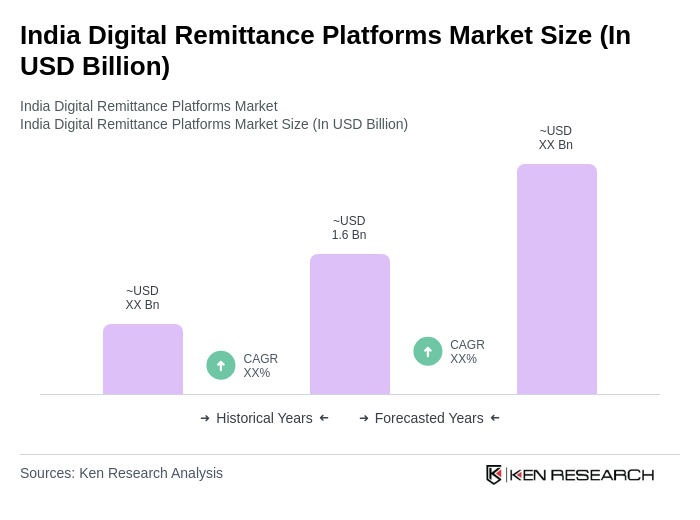
- The India Digital Remittance Platforms Market is valued at USD 1.6 billion, based on a five-year historical analysis. This growth is primarily driven by the increasing number of Indian expatriates abroad, the rise in digital payment adoption, and the convenience of online remittance services. The market has seen a significant shift towards digital platforms, which offer lower transaction fees and faster processing times compared to traditional methods .
- Key cities such as Mumbai, Delhi, and Bengaluru dominate the market due to their large expatriate populations and robust financial infrastructure. These urban centers are hubs for technology and finance, facilitating the growth of digital remittance services. Additionally, the presence of numerous fintech companies in these cities enhances competition and innovation in the remittance sector .
- The Foreign Exchange Management (Current Account Transactions) Rules, 2000, issued under the Foreign Exchange Management Act (FEMA) by the Reserve Bank of India, govern digital remittance services. These rules require remittance platforms to comply with anti-money laundering (AML) and know your customer (KYC) guidelines, ensuring transparency and security in cross-border transactions and fostering a safer environment for users .
India Digital Remittance Platforms Market Segmentation
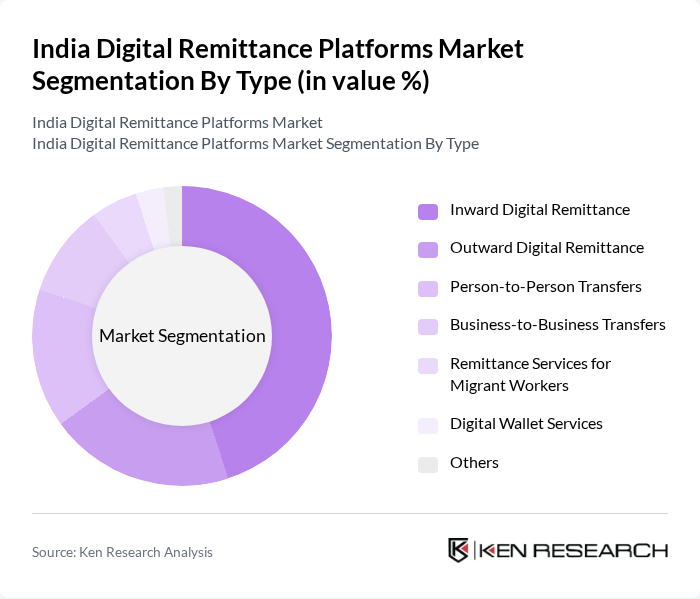
By Type:The segmentation by type includes various subsegments such as Inward Digital Remittance, Outward Digital Remittance, Person-to-Person Transfers, Business-to-Business Transfers, Remittance Services for Migrant Workers, Digital Wallet Services, and Others. Among these, Inward Digital Remittance is the leading subsegment, driven by the high volume of remittances sent by Indian expatriates from countries like the USA, UAE, and Canada. The ease of use and lower costs associated with digital platforms have made them the preferred choice for sending money back home .
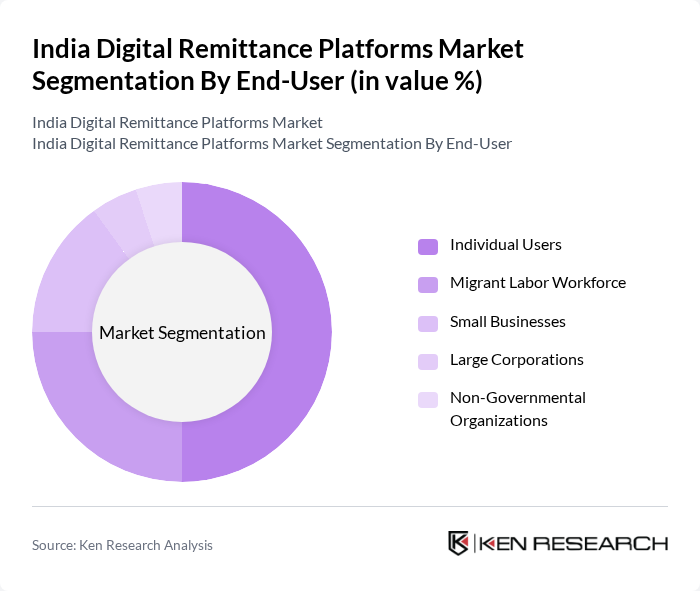
By End-User:The end-user segmentation includes Individual Users, Migrant Labor Workforce, Small Businesses, Large Corporations, and Non-Governmental Organizations. The Individual Users segment is the most significant, as it encompasses a vast number of people who rely on remittances for personal and family support. The increasing trend of digital payments among individuals, especially in urban areas, has further propelled this segment's growth .
India Digital Remittance Platforms Market Competitive Landscape
The India Digital Remittance Platforms Market is characterized by a dynamic mix of regional and international players. Leading participants such as PayPal Holdings, Inc., Western Union Company, MoneyGram International, Inc., Wise PLC (formerly TransferWise Ltd.), Remitly, Inc., Xoom Corporation, Payoneer Inc., Ria Money Transfer, WorldRemit Ltd., Nium (formerly InstaReM), Google Pay (GPay), PhonePe, MobiKwik, Freecharge, Razorpay, ICICI Bank, State Bank of India (SBI), HDFC Bank, Axis Bank, Kotak Mahindra Bank contribute to innovation, geographic expansion, and service delivery in this space.
India Digital Remittance Platforms Market Industry Analysis
Growth Drivers
- Increasing Cross-Border Transactions:The volume of cross-border transactions in India reached approximately $111 billion in remittance inflows, driven by a growing demand for remittance services. The World Bank reports that India remains the largest recipient of remittances globally, with the Indian expatriate population estimated at 18 million worldwide. This trend is expected to enhance the digital remittance landscape, as more individuals seek efficient and cost-effective ways to send money home.
- Rise in Digital Payment Adoption:Digital payment transactions in India have surged, with the Reserve Bank of India reporting over 13 billion monthly transactions via the Unified Payments Interface (UPI) platform, and the total value of digital payments exceeding $1.7 trillion. This rapid adoption of digital payment methods is a significant driver for digital remittance platforms, as consumers increasingly prefer online solutions for their financial transactions, including remittances.
- Government Initiatives for Financial Inclusion:The Indian government has launched several initiatives aimed at enhancing financial inclusion, such as the Pradhan Mantri Jan Dhan Yojana, which has opened over 500 million bank accounts. These efforts have significantly increased access to banking services, enabling more individuals to utilize digital remittance platforms. The government's push for a cashless economy further supports the growth of digital remittance services across the country.
Market Challenges
- Regulatory Compliance Issues:The digital remittance sector in India faces stringent regulatory compliance requirements, including adherence to the Foreign Exchange Management Act (FEMA). The Reserve Bank of India has imposed fines totaling $10 million on various platforms for non-compliance. These regulatory hurdles can hinder the operational efficiency of digital remittance providers, making it challenging for them to navigate the complex legal landscape while ensuring compliance.
- High Competition Among Platforms:The Indian digital remittance market is characterized by intense competition, with over 50 platforms vying for market share. This competitive landscape has led to price wars, reducing profit margins for many providers. The average transaction fee for remittances is $5, as platforms strive to attract customers. This competition can limit the ability of companies to invest in innovation and service enhancements.
India Digital Remittance Platforms Market Future Outlook
The future of the India digital remittance market appears promising, driven by technological advancements and increasing consumer demand. The integration of blockchain technology is expected to enhance transaction security and reduce costs, while artificial intelligence will improve customer service efficiency. Additionally, the ongoing expansion of internet connectivity in rural areas will likely facilitate greater access to digital remittance services, further propelling market growth and innovation in the coming years.
Market Opportunities
- Expansion into Rural Markets:With approximately 65% of India's population residing in rural areas, there is a significant opportunity for digital remittance platforms to expand their services. Rural internet penetration is estimated at 38%, with continued growth expected in future, enabling more individuals to access digital remittance solutions and increasing overall transaction volumes.
- Partnerships with Financial Institutions:Collaborating with banks and microfinance institutions can enhance the reach of digital remittance platforms. In future, partnerships are expected to lead to increased user acquisition for several platforms, demonstrating the potential for growth through strategic alliances that leverage existing customer bases and infrastructure.
Scope of the Report
| Segment | Sub-Segments |
|---|---|
| By Type | Inward Digital Remittance Outward Digital Remittance Person-to-Person Transfers Business-to-Business Transfers Remittance Services for Migrant Workers Digital Wallet Services Others |
| By End-User | Individual Users Migrant Labor Workforce Small Businesses Large Corporations Non-Governmental Organizations |
| By Region | North India South India East India West India |
| By Payment Channel | Banks Money Transfer Operators Online Platforms Mobile Payments Cash Pickup Services Others |
| By Transaction Size | Small Transactions Medium Transactions Large Transactions |
| By Frequency of Transactions | One-time Transfers Recurring Transfers Seasonal Transfers |
| By Customer Segment | Students Professionals Retirees Others |
Key Target Audience
Investors and Venture Capitalist Firms
Government and Regulatory Bodies (e.g., Reserve Bank of India, Ministry of Electronics and Information Technology)
Payment Service Providers
Telecommunication Companies
Financial Technology (FinTech) Startups
International Money Transfer Operators
Banking Institutions
Payment Gateway Providers
Players Mentioned in the Report:
PayPal Holdings, Inc.
Western Union Company
MoneyGram International, Inc.
Wise PLC (formerly TransferWise Ltd.)
Remitly, Inc.
Xoom Corporation
Payoneer Inc.
Ria Money Transfer
WorldRemit Ltd.
Nium (formerly InstaReM)
Google Pay (GPay)
PhonePe
MobiKwik
Freecharge
Razorpay
ICICI Bank
State Bank of India (SBI)
HDFC Bank
Axis Bank
Kotak Mahindra Bank
Table of Contents
Market Assessment Phase
1. Executive Summary and Approach
2. India Digital Remittance Platforms Market Overview
2.1 Key Insights and Strategic Recommendations
2.2 India Digital Remittance Platforms Market Overview
2.3 Definition and Scope
2.4 Evolution of Market Ecosystem
2.5 Timeline of Key Regulatory Milestones
2.6 Value Chain & Stakeholder Mapping
2.7 Business Cycle Analysis
2.8 Policy & Incentive Landscape
3. India Digital Remittance Platforms Market Analysis
3.1 Growth Drivers
3.1.1 Increasing Cross-Border Transactions
3.1.2 Rise in Digital Payment Adoption
3.1.3 Government Initiatives for Financial Inclusion
3.1.4 Growing Expatriate Population
3.2 Market Challenges
3.2.1 Regulatory Compliance Issues
3.2.2 High Competition Among Platforms
3.2.3 Currency Fluctuations
3.2.4 Cybersecurity Threats
3.3 Market Opportunities
3.3.1 Expansion into Rural Markets
3.3.2 Partnerships with Financial Institutions
3.3.3 Development of Innovative Payment Solutions
3.3.4 Increasing Demand for Remittance Services
3.4 Market Trends
3.4.1 Adoption of Blockchain Technology
3.4.2 Integration of AI in Customer Service
3.4.3 Growth of Mobile Wallets
3.4.4 Focus on User Experience Enhancement
3.5 Government Regulation
3.5.1 Foreign Exchange Management Act (FEMA)
3.5.2 Know Your Customer (KYC) Norms
3.5.3 Anti-Money Laundering (AML) Regulations
3.5.4 Digital Payment Guidelines by RBI
4. SWOT Analysis
5. Stakeholder Analysis
6. Porter's Five Forces Analysis
7. India Digital Remittance Platforms Market Market Size, 2019-2024
7.1 By Value
7.2 By Volume
7.3 By Average Selling Price
8. India Digital Remittance Platforms Market Segmentation
8.1 By Type
8.1.1 Inward Digital Remittance
8.1.2 Outward Digital Remittance
8.1.3 Person-to-Person Transfers
8.1.4 Business-to-Business Transfers
8.1.5 Remittance Services for Migrant Workers
8.1.6 Digital Wallet Services
8.1.7 Others
8.2 By End-User
8.2.1 Individual Users
8.2.2 Migrant Labor Workforce
8.2.3 Small Businesses
8.2.4 Large Corporations
8.2.5 Non-Governmental Organizations
8.3 By Region
8.3.1 North India
8.3.2 South India
8.3.3 East India
8.3.4 West India
8.4 By Payment Channel
8.4.1 Banks
8.4.2 Money Transfer Operators
8.4.3 Online Platforms
8.4.4 Mobile Payments
8.4.5 Cash Pickup Services
8.4.6 Others
8.5 By Transaction Size
8.5.1 Small Transactions
8.5.2 Medium Transactions
8.5.3 Large Transactions
8.6 By Frequency of Transactions
8.6.1 One-time Transfers
8.6.2 Recurring Transfers
8.6.3 Seasonal Transfers
8.7 By Customer Segment
8.7.1 Students
8.7.2 Professionals
8.7.3 Retirees
8.7.4 Others
9. India Digital Remittance Platforms Market Competitive Analysis
9.1 Market Share of Key Players
9.2 Cross Comparison of Key Players
9.2.1 Company Name
9.2.2 Group Size (Large, Medium, or Small as per industry convention)
9.2.3 Customer Acquisition Cost
9.2.4 Transaction Volume Growth Rate
9.2.5 Average Transaction Value
9.2.6 Customer Retention Rate
9.2.7 Pricing Strategy
9.2.8 Market Penetration Rate
9.2.9 Revenue Growth Rate
9.2.10 User Satisfaction Score
9.2.11 Regulatory Compliance Score
9.2.12 Digital Channel Adoption Rate
9.2.13 Geographic Coverage (Domestic/International)
9.3 SWOT Analysis of Top Players
9.4 Pricing Analysis
9.5 Detailed Profile of Major Companies
9.5.1 PayPal Holdings, Inc.
9.5.2 Western Union Company
9.5.3 MoneyGram International, Inc.
9.5.4 Wise PLC (formerly TransferWise Ltd.)
9.5.5 Remitly, Inc.
9.5.6 Xoom Corporation
9.5.7 Payoneer Inc.
9.5.8 Ria Money Transfer
9.5.9 WorldRemit Ltd.
9.5.10 Nium (formerly InstaReM)
9.5.11 Google Pay (GPay)
9.5.12 PhonePe
9.5.13 MobiKwik
9.5.14 Freecharge
9.5.15 Razorpay
9.5.16 ICICI Bank
9.5.17 State Bank of India (SBI)
9.5.18 HDFC Bank
9.5.19 Axis Bank
9.5.20 Kotak Mahindra Bank
10. India Digital Remittance Platforms Market End-User Analysis
10.1 Procurement Behavior of Key Ministries
10.1.1 Budget Allocation for Digital Services
10.1.2 Evaluation Criteria for Service Providers
10.1.3 Frequency of Procurement Cycles
10.2 Corporate Spend on Infrastructure & Energy
10.2.1 Investment in Digital Infrastructure
10.2.2 Spending on Cybersecurity Measures
10.2.3 Budget for User Training and Support
10.3 Pain Point Analysis by End-User Category
10.3.1 High Transaction Fees
10.3.2 Delays in Fund Transfers
10.3.3 Lack of Transparency in Pricing
10.4 User Readiness for Adoption
10.4.1 Awareness of Digital Remittance Options
10.4.2 Comfort with Technology Use
10.4.3 Trust in Digital Platforms
10.5 Post-Deployment ROI and Use Case Expansion
10.5.1 Measurement of Cost Savings
10.5.2 User Feedback and Improvement Areas
10.5.3 Potential for Service Diversification
11. India Digital Remittance Platforms Market Future Size, 2025-2030
11.1 By Value
11.2 By Volume
11.3 By Average Selling Price
Go-To-Market Strategy Phase
1. Whitespace Analysis + Business Model Canvas
1.1 Market Gaps Identification
1.2 Value Proposition Development
1.3 Revenue Streams Analysis
1.4 Cost Structure Evaluation
1.5 Key Partnerships Exploration
1.6 Customer Segmentation
1.7 Channels of Distribution
2. Marketing and Positioning Recommendations
2.1 Branding Strategies
2.2 Product USPs
2.3 Target Audience Identification
2.4 Communication Strategy
2.5 Digital Marketing Tactics
3. Distribution Plan
3.1 Urban Retail Strategies
3.2 Rural NGO Tie-ups
3.3 Online vs Offline Distribution
3.4 Partnership with Local Agents
4. Channel & Pricing Gaps
4.1 Underserved Routes
4.2 Pricing Bands Analysis
4.3 Competitor Pricing Comparison
5. Unmet Demand & Latent Needs
5.1 Category Gaps Identification
5.2 Consumer Segments Analysis
5.3 Emerging Trends Exploration
6. Customer Relationship
6.1 Loyalty Programs Development
6.2 After-sales Service Strategies
6.3 Customer Feedback Mechanisms
7. Value Proposition
7.1 Sustainability Initiatives
7.2 Integrated Supply Chains
7.3 Customer-Centric Innovations
8. Key Activities
8.1 Regulatory Compliance
8.2 Branding Initiatives
8.3 Distribution Setup
9. Entry Strategy Evaluation
9.1 Domestic Market Entry Strategy
9.1.1 Product Mix Considerations
9.1.2 Pricing Band Strategy
9.1.3 Packaging Options
9.2 Export Entry Strategy
9.2.1 Target Countries Identification
9.2.2 Compliance Roadmap Development
10. Entry Mode Assessment
10.1 Joint Ventures
10.2 Greenfield Investments
10.3 Mergers & Acquisitions
10.4 Distributor Model Evaluation
11. Capital and Timeline Estimation
11.1 Capital Requirements Analysis
11.2 Timelines for Implementation
12. Control vs Risk Trade-Off
12.1 Ownership vs Partnerships
13. Profitability Outlook
13.1 Breakeven Analysis
13.2 Long-term Sustainability Strategies
14. Potential Partner List
14.1 Distributors Identification
14.2 Joint Ventures Opportunities
14.3 Acquisition Targets
15. Execution Roadmap
15.1 Phased Plan for Market Entry
15.1.1 Market Setup
15.1.2 Market Entry
15.1.3 Growth Acceleration
15.1.4 Scale & Stabilize
15.2 Key Activities and Milestones
15.2.1 Milestone Planning
15.2.2 Activity Tracking
Research Methodology
Phase 1: Approach1
Desk Research
- Analysis of reports from the Reserve Bank of India on remittance trends
- Review of industry publications and white papers on digital payment systems
- Examination of government policies and regulations affecting remittance services
Primary Research
- Interviews with executives from leading digital remittance platforms
- Surveys targeting users of remittance services to gather consumer insights
- Focus group discussions with expatriate communities to understand their remittance behaviors
Validation & Triangulation
- Cross-validation of findings with data from financial institutions and remittance service providers
- Triangulation of user feedback with market trends and regulatory changes
- Sanity checks through expert panel reviews comprising industry veterans
Phase 2: Market Size Estimation1
Top-down Assessment
- Estimation of total remittance inflows into India based on World Bank and RBI data
- Segmentation of remittance flows by region and demographic profiles
- Incorporation of growth rates from historical data to project future trends
Bottom-up Modeling
- Analysis of transaction volumes from major digital remittance platforms
- Estimation of average transaction values based on user surveys
- Calculation of market size using volume x average transaction value methodology
Forecasting & Scenario Analysis
- Multi-factor regression analysis incorporating economic indicators and migration trends
- Scenario modeling based on potential regulatory changes and technological advancements
- Development of baseline, optimistic, and pessimistic forecasts through 2030
Phase 3: CATI Sample Composition1
| Scope Item/Segment | Sample Size | Target Respondent Profiles |
|---|---|---|
| Domestic Remittance Users | 100 | Individuals aged 18-65, frequent remittance senders |
| International Remittance Users | 80 | Expatriates and migrant workers sending money to India |
| Digital Payment Platform Providers | 50 | Product Managers, Business Development Executives |
| Regulatory Bodies | 40 | Policy Makers, Financial Regulators |
| Financial Institutions | 60 | Banking Executives, Financial Analysts |
Frequently Asked Questions
What is the current value of the India Digital Remittance Platforms Market?
The India Digital Remittance Platforms Market is valued at approximately USD 1.6 billion, reflecting significant growth driven by the increasing number of Indian expatriates, digital payment adoption, and the convenience of online remittance services.
What factors are driving the growth of digital remittance platforms in India?
Which cities are the primary hubs for digital remittance services in India?
What are the regulatory requirements for digital remittance platforms in India?
Other Regional/Country Reports
Other Adjacent Reports
South Africa Fintech Services Market
Global Cross-Border Payments Market Outlook to 2030APAC blockchain technology market Size, Share, Growth Drivers, Trends, Opportunities & Forecast 2025–2030Kuwait Forex Trading Market
Qatar E-Commerce Payment Gateway Market
Japan International Money Transfer Market
Qatar Cryptocurrency Exchange Market
Indonesia Peer-to-Peer Lending Market Size, Share & Forecast, By Product Type, Customer Segment & Institution Type, 2026–2032Why Buy From Us?

What makes us stand out is that our consultants follow Robust, Refine and Result (RRR) methodology. Robust for clear definitions, approaches and sanity checking, Refine for differentiating respondents' facts and opinions, and Result for presenting data with story.

We have set a benchmark in the industry by offering our clients with syndicated and customized market research reports featuring coverage of entire market as well as meticulous research and analyst insights.

While we don't replace traditional research, we flip the method upside down. Our dual approach of Top Bottom & Bottom Top ensures quality deliverable by not just verifying company fundamentals but also looking at the sector and macroeconomic factors.

With one step in the future, our research team constantly tries to show you the bigger picture. We help with some of the tough questions you may encounter along the way: How is the industry positioned? Best marketing channel? KPI's of competitors? By aligning every element, we help maximize success.

Our report gives you instant access to the answers and sources that other companies might choose to hide. We elaborate each steps of research methodology we have used and showcase you the sample size to earn your trust.

If you need any support, we are here! We pride ourselves on universe strength, data quality, and quick, friendly, and professional service.