Indonesia Dimer Acid Market Size Share Growth Drivers Trends Opportunities & Forecast 2025–2030

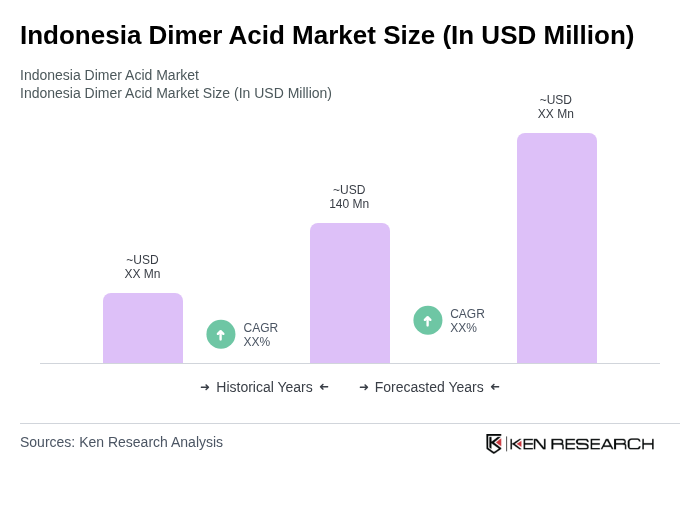
Indonesia Dimer Acid Market, valued at USD 140 Mn, is driven by construction and automotive sectors, with growth in bio-based products and government sustainability initiatives.

Region:Asia

Author(s):Rebecca

Product Code:KRAA4286

Pages:81

Published On:January 2026
About the Report

Base Year 2024

Indonesia Dimer Acid Market Overview

  • The Indonesia Dimer Acid Market is valued at USD 140 million, based on a five-year historical analysis and Indonesia’s share within the Asia Pacific and global dimer acid markets. This growth is primarily driven by the increasing demand for dimer acid in coatings, adhesives, and polyamide resins, supported by expansion in construction, automotive, packaging, and industrial maintenance activities. The rise in industrial activities in Indonesia and the growth of downstream oleochemical and resin-based value chains further fuel market expansion.
  • Key regions dominating the market include Java and Sumatra, where industrialization and urbanization are rapidly advancing. Java, being the economic and manufacturing hub, hosts a significant number of chemical, oleochemical, and coating production facilities, while Sumatra’s palm-based oleochemical industry and feedstock availability support the production of fatty-acid-based intermediates used for dimer acid. The strategic location of these regions, with major ports and logistics infrastructure, facilitates access to raw materials and export-oriented distribution networks.
  • In 2023, the Indonesian government strengthened policies promoting the use of safer and more environmentally friendly chemicals in manufacturing, including oleochemical and derivative products such as dimer-acid-based resins. The Regulation of the Minister of Trade of the Republic of Indonesia Number 36 of 2023 on Amendments to Regulation Number 25 of 2021 concerning the Stipulation of Hazardous Materials (Bahan Berbahaya) and Their Distribution sets requirements for classification, licensing, and control of hazardous substances and encourages substitution with less hazardous and more sustainable inputs where feasible in industrial processes. In parallel, implementation of the Indonesian National Standard (SNI) and environmental permitting under Law Number 32 of 2009 on Environmental Protection and Management continues to drive cleaner production practices in the chemical industry, supporting uptake of more eco-friendly resin and coating systems.
Indonesia Dimer Acid Market Size

Indonesia Dimer Acid Market Segmentation

By Product Type:The market is segmented into various product types, including Standard Dimer Acid, Distilled Dimer Acid, Distilled & Hydrogenated Dimer Acid, and Others, consistent with international segmentation of the dimer acid market. Standard Dimer Acid is widely used in Indonesia for general-purpose polyamide resins and coatings where cost-effectiveness and robust performance are required. Distilled Dimer Acid, which offers higher purity, color stability, and better performance, is increasingly preferred in higher-specification applications such as high-performance coatings, adhesives, and sealants. The distilled & hydrogenated dimer acid segment is gaining traction globally in premium segments, including specialty polyamides, UV-resistant coatings, and high-end lubricants, and is gradually finding similar high-value applications in Indonesia as customers seek better oxidative stability and low color.
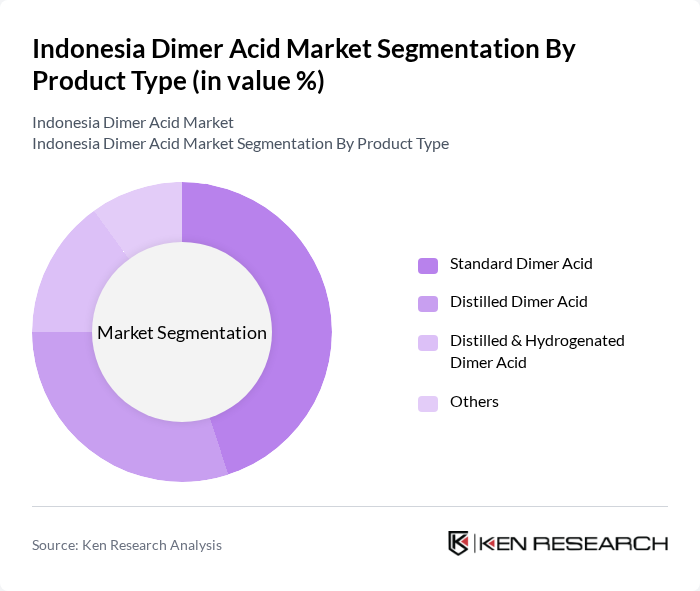
Indonesia Dimer Acid Market segmentation by Product Type.

By Application:The applications of dimer acid are diverse, including Reactive Polyamide Resins, Non-reactive Polyamide Resins, Oilfield Chemicals, Coatings & Adhesives, Lubricants, Cosmetic & Personal Care Products, and Others, aligned with standard global use patterns. The Coatings & Adhesives segment is a major consumer, supported by robust demand for durable, corrosion-resistant, and flexible coating systems in construction, automotive refinish, marine, and industrial maintenance applications. Reactive Polyamide Resins represent another important segment, driven by their use as curing agents and binders in epoxy and other adhesive and coating formulations that require strong adhesion and chemical resistance. The personal care and cosmetic segment, although smaller, benefits from Indonesia’s growing middle class and rising consumption of oleochemical-based emollients and specialty ingredients, where dimer-acid-derived esters and related materials are used in select formulations.
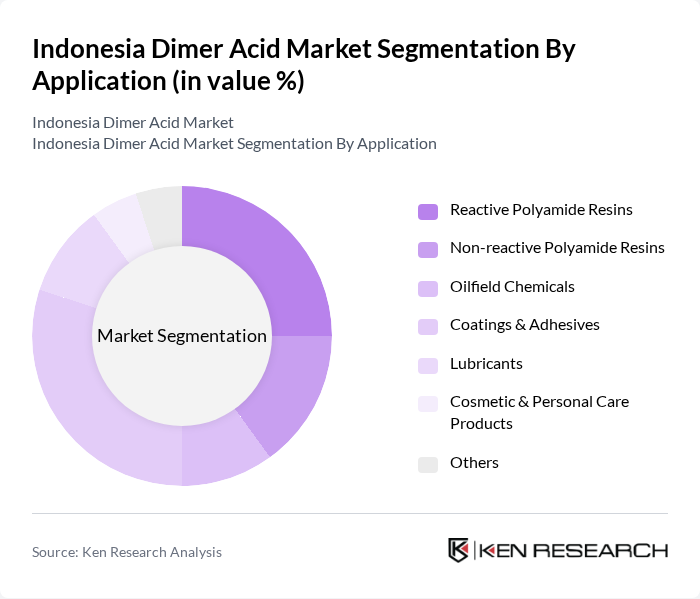
Indonesia Dimer Acid Market segmentation by Application.

Indonesia Dimer Acid Market Competitive Landscape

The Indonesia Dimer Acid Market is characterized by a dynamic mix of regional and international players. Leading participants such as PT. Wilmar Nabati Indonesia, PT. Musim Mas, PT. Ecogreen Oleochemicals, PT. Sumi Asih, PT. Safic Alcan Indonesia, PT. Lautan Luas Tbk, PT. Sumi Indo Kavako, Emery Oleochemicals (Indonesia Operations), BASF (Indonesia Operations), Croda (Indonesia Operations), PT. Clariant Indonesia Tbk, PT. Petronika, PT. Pacific Oleochemicals Indonesia, PT. Cemerlang Oleochemicals, and other emerging local producers contribute to innovation, geographic expansion, and service delivery in this space. These companies leverage Indonesia’s strong palm-based oleochemical base, integrated supply chains, and export linkages to supply dimer-acid-related intermediates, polyamide resins, and specialty chemical systems to domestic and regional customers.

PT. Wilmar Nabati Indonesia

1999

Surabaya, Indonesia

PT. Musim Mas

1972

Medan, Indonesia

PT. Ecogreen Oleochemicals

1991

Batam, Indonesia

PT. Sumi Asih

1980

Tangerang, Indonesia

PT. Safic Alcan Indonesia

2014

Jakarta, Indonesia

Company

Establishment Year

Headquarters

Group Size (Large, Medium, or Small as per industry convention)

Indonesia Dimer Acid Revenue (USD Million)

Indonesia Dimer Acid Revenue CAGR (Last 3–5 Years)

Indonesia Dimer Acid Market Share (%)

Capacity Installed in Indonesia (Kilotons per Year)

Capacity Utilization Rate (%)

Indonesia Dimer Acid Market Industry Analysis

Growth Drivers

  • Increasing Demand from End-User Industries:The Indonesian dimer acid market is experiencing a surge in demand, particularly from the coatings and adhesives sectors, which are projected to grow by 6% annually. In future, the construction industry alone is expected to contribute approximately IDR 1,200 trillion (USD 78 billion) to the economy, driving the need for high-performance materials. This growth is further supported by the rising production of consumer goods, which is anticipated to reach IDR 1,500 trillion (USD 99 billion) in the same period.
  • Expansion of Bio-based Products:The shift towards bio-based products is a significant growth driver in Indonesia's dimer acid market. With the government aiming for a 30% increase in bio-based chemical production in future, the market for dimer acid derived from renewable sources is expected to expand. The bio-based chemicals market in Indonesia is projected to reach IDR 500 trillion (USD 33 billion) in future, reflecting a growing consumer preference for sustainable alternatives in various applications, including personal care and packaging.
  • Government Initiatives for Sustainable Chemicals:The Indonesian government is actively promoting sustainable chemical production through various initiatives, including tax incentives and grants for green technology. In future, the government plans to allocate IDR 10 trillion (USD 670 million) to support the development of eco-friendly chemical processes. This initiative is expected to enhance the competitiveness of dimer acid manufacturers, encouraging investments in sustainable practices and technologies that align with global environmental standards.

Market Challenges

  • Fluctuating Raw Material Prices:One of the significant challenges facing the dimer acid market in Indonesia is the volatility of raw material prices. In future, the cost of key feedstocks, such as fatty acids, is projected to fluctuate between IDR 15,000 to IDR 20,000 per kilogram (USD 1.05 to USD 1.40). This unpredictability can severely impact profit margins for manufacturers, making it difficult to maintain stable pricing for end products and potentially leading to reduced competitiveness in the market.
  • Regulatory Compliance Costs:Compliance with stringent environmental regulations poses a significant challenge for dimer acid producers in Indonesia. In future, companies may face compliance costs averaging IDR 5 billion (USD 350,000) per facility to meet new chemical safety standards. These costs can strain smaller manufacturers, limiting their ability to invest in innovation and expansion, ultimately affecting the overall growth of the dimer acid market in the region.

Indonesia Dimer Acid Market Future Outlook

The future of the dimer acid market in Indonesia appears promising, driven by increasing demand for sustainable and high-performance materials. As the government continues to support green initiatives, manufacturers are likely to invest in innovative production technologies. Additionally, the growing personal care sector and the development of new applications for dimer acid will further enhance market dynamics. In future, the focus on eco-friendly products will likely lead to a more competitive landscape, fostering growth and expansion opportunities for industry players.

Market Opportunities

  • Growth in the Personal Care Sector:The personal care industry in Indonesia is projected to reach IDR 200 trillion (USD 14 billion) in future, creating significant opportunities for dimer acid applications in cosmetics and skincare products. This growth is driven by rising consumer awareness and demand for natural ingredients, positioning dimer acid as a key component in formulating eco-friendly personal care products.
  • Export Potential to Neighboring Countries:Indonesia's strategic location offers substantial export potential for dimer acid to neighboring markets, including Malaysia and Thailand. In future, exports are expected to increase by 15%, reaching IDR 50 trillion (USD 3.5 billion). This growth is fueled by regional demand for sustainable chemicals, providing Indonesian manufacturers with opportunities to expand their market reach and enhance profitability.

Scope of the Report

SegmentSub-Segments
By Product Type

Standard Dimer Acid

Distilled Dimer Acid

Distilled & Hydrogenated Dimer Acid

Others

By Application

Reactive Polyamide Resins

Non-reactive Polyamide Resins

Oilfield Chemicals

Coatings & Adhesives

Lubricants

Cosmetic & Personal Care Products

Others

By End-Use Industry

Construction

Automotive & Transportation

Oil & Gas

Personal Care & Cosmetics

Industrial & General Manufacturing

Others

By Distribution Channel

Direct Sales

Distributors

Online Sales

Others

By Geography

Java

Sumatra

Kalimantan

Sulawesi

Others

By Product Form

Liquid Dimer Acid

Solid Dimer Acid

Others

By Customer Size

Large Enterprises

Medium Enterprises

Small Enterprises

Key Target Audience

Investors and Venture Capitalist Firms

Government and Regulatory Bodies (e.g., Ministry of Industry, National Agency for Drug and Food Control)

Manufacturers and Producers

Distributors and Retailers

Chemical Industry Associations

Environmental Protection Agencies

Logistics and Supply Chain Companies

Financial Institutions

Players Mentioned in the Report:

PT. Wilmar Nabati Indonesia

PT. Musim Mas

PT. Ecogreen Oleochemicals

PT. Sumi Asih

PT. Safic Alcan Indonesia

PT. Lautan Luas Tbk

PT. Sumi Indo Kavako

Emery Oleochemicals (Indonesia Operations)

BASF (Indonesia Operations)

Croda (Indonesia Operations)

PT. Clariant Indonesia Tbk

PT. Petronika

PT. Pacific Oleochemicals Indonesia

PT. Cemerlang Oleochemicals

Other Emerging Local Producers

Table of Contents

Market Assessment Phase

1. Executive Summary and Approach


2. Indonesia Dimer Acid Market Overview

2.1 Key Insights and Strategic Recommendations

2.2 Indonesia Dimer Acid Market Overview

2.3 Definition and Scope

2.4 Evolution of Market Ecosystem

2.5 Timeline of Key Regulatory Milestones

2.6 Value Chain & Stakeholder Mapping

2.7 Business Cycle Analysis

2.8 Policy & Incentive Landscape


3. Indonesia Dimer Acid Market Analysis

3.1 Growth Drivers

3.1.1 Increasing Demand from End-User Industries
3.1.2 Expansion of Bio-based Products
3.1.3 Government Initiatives for Sustainable Chemicals
3.1.4 Rising Awareness of Eco-friendly Products

3.2 Market Challenges

3.2.1 Fluctuating Raw Material Prices
3.2.2 Regulatory Compliance Costs
3.2.3 Competition from Alternative Chemicals
3.2.4 Limited Awareness Among End-Users

3.3 Market Opportunities

3.3.1 Growth in the Personal Care Sector
3.3.2 Development of New Applications
3.3.3 Export Potential to Neighboring Countries
3.3.4 Investment in R&D for Product Innovation

3.4 Market Trends

3.4.1 Shift Towards Sustainable Manufacturing
3.4.2 Increasing Use of Dimer Acid in Adhesives
3.4.3 Technological Advancements in Production
3.4.4 Growing Demand for High-Performance Coatings

3.5 Government Regulation

3.5.1 Environmental Protection Regulations
3.5.2 Chemical Safety Standards
3.5.3 Import Tariffs on Raw Materials
3.5.4 Incentives for Green Chemistry Initiatives

4. SWOT Analysis


5. Stakeholder Analysis


6. Porter's Five Forces Analysis


7. Indonesia Dimer Acid Market Market Size, 2019-2024

7.1 By Value

7.2 By Volume

7.3 By Average Selling Price


8. Indonesia Dimer Acid Market Segmentation

8.1 By Product Type

8.1.1 Standard Dimer Acid
8.1.2 Distilled Dimer Acid
8.1.3 Distilled & Hydrogenated Dimer Acid
8.1.4 Others

8.2 By Application

8.2.1 Reactive Polyamide Resins
8.2.2 Non-reactive Polyamide Resins
8.2.3 Oilfield Chemicals
8.2.4 Coatings & Adhesives
8.2.5 Lubricants
8.2.6 Cosmetic & Personal Care Products
8.2.7 Others

8.3 By End-Use Industry

8.3.1 Construction
8.3.2 Automotive & Transportation
8.3.3 Oil & Gas
8.3.4 Personal Care & Cosmetics
8.3.5 Industrial & General Manufacturing
8.3.6 Others

8.4 By Distribution Channel

8.4.1 Direct Sales
8.4.2 Distributors
8.4.3 Online Sales
8.4.4 Others

8.5 By Geography

8.5.1 Java
8.5.2 Sumatra
8.5.3 Kalimantan
8.5.4 Sulawesi
8.5.5 Others

8.6 By Product Form

8.6.1 Liquid Dimer Acid
8.6.2 Solid Dimer Acid
8.6.3 Others

8.7 By Customer Size

8.7.1 Large Enterprises
8.7.2 Medium Enterprises
8.7.3 Small Enterprises

9. Indonesia Dimer Acid Market Competitive Analysis

9.1 Market Share of Key Players

9.2 Cross Comparison of Key Players

9.2.1 Company Name
9.2.2 Group Size (Large, Medium, or Small as per industry convention)
9.2.3 Indonesia Dimer Acid Revenue (USD Million)
9.2.4 Indonesia Dimer Acid Revenue CAGR (Last 3–5 Years)
9.2.5 Indonesia Dimer Acid Market Share (%)
9.2.6 Capacity Installed in Indonesia (Kilotons per Year)
9.2.7 Capacity Utilization Rate (%)
9.2.8 EBITDA Margin from Dimer Acid Business (%)
9.2.9 Return on Capital Employed (ROCE) – Dimer Acid Business (%)
9.2.10 R&D Intensity (% of Dimer Acid Revenue)
9.2.11 Export Share of Dimer Acid Sales (%)
9.2.12 Customer Concentration (Top 5 Customers Share, %)

9.3 SWOT Analysis of Top Players

9.4 Pricing Analysis

9.5 Detailed Profile of Major Companies

9.5.1 PT. Wilmar Nabati Indonesia
9.5.2 PT. Musim Mas
9.5.3 PT. Ecogreen Oleochemicals
9.5.4 PT. Sumi Asih
9.5.5 PT. Safic Alcan Indonesia
9.5.6 PT. Lautan Luas Tbk
9.5.7 PT. Sumi Indo Kavako
9.5.8 Emery Oleochemicals (Indonesia Operations)
9.5.9 BASF (Indonesia Operations)
9.5.10 Croda (Indonesia Operations)
9.5.11 PT. Clariant Indonesia Tbk
9.5.12 PT. Petronika
9.5.13 PT. Pacific Oleochemicals Indonesia
9.5.14 PT. Cemerlang Oleochemicals
9.5.15 Other Emerging Local Producers

10. Indonesia Dimer Acid Market End-User Analysis

10.1 Procurement Behavior of Key Ministries

10.1.1 Key Procurement Policies
10.1.2 Budget Allocation Trends
10.1.3 Supplier Selection Criteria
10.1.4 Contract Management Practices

10.2 Corporate Spend on Infrastructure & Energy

10.2.1 Investment Trends in Infrastructure
10.2.2 Energy Consumption Patterns
10.2.3 Budgeting for Sustainable Solutions
10.2.4 Corporate Social Responsibility Initiatives

10.3 Pain Point Analysis by End-User Category

10.3.1 Challenges Faced by Manufacturers
10.3.2 Issues in Supply Chain Management
10.3.3 Regulatory Compliance Difficulties
10.3.4 Market Access Barriers

10.4 User Readiness for Adoption

10.4.1 Awareness Levels of Dimer Acid Benefits
10.4.2 Training and Support Needs
10.4.3 Adoption Barriers
10.4.4 Feedback Mechanisms

10.5 Post-Deployment ROI and Use Case Expansion

10.5.1 Measurement of ROI
10.5.2 Case Studies of Successful Implementations
10.5.3 Future Use Case Opportunities
10.5.4 Customer Satisfaction Metrics

11. Indonesia Dimer Acid Market Future Size, 2025-2030

11.1 By Value

11.2 By Volume

11.3 By Average Selling Price


Go-To-Market Strategy Phase

1. Whitespace Analysis + Business Model Canvas

1.1 Market Gaps Identification

1.2 Value Proposition Development

1.3 Revenue Streams Analysis

1.4 Cost Structure Evaluation

1.5 Key Partnerships Exploration

1.6 Customer Segmentation

1.7 Channels of Distribution


2. Marketing and Positioning Recommendations

2.1 Branding Strategies

2.2 Product USPs

2.3 Target Market Positioning

2.4 Communication Strategies

2.5 Digital Marketing Approaches


3. Distribution Plan

3.1 Urban Retail Strategies

3.2 Rural NGO Tie-ups

3.3 Logistics and Supply Chain Management

3.4 Distribution Channel Optimization


4. Channel & Pricing Gaps

4.1 Underserved Routes

4.2 Pricing Bands Analysis

4.3 Competitor Pricing Strategies

4.4 Customer Willingness to Pay


5. Unmet Demand & Latent Needs

5.1 Category Gaps Identification

5.2 Consumer Segments Analysis

5.3 Product Development Opportunities

5.4 Market Entry Strategies


6. Customer Relationship

6.1 Loyalty Programs

6.2 After-sales Service

6.3 Customer Feedback Mechanisms

6.4 Relationship Management Strategies


7. Value Proposition

7.1 Sustainability Initiatives

7.2 Integrated Supply Chains

7.3 Competitive Advantage Analysis

7.4 Customer-Centric Approaches


8. Key Activities

8.1 Regulatory Compliance

8.2 Branding Initiatives

8.3 Distribution Setup

8.4 Market Research Activities


9. Entry Strategy Evaluation

9.1 Domestic Market Entry Strategy

9.1.1 Product Mix Considerations
9.1.2 Pricing Band Strategies
9.1.3 Packaging Innovations

9.2 Export Entry Strategy

9.2.1 Target Countries Identification
9.2.2 Compliance Roadmap Development

10. Entry Mode Assessment

10.1 Joint Ventures

10.2 Greenfield Investments

10.3 Mergers & Acquisitions

10.4 Distributor Model Evaluation


11. Capital and Timeline Estimation

11.1 Capital Requirements Analysis

11.2 Timelines for Market Entry


12. Control vs Risk Trade-Off

12.1 Ownership vs Partnerships

12.2 Risk Management Strategies


13. Profitability Outlook

13.1 Breakeven Analysis

13.2 Long-term Sustainability Strategies


14. Potential Partner List

14.1 Distributors

14.2 Joint Ventures

14.3 Acquisition Targets


15. Execution Roadmap

15.1 Phased Plan for Market Entry

15.1.1 Market Setup
15.1.2 Market Entry
15.1.3 Growth Acceleration
15.1.4 Scale & Stabilize

15.2 Key Activities and Milestones

15.2.1 Milestone Planning
15.2.2 Activity Tracking

Research Methodology

ApproachModellingSample

Phase 1: Approach1

Desk Research

  • Analysis of trade statistics from the Indonesian Ministry of Trade and industry reports
  • Review of market reports from chemical industry associations and trade journals
  • Examination of regulatory frameworks and environmental policies affecting dimer acid production

Primary Research

  • Interviews with key stakeholders in the dimer acid supply chain, including manufacturers and distributors
  • Surveys targeting end-users in sectors such as coatings, adhesives, and surfactants
  • Field visits to production facilities to gather insights on operational practices and capacity

Validation & Triangulation

  • Cross-validation of findings through comparison with historical market data and trends
  • Triangulation of insights from primary interviews with secondary data sources
  • Sanity checks conducted through expert panel discussions with industry veterans

Phase 2: Market Size Estimation1

Top-down Assessment

  • Estimation of market size based on national chemical production statistics and consumption patterns
  • Segmentation of the market by application areas such as personal care, automotive, and industrial uses
  • Incorporation of growth forecasts from government and industry reports on chemical demand

Bottom-up Modeling

  • Collection of production capacity data from major dimer acid manufacturers in Indonesia
  • Estimation of market share based on sales volume and revenue from key players
  • Analysis of pricing trends and cost structures to derive revenue projections

Forecasting & Scenario Analysis

  • Development of predictive models using historical growth rates and market drivers
  • Scenario analysis based on potential regulatory changes and shifts in consumer preferences
  • Creation of multiple forecasts (baseline, optimistic, and pessimistic) through 2030

Phase 3: CATI Sample Composition1

Scope Item/SegmentSample SizeTarget Respondent Profiles
Coatings Industry Applications100Product Managers, R&D Directors
Adhesives and Sealants Sector85Procurement Managers, Technical Sales Representatives
Personal Care Products75Formulation Chemists, Brand Managers
Industrial Applications60Operations Managers, Quality Assurance Specialists
Surfactants and Detergents90Product Development Managers, Supply Chain Analysts

Frequently Asked Questions

What is the current value of the Indonesia Dimer Acid Market?

The Indonesia Dimer Acid Market is valued at approximately USD 140 million, reflecting a robust growth trajectory driven by increasing demand in sectors such as coatings, adhesives, and polyamide resins, particularly in construction and automotive industries.

Which regions in Indonesia dominate the Dimer Acid Market?

What are the main applications of dimer acid in Indonesia?

What types of dimer acid products are available in the Indonesian market?

Why Buy From Us?

Refine Robust Result (RRR) Framework

What makes us stand out is that our consultants follow Robust, Refine and Result (RRR) methodology. Robust for clear definitions, approaches and sanity checking, Refine for differentiating respondents' facts and opinions, and Result for presenting data with story.

Our Reach Is Unmatched

We have set a benchmark in the industry by offering our clients with syndicated and customized market research reports featuring coverage of entire market as well as meticulous research and analyst insights.

Shifting the Research Paradigm

While we don't replace traditional research, we flip the method upside down. Our dual approach of Top Bottom & Bottom Top ensures quality deliverable by not just verifying company fundamentals but also looking at the sector and macroeconomic factors.

More Insights-Better Decisions

With one step in the future, our research team constantly tries to show you the bigger picture. We help with some of the tough questions you may encounter along the way: How is the industry positioned? Best marketing channel? KPI's of competitors? By aligning every element, we help maximize success.

Transparency and Trust

Our report gives you instant access to the answers and sources that other companies might choose to hide. We elaborate each steps of research methodology we have used and showcase you the sample size to earn your trust.

Round the Clock Support

If you need any support, we are here! We pride ourselves on universe strength, data quality, and quick, friendly, and professional service.

Why Clients Choose Us?

400000+
Reports in repository
150+
Consulting projects a year
100+
Analysts
8000+
Client Queries in 2022








