France Cold Chain & Food Storage Market

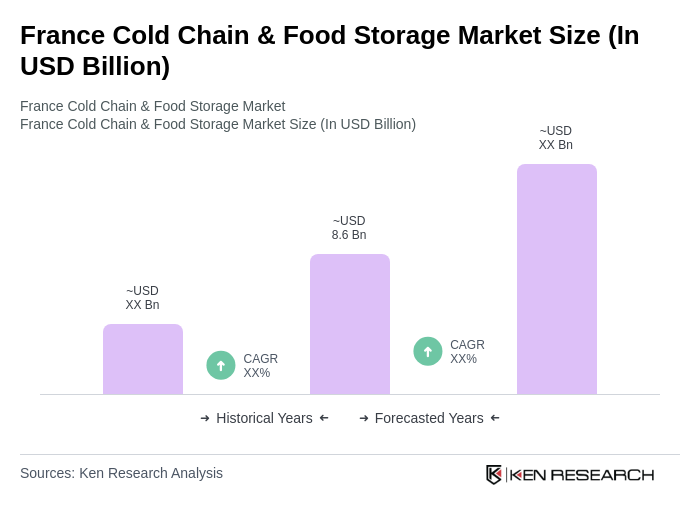
France Cold Chain & Food Storage Market is worth USD 8.6 Bn, fueled by perishable goods demand, e-commerce expansion, and strict regulations, projecting strong growth through tech advancements.

Region:Europe

Author(s):Geetanshi

Product Code:KRAB2701

Pages:92

Published On:October 2025
About the Report

Base Year 2024

France Cold Chain & Food Storage Market Overview

  • The France Cold Chain & Food Storage Market is valued at USD 8.6 billion, based on a five-year historical analysis. Growth is primarily driven by rising demand for fresh produce and processed foods, the rapid expansion of e-commerce in grocery and meal delivery, and increasingly stringent food safety regulations. The market has seen a significant uptick in investments in cold storage infrastructure, refrigerated transport, and advanced monitoring technologies to ensure product quality and reduce spoilage throughout the supply chain .
  • Key cities such as Paris, Lyon, and Marseille dominate the market due to their strategic geographic locations, robust logistics infrastructure, and dense population centers. These urban hubs serve as primary distribution points, enabling efficient supply chain operations and supporting the concentration of food processing industries, retail chains, and pharmaceutical distribution in the region .
  • The French cold chain industry is governed by the “Arrêté du 21 décembre 2009 relatif aux règles sanitaires applicables aux activités de commerce de détail, d’entreposage et de transport de produits d’origine animale et denrées alimentaires en contenant,” issued by the Ministry of Agriculture and Food. This regulation mandates strict temperature control requirements for the storage and transport of food products of animal origin, including operational thresholds, monitoring, and documentation for compliance. Adherence to these standards is essential for all businesses involved in food storage and distribution .
France Cold Chain & Food Storage Market Size

France Cold Chain & Food Storage Market Segmentation

By Type:The market is segmented into Refrigerated Transport, Cold Storage Warehousing, Temperature-Controlled Packaging, Monitoring & Tracking Systems, and Value-Added Services such as Blast Freezing, Labeling, and Inventory Management. Each segment is vital for maintaining the integrity and safety of temperature-sensitive products, with storage and transportation representing the largest shares due to their central role in the supply chain .
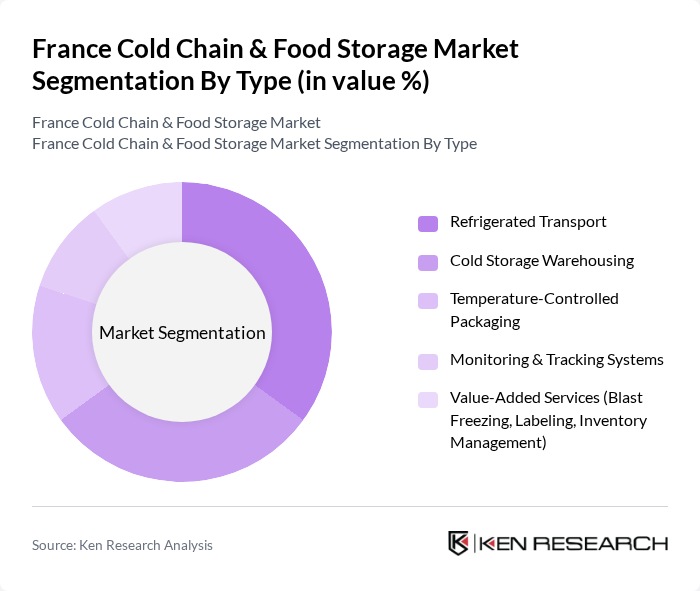
France Cold Chain & Food Storage Market segmentation by Type.

By End-User:The end-user segmentation includes Food and Beverage (covering Dairy, Meat, Seafood, Fruits & Vegetables, Frozen Foods, Bakery & Confectionery), Pharmaceuticals & Life Sciences, Retail & E-commerce, Agriculture & Horticulture, and Chemicals & Industrial Goods. The food and beverage sector remains the largest consumer of cold chain services, supported by the growing demand for fresh, frozen, and convenience foods, as well as the need for compliance with food safety and quality standards .
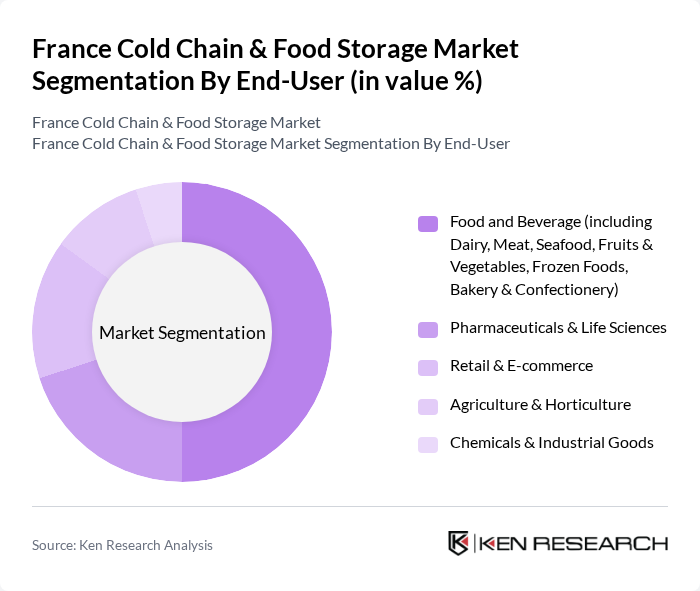
France Cold Chain & Food Storage Market segmentation by End-User.

France Cold Chain & Food Storage Market Competitive Landscape

The France Cold Chain & Food Storage Market is characterized by a dynamic mix of regional and international players. Leading participants such as STEF, XPO Logistics, DHL Supply Chain, Kuehne + Nagel, Geodis, DB Schenker, Lineage Logistics, NewCold, IRIS Logistics, Socopal, Norbert Dentressangle (XPO Logistics France), Cold Chain Technologies, Katoen Natie, A.P. Moller - Maersk, Nichirei Logistics Group contribute to innovation, geographic expansion, and service delivery in this space.

STEF

1920

Paris, France

XPO Logistics

1989

Levallois-Perret, France

DHL Supply Chain

1969

Bonn, Germany

Kuehne + Nagel

1890

Schindellegi, Switzerland

Geodis

1904

Levallois-Perret, France

Company

Establishment Year

Headquarters

Group Size (Large, Medium, or Small as per industry convention)

Revenue Growth Rate (YoY %)

Market Penetration Rate (France-specific % share)

Customer Retention Rate (%)

Operational Efficiency (e.g., average delivery time, order accuracy %)

Pricing Strategy (per pallet, per cubic meter, per delivery, etc.)

France Cold Chain & Food Storage Market Industry Analysis

Growth Drivers

  • Increasing Demand for Perishable Goods:The demand for perishable goods in France is projected to reach €200 billion in future, driven by a growing population and changing dietary preferences. The rise in consumer spending on fresh produce, dairy, and meat products, which accounted for approximately €82 billion in future, necessitates efficient cold chain logistics. This trend is further supported by the increasing number of supermarkets and grocery stores, which are expanding their perishable product offerings to meet consumer expectations.
  • Expansion of E-commerce in Food Delivery:The e-commerce food delivery market in France is expected to grow to €11 billion in future, reflecting a significant shift in consumer purchasing behavior. With over 15% of consumers now opting for online grocery shopping, the demand for reliable cold chain solutions is critical. This growth is bolstered by the increasing number of delivery platforms and the convenience they offer, which drives the need for efficient temperature-controlled logistics to ensure product quality and safety.
  • Rising Consumer Awareness About Food Safety:In future, approximately 70% of French consumers prioritize food safety, leading to increased demand for cold chain solutions. This heightened awareness is reflected in the €5 billion spent annually on food safety initiatives and certifications. As consumers become more informed about the risks associated with improper food storage, businesses are compelled to invest in advanced cold storage technologies and practices to maintain compliance and ensure product integrity throughout the supply chain.

Market Challenges

  • High Operational Costs:The operational costs associated with cold chain logistics in France are projected to exceed €15 billion in future. Factors contributing to these costs include energy expenses, maintenance of refrigeration equipment, and labor costs. The need for continuous temperature monitoring and compliance with stringent regulations further exacerbates these expenses, making it challenging for smaller operators to compete effectively in the market.
  • Stringent Regulatory Compliance:The cold chain industry in France faces rigorous regulatory compliance requirements, with over 50 regulations governing food safety and storage practices. These regulations necessitate significant investments in technology and training, which can be burdensome for businesses. Non-compliance can result in severe penalties, including fines and product recalls, which can adversely affect a company's reputation and financial stability in the competitive market landscape.

France Cold Chain & Food Storage Market Future Outlook

The future of the France cold chain and food storage market appears promising, driven by technological advancements and evolving consumer preferences. The integration of IoT and AI technologies is expected to enhance operational efficiency and reduce costs, while the focus on sustainability will lead to the adoption of eco-friendly practices. Additionally, the increasing demand for organic and locally sourced products will further stimulate growth, as businesses adapt to meet consumer expectations for quality and safety in food supply chains.

Market Opportunities

  • Growth in Organic Food Market:The organic food market in France is projected to reach €12 billion in future, presenting significant opportunities for cold chain providers. As consumers increasingly seek organic options, businesses must ensure proper storage and transportation to maintain product quality. This trend encourages investments in specialized cold storage facilities tailored for organic products, enhancing market competitiveness.
  • Adoption of IoT in Cold Chain Management:The adoption of IoT technology in cold chain management is expected to increase by 30% in future. This technology enables real-time monitoring of temperature and humidity levels, improving operational efficiency and reducing spoilage. Companies that invest in IoT solutions can enhance their service offerings, ensuring compliance with safety standards while optimizing logistics and reducing costs.

Scope of the Report

SegmentSub-Segments
By Type

Refrigerated Transport

Cold Storage Warehousing

Temperature-Controlled Packaging

Monitoring & Tracking Systems

Value-Added Services (Blast Freezing, Labeling, Inventory Management)

By End-User

Food and Beverage (including Dairy, Meat, Seafood, Fruits & Vegetables, Frozen Foods, Bakery & Confectionery)

Pharmaceuticals & Life Sciences

Retail & E-commerce

Agriculture & Horticulture

Chemicals & Industrial Goods

By Distribution Mode

Direct Distribution

Third-Party Logistics (3PL)

E-commerce Platforms

Others

By Application

Dairy Products

Meat and Seafood

Fruits and Vegetables

Frozen Foods

Pharmaceuticals

Processed Foods

Others

By Storage Type

Chilled Storage

Frozen Storage

Ambient Storage

Others

By Sales Channel

Online Sales

Offline Sales

Distributors

Others

By Price Range

Budget

Mid-Range

Premium

Others

Key Target Audience

Investors and Venture Capitalist Firms

Government and Regulatory Bodies (e.g., French Ministry of Agriculture and Food, French Food Safety Agency)

Manufacturers and Producers

Distributors and Retailers

Logistics and Supply Chain Companies

Cold Storage Facility Operators

Food and Beverage Industry Associations

Financial Institutions

Players Mentioned in the Report:

STEF

XPO Logistics

DHL Supply Chain

Kuehne + Nagel

Geodis

DB Schenker

Lineage Logistics

NewCold

IRIS Logistics

Socopal

Norbert Dentressangle (XPO Logistics France)

Cold Chain Technologies

Katoen Natie

A.P. Moller - Maersk

Nichirei Logistics Group

Table of Contents

Market Assessment Phase

1. Executive Summary and Approach


2. France Cold Chain & Food Storage Market Overview

2.1 Key Insights and Strategic Recommendations

2.2 France Cold Chain & Food Storage Market Overview

2.3 Definition and Scope

2.4 Evolution of Market Ecosystem

2.5 Timeline of Key Regulatory Milestones

2.6 Value Chain & Stakeholder Mapping

2.7 Business Cycle Analysis

2.8 Policy & Incentive Landscape


3. France Cold Chain & Food Storage Market Analysis

3.1 Growth Drivers

3.1.1 Increasing demand for perishable goods
3.1.2 Expansion of e-commerce in food delivery
3.1.3 Rising consumer awareness about food safety
3.1.4 Technological advancements in refrigeration

3.2 Market Challenges

3.2.1 High operational costs
3.2.2 Stringent regulatory compliance
3.2.3 Limited infrastructure in rural areas
3.2.4 Fluctuating energy prices

3.3 Market Opportunities

3.3.1 Growth in organic food market
3.3.2 Adoption of IoT in cold chain management
3.3.3 Expansion of logistics networks
3.3.4 Increasing investments in cold storage facilities

3.4 Market Trends

3.4.1 Shift towards sustainable practices
3.4.2 Integration of AI and machine learning
3.4.3 Rise of temperature-controlled packaging
3.4.4 Focus on last-mile delivery solutions

3.5 Government Regulation

3.5.1 EU food safety regulations
3.5.2 National cold chain standards
3.5.3 Environmental regulations on refrigerants
3.5.4 Incentives for energy-efficient technologies

4. SWOT Analysis


5. Stakeholder Analysis


6. Porter's Five Forces Analysis


7. France Cold Chain & Food Storage Market Market Size, 2019-2024

7.1 By Value

7.2 By Volume

7.3 By Average Selling Price


8. France Cold Chain & Food Storage Market Segmentation

8.1 By Type

8.1.1 Refrigerated Transport
8.1.2 Cold Storage Warehousing
8.1.3 Temperature-Controlled Packaging
8.1.4 Monitoring & Tracking Systems
8.1.5 Value-Added Services (Blast Freezing, Labeling, Inventory Management)

8.2 By End-User

8.2.1 Food and Beverage (including Dairy, Meat, Seafood, Fruits & Vegetables, Frozen Foods, Bakery & Confectionery)
8.2.2 Pharmaceuticals & Life Sciences
8.2.3 Retail & E-commerce
8.2.4 Agriculture & Horticulture
8.2.5 Chemicals & Industrial Goods

8.3 By Distribution Mode

8.3.1 Direct Distribution
8.3.2 Third-Party Logistics (3PL)
8.3.3 E-commerce Platforms
8.3.4 Others

8.4 By Application

8.4.1 Dairy Products
8.4.2 Meat and Seafood
8.4.3 Fruits and Vegetables
8.4.4 Frozen Foods
8.4.5 Pharmaceuticals
8.4.6 Processed Foods
8.4.7 Others

8.5 By Storage Type

8.5.1 Chilled Storage
8.5.2 Frozen Storage
8.5.3 Ambient Storage
8.5.4 Others

8.6 By Sales Channel

8.6.1 Online Sales
8.6.2 Offline Sales
8.6.3 Distributors
8.6.4 Others

8.7 By Price Range

8.7.1 Budget
8.7.2 Mid-Range
8.7.3 Premium
8.7.4 Others

9. France Cold Chain & Food Storage Market Competitive Analysis

9.1 Market Share of Key Players

9.2 Cross Comparison of Key Players

9.2.1 Company Name
9.2.2 Group Size (Large, Medium, or Small as per industry convention)
9.2.3 Revenue Growth Rate (YoY %)
9.2.4 Market Penetration Rate (France-specific % share)
9.2.5 Customer Retention Rate (%)
9.2.6 Operational Efficiency (e.g., average delivery time, order accuracy %)
9.2.7 Pricing Strategy (per pallet, per cubic meter, per delivery, etc.)
9.2.8 Service Level Agreement (SLA) Compliance (%)
9.2.9 Inventory Turnover Ratio
9.2.10 Return on Investment (ROI)
9.2.11 Cold Storage Capacity (cubic meters or pallet positions)
9.2.12 Number of Temperature-Controlled Vehicles
9.2.13 Geographic Coverage (number of regions/cities served in France)

9.3 SWOT Analysis of Top Players

9.4 Pricing Analysis

9.5 Detailed Profile of Major Companies

9.5.1 STEF
9.5.2 XPO Logistics
9.5.3 DHL Supply Chain
9.5.4 Kuehne + Nagel
9.5.5 Geodis
9.5.6 DB Schenker
9.5.7 Lineage Logistics
9.5.8 NewCold
9.5.9 IRIS Logistics
9.5.10 Socopal
9.5.11 Norbert Dentressangle (XPO Logistics France)
9.5.12 Cold Chain Technologies
9.5.13 Katoen Natie
9.5.14 A.P. Moller - Maersk
9.5.15 Nichirei Logistics Group

10. France Cold Chain & Food Storage Market End-User Analysis

10.1 Procurement Behavior of Key Ministries

10.1.1 Ministry of Agriculture
10.1.2 Ministry of Health
10.1.3 Ministry of Economy

10.2 Corporate Spend on Infrastructure & Energy

10.2.1 Investment in Cold Storage Facilities
10.2.2 Energy Efficiency Initiatives
10.2.3 Infrastructure Upgrades

10.3 Pain Point Analysis by End-User Category

10.3.1 Food Safety Compliance
10.3.2 Supply Chain Disruptions
10.3.3 Cost Management

10.4 User Readiness for Adoption

10.4.1 Technology Adoption Rates
10.4.2 Training and Skill Development
10.4.3 Investment in New Technologies

10.5 Post-Deployment ROI and Use Case Expansion

10.5.1 Performance Metrics
10.5.2 Case Studies of Successful Implementations
10.5.3 Future Expansion Plans

11. France Cold Chain & Food Storage Market Future Size, 2025-2030

11.1 By Value

11.2 By Volume

11.3 By Average Selling Price


Go-To-Market Strategy Phase

1. Whitespace Analysis + Business Model Canvas

1.1 Market Gaps Identification

1.2 Business Model Framework


2. Marketing and Positioning Recommendations

2.1 Branding Strategies

2.2 Product USPs


3. Distribution Plan

3.1 Urban Retail Strategies

3.2 Rural NGO Tie-Ups


4. Channel & Pricing Gaps

4.1 Underserved Routes

4.2 Pricing Bands


5. Unmet Demand & Latent Needs

5.1 Category Gaps

5.2 Consumer Segments


6. Customer Relationship

6.1 Loyalty Programs

6.2 After-Sales Service


7. Value Proposition

7.1 Sustainability Initiatives

7.2 Integrated Supply Chains


8. Key Activities

8.1 Regulatory Compliance

8.2 Branding Efforts

8.3 Distribution Setup


9. Entry Strategy Evaluation

9.1 Domestic Market Entry Strategy

9.1.1 Product Mix Considerations
9.1.2 Pricing Band Strategy
9.1.3 Packaging Solutions

9.2 Export Entry Strategy

9.2.1 Target Countries
9.2.2 Compliance Roadmap

10. Entry Mode Assessment

10.1 Joint Ventures

10.2 Greenfield Investments

10.3 Mergers & Acquisitions

10.4 Distributor Model


11. Capital and Timeline Estimation

11.1 Capital Requirements

11.2 Timelines for Implementation


12. Control vs Risk Trade-Off

12.1 Ownership vs Partnerships


13. Profitability Outlook

13.1 Breakeven Analysis

13.2 Long-Term Sustainability


14. Potential Partner List

14.1 Distributors

14.2 Joint Ventures

14.3 Acquisition Targets


15. Execution Roadmap

15.1 Phased Plan for Market Entry

15.1.1 Market Setup
15.1.2 Market Entry
15.1.3 Growth Acceleration
15.1.4 Scale & Stabilize

15.2 Key Activities and Milestones

15.2.1 Milestone Planning
15.2.2 Activity Tracking

Research Methodology

ApproachModellingSample

Phase 1: Approach1

Desk Research

  • Analysis of industry reports from French agricultural and food storage associations
  • Review of government publications on cold chain regulations and food safety standards
  • Examination of market trends through academic journals and trade publications focused on cold chain logistics

Primary Research

  • Interviews with logistics managers at major food distribution centers in France
  • Surveys with cold storage facility operators to gather insights on operational challenges
  • Field interviews with stakeholders in the food supply chain, including producers and retailers

Validation & Triangulation

  • Cross-validation of data through multiple sources, including trade associations and government statistics
  • Triangulation of findings from primary interviews with secondary data trends
  • Sanity checks conducted through expert panel reviews comprising industry veterans

Phase 2: Market Size Estimation1

Top-down Assessment

  • Estimation of the cold chain market size based on national food consumption statistics
  • Segmentation of the market by temperature-controlled storage types and end-user industries
  • Incorporation of growth rates from related sectors such as e-commerce food delivery

Bottom-up Modeling

  • Collection of operational data from leading cold storage facilities to establish volume benchmarks
  • Cost analysis based on service pricing models for temperature-controlled logistics
  • Calculation of market size using volume x cost methodology for various food categories

Forecasting & Scenario Analysis

  • Multi-factor regression analysis incorporating factors like consumer demand shifts and regulatory changes
  • Scenario modeling based on potential impacts of climate change on food storage needs
  • Development of baseline, optimistic, and pessimistic forecasts through 2030

Phase 3: CATI Sample Composition1

Scope Item/SegmentSample SizeTarget Respondent Profiles
Cold Storage Facilities100Facility Managers, Operations Directors
Food Distribution Networks60Logistics Coordinators, Supply Chain Managers
Retail Food Outlets50Store Managers, Procurement Specialists
Food Producers and Processors70Production Managers, Quality Assurance Officers
Regulatory Bodies and Associations40Policy Makers, Compliance Officers

Frequently Asked Questions

What is the current value of the France Cold Chain & Food Storage Market?

The France Cold Chain & Food Storage Market is valued at approximately USD 8.6 billion, driven by increasing demand for fresh produce, processed foods, and stringent food safety regulations. Investments in cold storage infrastructure and refrigerated transport are also contributing to market growth.

What are the key drivers of growth in the France Cold Chain Market?

Which cities are the main hubs for the France Cold Chain Market?

What regulations govern the cold chain industry in France?

Other Adjacent Reports

Kuwait Refrigerated Transportation Market

Egypt Cold Storage Warehousing Market

Belgium Temperature-Controlled Packaging Market

India Food Processing Market Outlook to 2030Global pharmaceutical logistics market Size, Share, Growth Drivers, Trends, Opportunities & Forecast 2025–2030Philippines E-Commerce Grocery Delivery Market

Indonesia Food Safety Monitoring Market

UAE Supply Chain Management Software MarketUAE Perishable Goods Logistics Market

Malaysia Sustainable Refrigeration Technology Market

Why Buy From Us?

Refine Robust Result (RRR) Framework

What makes us stand out is that our consultants follow Robust, Refine and Result (RRR) methodology. Robust for clear definitions, approaches and sanity checking, Refine for differentiating respondents' facts and opinions, and Result for presenting data with story.

Our Reach Is Unmatched

We have set a benchmark in the industry by offering our clients with syndicated and customized market research reports featuring coverage of entire market as well as meticulous research and analyst insights.

Shifting the Research Paradigm

While we don't replace traditional research, we flip the method upside down. Our dual approach of Top Bottom & Bottom Top ensures quality deliverable by not just verifying company fundamentals but also looking at the sector and macroeconomic factors.

More Insights-Better Decisions

With one step in the future, our research team constantly tries to show you the bigger picture. We help with some of the tough questions you may encounter along the way: How is the industry positioned? Best marketing channel? KPI's of competitors? By aligning every element, we help maximize success.

Transparency and Trust

Our report gives you instant access to the answers and sources that other companies might choose to hide. We elaborate each steps of research methodology we have used and showcase you the sample size to earn your trust.

Round the Clock Support

If you need any support, we are here! We pride ourselves on universe strength, data quality, and quick, friendly, and professional service.

Why Clients Choose Us?

400000+
Reports in repository
150+
Consulting projects a year
100+
Analysts
8000+
Client Queries in 2022








