About the Report
Base Year 2024Philippines Cold Chain & Food Storage Market Overview
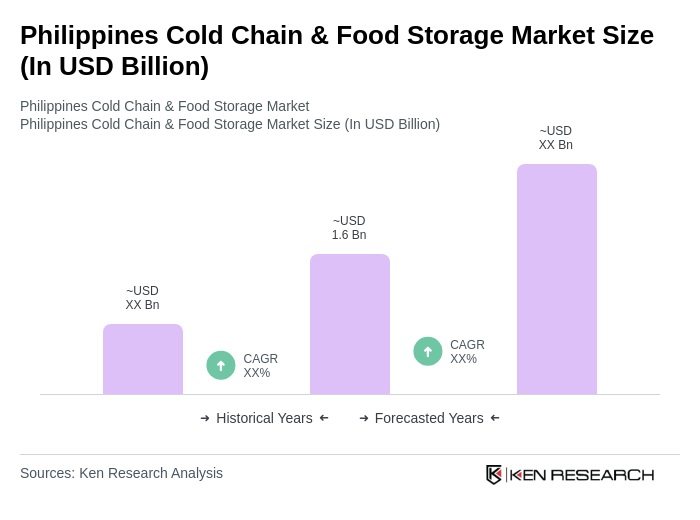
- The Philippines Cold Chain & Food Storage Market is valued at USD 1.6 billion, based on a five-year historical analysis. This growth is primarily driven by the increasing demand for perishable goods, the expansion of the food and beverage sector, and the rising awareness of food safety standards. The market is also supported by advancements in technology, such as real-time tracking, automation, and energy-efficient refrigeration systems, which enhance the efficiency of cold chain logistics. The proliferation of e-commerce platforms and the surge in online grocery and food delivery services have further accelerated demand for cold storage and last-mile temperature-controlled logistics. Additionally, the pharmaceutical sector’s requirements for vaccine and biologic storage have contributed significantly to market expansion.
- Metro Manila, Cebu, and Davao are the dominant cities in the Philippines Cold Chain & Food Storage Market. Metro Manila, being the capital, serves as the primary hub for trade and commerce, while Cebu and Davao are key logistical centers due to their strategic locations and growing population. These cities have seen significant investments in cold storage facilities and transportation infrastructure, further solidifying their market dominance. The Luzon region, particularly Metro Manila, accounts for the majority of cold storage facilities, with ongoing expansion in Visayas and Mindanao to meet rising regional demand.
- The Philippine government has implemented theFood Safety Act of 2013 (Republic Act No. 10611, issued by the Congress of the Philippines, 2013), which mandates strict compliance with food safety standards across the supply chain. This regulation requires all food business operators to ensure the safety and quality of food products through proper storage, handling, and transportation, with specific provisions for cold chain management. The act is enforced by the Department of Agriculture and the Department of Health, and non-compliance can result in penalties, suspension, or revocation of licenses.
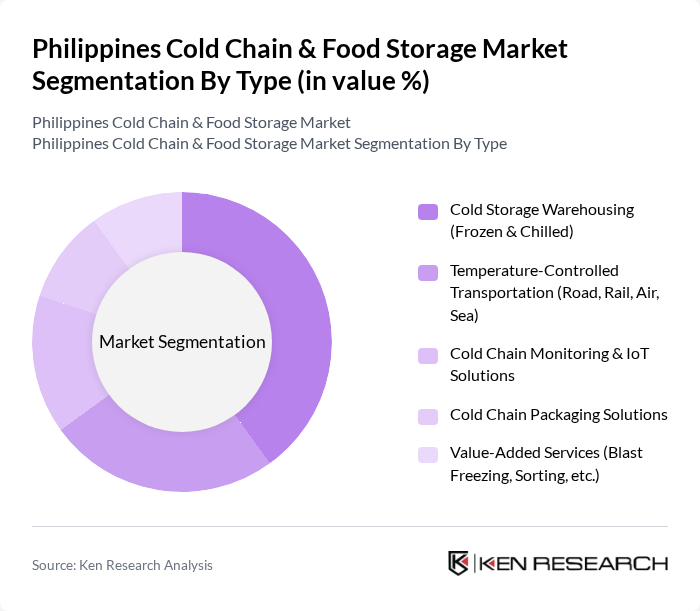
Philippines Cold Chain & Food Storage Market Segmentation
By Type:The market is segmented into various types, including Cold Storage Warehousing (Frozen & Chilled), Temperature-Controlled Transportation (Road, Rail, Air, Sea), Cold Chain Monitoring & IoT Solutions, Cold Chain Packaging Solutions, and Value-Added Services (Blast Freezing, Sorting, etc.). Among these,Cold Storage Warehousingis the leading segment due to the increasing demand for frozen and chilled products, driven by the food and beverage industry. The adoption of automation, temperature monitoring, and energy-efficient systems is transforming warehousing operations. Temperature-controlled transportation is also expanding rapidly, supported by investments in refrigerated trucks and last-mile delivery solutions for e-commerce and pharmaceuticals.
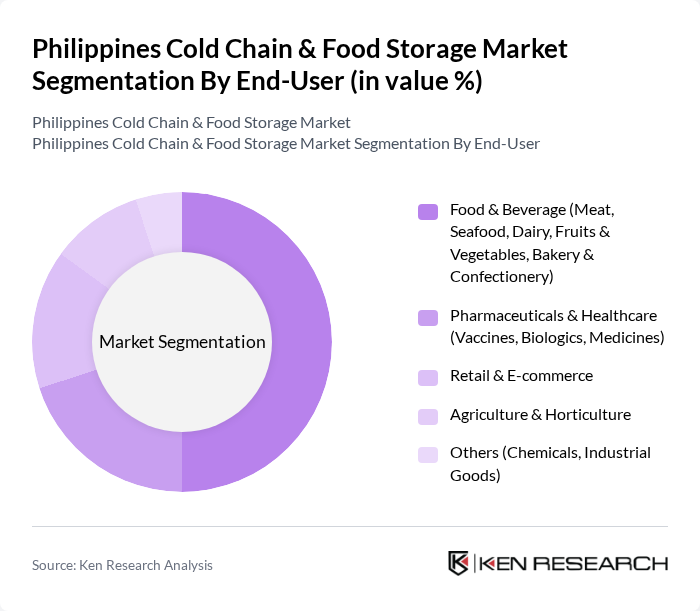
By End-User:The end-user segmentation includes Food & Beverage (Meat, Seafood, Dairy, Fruits & Vegetables, Bakery & Confectionery), Pharmaceuticals & Healthcare (Vaccines, Biologics, Medicines), Retail & E-commerce, Agriculture & Horticulture, and Others (Chemicals, Industrial Goods). TheFood & Beverage sectordominates this segment, driven by the increasing consumption of perishable goods, the shift towards convenience and frozen foods, and the growing trend of online grocery shopping. The Pharmaceuticals & Healthcare segment is expanding due to rising demand for temperature-sensitive medicines and vaccines, especially following the pandemic.
Philippines Cold Chain & Food Storage Market Competitive Landscape
The Philippines Cold Chain & Food Storage Market is characterized by a dynamic mix of regional and international players. Leading participants such as Jentec Storage Inc., Glacier Megafridge Inc., Royal Cargo Inc., Big Blue Logistics Corporation, Mets Logistics, Inc., Cold Chain Solutions, Inc., Fast Logistics Group, Koldstor Centre Philippines, Inc., Royal Cargo Logistics, Inc., Thermo King Philippines, Cargill Philippines, Inc., San Miguel Corporation, Universal Robina Corporation, Del Monte Philippines, Inc., AgriNurture, Inc. contribute to innovation, geographic expansion, and service delivery in this space. These companies are investing in capacity expansion, value-added services, and technology integration to enhance operational efficiency and meet evolving customer requirements.
Philippines Cold Chain & Food Storage Market Industry Analysis
Growth Drivers
- Increasing Demand for Perishable Goods:The Philippines has seen a significant rise in the consumption of perishable goods, with the market for fruits and vegetables alone reaching approximately 1.6 million metric tons in future. This surge is driven by urbanization and changing dietary preferences, leading to a projected increase in demand for cold chain logistics. The World Bank estimates that the food sector will grow by 6.5% annually, further emphasizing the need for efficient cold storage solutions to minimize spoilage and ensure food safety.
- Expansion of E-commerce and Online Grocery Delivery:The e-commerce sector in the Philippines is projected to reach $13 billion in future, with online grocery sales contributing significantly to this growth. As consumers increasingly prefer the convenience of online shopping, the demand for cold chain logistics to support perishable deliveries is rising. In future, online grocery sales accounted for 16% of total grocery sales, highlighting the urgent need for enhanced cold storage and transportation capabilities to meet consumer expectations.
- Government Initiatives to Improve Food Safety:The Philippine government has implemented various initiatives aimed at enhancing food safety standards, including the Food Safety Act of 2013. This legislation mandates strict compliance with food safety regulations, which has led to an increased focus on cold chain management. In future, the government plans to allocate approximately $55 million to improve cold storage facilities, ensuring that food products are stored and transported under optimal conditions, thereby reducing foodborne illnesses.
Market Challenges
- High Initial Investment Costs:Establishing cold chain infrastructure requires substantial capital investment, often exceeding $1.2 million for a single facility. This financial barrier poses a significant challenge for small and medium-sized enterprises (SMEs) in the Philippines, which may struggle to secure funding. Additionally, the high operational costs associated with maintaining temperature-controlled environments further deter investment, limiting the growth potential of the cold chain sector in the region.
- Inadequate Infrastructure in Rural Areas:Approximately 62% of the Philippine population resides in rural areas, where cold chain infrastructure is severely lacking. Many rural regions lack reliable electricity and transportation networks, making it difficult to implement effective cold storage solutions. The Asian Development Bank reports that only 32% of rural areas have access to adequate cold chain facilities, which hampers the distribution of perishable goods and increases food waste significantly in these regions.
Philippines Cold Chain & Food Storage Market Future Outlook
The future of the Philippines cold chain and food storage market appears promising, driven by technological advancements and increasing consumer demand for quality food products. As the government continues to invest in infrastructure improvements, the sector is expected to witness enhanced efficiency and reduced food waste. Furthermore, the integration of IoT and automation technologies will streamline operations, providing real-time monitoring and management of cold chain processes, ultimately leading to improved food safety and quality assurance.
Market Opportunities
- Growth in the Pharmaceutical Cold Chain Sector:The pharmaceutical cold chain market in the Philippines is projected to grow significantly, with an estimated value of $600 million in future. This growth is driven by the increasing demand for temperature-sensitive medications and vaccines, necessitating robust cold storage solutions to ensure product integrity and compliance with safety regulations.
- Adoption of IoT and Automation in Logistics:The integration of IoT technologies in cold chain logistics is expected to enhance operational efficiency. In future, it is anticipated that 45% of cold chain facilities will adopt IoT solutions, enabling real-time tracking and monitoring of temperature-sensitive goods. This shift will not only improve supply chain transparency but also reduce spoilage rates, ultimately benefiting both businesses and consumers.
Scope of the Report
| Segment | Sub-Segments |
|---|---|
| By Type | Cold Storage Warehousing (Frozen & Chilled) Temperature-Controlled Transportation (Road, Rail, Air, Sea) Cold Chain Monitoring & IoT Solutions Cold Chain Packaging Solutions Value-Added Services (Blast Freezing, Sorting, etc.) |
| By End-User | Food & Beverage (Meat, Seafood, Dairy, Fruits & Vegetables, Bakery & Confectionery) Pharmaceuticals & Healthcare (Vaccines, Biologics, Medicines) Retail & E-commerce Agriculture & Horticulture Others (Chemicals, Industrial Goods) |
| By Distribution Mode | Direct Distribution (Captive Logistics) Third-Party Logistics (3PL/4PL) E-commerce Fulfillment Others |
| By Application | Fresh Produce Dairy & Ice Cream Meat, Poultry & Seafood Pharmaceuticals & Vaccines Others |
| By Sales Channel | Online Sales Retail Outlets Wholesale Distributors Others |
| By Price Range | Budget Mid-Range Premium |
| By Policy Support | Government Subsidies Tax Incentives Grants for Infrastructure Development |
Key Target Audience
Investors and Venture Capitalist Firms
Government and Regulatory Bodies (e.g., Department of Agriculture, Food and Drug Administration)
Manufacturers and Producers
Distributors and Retailers
Logistics and Supply Chain Companies
Cold Chain Equipment Suppliers
Industry Associations (e.g., Philippine Chamber of Commerce and Industry)
Financial Institutions
Players Mentioned in the Report:
Jentec Storage Inc.
Glacier Megafridge Inc.
Royal Cargo Inc.
Big Blue Logistics Corporation
Mets Logistics, Inc.
Cold Chain Solutions, Inc.
Fast Logistics Group
Koldstor Centre Philippines, Inc.
Royal Cargo Logistics, Inc.
Thermo King Philippines
Cargill Philippines, Inc.
San Miguel Corporation
Universal Robina Corporation
Del Monte Philippines, Inc.
AgriNurture, Inc.
Table of Contents
Market Assessment Phase
1. Executive Summary and Approach
2. Philippines Cold Chain & Food Storage Market Overview
2.1 Key Insights and Strategic Recommendations
2.2 Philippines Cold Chain & Food Storage Market Overview
2.3 Definition and Scope
2.4 Evolution of Market Ecosystem
2.5 Timeline of Key Regulatory Milestones
2.6 Value Chain & Stakeholder Mapping
2.7 Business Cycle Analysis
2.8 Policy & Incentive Landscape
3. Philippines Cold Chain & Food Storage Market Analysis
3.1 Growth Drivers
3.1.1 Increasing demand for perishable goods
3.1.2 Expansion of e-commerce and online grocery delivery
3.1.3 Government initiatives to improve food safety
3.1.4 Rising consumer awareness about food quality
3.2 Market Challenges
3.2.1 High initial investment costs
3.2.2 Inadequate infrastructure in rural areas
3.2.3 Regulatory compliance complexities
3.2.4 Limited access to advanced technology
3.3 Market Opportunities
3.3.1 Growth in the pharmaceutical cold chain sector
3.3.2 Adoption of IoT and automation in logistics
3.3.3 Expansion of cold storage facilities
3.3.4 Increasing investment from private sectors
3.4 Market Trends
3.4.1 Shift towards sustainable and eco-friendly practices
3.4.2 Integration of technology in supply chain management
3.4.3 Rise of temperature-controlled transportation
3.4.4 Focus on end-to-end visibility in logistics
3.5 Government Regulation
3.5.1 Implementation of food safety standards
3.5.2 Regulations on temperature monitoring
3.5.3 Licensing requirements for cold storage facilities
3.5.4 Incentives for energy-efficient technologies
4. SWOT Analysis
5. Stakeholder Analysis
6. Porter's Five Forces Analysis
7. Philippines Cold Chain & Food Storage Market Market Size, 2019-2024
7.1 By Value
7.2 By Volume
7.3 By Average Selling Price
8. Philippines Cold Chain & Food Storage Market Segmentation
8.1 By Type
8.1.1 Cold Storage Warehousing (Frozen & Chilled)
8.1.2 Temperature-Controlled Transportation (Road, Rail, Air, Sea)
8.1.3 Cold Chain Monitoring & IoT Solutions
8.1.4 Cold Chain Packaging Solutions
8.1.5 Value-Added Services (Blast Freezing, Sorting, etc.)
8.2 By End-User
8.2.1 Food & Beverage (Meat, Seafood, Dairy, Fruits & Vegetables, Bakery & Confectionery)
8.2.2 Pharmaceuticals & Healthcare (Vaccines, Biologics, Medicines)
8.2.3 Retail & E-commerce
8.2.4 Agriculture & Horticulture
8.2.5 Others (Chemicals, Industrial Goods)
8.3 By Distribution Mode
8.3.1 Direct Distribution (Captive Logistics)
8.3.2 Third-Party Logistics (3PL/4PL)
8.3.3 E-commerce Fulfillment
8.3.4 Others
8.4 By Application
8.4.1 Fresh Produce
8.4.2 Dairy & Ice Cream
8.4.3 Meat, Poultry & Seafood
8.4.4 Pharmaceuticals & Vaccines
8.4.5 Others
8.5 By Sales Channel
8.5.1 Online Sales
8.5.2 Retail Outlets
8.5.3 Wholesale Distributors
8.5.4 Others
8.6 By Price Range
8.6.1 Budget
8.6.2 Mid-Range
8.6.3 Premium
8.7 By Policy Support
8.7.1 Government Subsidies
8.7.2 Tax Incentives
8.7.3 Grants for Infrastructure Development
9. Philippines Cold Chain & Food Storage Market Competitive Analysis
9.1 Market Share of Key Players
9.2 Cross Comparison of Key Players
9.2.1 Company Name
9.2.2 Group Size (Large, Medium, Small)
9.2.3 Revenue (PHP or USD, latest fiscal year)
9.2.4 Market Share (%)
9.2.5 Number of Cold Storage Facilities / Pallet Capacity
9.2.6 Geographic Coverage (Regions/Islands Served)
9.2.7 Fleet Size (Refrigerated Vehicles/Containers)
9.2.8 Utilization Rate (%)
9.2.9 Average Storage Turnover (Days)
9.2.10 Service Portfolio (Warehousing, Transport, Value-Added Services)
9.2.11 Technology Adoption (IoT, WMS, Automation)
9.2.12 Certifications (ISO, HACCP, LEED, etc.)
9.2.13 Customer Segments Served
9.2.14 Return on Investment (ROI)
9.3 SWOT Analysis of Top Players
9.4 Pricing Analysis
9.5 Detailed Profile of Major Companies
9.5.1 Jentec Storage Inc.
9.5.2 Glacier Megafridge Inc.
9.5.3 Royal Cargo Inc.
9.5.4 Big Blue Logistics Corporation
9.5.5 Mets Logistics, Inc.
9.5.6 Cold Chain Solutions, Inc.
9.5.7 Fast Logistics Group
9.5.8 Koldstor Centre Philippines, Inc.
9.5.9 Royal Cargo Logistics, Inc.
9.5.10 Thermo King Philippines
9.5.11 Cargill Philippines, Inc.
9.5.12 San Miguel Corporation
9.5.13 Universal Robina Corporation
9.5.14 Del Monte Philippines, Inc.
9.5.15 AgriNurture, Inc.
10. Philippines Cold Chain & Food Storage Market End-User Analysis
10.1 Procurement Behavior of Key Ministries
10.1.1 Department of Agriculture
10.1.2 Department of Health
10.1.3 Department of Trade and Industry
10.2 Corporate Spend on Infrastructure & Energy
10.2.1 Investment in Cold Storage Facilities
10.2.2 Budget Allocation for Technology Upgrades
10.2.3 Expenditure on Transportation Logistics
10.3 Pain Point Analysis by End-User Category
10.3.1 Food and Beverage Sector
10.3.2 Pharmaceutical Sector
10.3.3 Retail Sector
10.4 User Readiness for Adoption
10.4.1 Awareness of Cold Chain Solutions
10.4.2 Willingness to Invest in Technology
10.4.3 Training and Skill Development Needs
10.5 Post-Deployment ROI and Use Case Expansion
10.5.1 Measurement of Efficiency Gains
10.5.2 Expansion into New Markets
10.5.3 Long-term Cost Savings
11. Philippines Cold Chain & Food Storage Market Future Size, 2025-2030
11.1 By Value
11.2 By Volume
11.3 By Average Selling Price
Go-To-Market Strategy Phase
1. Whitespace Analysis + Business Model Canvas
1.1 Market Gaps Identification
1.2 Value Proposition Development
1.3 Revenue Streams Analysis
1.4 Key Partnerships Exploration
1.5 Cost Structure Assessment
1.6 Customer Segmentation
1.7 Channels of Distribution
2. Marketing and Positioning Recommendations
2.1 Branding Strategies
2.2 Product USPs
2.3 Target Audience Identification
2.4 Communication Strategy
2.5 Digital Marketing Approaches
3. Distribution Plan
3.1 Urban Retail Strategies
3.2 Rural NGO Tie-ups
3.3 Logistics Optimization
3.4 Partnership with Local Distributors
4. Channel & Pricing Gaps
4.1 Underserved Routes
4.2 Pricing Bands Analysis
4.3 Competitor Pricing Strategies
5. Unmet Demand & Latent Needs
5.1 Category Gaps Identification
5.2 Consumer Segments Analysis
5.3 Emerging Trends Exploration
6. Customer Relationship
6.1 Loyalty Programs Development
6.2 After-sales Service Enhancements
6.3 Customer Feedback Mechanisms
7. Value Proposition
7.1 Sustainability Initiatives
7.2 Integrated Supply Chains
7.3 Competitive Advantages
8. Key Activities
8.1 Regulatory Compliance
8.2 Branding Initiatives
8.3 Distribution Setup
9. Entry Strategy Evaluation
9.1 Domestic Market Entry Strategy
9.1.1 Product Mix Considerations
9.1.2 Pricing Band Strategy
9.1.3 Packaging Innovations
9.2 Export Entry Strategy
9.2.1 Target Countries Identification
9.2.2 Compliance Roadmap Development
10. Entry Mode Assessment
10.1 Joint Ventures
10.2 Greenfield Investments
10.3 Mergers & Acquisitions
10.4 Distributor Model Evaluation
11. Capital and Timeline Estimation
11.1 Capital Requirements Analysis
11.2 Timelines for Implementation
12. Control vs Risk Trade-Off
12.1 Ownership vs Partnerships
12.2 Risk Management Strategies
13. Profitability Outlook
13.1 Breakeven Analysis
13.2 Long-term Sustainability Strategies
14. Potential Partner List
14.1 Distributors Identification
14.2 Joint Ventures Opportunities
14.3 Acquisition Targets
15. Execution Roadmap
15.1 Phased Plan for Market Entry
15.1.1 Market Setup
15.1.2 Market Entry
15.1.3 Growth Acceleration
15.1.4 Scale & Stabilize
15.2 Key Activities and Milestones
15.2.1 Milestone Planning
15.2.2 Activity Tracking
Research Methodology
Phase 1: Approach1
Desk Research
- Analysis of government reports on cold chain infrastructure and food storage regulations
- Review of industry publications and market reports focusing on the Philippines cold chain sector
- Examination of trade statistics and import/export data related to refrigerated goods
Primary Research
- Interviews with key stakeholders in the cold chain logistics sector, including warehouse operators and transport companies
- Surveys with food manufacturers and distributors to understand their cold storage needs and challenges
- Field visits to cold storage facilities to assess operational practices and technology usage
Validation & Triangulation
- Cross-validation of findings through multiple data sources, including industry reports and expert opinions
- Triangulation of market size estimates using both top-down and bottom-up approaches
- Sanity checks through feedback from industry experts and stakeholders
Phase 2: Market Size Estimation1
Top-down Assessment
- Estimation of the overall cold chain market size based on national food consumption data
- Segmentation of the market by end-user categories such as retail, food service, and pharmaceuticals
- Incorporation of growth rates from related sectors, such as e-commerce and food delivery services
Bottom-up Modeling
- Collection of operational data from leading cold storage providers to establish capacity and utilization rates
- Cost analysis based on service pricing models and operational expenses of cold chain facilities
- Volume estimates derived from product flow analysis across different food categories
Forecasting & Scenario Analysis
- Development of forecasting models based on historical growth trends and market drivers
- Scenario analysis considering factors such as regulatory changes and technological advancements
- Projections for market growth through 2034 under various economic conditions
Phase 3: CATI Sample Composition1
| Scope Item/Segment | Sample Size | Target Respondent Profiles |
|---|---|---|
| Cold Storage Facilities | 85 | Facility Managers, Operations Directors |
| Food Manufacturers | 75 | Production Managers, Supply Chain Coordinators |
| Logistics Providers | 65 | Logistics Managers, Fleet Supervisors |
| Retail Sector Cold Chain | 55 | Store Managers, Procurement Officers |
| Pharmaceutical Cold Chain | 45 | Quality Assurance Managers, Regulatory Affairs Specialists |
Frequently Asked Questions
What is the current value of the Philippines Cold Chain & Food Storage Market?
The Philippines Cold Chain & Food Storage Market is valued at approximately USD 1.6 billion, driven by the increasing demand for perishable goods, advancements in technology, and the expansion of the food and beverage sector.
What are the key drivers of growth in the Philippines Cold Chain Market?
Which cities dominate the Philippines Cold Chain & Food Storage Market?
What are the main segments of the Philippines Cold Chain Market?
Other Adjacent Reports
Thailand Refrigerated Transportation Market
UAE food processing equipment market size, share, growth drivers, trends, opportunities & forecast 2025–2030Egypt Pharmaceutical Cold Chain Market
UK E-Commerce Logistics MarketVietnam warehouse automation market report size, share, growth drivers, trends, opportunities & forecast 2025–2030Philippines IoT Supply Chain Solutions Market
Belgium Food Safety Testing Market
Egypt Temperature-Controlled Packaging Market
Kuwait Agricultural Supply Chain Market
KSA Perishable Goods Distribution Market
Why Buy From Us?

What makes us stand out is that our consultants follow Robust, Refine and Result (RRR) methodology. Robust for clear definitions, approaches and sanity checking, Refine for differentiating respondents' facts and opinions, and Result for presenting data with story.

We have set a benchmark in the industry by offering our clients with syndicated and customized market research reports featuring coverage of entire market as well as meticulous research and analyst insights.

While we don't replace traditional research, we flip the method upside down. Our dual approach of Top Bottom & Bottom Top ensures quality deliverable by not just verifying company fundamentals but also looking at the sector and macroeconomic factors.

With one step in the future, our research team constantly tries to show you the bigger picture. We help with some of the tough questions you may encounter along the way: How is the industry positioned? Best marketing channel? KPI's of competitors? By aligning every element, we help maximize success.

Our report gives you instant access to the answers and sources that other companies might choose to hide. We elaborate each steps of research methodology we have used and showcase you the sample size to earn your trust.

If you need any support, we are here! We pride ourselves on universe strength, data quality, and quick, friendly, and professional service.