About the Report
Base Year 2024Japan Automotive Telematics Market Overview
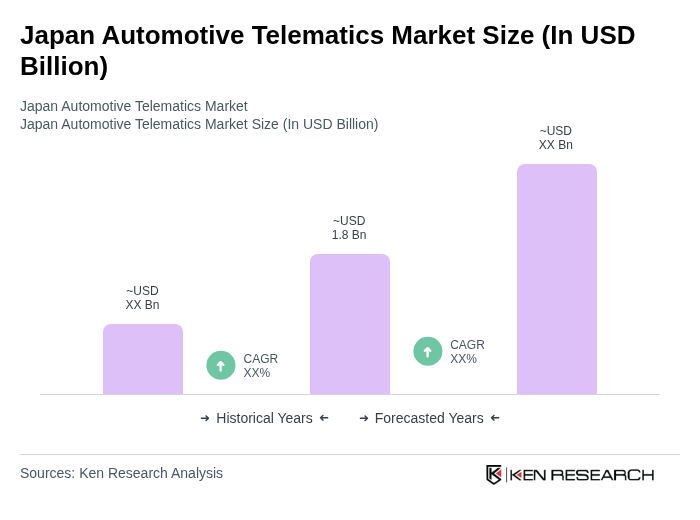
- The Japan Automotive Telematics Market is valued at USD 1.8 billion, based on a five-year historical analysis. This growth is primarily driven by the increasing demand for connected vehicles, advancements in cellular and vehicle-to-everything (V2X) communication technologies, and the rising focus on vehicle safety, efficiency, and data-driven services. The integration of telematics solutions in vehicles has become essential for enabling real-time tracking, remote diagnostics, over-the-air updates, and enhanced user experience and operational efficiency.
- Key cities such as Tokyo, Osaka, and Nagoya dominate the market due to their high population density, advanced ICT and transport infrastructure, and significant automotive manufacturing and R&D presence. These urban centers are also hubs for technological innovation, including smart city and connected mobility initiatives, which foster the adoption of telematics solutions among consumers, fleet operators, and mobility service providers.
- Japan has progressively strengthened vehicle connectivity and safety requirements through regulations such as the Road Transport Vehicle Act and associated safety regulations administered by the Ministry of Land, Infrastructure, Transport and Tourism (MLIT), as well as mandatory fitment of emergency call functions based on the Advanced Mobile Safety (ASV) program. These instruments promote the installation of advanced communication, emergency notification, and data communication systems in new vehicles to enhance road safety, support incident response, and enable real-time data collection for traffic and mobility management.
Japan Automotive Telematics Market Segmentation
By Solution Type:
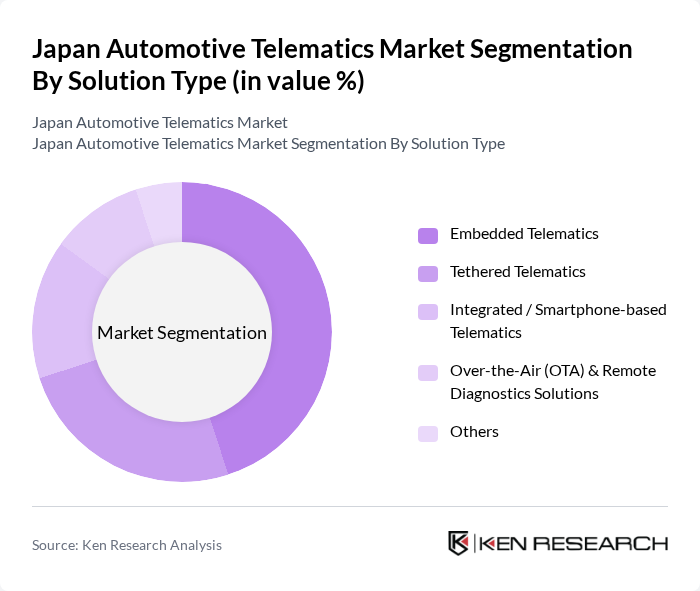
The solution type segmentation includes Embedded Telematics, Tethered Telematics, Integrated / Smartphone-based Telematics, Over-the-Air (OTA) & Remote Diagnostics Solutions, and Others. Among these, Embedded Telematics is the leading subsegment, driven by its seamless integration into vehicles, providing real-time data, safety services, and connectivity from the point of sale. The growing trend of connected cars, OEM-branded connected services, and the demand for advanced safety and navigation features have further propelled the adoption of embedded solutions in Japan. Tethered and integrated/smartphone-based telematics are also gaining traction, particularly among tech-savvy consumers who prefer app-based services and smartphone connectivity for infotainment, navigation, and basic vehicle status functions.
By Service Type:
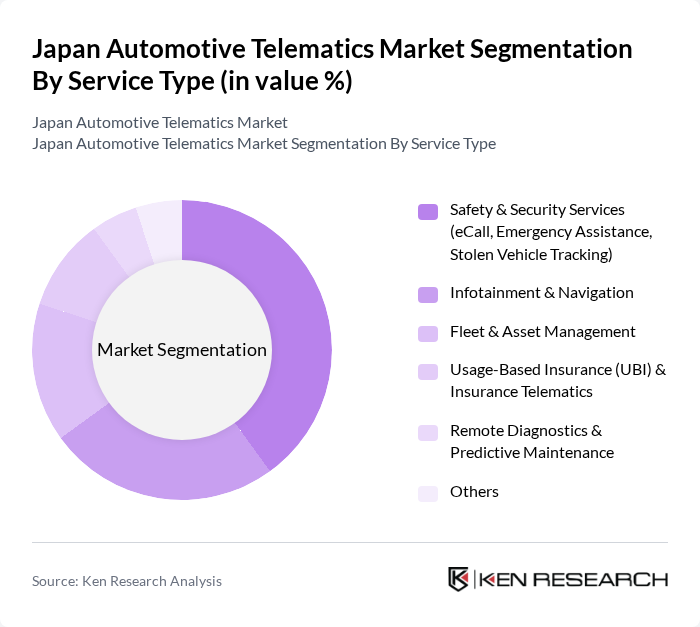
The service type segmentation encompasses Safety & Security Services (eCall, Emergency Assistance, Stolen Vehicle Tracking), Infotainment & Navigation, Fleet & Asset Management, Usage-Based Insurance (UBI) & Insurance Telematics, Remote Diagnostics & Predictive Maintenance, and Others. Safety & Security Services are the most prominent subsegment, driven by increasing consumer awareness regarding vehicle safety, demand for automatic emergency notification, and support for government safety initiatives. The rise in connected safety applications, accident response needs, and OEM offerings such as emergency call, roadside assistance, and stolen vehicle tracking has further fueled the demand for these services, making them a priority for both manufacturers, insurers, and consumers.
Japan Automotive Telematics Market Competitive Landscape
The Japan Automotive Telematics Market is characterized by a dynamic mix of regional and international players. Leading participants such as Toyota Motor Corporation, Honda Motor Co., Ltd., Nissan Motor Co., Ltd., DENSO Corporation, Panasonic Holdings Corporation, Fujitsu Limited, Hitachi, Ltd., Mitsubishi Electric Corporation, Subaru Corporation, Mazda Motor Corporation, Clarion Co., Ltd. (Faurecia Clarion Electronics), Aisin Corporation, Continental AG, Valeo SA, Robert Bosch GmbH contribute to innovation, geographic expansion, and service delivery in this space.
Japan Automotive Telematics Market Industry Analysis
Growth Drivers
- Increasing Demand for Connected Vehicles:The demand for connected vehicles in Japan is projected to reach 8.5 million units in future, driven by consumer preferences for enhanced connectivity features. The automotive sector's growth is supported by a 4% increase in disposable income, allowing consumers to invest in advanced telematics systems. Additionally, the Japanese government aims to have 95% of new vehicles equipped with connected technologies in future, further propelling market growth.
- Government Initiatives for Smart Transportation:The Japanese government has allocated approximately ¥1.2 trillion (around $10.8 billion) for smart transportation initiatives in future. This funding supports the development of intelligent transportation systems (ITS) that integrate telematics solutions. With a focus on reducing traffic congestion and enhancing road safety, these initiatives are expected to increase telematics adoption in both commercial and personal vehicles, fostering a more connected automotive ecosystem.
- Advancements in Telematics Technology:The telematics technology landscape in Japan is evolving rapidly, with investments in AI and machine learning expected to exceed ¥600 billion ($5.4 billion) in future. These advancements enable real-time data analytics, improving vehicle performance and safety features. As a result, manufacturers are increasingly integrating telematics solutions into their vehicles, enhancing user experience and driving market growth. The rise of 5G technology will further enhance these capabilities, providing faster and more reliable connectivity.
Market Challenges
- High Implementation Costs:The initial costs associated with implementing telematics systems can be significant, often exceeding ¥350,000 ($3,150) per vehicle. This financial barrier can deter manufacturers and consumers from adopting advanced telematics solutions. Additionally, ongoing maintenance and software updates contribute to the overall expense, making it challenging for smaller automotive companies to compete in the telematics market, which may hinder overall market growth.
- Data Privacy Concerns:With the increasing integration of telematics systems, data privacy concerns are becoming more pronounced. In future, it is estimated that 65% of consumers in Japan will express concerns about how their data is collected and used. This apprehension can lead to resistance against adopting telematics solutions, as consumers prioritize their privacy. Regulatory frameworks are evolving, but the lack of comprehensive data protection laws may further complicate the situation for telematics providers.
Japan Automotive Telematics Market Future Outlook
The future of the Japan automotive telematics market appears promising, driven by technological advancements and government support. As 5G networks expand, the potential for enhanced vehicle-to-everything (V2X) communication will significantly improve telematics capabilities. Furthermore, the increasing adoption of electric vehicles will create new opportunities for telematics integration, allowing for better energy management and user experience. The collaboration between automotive manufacturers and technology firms will also play a crucial role in shaping the market landscape, fostering innovation and growth.
Market Opportunities
- Expansion of 5G Networks:The rollout of 5G networks in Japan is expected to enhance telematics capabilities significantly. In future, over 95% of urban areas will have 5G coverage, enabling faster data transmission and improved connectivity. This technological advancement will facilitate real-time communication between vehicles and infrastructure, enhancing safety and efficiency in transportation systems.
- Growth in Electric Vehicle Adoption:The electric vehicle market in Japan is projected to grow to 2 million units in future, creating substantial opportunities for telematics integration. As more consumers opt for electric vehicles, the demand for telematics solutions that optimize energy consumption and provide real-time diagnostics will increase. This trend will drive innovation and investment in telematics technologies tailored for electric vehicles.
Scope of the Report
| Segment | Sub-Segments |
|---|---|
| By Solution Type | Embedded Telematics Tethered Telematics Integrated / Smartphone-based Telematics Over-the-Air (OTA) & Remote Diagnostics Solutions Others |
| By Service Type | Safety & Security Services (eCall, Emergency Assistance, Stolen Vehicle Tracking) Infotainment & Navigation Fleet & Asset Management Usage-Based Insurance (UBI) & Insurance Telematics Remote Diagnostics & Predictive Maintenance Others |
| By Connectivity | Cellular (3G/4G/LTE) G Satellite Short-Range (Wi-Fi, Bluetooth, DSRC) Others |
| By Channel Type | OEM-installed Telematics Aftermarket Telematics |
| By Vehicle Type | Passenger Cars Light Commercial Vehicles (LCVs) Heavy Commercial Vehicles (HCVs & Buses) Two-wheelers and Micro-mobility Electric Vehicles (Battery Electric, Plug-in Hybrid) Others |
| By Application | Navigation & Route Optimization Driver Behavior Monitoring & Scoring Vehicle Health Monitoring & Diagnostics V2X & ADAS Support Functions Regulatory Compliance & Electronic Logging Others |
| By Region (Japan) | Kanto Kansai / Kinki Chubu (Central) Kyushu–Okinawa Tohoku Chugoku Hokkaido Shikoku |
Key Target Audience
Investors and Venture Capitalist Firms
Government and Regulatory Bodies (e.g., Ministry of Land, Infrastructure, Transport and Tourism)
Automotive Manufacturers
Telematics Solution Providers
Insurance Companies
Fleet Management Companies
Telecommunications Providers
Automotive Aftermarket Service Providers
Players Mentioned in the Report:
Toyota Motor Corporation
Honda Motor Co., Ltd.
Nissan Motor Co., Ltd.
DENSO Corporation
Panasonic Holdings Corporation
Fujitsu Limited
Hitachi, Ltd.
Mitsubishi Electric Corporation
Subaru Corporation
Mazda Motor Corporation
Clarion Co., Ltd. (Faurecia Clarion Electronics)
Aisin Corporation
Continental AG
Valeo SA
Robert Bosch GmbH
Table of Contents
Market Assessment Phase
1. Executive Summary and Approach
2. Japan Automotive Telematics Market Overview
2.1 Key Insights and Strategic Recommendations
2.2 Japan Automotive Telematics Market Overview
2.3 Definition and Scope
2.4 Evolution of Market Ecosystem
2.5 Timeline of Key Regulatory Milestones
2.6 Value Chain & Stakeholder Mapping
2.7 Business Cycle Analysis
2.8 Policy & Incentive Landscape
3. Japan Automotive Telematics Market Analysis
3.1 Growth Drivers
3.1.1 Increasing demand for connected vehicles
3.1.2 Government initiatives for smart transportation
3.1.3 Rising consumer preference for safety features
3.1.4 Advancements in telematics technology
3.2 Market Challenges
3.2.1 High implementation costs
3.2.2 Data privacy concerns
3.2.3 Integration with legacy systems
3.2.4 Limited consumer awareness
3.3 Market Opportunities
3.3.1 Expansion of 5G networks
3.3.2 Growth in electric vehicle adoption
3.3.3 Development of autonomous driving technologies
3.3.4 Partnerships with tech companies
3.4 Market Trends
3.4.1 Increasing focus on vehicle-to-everything (V2X) communication
3.4.2 Rise of subscription-based telematics services
3.4.3 Integration of AI and machine learning in telematics
3.4.4 Shift towards sustainable telematics solutions
3.5 Government Regulation
3.5.1 Stricter emissions regulations
3.5.2 Data protection laws
3.5.3 Incentives for electric vehicle telematics
3.5.4 Standards for telematics data sharing
4. SWOT Analysis
5. Stakeholder Analysis
6. Porter's Five Forces Analysis
7. Japan Automotive Telematics Market Market Size, 2019-2024
7.1 By Value
7.2 By Volume
7.3 By Average Selling Price
8. Japan Automotive Telematics Market Segmentation
8.1 By Solution Type
8.1.1 Embedded Telematics
8.1.2 Tethered Telematics
8.1.3 Integrated / Smartphone-based Telematics
8.1.4 Over-the-Air (OTA) & Remote Diagnostics Solutions
8.1.5 Others
8.2 By Service Type
8.2.1 Safety & Security Services (eCall, Emergency Assistance, Stolen Vehicle Tracking)
8.2.2 Infotainment & Navigation
8.2.3 Fleet & Asset Management
8.2.4 Usage-Based Insurance (UBI) & Insurance Telematics
8.2.5 Remote Diagnostics & Predictive Maintenance
8.2.6 Others
8.3 By Connectivity
8.3.1 Cellular (3G/4G/LTE)
8.3.2 5G
8.3.3 Satellite
8.3.4 Short-Range (Wi-Fi, Bluetooth, DSRC)
8.3.5 Others
8.4 By Channel Type
8.4.1 OEM-installed Telematics
8.4.2 Aftermarket Telematics
8.5 By Vehicle Type
8.5.1 Passenger Cars
8.5.2 Light Commercial Vehicles (LCVs)
8.5.3 Heavy Commercial Vehicles (HCVs & Buses)
8.5.4 Two-wheelers and Micro-mobility
8.5.5 Electric Vehicles (Battery Electric, Plug-in Hybrid)
8.5.6 Others
8.6 By Application
8.6.1 Navigation & Route Optimization
8.6.2 Driver Behavior Monitoring & Scoring
8.6.3 Vehicle Health Monitoring & Diagnostics
8.6.4 V2X & ADAS Support Functions
8.6.5 Regulatory Compliance & Electronic Logging
8.6.6 Others
8.7 By Region (Japan)
8.7.1 Kanto
8.7.2 Kansai / Kinki
8.7.3 Chubu (Central)
8.7.4 Kyushu–Okinawa
8.7.5 Tohoku
8.7.6 Chugoku
8.7.7 Hokkaido
8.7.8 Shikoku
9. Japan Automotive Telematics Market Competitive Analysis
9.1 Market Share of Key Players
9.2 Cross Comparison of Key Players
9.2.1 Company Name
9.2.2 Group Size (Large, Medium, or Small as per industry convention)
9.2.3 Japan Automotive Telematics Revenue (USD Mn)
9.2.4 Japan Telematics Revenue CAGR (3–5 Years)
9.2.5 Connected Vehicles in Operation (Units, Japan)
9.2.6 Average Revenue per Connected Vehicle (ARPV)
9.2.7 Telematics Penetration in New Vehicle Sales (%)
9.2.8 Share of Recurring / Subscription Revenue (%)
9.2.9 Customer Acquisition Cost (CAC) per Vehicle / Account
9.2.10 Customer Lifetime Value (CLV)
9.2.11 EBITDA Margin from Telematics Business (%)
9.2.12 R&D Spend on Connected & Telematics Solutions (% of Revenue)
9.2.13 Average Contract Tenure (Years)
9.2.14 Churn Rate (%)
9.2.15 Net Promoter Score (NPS) / Customer Satisfaction Score
9.3 SWOT Analysis of Top Players
9.4 Pricing Analysis
9.5 Detailed Profile of Major Companies
9.5.1 Toyota Motor Corporation
9.5.2 Honda Motor Co., Ltd.
9.5.3 Nissan Motor Co., Ltd.
9.5.4 DENSO Corporation
9.5.5 Panasonic Holdings Corporation
9.5.6 Fujitsu Limited
9.5.7 Hitachi, Ltd.
9.5.8 Mitsubishi Electric Corporation
9.5.9 Subaru Corporation
9.5.10 Mazda Motor Corporation
9.5.11 Clarion Co., Ltd. (Faurecia Clarion Electronics)
9.5.12 Aisin Corporation
9.5.13 Continental AG
9.5.14 Valeo SA
9.5.15 Robert Bosch GmbH
10. Japan Automotive Telematics Market End-User Analysis
10.1 Procurement Behavior of Key Ministries
10.1.1 Government procurement processes
10.1.2 Budget allocation for telematics
10.1.3 Evaluation criteria for telematics solutions
10.1.4 Collaboration with private sector
10.2 Corporate Spend on Infrastructure & Energy
10.2.1 Investment in telematics infrastructure
10.2.2 Budget trends in automotive telematics
10.2.3 Corporate partnerships for telematics solutions
10.2.4 Impact of telematics on operational efficiency
10.3 Pain Point Analysis by End-User Category
10.3.1 Challenges faced by fleet operators
10.3.2 Issues in data integration
10.3.3 User experience concerns
10.3.4 Regulatory compliance challenges
10.4 User Readiness for Adoption
10.4.1 Awareness of telematics benefits
10.4.2 Training and support needs
10.4.3 Technology adoption barriers
10.4.4 Feedback from early adopters
10.5 Post-Deployment ROI and Use Case Expansion
10.5.1 Measurement of ROI post-implementation
10.5.2 Expansion of use cases in telematics
10.5.3 Long-term benefits of telematics
10.5.4 Case studies of successful deployments
11. Japan Automotive Telematics Market Future Size, 2025-2030
11.1 By Value
11.2 By Volume
11.3 By Average Selling Price
Go-To-Market Strategy Phase
1. Whitespace Analysis + Business Model Canvas
1.1 Market gaps identification
1.2 Business model development
1.3 Value proposition analysis
1.4 Competitive landscape assessment
1.5 Customer segmentation
1.6 Revenue stream identification
1.7 Cost structure analysis
2. Marketing and Positioning Recommendations
2.1 Branding strategies
2.2 Product USPs
2.3 Target audience identification
2.4 Communication strategies
2.5 Digital marketing tactics
2.6 Partnership opportunities
2.7 Market positioning framework
3. Distribution Plan
3.1 Urban retail strategies
3.2 Rural NGO tie-ups
3.3 Online distribution channels
3.4 Direct sales strategies
3.5 Distribution partnerships
3.6 Logistics and supply chain considerations
3.7 Inventory management strategies
4. Channel & Pricing Gaps
4.1 Underserved routes
4.2 Pricing bands analysis
4.3 Competitor pricing strategies
4.4 Customer willingness to pay
4.5 Value-based pricing models
4.6 Discounting strategies
4.7 Pricing optimization techniques
5. Unmet Demand & Latent Needs
5.1 Category gaps analysis
5.2 Consumer segments identification
5.3 Emerging trends in consumer preferences
5.4 Product development opportunities
5.5 Market entry barriers
5.6 Customer feedback mechanisms
5.7 Innovation opportunities
6. Customer Relationship
6.1 Loyalty programs
6.2 After-sales service strategies
6.3 Customer engagement tactics
6.4 Feedback collection methods
6.5 Relationship management tools
6.6 Customer retention strategies
6.7 Community building initiatives
7. Value Proposition
7.1 Sustainability initiatives
7.2 Integrated supply chains
7.3 Unique selling propositions
7.4 Customer-centric approaches
7.5 Competitive advantages
7.6 Value delivery mechanisms
7.7 Brand loyalty factors
8. Key Activities
8.1 Regulatory compliance
8.2 Branding initiatives
8.3 Distribution setup
8.4 Marketing campaigns
8.5 Training and development
8.6 Performance monitoring
8.7 Stakeholder engagement
9. Entry Strategy Evaluation
9.1 Domestic Market Entry Strategy
9.1.1 Product mix considerations
9.1.2 Pricing band analysis
9.1.3 Packaging strategies
9.2 Export Entry Strategy
9.2.1 Target countries identification
9.2.2 Compliance roadmap development
10. Entry Mode Assessment
10.1 Joint Ventures
10.2 Greenfield Investments
10.3 Mergers & Acquisitions
10.4 Distributor Model
10.5 Risk assessment
10.6 Strategic fit analysis
10.7 Long-term sustainability considerations
11. Capital and Timeline Estimation
11.1 Capital requirements
11.2 Timelines for market entry
11.3 Financial projections
11.4 Funding sources
11.5 Budget allocation
11.6 Cost management strategies
11.7 Risk mitigation plans
12. Control vs Risk Trade-Off
12.1 Ownership considerations
12.2 Partnership dynamics
12.3 Risk assessment frameworks
12.4 Control mechanisms
12.5 Strategic alignment
12.6 Long-term implications
12.7 Exit strategies
13. Profitability Outlook
13.1 Breakeven analysis
13.2 Long-term sustainability
13.3 Profit margin projections
13.4 Revenue growth forecasts
13.5 Cost structure analysis
13.6 Financial health indicators
13.7 Investment return expectations
14. Potential Partner List
14.1 Distributors
14.2 Joint Ventures
14.3 Acquisition targets
14.4 Strategic alliances
14.5 Technology partners
14.6 Research collaborations
14.7 Industry associations
15. Execution Roadmap
15.1 Phased Plan for Market Entry
15.1.1 Market Setup
15.1.2 Market Entry
15.1.3 Growth Acceleration
15.1.4 Scale & Stabilize
15.2 Key Activities and Milestones
15.2.1 Timeline for key activities
15.2.2 Milestone tracking
15.2.3 Performance evaluation
15.2.4 Adjustment strategies
Research Methodology
Phase 1: Approach1
Desk Research
- Analysis of industry reports from automotive associations and telematics organizations
- Review of government publications and regulatory frameworks impacting telematics in Japan
- Examination of market trends and forecasts from reputable market research firms
Primary Research
- Interviews with telematics solution providers and automotive manufacturers
- Surveys conducted with fleet management companies and logistics operators
- Focus groups with end-users to understand adoption barriers and preferences
Validation & Triangulation
- Cross-validation of findings through multiple data sources including trade publications and expert opinions
- Triangulation of quantitative data with qualitative insights from industry experts
- Sanity checks through expert panel reviews to ensure data reliability
Phase 2: Market Size Estimation1
Top-down Assessment
- Estimation of total addressable market based on Japan's automotive sales and telematics penetration rates
- Segmentation of market size by vehicle type, including passenger cars and commercial vehicles
- Incorporation of government initiatives promoting smart transportation and telematics adoption
Bottom-up Modeling
- Collection of data from leading telematics service providers on subscription rates and service uptake
- Estimation of market size based on the number of connected vehicles and average revenue per user (ARPU)
- Analysis of growth rates in telematics services across different automotive segments
Forecasting & Scenario Analysis
- Multi-factor regression analysis incorporating economic indicators and technological advancements
- Scenario modeling based on varying levels of regulatory support and consumer adoption rates
- Development of baseline, optimistic, and pessimistic forecasts through 2030
Phase 3: CATI Sample Composition1
| Scope Item/Segment | Sample Size | Target Respondent Profiles |
|---|---|---|
| Telematics Service Providers | 60 | Product Managers, Business Development Executives |
| Automotive Manufacturers | 50 | R&D Managers, Technology Officers |
| Fleet Management Companies | 40 | Operations Managers, Fleet Directors |
| Regulatory Bodies | 40 | Policy Makers, Compliance Officers |
| End-Users (Consumers) | 70 | Car Owners, Fleet Users |
Frequently Asked Questions
What is the current value of the Japan Automotive Telematics Market?
The Japan Automotive Telematics Market is valued at approximately USD 1.8 billion, driven by the increasing demand for connected vehicles and advancements in communication technologies, enhancing vehicle safety and operational efficiency.
What are the key drivers of growth in the Japan Automotive Telematics Market?
Which cities are leading in the Japan Automotive Telematics Market?
What are the main types of telematics solutions in Japan?
Other Regional/Country Reports
Other Adjacent Reports
Belgium Connected Vehicles Market
Germany Vehicle-to-Everything Communication Market
Indonesia Automotive Safety Systems Market
Canada Fleet Management Market Size, Share & Forecast, By Solution Type, Deployment Model & End-Use Industry, 2025-2032Brazil Usage-Based Insurance Market
Bahrain Automotive Infotainment Market
Kuwait Remote Diagnostics Market
Japan Over-the-Air Updates Market
Kuwait smart transportation market size, share, growth drivers, trends, opportunities & forecast 2025–2030Indonesia Automotive IoT Market Outlook to 2030Why Buy From Us?

What makes us stand out is that our consultants follow Robust, Refine and Result (RRR) methodology. Robust for clear definitions, approaches and sanity checking, Refine for differentiating respondents' facts and opinions, and Result for presenting data with story.

We have set a benchmark in the industry by offering our clients with syndicated and customized market research reports featuring coverage of entire market as well as meticulous research and analyst insights.

While we don't replace traditional research, we flip the method upside down. Our dual approach of Top Bottom & Bottom Top ensures quality deliverable by not just verifying company fundamentals but also looking at the sector and macroeconomic factors.

With one step in the future, our research team constantly tries to show you the bigger picture. We help with some of the tough questions you may encounter along the way: How is the industry positioned? Best marketing channel? KPI's of competitors? By aligning every element, we help maximize success.

Our report gives you instant access to the answers and sources that other companies might choose to hide. We elaborate each steps of research methodology we have used and showcase you the sample size to earn your trust.

If you need any support, we are here! We pride ourselves on universe strength, data quality, and quick, friendly, and professional service.