Malaysia Argon Gas Market Report Size Share Growth Drivers Trends Opportunities & Forecast 2025–2030

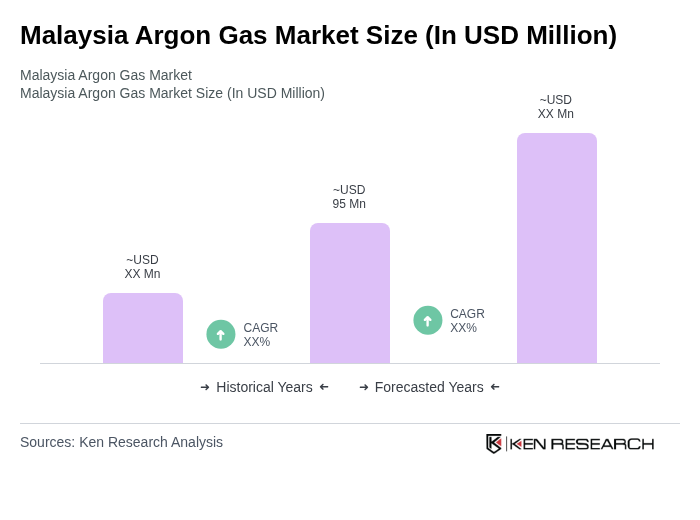
Malaysia argon gas market, worth USD 95 million, grows with industrial applications in metal fabrication, electronics, and healthcare amid manufacturing expansion.

Region:Asia

Author(s):Rebecca

Product Code:KRAB1996

Pages:85

Published On:January 2026
About the Report

Base Year 2024

Malaysia Argon Gas Market Overview

  • The Malaysia Argon Gas Market is valued at USD 95 million, based on a five-year historical analysis and its share within the Malaysia industrial gases market, which generated about USD 630 million in revenue for industrial gases overall. This growth is primarily driven by the increasing demand for argon in various industrial applications, particularly in welding and metal fabrication, electronics and semiconductor manufacturing, and healthcare and laboratory usage, in line with broader industrial gas consumption trends in Malaysia and Asia Pacific. The expansion of manufacturing sectors, especially electronics, automotive, metalworking, and chemical processing, along with investments in advanced air separation and bulk gas supply systems, has further fueled market growth.
  • Key cities such as Kuala Lumpur, Penang, and Johor Bahru dominate the market due to their robust industrial bases, including electronics clusters, petrochemical and refining complexes, and metal fabrication hubs. These regions benefit from well-established infrastructure, deep-water ports (Port Klang, Penang Port, Johor’s Pasir Gudang and Tanjung Pelepas), and road logistics networks that facilitate efficient bulk, cylinder, and on-site distribution of industrial gases, including argon, to a wide range of end users.
  • The safe handling, storage, and use of industrial gases, including argon, in Malaysia are governed by binding safety and occupational health legislation such as the Factories and Machinery (Safety, Health and Welfare) Regulations 1970 issued under the Factories and Machinery Act 1967 by the Department of Occupational Safety and Health (DOSH), which requires employers to ensure safe systems of work, proper ventilation, and control of hazardous atmospheres when using compressed gases. In parallel, gas suppliers and users typically comply with Malaysian Standards such as MS 2675 for industrial gas safety and adopt international best practices and standards (for example, ISO-based gas quality and cylinder handling norms) to strengthen safety management, emergency response, and operational efficiency across the argon gas value chain.
Malaysia Argon Gas Market Size

Malaysia Argon Gas Market Segmentation

By Product Form:The argon gas market can be segmented into two primary product forms: gaseous argon and liquid argon. Gaseous argon is widely used in various applications, especially welding, metal fabrication, and general industrial shielding, due to its ease of handling in cylinders and pipeline distribution. Liquid argon is preferred for applications requiring high purity and larger continuous volumes, such as electronics, steelmaking, and bulk supply to industrial clusters, where cryogenic storage and vaporization systems are installed. Gaseous argon currently accounts for the larger share of usage because of its versatility across small and medium manufacturing users and lower logistics barriers for cylinder and packaged gas distribution.
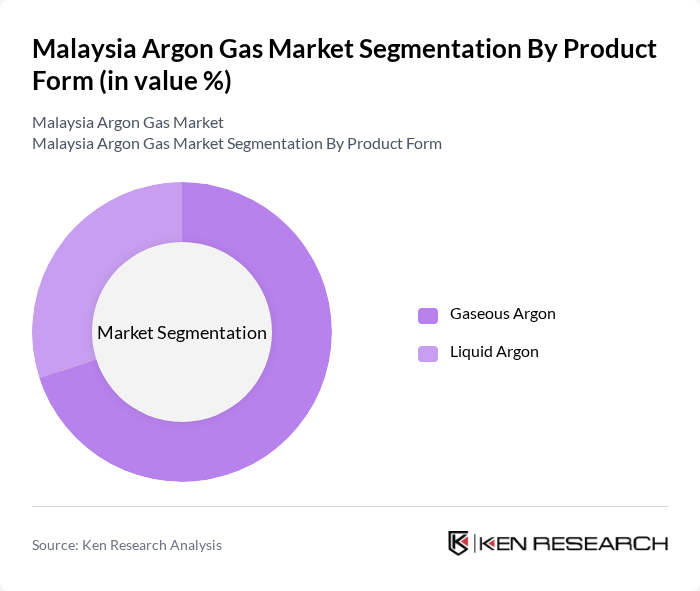
Malaysia Argon Gas Market segmentation by Product Form.

By Grade / Purity Level:The market can be categorized based on the grade or purity level of argon, including industrial grade argon, high purity argon (4N, 5N), ultra high purity argon (6N and above), specialty argon mixtures, and others. Industrial grade argon is predominantly used in welding, cutting, and general metal fabrication where extremely low impurity levels are not critical. High purity argon is essential for electronics, semiconductor manufacturing, and certain laboratory and pharmaceutical applications that require controlled atmospheres with very low contamination. The high purity and ultra-high purity segments are gaining traction, supported by the growth of electronics, semiconductor packaging, and precision engineering in Malaysia and the wider Asia Pacific region, as well as more stringent process control requirements in these industries.
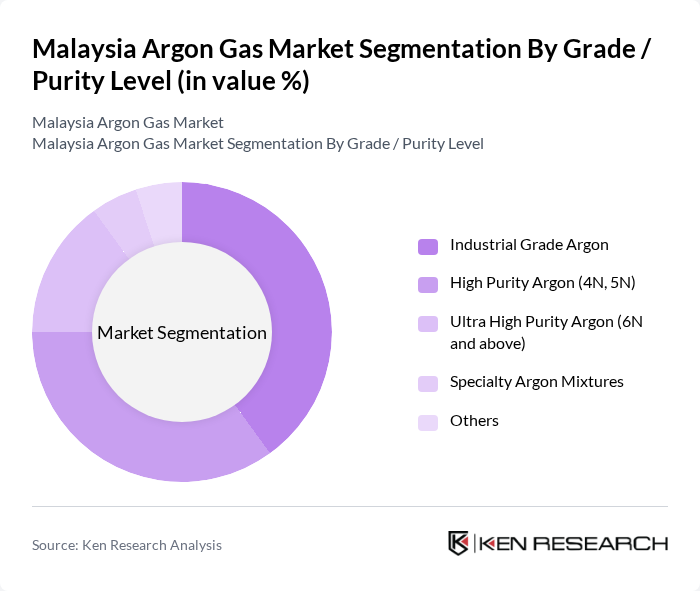
Malaysia Argon Gas Market segmentation by Grade / Purity Level.

Malaysia Argon Gas Market Competitive Landscape

The Malaysia Argon Gas Market is characterized by a dynamic mix of regional and international players. Leading participants such as Linde Malaysia Sdn Bhd, Air Products Malaysia Sdn Bhd, Southern Industrial Gas Sdn Bhd, Air Liquide Malaysia Sdn Bhd, KBS Industrial Gases Sdn Bhd, Iwatani Malaysia Sdn Bhd, Ace Gases Marketing Sdn Bhd, B.I.G. Industrial Gas Sdn Bhd, Universal Industrial Gases, Inc., Gulf Cryo, Messer Group GmbH, Taiyo Nippon Sanso Corporation, Inox Air Products Ltd., Airgas, Inc., and other emerging regional players contribute to innovation, geographic expansion, and service delivery in this space, aligning with the broader industrial gases competitive landscape in Asia Pacific.

Linde Malaysia Sdn Bhd

1960

Kuala Lumpur, Malaysia

Air Products Malaysia Sdn Bhd

1974

Petaling Jaya, Malaysia

Southern Industrial Gas Sdn Bhd

1995

Johor Bahru, Malaysia

Air Liquide Malaysia Sdn Bhd

1925

Kuala Lumpur, Malaysia

KBS Industrial Gases Sdn Bhd

2004

Selangor, Malaysia

Company

Establishment Year

Headquarters

Group Size (Large, Medium, or Small as per industry convention)

Malaysia Argon Revenue (USD Million)

Argon Revenue CAGR (3–5 Years)

Argon Volume Sold (Tonnes per Year)

Market Share in Malaysia Argon Gas (%)

EBITDA Margin from Argon Business (%)

Malaysia Argon Gas Market Industry Analysis

Growth Drivers

  • Increasing Demand from Industrial Applications:The industrial sector in Malaysia is projected to consume approximately 30,000 tons of argon gas in future, driven by its use in metal fabrication and manufacturing processes. The Malaysian Industrial Development Authority (MIDA) reported a positive annual growth trend in manufacturing output, indicating a robust demand for argon in welding and cutting applications. This trend is expected to continue as industries seek to enhance productivity and efficiency through advanced gas technologies.
  • Expansion of the Electronics Sector:Malaysia's electronics sector, contributing around 25% to the country's GDP, is anticipated to require over 15,000 tons of argon gas in future. The growth of semiconductor manufacturing and assembly operations, particularly in Penang and Selangor, is a significant driver. The Malaysian Investment Development Authority (MIDA) has reported a continued inflow of foreign direct investment in electronics, further boosting argon demand for processes like sputtering and plasma etching.
  • Rising Adoption in Healthcare and Medical Applications:The healthcare sector's demand for argon gas is projected to reach 5,000 tons in future, primarily for applications in cryotherapy and laser surgeries. The Ministry of Health Malaysia has emphasized the importance of advanced medical technologies, leading to increased investments in healthcare facilities. This trend is supported by a growth in healthcare expenditure, which is expected to drive further adoption of argon in medical applications.

Market Challenges

  • High Production Costs:The production cost of argon gas in Malaysia is estimated at RM 2,500 per ton, significantly impacting profitability for manufacturers. Factors such as energy prices, which have risen by 15% in the past year, contribute to these high costs. Additionally, the reliance on imported raw materials for gas production exacerbates the financial burden, making it challenging for local producers to compete with international suppliers.
  • Limited Awareness Among Potential Users:Despite the benefits of argon gas, many potential users in Malaysia remain unaware of its applications and advantages. A recent industry survey indicated that 40% of small and medium enterprises (SMEs) in manufacturing do not utilize argon due to a lack of knowledge. This gap in awareness hinders market growth, as businesses may opt for more familiar alternatives, limiting the overall adoption of argon gas in various sectors.

Malaysia Argon Gas Market Future Outlook

The future of the argon gas market in Malaysia appears promising, driven by technological advancements and increasing industrial applications. As the country focuses on sustainable practices, the adoption of argon in renewable energy sectors, such as solar panel manufacturing, is expected to rise. Additionally, the expansion of the electronics and automotive industries will further enhance demand. With government support for clean technology, the market is poised for growth, fostering innovation and new applications across various sectors.

Market Opportunities

  • Growth in Renewable Energy Sector:The renewable energy sector in Malaysia is projected to grow by 20% annually, creating significant opportunities for argon gas in solar panel production. As the government aims for 20% of energy generation from renewable sources in future, argon’s role in manufacturing processes will become increasingly vital, enhancing market potential.
  • Technological Advancements in Gas Production:Innovations in gas production technologies, such as cryogenic distillation, are expected to reduce production costs by 10% in future. These advancements will enable manufacturers to offer competitive pricing, expanding the market for argon gas. As efficiency improves, more industries will likely adopt argon, driving overall market growth.

Scope of the Report

SegmentSub-Segments
By Product Form

Gaseous Argon

Liquid Argon

By Grade / Purity Level

Industrial Grade Argon

High Purity Argon (4N, 5N)

Ultra High Purity Argon (6N and above)

Specialty Argon Mixtures

Others

By Application

Welding and Metal Fabrication

Inerting and Shielding

Electronics and Semiconductor Manufacturing

Healthcare and Medical Applications

Lighting, Glass and Other Industrial Uses

By End-User Industry

Manufacturing and Metal Fabrication

Electronics and Semiconductors

Healthcare and Pharmaceuticals

Chemicals and Petrochemicals

Food and Beverage Processing

Others

By Distribution Mode

On-site Supply

Bulk / Merchant Liquid

Cylinder Gas

By Region

Central Region

Northern Region

Southern Region

Eastern Region

Key Target Audience

Investors and Venture Capitalist Firms

Government and Regulatory Bodies (e.g., Ministry of International Trade and Industry, Department of Environment)

Manufacturers and Producers of Argon Gas

Industrial Gas Distributors

Welding and Fabrication Companies

Healthcare and Medical Gas Suppliers

Energy Sector Companies

Environmental and Safety Compliance Organizations

Players Mentioned in the Report:

Linde Malaysia Sdn Bhd

Air Products Malaysia Sdn Bhd

Southern Industrial Gas Sdn Bhd

Air Liquide Malaysia Sdn Bhd

KBS Industrial Gases Sdn Bhd

Iwatani Malaysia Sdn Bhd

Ace Gases Marketing Sdn Bhd

B.I.G. Industrial Gas Sdn Bhd

Universal Industrial Gases, Inc.

Gulf Cryo

Messer Group GmbH

Taiyo Nippon Sanso Corporation

Inox Air Products Ltd.

Airgas, Inc.

Other Emerging Regional Players

Table of Contents

Market Assessment Phase

1. Executive Summary and Approach


2. Malaysia Argon Gas Market Overview

2.1 Key Insights and Strategic Recommendations

2.2 Malaysia Argon Gas Market Overview

2.3 Definition and Scope

2.4 Evolution of Market Ecosystem

2.5 Timeline of Key Regulatory Milestones

2.6 Value Chain & Stakeholder Mapping

2.7 Business Cycle Analysis

2.8 Policy & Incentive Landscape


3. Malaysia Argon Gas Market Analysis

3.1 Growth Drivers

3.1.1 Increasing Demand from Industrial Applications
3.1.2 Expansion of the Electronics Sector
3.1.3 Rising Adoption in Healthcare and Medical Applications
3.1.4 Government Initiatives Supporting Gas Production

3.2 Market Challenges

3.2.1 High Production Costs
3.2.2 Limited Awareness Among Potential Users
3.2.3 Regulatory Compliance Issues
3.2.4 Competition from Alternative Gases

3.3 Market Opportunities

3.3.1 Growth in Renewable Energy Sector
3.3.2 Technological Advancements in Gas Production
3.3.3 Export Potential to Neighboring Countries
3.3.4 Development of New Applications in Various Industries

3.4 Market Trends

3.4.1 Increasing Use of Argon in Welding Processes
3.4.2 Shift Towards Sustainable Production Practices
3.4.3 Rising Demand for Specialty Gases
3.4.4 Growth of the Automotive Sector Utilizing Argon

3.5 Government Regulation

3.5.1 Environmental Protection Regulations
3.5.2 Safety Standards for Gas Handling
3.5.3 Import and Export Regulations
3.5.4 Incentives for Clean Technology Adoption

4. SWOT Analysis


5. Stakeholder Analysis


6. Porter's Five Forces Analysis


7. Malaysia Argon Gas Market Market Size, 2019-2024

7.1 By Value

7.2 By Volume

7.3 By Average Selling Price


8. Malaysia Argon Gas Market Segmentation

8.1 By Product Form

8.1.1 Gaseous Argon
8.1.2 Liquid Argon

8.2 By Grade / Purity Level

8.2.1 Industrial Grade Argon
8.2.2 High Purity Argon (4N, 5N)
8.2.3 Ultra High Purity Argon (6N and above)
8.2.4 Specialty Argon Mixtures
8.2.5 Others

8.3 By Application

8.3.1 Welding and Metal Fabrication
8.3.2 Inerting and Shielding
8.3.3 Electronics and Semiconductor Manufacturing
8.3.4 Healthcare and Medical Applications
8.3.5 Lighting, Glass and Other Industrial Uses

8.4 By End-User Industry

8.4.1 Manufacturing and Metal Fabrication
8.4.2 Electronics and Semiconductors
8.4.3 Healthcare and Pharmaceuticals
8.4.4 Chemicals and Petrochemicals
8.4.5 Food and Beverage Processing
8.4.6 Others

8.5 By Distribution Mode

8.5.1 On-site Supply
8.5.2 Bulk / Merchant Liquid
8.5.3 Cylinder Gas

8.6 By Region

8.6.1 Central Region
8.6.2 Northern Region
8.6.3 Southern Region
8.6.4 Eastern Region

9. Malaysia Argon Gas Market Competitive Analysis

9.1 Market Share of Key Players

9.2 Cross Comparison of Key Players

9.2.1 Company Name
9.2.2 Group Size (Large, Medium, or Small as per industry convention)
9.2.3 Malaysia Argon Revenue (USD Million)
9.2.4 Argon Revenue CAGR (3–5 Years)
9.2.5 Argon Volume Sold (Tonnes per Year)
9.2.6 Market Share in Malaysia Argon Gas (%)
9.2.7 EBITDA Margin from Argon Business (%)
9.2.8 Capacity Utilization Rate (%)
9.2.9 On?site vs Merchant / Cylinder Sales Mix (%)
9.2.10 Average Selling Price per m³ / tonne
9.2.11 R&D / Capex Intensity (% of Revenue)
9.2.12 Customer Concentration (Top?5 Share %)
9.2.13 Contract Tenure Profile (Average Years)

9.3 SWOT Analysis of Top Players

9.4 Pricing Analysis

9.5 Detailed Profile of Major Companies

9.5.1 Linde Malaysia Sdn Bhd
9.5.2 Air Products Malaysia Sdn Bhd
9.5.3 Southern Industrial Gas Sdn Bhd
9.5.4 Air Liquide Malaysia Sdn Bhd
9.5.5 KBS Industrial Gases Sdn Bhd
9.5.6 Iwatani Malaysia Sdn Bhd
9.5.7 Ace Gases Marketing Sdn Bhd
9.5.8 B.I.G. Industrial Gas Sdn Bhd
9.5.9 Universal Industrial Gases, Inc.
9.5.10 Gulf Cryo
9.5.11 Messer Group GmbH
9.5.12 Taiyo Nippon Sanso Corporation
9.5.13 Inox Air Products Ltd.
9.5.14 Airgas, Inc.
9.5.15 Other Emerging Regional Players

10. Malaysia Argon Gas Market End-User Analysis

10.1 Procurement Behavior of Key Ministries

10.1.1 Ministry of Energy and Natural Resources
10.1.2 Ministry of Health
10.1.3 Ministry of International Trade and Industry
10.1.4 Ministry of Agriculture and Food Security

10.2 Corporate Spend on Infrastructure & Energy

10.2.1 Investment in Industrial Facilities
10.2.2 Expenditure on Healthcare Infrastructure
10.2.3 Spending on Electronics Manufacturing
10.2.4 Budget for Food Processing Facilities

10.3 Pain Point Analysis by End-User Category

10.3.1 Industrial Users
10.3.2 Healthcare Providers
10.3.3 Electronics Manufacturers
10.3.4 Food and Beverage Companies

10.4 User Readiness for Adoption

10.4.1 Awareness of Argon Benefits
10.4.2 Availability of Infrastructure
10.4.3 Training and Support Needs
10.4.4 Financial Readiness

10.5 Post-Deployment ROI and Use Case Expansion

10.5.1 Measurement of Cost Savings
10.5.2 Evaluation of Performance Improvements
10.5.3 Identification of New Applications
10.5.4 Long-term Sustainability Assessment

11. Malaysia Argon Gas Market Future Size, 2025-2030

11.1 By Value

11.2 By Volume

11.3 By Average Selling Price


Go-To-Market Strategy Phase

1. Whitespace Analysis + Business Model Canvas

1.1 Market Gaps Identification

1.2 Business Model Development


2. Marketing and Positioning Recommendations

2.1 Branding Strategies

2.2 Product USPs


3. Distribution Plan

3.1 Urban Retail Strategies

3.2 Rural NGO Tie-ups


4. Channel & Pricing Gaps

4.1 Underserved Routes

4.2 Pricing Bands


5. Unmet Demand & Latent Needs

5.1 Category Gaps

5.2 Consumer Segments


6. Customer Relationship

6.1 Loyalty Programs

6.2 After-sales Service


7. Value Proposition

7.1 Sustainability Initiatives

7.2 Integrated Supply Chains


8. Key Activities

8.1 Regulatory Compliance

8.2 Branding Efforts

8.3 Distribution Setup


9. Entry Strategy Evaluation

9.1 Domestic Market Entry Strategy

9.1.1 Product Mix
9.1.2 Pricing Band
9.1.3 Packaging

9.2 Export Entry Strategy

9.2.1 Target Countries
9.2.2 Compliance Roadmap

10. Entry Mode Assessment

10.1 Joint Ventures

10.2 Greenfield Investments

10.3 Mergers & Acquisitions

10.4 Distributor Model


11. Capital and Timeline Estimation

11.1 Capital Requirements

11.2 Timelines


12. Control vs Risk Trade-Off

12.1 Ownership vs Partnerships


13. Profitability Outlook

13.1 Breakeven Analysis

13.2 Long-term Sustainability


14. Potential Partner List

14.1 Distributors

14.2 Joint Ventures

14.3 Acquisition Targets


15. Execution Roadmap

15.1 Phased Plan for Market Entry

15.1.1 Market Setup
15.1.2 Market Entry
15.1.3 Growth Acceleration
15.1.4 Scale & Stabilize

15.2 Key Activities and Milestones

15.2.1 Activity Planning
15.2.2 Milestone Tracking

Research Methodology

ApproachModellingSample

Phase 1: Approach1

Desk Research

  • Analysis of industry reports from Malaysian government agencies and trade associations
  • Review of academic journals and publications focusing on argon gas applications and market trends
  • Examination of import/export data and trade statistics from the Department of Statistics Malaysia

Primary Research

  • Interviews with key stakeholders in the argon gas supply chain, including manufacturers and distributors
  • Surveys targeting end-users in industries such as welding, electronics, and healthcare
  • Field visits to production facilities and industrial sites utilizing argon gas

Validation & Triangulation

  • Cross-validation of findings through multiple data sources, including market reports and expert opinions
  • Triangulation of quantitative data with qualitative insights from industry experts
  • Sanity checks through feedback from a panel of industry veterans and market analysts

Phase 2: Market Size Estimation1

Top-down Assessment

  • Estimation of the total addressable market based on national gas consumption statistics
  • Segmentation of the market by application areas such as industrial, medical, and research
  • Incorporation of growth rates from related sectors, including manufacturing and healthcare

Bottom-up Modeling

  • Collection of sales data from leading argon gas suppliers in Malaysia
  • Estimation of average pricing per cubic meter of argon gas across different applications
  • Volume calculations based on production capacities and consumption patterns in key industries

Forecasting & Scenario Analysis

  • Development of forecasts using historical data trends and projected growth rates
  • Scenario analysis based on potential regulatory changes and technological advancements
  • Creation of multiple market scenarios (baseline, optimistic, and pessimistic) through 2030

Phase 3: CATI Sample Composition1

Scope Item/SegmentSample SizeTarget Respondent Profiles
Industrial Gas Suppliers60Sales Managers, Business Development Executives
Welding and Fabrication Companies60Operations Managers, Procurement Specialists
Healthcare Facilities Utilizing Argon40Facility Managers, Medical Equipment Technicians
Research Institutions and Laboratories40Lab Managers, Research Scientists
Electronics Manufacturing Firms50Production Supervisors, Quality Control Managers

Frequently Asked Questions

What is the current value of the Malaysia Argon Gas Market?

The Malaysia Argon Gas Market is valued at approximately USD 95 million, contributing to the overall industrial gases market in Malaysia, which generates around USD 630 million in revenue. This growth is driven by increasing demand across various industrial applications.

What are the primary applications of argon gas in Malaysia?

Which regions in Malaysia dominate the argon gas market?

What are the safety regulations governing argon gas usage in Malaysia?

Why Buy From Us?

Refine Robust Result (RRR) Framework

What makes us stand out is that our consultants follow Robust, Refine and Result (RRR) methodology. Robust for clear definitions, approaches and sanity checking, Refine for differentiating respondents' facts and opinions, and Result for presenting data with story.

Our Reach Is Unmatched

We have set a benchmark in the industry by offering our clients with syndicated and customized market research reports featuring coverage of entire market as well as meticulous research and analyst insights.

Shifting the Research Paradigm

While we don't replace traditional research, we flip the method upside down. Our dual approach of Top Bottom & Bottom Top ensures quality deliverable by not just verifying company fundamentals but also looking at the sector and macroeconomic factors.

More Insights-Better Decisions

With one step in the future, our research team constantly tries to show you the bigger picture. We help with some of the tough questions you may encounter along the way: How is the industry positioned? Best marketing channel? KPI's of competitors? By aligning every element, we help maximize success.

Transparency and Trust

Our report gives you instant access to the answers and sources that other companies might choose to hide. We elaborate each steps of research methodology we have used and showcase you the sample size to earn your trust.

Round the Clock Support

If you need any support, we are here! We pride ourselves on universe strength, data quality, and quick, friendly, and professional service.

Why Clients Choose Us?

400000+
Reports in repository
150+
Consulting projects a year
100+
Analysts
8000+
Client Queries in 2022








