About the Report
Base Year 2024Malaysia Critical Illness Insurance Market Overview
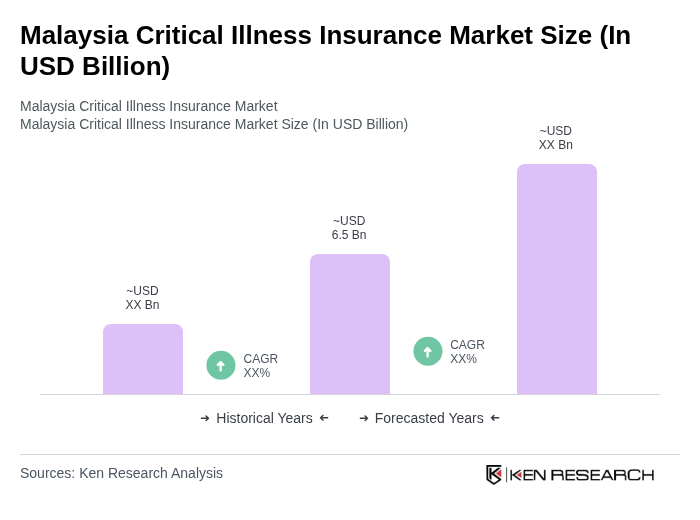
- The Malaysia Critical Illness Insurance Market is valued at USD 6.5 billion, based on current market analysis. This growth is primarily driven by increasing healthcare costs, rising awareness of critical illnesses, and a growing middle-class population seeking financial protection against health-related risks.
- Key cities such as Kuala Lumpur, Penang, and Johor Bahru dominate the market due to their high population density, economic activity, and access to healthcare facilities. These urban centers have a higher concentration of individuals seeking insurance products, contributing to the overall market growth.
- The Malaysian regulatory framework supports critical illness insurance adoption through government-led health inclusion initiatives and tax benefits on health premiums that foster policy adoption. These measures aim to enhance the financial protection of individuals against critical illnesses and improve the overall healthcare system in the country.
Malaysia Critical Illness Insurance Market Segmentation
By Policy Type:
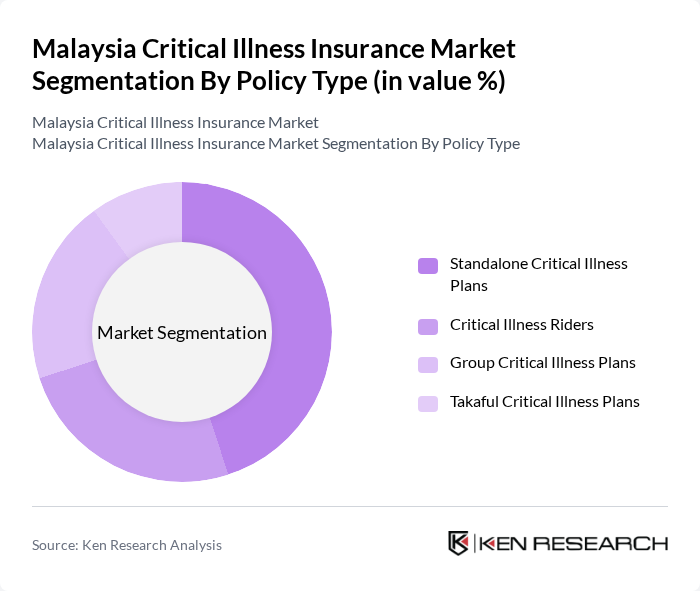
The policy type segmentation includes Standalone Critical Illness Plans, Critical Illness Riders, Group Critical Illness Plans, and Takaful Critical Illness Plans. Among these, Standalone Critical Illness Plans are currently dominating the market due to their comprehensive coverage and flexibility, allowing policyholders to tailor their insurance according to specific health risks. The increasing prevalence of critical illnesses such as cancer and heart diseases has led consumers to prefer standalone plans that offer higher coverage amounts and benefits. This trend is further supported by rising health awareness and the need for financial security in the face of serious health challenges. Additionally, employers across Malaysia are increasingly including critical illness coverage in corporate benefit programs to attract and retain employees, with group insurance plans offering lower premiums and broader coverage options.
By Coverage Stages:
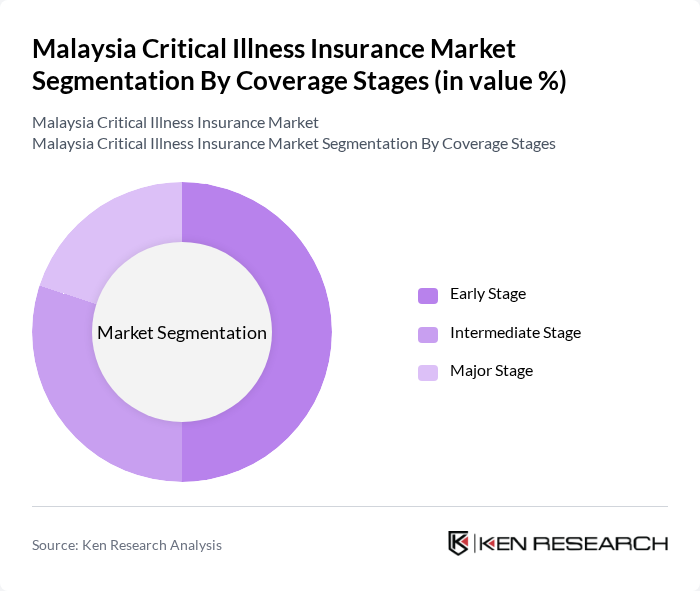
The coverage stages segmentation includes Early Stage, Intermediate Stage, and Major Stage. The Early Stage coverage is currently leading the market, as it provides policyholders with essential financial support during the initial diagnosis of critical illnesses. This segment appeals to consumers who prefer to manage their healthcare costs proactively. The increasing awareness of early detection and treatment options has further fueled the demand for early-stage coverage, making it a preferred choice among policyholders seeking to mitigate financial risks associated with critical health conditions.
Malaysia Critical Illness Insurance Market Competitive Landscape
The Malaysia Critical Illness Insurance Market is characterized by a dynamic mix of regional and international players. Leading participants such as AIA Malaysia, Prudential Assurance Malaysia, Great Eastern Life Assurance, Allianz Malaysia, Tokio Marine Life Insurance Malaysia, Zurich Insurance Malaysia, Hong Leong Assurance, AmMetLife Insurance, Etiqa Insurance, MSIG Insurance, Takaful Malaysia, RHB Insurance, Kurnia Insurans, FWD Insurance, Manulife Insurance contribute to innovation, geographic expansion, and service delivery in this space. Digital transformation is accelerating across the sector, with insurers integrating AI-based underwriting, data analytics, and mobile banking platforms to improve claim processing, risk assessment accuracy, and premium payment convenience.
Malaysia Critical Illness Insurance Market Industry Analysis
Growth Drivers
- Increasing Prevalence of Critical Illnesses:The rise in critical illnesses such as cancer, heart disease, and diabetes is a significant driver for the critical illness insurance market in Malaysia. According to the Ministry of Health Malaysia, approximately 40% of deaths in the recent past were due to non-communicable diseases. This alarming statistic underscores the urgent need for financial protection against such illnesses, prompting more individuals to seek critical illness insurance policies to safeguard their health and finances.
- Rising Healthcare Costs:The escalating costs of healthcare services in Malaysia are a major concern for consumers. The World Bank reported that healthcare expenditure per capita reached RM 4,500, reflecting a 12.5% increase from the previous period. This surge in costs drives individuals to invest in critical illness insurance as a means to mitigate potential financial burdens associated with medical treatments, thereby enhancing market growth prospects.
- Growing Awareness of Health Insurance:There is a notable increase in public awareness regarding the importance of health insurance in Malaysia. A survey by the Insurance Services Malaysia indicated that 70% of respondents recognized the necessity of health insurance, up from 50%. This growing awareness is fostering a more informed consumer base, leading to higher demand for critical illness insurance products as individuals seek to protect themselves and their families from unforeseen health issues.
Market Challenges
- Low Penetration Rates of Insurance Products:Despite the growing awareness, Malaysia's insurance penetration rate remains low, at approximately 5.0% of GDP, according to Bank Negara Malaysia. This low penetration indicates that a significant portion of the population remains uninsured or underinsured, presenting a challenge for insurers to expand their market reach and effectively promote critical illness insurance products to a broader audience.
- High Competition Among Insurers:The Malaysian critical illness insurance market is characterized by intense competition, with over 35 insurance providers vying for market share. This competitive landscape has led to aggressive pricing strategies and product offerings, which can dilute profit margins. According to industry reports, the average premium growth rate for critical illness insurance was only 4% in the recent past, indicating that insurers must innovate to differentiate their products and attract customers.
Malaysia Critical Illness Insurance Market Future Outlook
The future of the critical illness insurance market in Malaysia appears promising, driven by technological advancements and evolving consumer preferences. The integration of digital platforms for insurance purchasing and claims processing is expected to enhance customer experience significantly in future. Additionally, as the population ages and healthcare needs increase, insurers will likely focus on developing tailored products that address specific health concerns, ensuring that coverage remains relevant and accessible to a diverse demographic.
Market Opportunities
- Expansion of Digital Insurance Platforms:The rise of digital insurance platforms presents a significant opportunity for growth. In future, online insurance sales in Malaysia are expected to increase by 30%, indicating a shift towards digital solutions. Insurers can leverage this trend to streamline processes, enhance customer engagement, and reach tech-savvy consumers more effectively.
- Customization of Insurance Products:There is a growing demand for personalized insurance solutions tailored to individual health needs. A report from the Malaysian Insurance Institute noted that 75% of consumers prefer customizable policies. Insurers can capitalize on this trend by offering flexible coverage options that cater to specific health conditions, thereby attracting a broader customer base and increasing policy uptake.
Scope of the Report
| Segment | Sub-Segments |
|---|---|
| By Policy Type | Standalone Critical Illness Plans Critical Illness Riders Group Critical Illness Plans Takaful Critical Illness Plans |
| By Coverage Stages | Early Stage Intermediate Stage Major Stage |
| By Illness Category | Cancer Heart-related Stroke Organ Failure Others |
| By Distribution Channel | Agents/Brokers Bancassurance Digital/Online Platforms Direct Sales |
| By Gender | Male-specific Plans Female-specific Plans Unisex Plans |
Key Target Audience
Investors and Venture Capitalist Firms
Government and Regulatory Bodies (e.g., Bank Negara Malaysia, Ministry of Finance)
Insurance Companies
Healthcare Providers
Insurance Brokers and Agents
Financial Advisors
Industry Associations (e.g., Life Insurance Association of Malaysia)
Technology Providers for Insurance Solutions
Players Mentioned in the Report:
AIA Malaysia
Prudential Assurance Malaysia
Great Eastern Life Assurance
Allianz Malaysia
Tokio Marine Life Insurance Malaysia
Zurich Insurance Malaysia
Hong Leong Assurance
AmMetLife Insurance
Etiqa Insurance
MSIG Insurance
Takaful Malaysia
RHB Insurance
Kurnia Insurans
FWD Insurance
Manulife Insurance
Table of Contents
Market Assessment Phase
1. Executive Summary and Approach
2. Malaysia Critical Illness Insurance Market Overview
2.1 Key Insights and Strategic Recommendations
2.2 Malaysia Critical Illness Insurance Market Overview
2.3 Definition and Scope
2.4 Evolution of Market Ecosystem
2.5 Timeline of Key Regulatory Milestones
2.6 Value Chain & Stakeholder Mapping
2.7 Business Cycle Analysis
2.8 Policy & Incentive Landscape
3. Malaysia Critical Illness Insurance Market Analysis
3.1 Growth Drivers
3.1.1 Increasing prevalence of critical illnesses
3.1.2 Rising healthcare costs
3.1.3 Growing awareness of health insurance
3.1.4 Government initiatives promoting health insurance
3.2 Market Challenges
3.2.1 Low penetration rates of insurance products
3.2.2 High competition among insurers
3.2.3 Regulatory hurdles
3.2.4 Consumer skepticism towards insurance products
3.3 Market Opportunities
3.3.1 Expansion of digital insurance platforms
3.3.2 Customization of insurance products
3.3.3 Partnerships with healthcare providers
3.3.4 Increasing demand for family health coverage
3.4 Market Trends
3.4.1 Shift towards telemedicine and virtual consultations
3.4.2 Integration of AI in underwriting processes
3.4.3 Rise of wellness programs linked to insurance
3.4.4 Focus on preventive healthcare measures
3.5 Government Regulation
3.5.1 Mandatory health insurance for certain demographics
3.5.2 Regulatory frameworks for product offerings
3.5.3 Consumer protection laws in insurance
3.5.4 Tax incentives for health insurance policies
4. SWOT Analysis
5. Stakeholder Analysis
6. Porter's Five Forces Analysis
7. Malaysia Critical Illness Insurance Market Market Size, 2019-2024
7.1 By Value
7.2 By Volume
7.3 By Average Selling Price
8. Malaysia Critical Illness Insurance Market Segmentation
8.1 By Policy Type
8.1.1 Standalone Critical Illness Plans
8.1.2 Critical Illness Riders
8.1.3 Group Critical Illness Plans
8.1.4 Takaful Critical Illness Plans
8.2 By Coverage Stages
8.2.1 Early Stage
8.2.2 Intermediate Stage
8.2.3 Major Stage
8.3 By Illness Category
8.3.1 Cancer
8.3.2 Heart-related
8.3.3 Stroke
8.3.4 Organ Failure
8.3.5 Others
8.4 By Distribution Channel
8.4.1 Agents/Brokers
8.4.2 Bancassurance
8.4.3 Digital/Online Platforms
8.4.4 Direct Sales
8.5 By Gender
8.5.1 Male-specific Plans
8.5.2 Female-specific Plans
8.5.3 Unisex Plans
9. Malaysia Critical Illness Insurance Market Competitive Analysis
9.1 Market Share of Key Players
9.2 Cross Comparison of Key Players
9.2.1 Company Name
9.2.2 Gross Written Premium (GWP)
9.2.3 New Business Premium (NBP) Growth
9.2.4 Claims Settlement Ratio (%)
9.2.5 Policy Renewal Rate (%)
9.2.6 Customer Acquisition Cost (CAC)
9.2.7 Market Share (%)
9.2.8 Combined Ratio (%)
9.2.9 Digital Penetration (% of Sales)
9.2.10 Return on Equity (ROE %)
9.3 SWOT Analysis of Top Players
9.4 Pricing Analysis
9.5 Detailed Profile of Major Companies
9.5.1 AIA Malaysia
9.5.2 Prudential Assurance Malaysia
9.5.3 Great Eastern Life Assurance
9.5.4 Allianz Malaysia
9.5.5 Tokio Marine Life Insurance Malaysia
9.5.6 Zurich Insurance Malaysia
9.5.7 Hong Leong Assurance
9.5.8 AmMetLife Insurance
9.5.9 Etiqa Insurance
9.5.10 MSIG Insurance
9.5.11 Takaful Malaysia
9.5.12 RHB Insurance
9.5.13 Kurnia Insurans
9.5.14 FWD Insurance
9.5.15 Manulife Insurance
10. Malaysia Critical Illness Insurance Market End-User Analysis
10.1 Procurement Behavior of Key Ministries
10.1.1 Health Ministry
10.1.2 Finance Ministry
10.1.3 Education Ministry
10.1.4 Others
10.2 Corporate Spend on Infrastructure & Energy
10.2.1 Corporate Health Initiatives
10.2.2 Employee Benefits Programs
10.2.3 Others
10.3 Pain Point Analysis by End-User Category
10.3.1 Individual Consumers
10.3.2 Corporates
10.3.3 Government Entities
10.3.4 Others
10.4 User Readiness for Adoption
10.4.1 Awareness Levels
10.4.2 Financial Literacy
10.4.3 Others
10.5 Post-Deployment ROI and Use Case Expansion
10.5.1 Customer Retention Rates
10.5.2 Policy Upgrade Rates
10.5.3 Others
11. Malaysia Critical Illness Insurance Market Future Size, 2025-2030
11.1 By Value
11.2 By Volume
11.3 By Average Selling Price
Go-To-Market Strategy Phase
1. Whitespace Analysis + Business Model Canvas
1.1 Market Gaps Identification
1.2 Business Model Framework
2. Marketing and Positioning Recommendations
2.1 Branding Strategies
2.2 Product USPs
3. Distribution Plan
3.1 Urban Retail vs Rural NGO Tie-ups
4. Channel & Pricing Gaps
4.1 Underserved Routes
4.2 Pricing Bands
5. Unmet Demand & Latent Needs
5.1 Category Gaps
5.2 Consumer Segments
6. Customer Relationship
6.1 Loyalty Programs
6.2 After-sales Service
7. Value Proposition
7.1 Sustainability
7.2 Integrated Supply Chains
8. Key Activities
8.1 Regulatory Compliance
8.2 Branding
8.3 Distribution Setup
9. Entry Strategy Evaluation
9.1 Domestic Market Entry Strategy
9.1.1 Product Mix
9.1.2 Pricing Band
9.1.3 Packaging
9.2 Export Entry Strategy
9.2.1 Target Countries
9.2.2 Compliance Roadmap
10. Entry Mode Assessment
10.1 JV
10.2 Greenfield
10.3 M&A
10.4 Distributor Model
11. Capital and Timeline Estimation
11.1 Capital Requirements
11.2 Timelines
12. Control vs Risk Trade-Off
12.1 Ownership vs Partnerships
13. Profitability Outlook
13.1 Breakeven Analysis
13.2 Long-term Sustainability
14. Potential Partner List
14.1 Distributors
14.2 JVs
14.3 Acquisition Targets
15. Execution Roadmap
15.1 Phased Plan for Market Entry
15.1.1 Market Setup
15.1.2 Market Entry
15.1.3 Growth Acceleration
15.1.4 Scale & Stabilize
15.2 Key Activities and Milestones
15.2.1 Activity Timeline
15.2.2 Milestone Tracking
Research Methodology
Phase 1: Approach1
Desk Research
- Analysis of industry reports from regulatory bodies such as Bank Negara Malaysia and the Insurance Regulatory Authority
- Review of published market studies and white papers on critical illness insurance trends in Malaysia
- Examination of demographic and health statistics from the Department of Statistics Malaysia to understand target market segments
Primary Research
- Interviews with insurance product managers from leading Malaysian insurance companies
- Telephonic surveys with financial advisors and insurance agents to gather insights on consumer preferences
- Focus group discussions with policyholders to understand their experiences and expectations regarding critical illness insurance
Validation & Triangulation
- Cross-validation of findings through comparison with global critical illness insurance trends
- Triangulation of data from primary interviews, secondary research, and market statistics
- Sanity check through expert panel reviews consisting of industry veterans and academic professionals
Phase 2: Market Size Estimation1
Top-down Assessment
- Estimation of total market size based on national health expenditure and insurance penetration rates
- Segmentation of the market by age groups, gender, and income levels to identify key consumer demographics
- Incorporation of government health initiatives and their impact on insurance uptake
Bottom-up Modeling
- Analysis of policy sales data from major insurance providers to establish baseline figures
- Estimation of average premium rates and claim ratios to derive revenue potential
- Volume x premium basis for projecting future growth in critical illness insurance policies
Forecasting & Scenario Analysis
- Multi-factor regression analysis incorporating economic indicators, healthcare trends, and demographic shifts
- Scenario modeling based on potential regulatory changes and public health crises
- Baseline, optimistic, and pessimistic projections for market growth through 2030
Phase 3: CATI Sample Composition1
| Scope Item/Segment | Sample Size | Target Respondent Profiles |
|---|---|---|
| Individual Policyholders | 120 | Current policyholders, potential buyers aged 30-50 |
| Insurance Agents | 100 | Insurance agents and financial advisors |
| Healthcare Professionals | 80 | Doctors, hospital administrators, and health consultants |
| Corporate Clients | 70 | HR managers and benefits coordinators from large firms |
| Regulatory Bodies | 40 | Officials from insurance regulatory authorities and health ministries |
Frequently Asked Questions
What is the current value of the Malaysia Critical Illness Insurance Market?
The Malaysia Critical Illness Insurance Market is valued at approximately USD 6.5 billion. This growth is driven by increasing healthcare costs, rising awareness of critical illnesses, and a growing middle-class population seeking financial protection against health-related risks.
Which cities are the main contributors to the Malaysia Critical Illness Insurance Market?
What types of critical illness insurance policies are available in Malaysia?
What are the coverage stages in Malaysia's critical illness insurance?
Other Regional/Country Reports
Other Adjacent Reports
Thailand Group Insurance Market
Germany Medical Insurance Market
South Africa Healthcare Services Market
UAE pharmaceutical market report size, share, growth drivers, trends, opportunities & forecast 2025–2030Asia Pacific Digital Health Market Outlook to 2030: Size, Share, Growth and TrendsBrazil Wellness Products Market
Why Buy From Us?

What makes us stand out is that our consultants follow Robust, Refine and Result (RRR) methodology. Robust for clear definitions, approaches and sanity checking, Refine for differentiating respondents' facts and opinions, and Result for presenting data with story.

We have set a benchmark in the industry by offering our clients with syndicated and customized market research reports featuring coverage of entire market as well as meticulous research and analyst insights.

While we don't replace traditional research, we flip the method upside down. Our dual approach of Top Bottom & Bottom Top ensures quality deliverable by not just verifying company fundamentals but also looking at the sector and macroeconomic factors.

With one step in the future, our research team constantly tries to show you the bigger picture. We help with some of the tough questions you may encounter along the way: How is the industry positioned? Best marketing channel? KPI's of competitors? By aligning every element, we help maximize success.

Our report gives you instant access to the answers and sources that other companies might choose to hide. We elaborate each steps of research methodology we have used and showcase you the sample size to earn your trust.

If you need any support, we are here! We pride ourselves on universe strength, data quality, and quick, friendly, and professional service.