About the Report
Base Year 2024Middle East Legal Cannabis Market Overview
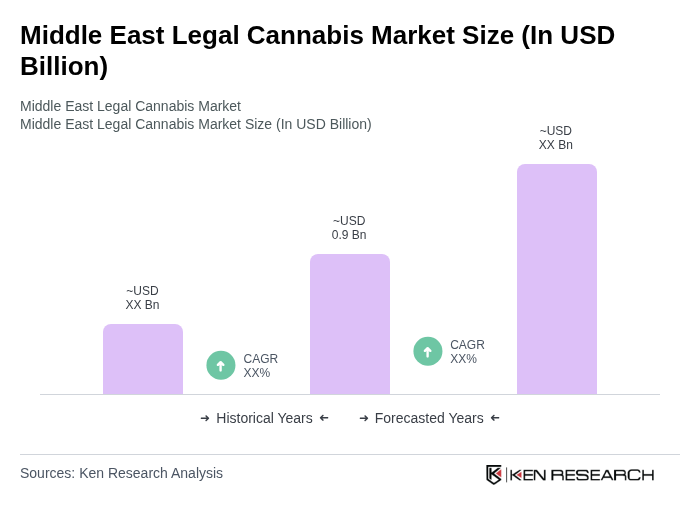
- The Middle East Legal Cannabis Market is valued at USD 0.9 billion, based on a five-year historical analysis. This growth is primarily driven by increasing acceptance of cannabis for medical use, supported by expanding access pathways for cannabis-based pharmaceuticals and medical marijuana products across selected Middle East jurisdictions. The rising demand for cannabis-based products, particularly in medical, pharmaceutical, and wellness-oriented CBD segments, has significantly contributed to the market's expansion.
- Key country-level contributors in this market include Israel, Lebanon, and selected Gulf and North African markets that import or regulate medical cannabis products. Israel is recognized for its advanced medical cannabis research ecosystem, structured patient access program, and established regulatory framework overseen historically by the Israeli Ministry of Health’s Medical Cannabis Unit (IMCA). Lebanon’s legalization of cannabis for medical and industrial purposes has positioned it as a producer of high-quality cannabis for regulated export and domestic value-add processing under a licensing regime. In parallel, Gulf markets such as the United Arab Emirates and Saudi Arabia are emerging as demand centers for tightly controlled, cannabis-derived pharmaceuticals and CBD wellness products distributed through regulated medical and pharmacy channels.
- In the United Arab Emirates, recent federal amendments have focused on clarifying the handling of narcotic and psychotropic substances, including cannabis derivatives, alongside a growing framework for permitting certain hemp-derived and CBD-based products under strict controls for import, formulation, and sale in wellness and cosmetic segments. The Federal Decree-Law No. 30 of 2021 on Combating Narcotics and Psychotropic Substances, issued by the UAE government, governs the control, licensing, and penalties related to narcotic substances, including cannabis, and sets the basis under which medical and wellness products containing controlled cannabinoids can be handled through licensed entities. Within this framework, patient access to cannabis-derived pharmaceuticals is channeled via approved medical prescriptions and authorized importers, while wellness-focused CBD and hemp products are subject to product registration, quality standards, and retail licensing requirements.
Middle East Legal Cannabis Market Segmentation
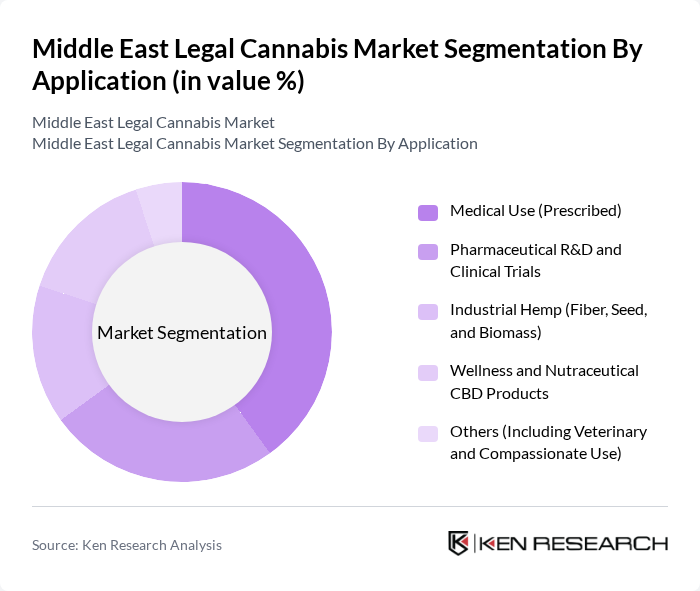
By Application:The application segment of the market includes various uses of cannabis, with medical use (prescribed) being the most significant, reflecting the dominance of regulated medical and pharmaceutical channels across the region. This sub-segment is driven by the increasing recognition of cannabis as a viable treatment option for various medical conditions, including chronic pain, epilepsy, multiple sclerosis, chemotherapy-induced nausea, and certain refractory neurological disorders. Pharmaceutical R&D and clinical trials are also gaining traction as companies and academic centers in Israel and selected Middle East markets invest in developing standardized cannabis-based therapies and drug-delivery formats. Industrial hemp is emerging as a sustainable resource for textiles, construction materials, food ingredients, and biomass feedstocks, particularly in countries that have legalized hemp cultivation for industrial and medical purposes such as Lebanon and parts of North Africa. Wellness and nutraceutical CBD products are becoming popular among health-conscious consumers through pharmacy, e-commerce, and specialty retail, especially where low-THC, hemp-derived CBD is permitted. The "Others" category includes veterinary applications, palliative and compassionate use programs, and institutional research supply, which are also contributing to market growth.
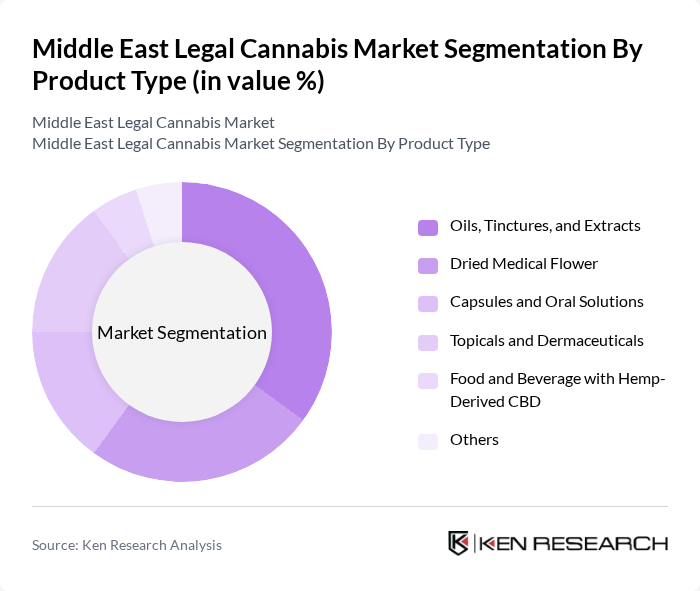
By Product Type:This segment encompasses various cannabis products, with oils, tinctures, and extracts leading the market due to their versatility, dose precision, and use in both medical prescriptions and wellness formulations. Dried medical flowers remain important for established patient programs, particularly in Israel, where inhaled and vaporized flower is widely prescribed under the national medical cannabis scheme. Capsules and oral solutions are gaining traction for their convenience, standardized dosing, and suitability for elderly and chronic-disease patients. Topicals and dermaceuticals are increasingly used for localized pain, inflammatory conditions, and dermatological applications, often formulated with hemp-derived CBD for over-the-counter use. The food and beverage sector is witnessing a rise in hemp-derived CBD products, including functional beverages, snacks, and fortified foods, in markets where such products are permitted and subject to food-safety and product-registration rules. The "Others" category includes various niche products such as transdermal patches, suppositories, and veterinary formulations that cater to specific patient and consumer needs.
Middle East Legal Cannabis Market Competitive Landscape
The Middle East Legal Cannabis Market is characterized by a dynamic mix of regional and international players. Leading participants such as Tikun Olam-Cannbit Pharmaceuticals Ltd. (Israel), Panaxia Labs Israel Ltd. (Israel), InterCure Ltd. (Canndoc) (Israel), BOL Pharma (Breath of Life Pharma) (Israel), IM Cannabis Corp. (Middle East Operations), Seach Medical Group (Israel), CANNDOC-Pharma Partnerships in the Gulf (Including UAE and Bahrain Distribution Partners), Pharm Yarok (Israel), Lebanese Regulated Cannabis Producers (Licensed Under Lebanon’s Medical and Industrial Cannabis Framework), Turkish Medical Cannabis and Industrial Hemp License Holders, UAE-Based CBD and Wellness Brands Operating Under Federal Regulations, Saudi Arabia-Regulated Importers of Medical Cannabis-Derived Pharmaceuticals, Qatar and Egypt Hospital-Linked Import and Distribution Consortia, Global Medical Cannabis Companies with Active Supply Agreements into Israel and the Wider Middle East, Regional Contract Research Organizations (CROs) Specializing in Cannabinoid Clinical Trials contribute to innovation, geographic expansion, and service delivery in this space.
Middle East Legal Cannabis Market Industry Analysis
Growth Drivers
- Increasing Legalization and Acceptance:The Middle East is witnessing a significant shift towards the legalization of cannabis, with countries like Lebanon and the UAE taking steps to regulate its use. In future, Lebanon legalized cannabis cultivation for medical purposes, aiming to generate an estimated $1.5 billion in annual revenue. This trend is supported by a growing acceptance of cannabis in society, with 70% of the population in the UAE favoring its medicinal use, according to a recent survey by the Dubai Health Authority.
- Rising Demand for Medicinal Cannabis Products:The demand for medicinal cannabis products is surging, driven by an increase in chronic health conditions. The World Health Organization reported that over 35% of adults in the Middle East suffer from chronic pain, creating a substantial market for cannabis-based therapies. In future, the medicinal cannabis market in the region is projected to reach $600 million, fueled by the growing acceptance of cannabis as a legitimate treatment option for various ailments.
- Expansion of Cannabis Research and Development:Investment in cannabis research is expanding, with several universities and private firms establishing R&D facilities. In future, the UAE government allocated $60 million to support cannabis research initiatives aimed at exploring its therapeutic benefits. This investment is expected to enhance product development and innovation, leading to a more robust market. The increasing number of clinical trials, currently at 20 ongoing studies, indicates a commitment to understanding cannabis's potential in healthcare.
Market Challenges
- Regulatory Hurdles and Compliance Issues:The legal landscape for cannabis in the Middle East remains complex, with varying regulations across countries. For instance, while Lebanon has legalized medical cannabis, other nations like Saudi Arabia maintain strict prohibitions. This inconsistency creates significant compliance challenges for businesses, as navigating the regulatory framework can incur costs exceeding $250,000 annually for legal consultations and licensing fees, hindering market entry and expansion.
- Stigma Associated with Cannabis Use:Despite increasing acceptance, stigma surrounding cannabis use persists in many Middle Eastern societies. Cultural perceptions often view cannabis negatively, impacting consumer willingness to engage with legal products. A recent study indicated that 50% of respondents in the UAE still associate cannabis with illicit activities. This stigma can deter potential customers and limit market growth, as businesses struggle to educate consumers about the benefits of legal cannabis products.
Middle East Legal Cannabis Market Future Outlook
The future of the Middle East legal cannabis market appears promising, driven by ongoing legislative reforms and increasing consumer awareness. As more countries consider legalization, the market is expected to expand significantly. Additionally, the integration of technology in cultivation and distribution will enhance efficiency and product quality. The rise of e-commerce platforms will facilitate access to cannabis products, catering to a broader audience and fostering a more informed consumer base, ultimately shaping a dynamic market landscape.
Market Opportunities
- Development of Innovative Cannabis Products:There is a growing opportunity for companies to develop innovative cannabis products tailored to local preferences. With the wellness market projected to reach $2 billion in the region by future, businesses can capitalize on this trend by creating unique formulations that cater to health-conscious consumers, enhancing market penetration and brand loyalty.
- Investment in Cannabis Tourism:The potential for cannabis tourism is significant, particularly in countries like Israel and Lebanon, where cannabis is becoming more accepted. In future, cannabis tourism could generate an estimated $400 million in revenue, attracting international visitors seeking cannabis-related experiences. This opportunity can stimulate local economies and promote cultural exchange, further legitimizing the cannabis industry.
Scope of the Report
| Segment | Sub-Segments |
|---|---|
| By Application | Medical Use (Prescribed) Pharmaceutical R&D and Clinical Trials Industrial Hemp (Fiber, Seed, and Biomass) Wellness and Nutraceutical CBD Products Others (Including Veterinary and Compassionate Use) |
| By Product Type | Oils, Tinctures, and Extracts Dried Medical Flower Capsules and Oral Solutions Topicals and Dermaceuticals Food and Beverage with Hemp-Derived CBD Others |
| By End-Use Sector | Hospitals and Specialty Clinics Licensed Pharmacies Pharmaceutical and Biotech Companies Research and Academic Institutions Wellness and Spa Chains Others |
| By Distribution Channel | Prescription-Based Hospital Pharmacies Retail and Chain Pharmacies Licensed Importers and Distributors Online Pharmacies and Telemedicine Platforms Others |
| By Cannabinoid Profile | CBD-Dominant Products THC-Dominant Products (Where Permitted) Balanced THC:CBD Products Broad-Spectrum and Isolate Formulations Others |
| By Country | Israel Lebanon Turkey United Arab Emirates Saudi Arabia Qatar Egypt Rest of Middle East |
| By Regulatory Framework | Established Medical Cannabis Programs Pilot or Limited-Scope Medical Use Industrial Hemp Only Import-Only Regimes Prohibition with Emerging Reform Discussions |
Key Target Audience
Investors and Venture Capitalist Firms
Government and Regulatory Bodies (e.g., Ministry of Health, Ministry of Agriculture)
Manufacturers and Producers
Distributors and Retailers
Pharmaceutical Companies
Healthcare Providers
Industry Associations (e.g., Cannabis Industry Association)
Financial Institutions
Players Mentioned in the Report:
Tikun Olam-Cannbit Pharmaceuticals Ltd. (Israel)
Panaxia Labs Israel Ltd. (Israel)
InterCure Ltd. (Canndoc) (Israel)
BOL Pharma (Breath of Life Pharma) (Israel)
IM Cannabis Corp. (Middle East Operations)
Seach Medical Group (Israel)
CANNDOC-Pharma Partnerships in the Gulf (Including UAE and Bahrain Distribution Partners)
Pharm Yarok (Israel)
Lebanese Regulated Cannabis Producers (Licensed Under Lebanons Medical and Industrial Cannabis Framework)
Turkish Medical Cannabis and Industrial Hemp License Holders
UAE-Based CBD and Wellness Brands Operating Under Federal Regulations
Saudi Arabia-Regulated Importers of Medical Cannabis-Derived Pharmaceuticals
Qatar and Egypt Hospital-Linked Import and Distribution Consortia
Global Medical Cannabis Companies with Active Supply Agreements into Israel and the Wider Middle East
Regional Contract Research Organizations (CROs) Specializing in Cannabinoid Clinical Trials
Table of Contents
Market Assessment Phase
1. Executive Summary and Approach
2. Middle East Legal Cannabis Market Overview
2.1 Key Insights and Strategic Recommendations
2.2 Middle East Legal Cannabis Market Overview
2.3 Definition and Scope
2.4 Evolution of Market Ecosystem
2.5 Timeline of Key Regulatory Milestones
2.6 Value Chain & Stakeholder Mapping
2.7 Business Cycle Analysis
2.8 Policy & Incentive Landscape
3. Middle East Legal Cannabis Market Analysis
3.1 Growth Drivers
3.1.1 Increasing legalization and acceptance of cannabis
3.1.2 Rising demand for medicinal cannabis products
3.1.3 Expansion of cannabis research and development
3.1.4 Growth in consumer awareness and education
3.2 Market Challenges
3.2.1 Regulatory hurdles and compliance issues
3.2.2 Stigma associated with cannabis use
3.2.3 Limited access to banking and financial services
3.2.4 Competition from illegal markets
3.3 Market Opportunities
3.3.1 Development of innovative cannabis products
3.3.2 Potential for export to international markets
3.3.3 Collaborations with healthcare providers
3.3.4 Investment in cannabis tourism
3.4 Market Trends
3.4.1 Increasing focus on sustainability in cultivation
3.4.2 Rise of CBD products in wellness and beauty
3.4.3 Technological advancements in cultivation techniques
3.4.4 Shift towards online sales and e-commerce
3.5 Government Regulation
3.5.1 Licensing requirements for cannabis businesses
3.5.2 Restrictions on advertising and marketing
3.5.3 Taxation policies on cannabis sales
3.5.4 Guidelines for product safety and testing
4. SWOT Analysis
5. Stakeholder Analysis
6. Porter's Five Forces Analysis
7. Middle East Legal Cannabis Market Market Size, 2019-2024
7.1 By Value
7.2 By Volume
7.3 By Average Selling Price
8. Middle East Legal Cannabis Market Segmentation
8.1 By Application
8.1.1 Medical Use (Prescribed)
8.1.2 Pharmaceutical R&D and Clinical Trials
8.1.3 Industrial Hemp (Fiber, Seed, and Biomass)
8.1.4 Wellness and Nutraceutical CBD Products
8.1.5 Others (Including Veterinary and Compassionate Use)
8.2 By Product Type
8.2.1 Oils, Tinctures, and Extracts
8.2.2 Dried Medical Flower
8.2.3 Capsules and Oral Solutions
8.2.4 Topicals and Dermaceuticals
8.2.5 Food and Beverage with Hemp-Derived CBD
8.2.6 Others
8.3 By End-Use Sector
8.3.1 Hospitals and Specialty Clinics
8.3.2 Licensed Pharmacies
8.3.3 Pharmaceutical and Biotech Companies
8.3.4 Research and Academic Institutions
8.3.5 Wellness and Spa Chains
8.3.6 Others
8.4 By Distribution Channel
8.4.1 Prescription-Based Hospital Pharmacies
8.4.2 Retail and Chain Pharmacies
8.4.3 Licensed Importers and Distributors
8.4.4 Online Pharmacies and Telemedicine Platforms
8.4.5 Others
8.5 By Cannabinoid Profile
8.5.1 CBD-Dominant Products
8.5.2 THC-Dominant Products (Where Permitted)
8.5.3 Balanced THC:CBD Products
8.5.4 Broad-Spectrum and Isolate Formulations
8.5.5 Others
8.6 By Country
8.6.1 Israel
8.6.2 Lebanon
8.6.3 Turkey
8.6.4 United Arab Emirates
8.6.5 Saudi Arabia
8.6.6 Qatar
8.6.7 Egypt
8.6.8 Rest of Middle East
8.7 By Regulatory Framework
8.7.1 Established Medical Cannabis Programs
8.7.2 Pilot or Limited-Scope Medical Use
8.7.3 Industrial Hemp Only
8.7.4 Import-Only Regimes
8.7.5 Prohibition with Emerging Reform Discussions
9. Middle East Legal Cannabis Market Competitive Analysis
9.1 Market Share of Key Players
9.2 Cross Comparison of Key Players
9.2.1 Company Name and Headquarters Region
9.2.2 Scale of Operations in Middle East (Licensed Capacity, Hectares Under Cultivation, or SKU Count)
9.2.3 Revenue from Middle East Legal Cannabis (USD Million)
9.2.4 CAGR of Middle East Cannabis Revenue (Historical 3–5 Years)
9.2.5 Number of Active Supply and Distribution Agreements in Middle East
9.2.6 Portfolio Mix (Share of Medical vs Industrial Hemp vs CBD Wellness)
9.2.7 R&D Intensity (R&D Spend as % of Revenue or Number of Ongoing Clinical/Field Trials)
9.2.8 Regulatory Footprint (Number of Countries with Licenses / Approvals)
9.2.9 GMP/GACP and Other Quality Certifications Held in the Region
9.2.10 Strategic Partnership and JV Index (Count of JVs, Licensing and Technology-Transfer Deals)
9.2.11 Brand and Physician Adoption Metrics (Prescriber Base, Patient Enrolments, or Brand Awareness Surveys)
9.3 SWOT Analysis of Top Players
9.4 Pricing Analysis
9.5 Detailed Profile of Major Companies
9.5.1 Tikun Olam-Cannbit Pharmaceuticals Ltd. (Israel)
9.5.2 Panaxia Labs Israel Ltd. (Israel)
9.5.3 InterCure Ltd. (Canndoc) (Israel)
9.5.4 BOL Pharma (Breath of Life Pharma) (Israel)
9.5.5 IM Cannabis Corp. (Middle East Operations)
9.5.6 Seach Medical Group (Israel)
9.5.7 CANNDOC-Pharma Partnerships in the Gulf (Including UAE and Bahrain Distribution Partners)
9.5.8 Pharm Yarok (Israel)
9.5.9 Lebanese Regulated Cannabis Producers (Licensed Under Lebanon’s Medical and Industrial Cannabis Framework)
9.5.10 Turkish Medical Cannabis and Industrial Hemp License Holders
9.5.11 UAE-Based CBD and Wellness Brands Operating Under Federal Regulations
9.5.12 Saudi Arabia-Regulated Importers of Medical Cannabis-Derived Pharmaceuticals
9.5.13 Qatar and Egypt Hospital-Linked Import and Distribution Consortia
9.5.14 Global Medical Cannabis Companies with Active Supply Agreements into Israel and the Wider Middle East
9.5.15 Regional Contract Research Organizations (CROs) Specializing in Cannabinoid Clinical Trials
10. Middle East Legal Cannabis Market End-User Analysis
10.1 Procurement Behavior of Key Ministries
10.1.1 Ministry of Health
10.1.2 Ministry of Agriculture
10.1.3 Ministry of Commerce
10.1.4 Ministry of Interior
10.1.5 Others
10.2 Corporate Spend on Infrastructure & Energy
10.2.1 Investment in Cultivation Facilities
10.2.2 Expenditure on Research and Development
10.2.3 Budget for Marketing and Branding
10.2.4 Funding for Compliance and Legal Services
10.2.5 Others
10.3 Pain Point Analysis by End-User Category
10.3.1 Healthcare Providers
10.3.2 Retail Consumers
10.3.3 Distributors
10.3.4 Investors
10.3.5 Others
10.4 User Readiness for Adoption
10.4.1 Awareness Levels
10.4.2 Perceived Benefits
10.4.3 Accessibility of Products
10.4.4 Support from Healthcare Professionals
10.4.5 Others
10.5 Post-Deployment ROI and Use Case Expansion
10.5.1 Measurement of ROI
10.5.2 Case Studies of Successful Implementations
10.5.3 Feedback Mechanisms
10.5.4 Future Use Case Development
10.5.5 Others
11. Middle East Legal Cannabis Market Future Size, 2025-2030
11.1 By Value
11.2 By Volume
11.3 By Average Selling Price
Go-To-Market Strategy Phase
1. Whitespace Analysis + Business Model Canvas
1.1 Market Gaps Identification
1.2 Business Model Development
2. Marketing and Positioning Recommendations
2.1 Branding Strategies
2.2 Product USPs
3. Distribution Plan
3.1 Urban Retail vs Rural NGO Tie-ups
4. Channel & Pricing Gaps
4.1 Underserved Routes
4.2 Pricing Bands
5. Unmet Demand & Latent Needs
5.1 Category Gaps
5.2 Consumer Segments
6. Customer Relationship
6.1 Loyalty Programs
7. Value Proposition
7.1 Sustainability
7.2 Integrated Supply Chains
8. Key Activities
8.1 Regulatory Compliance
8.2 Branding
8.3 Distribution Setup
9. Entry Strategy Evaluation
9.1 Domestic Market Entry Strategy
9.1.1 Product Mix
9.1.2 Pricing Band
9.1.3 Packaging
9.2 Export Entry Strategy
9.2.1 Target Countries
9.2.2 Compliance Roadmap
10. Entry Mode Assessment
10.1 JV
10.2 Greenfield
10.3 M&A
10.4 Distributor Model
11. Capital and Timeline Estimation
11.1 Capital Requirements
11.2 Timelines
12. Control vs Risk Trade-Off
12.1 Ownership vs Partnerships
13. Profitability Outlook
13.1 Breakeven Analysis
13.2 Long-term Sustainability
14. Potential Partner List
14.1 Distributors
14.2 JVs
14.3 Acquisition Targets
15. Execution Roadmap
15.1 Phased Plan for Market Entry
15.1.1 Market Setup
15.1.2 Market Entry
15.1.3 Growth Acceleration
15.1.4 Scale & Stabilize
15.2 Key Activities and Milestones
Research Methodology
Phase 1: Approach1
Desk Research
- Analysis of existing market reports and white papers on cannabis legalization in the Middle East
- Review of government publications and regulatory frameworks regarding cannabis use and trade
- Examination of demographic and economic data from national statistics offices to understand potential market size
Primary Research
- Interviews with legal experts specializing in cannabis law and policy in the Middle East
- Surveys with healthcare professionals regarding medical cannabis applications and perceptions
- Focus groups with potential consumers to gauge attitudes towards cannabis products
Validation & Triangulation
- Cross-validation of findings through multiple expert interviews and stakeholder feedback
- Triangulation of data from regulatory bodies, market reports, and consumer insights
- Sanity checks through comparative analysis with established cannabis markets globally
Phase 2: Market Size Estimation1
Top-down Assessment
- Estimation of market size based on GDP contribution from sectors likely to adopt cannabis (healthcare, agriculture)
- Analysis of potential tax revenues from cannabis sales as a percentage of total government revenue
- Incorporation of projected growth rates from similar markets in North America and Europe
Bottom-up Modeling
- Collection of data on the number of licensed cannabis producers and their production capacities
- Estimation of average consumer spending on cannabis products based on survey data
- Volume x price analysis to derive revenue projections for different cannabis product categories
Forecasting & Scenario Analysis
- Multi-factor regression analysis incorporating variables such as population growth, changing legal frameworks, and consumer acceptance
- Scenario modeling based on varying levels of regulatory acceptance and market entry of international players
- Development of baseline, optimistic, and pessimistic forecasts through 2030
Phase 3: CATI Sample Composition1
| Scope Item/Segment | Sample Size | Target Respondent Profiles |
|---|---|---|
| Medical Cannabis Usage | 120 | Healthcare Professionals, Pharmacists |
| Consumer Attitudes Towards Cannabis | 140 | Potential Consumers, Young Adults |
| Cannabis Industry Stakeholders | 80 | Producers, Distributors, Retailers |
| Regulatory Perspectives | 40 | Government Officials, Legal Experts |
| Market Entry Strategies | 60 | Business Development Managers, Investors |
Frequently Asked Questions
What is the current value of the Middle East Legal Cannabis Market?
The Middle East Legal Cannabis Market is valued at approximately USD 0.9 billion, driven by increasing acceptance of cannabis for medical use and expanding access to cannabis-based pharmaceuticals across selected jurisdictions in the region.
Which countries are leading in the Middle East Legal Cannabis Market?
What are the main applications of cannabis in the Middle East?
How is the regulatory landscape for cannabis in the UAE?
Other Regional/Country Reports
Other Adjacent Reports
Kuwait Medical Pharmaceuticals Market
Mexico CBD Wellness Products Market
UAE Oceania Industrial Hemp Market Size Share Growth Drivers Trends Opportunities & Forecast 2025–2030GCC Nutraceuticals MarketBrazil Cannabis Research Market
Brazil Agricultural Technology Market
Regulatory Compliance MarketPhilippines Cannabis Tourism Market Report Size, Share, Growth Drivers, Trends, Opportunities & Forecast 2025–2030Malaysia Functional Foods MarketSouth Korea Veterinary Cannabis Market
Why Buy From Us?

What makes us stand out is that our consultants follow Robust, Refine and Result (RRR) methodology. Robust for clear definitions, approaches and sanity checking, Refine for differentiating respondents' facts and opinions, and Result for presenting data with story.

We have set a benchmark in the industry by offering our clients with syndicated and customized market research reports featuring coverage of entire market as well as meticulous research and analyst insights.

While we don't replace traditional research, we flip the method upside down. Our dual approach of Top Bottom & Bottom Top ensures quality deliverable by not just verifying company fundamentals but also looking at the sector and macroeconomic factors.

With one step in the future, our research team constantly tries to show you the bigger picture. We help with some of the tough questions you may encounter along the way: How is the industry positioned? Best marketing channel? KPI's of competitors? By aligning every element, we help maximize success.

Our report gives you instant access to the answers and sources that other companies might choose to hide. We elaborate each steps of research methodology we have used and showcase you the sample size to earn your trust.

If you need any support, we are here! We pride ourselves on universe strength, data quality, and quick, friendly, and professional service.