Region:Middle East
Author(s):Rebecca
Product Code:KRAB1992
Pages:89
Published On:January 2026
By Grade:The argon gas market can be segmented into various grades, including Industrial Grade Argon, High Purity Argon, Ultra High Purity / Specialty Argon, and Other Grades (including Research & Nuclear Grade). This classification aligns with standard industrial gases practice, where industrial grade is used for general welding and fabrication, high purity and ultra-high purity are used in electronics, laboratories, and specialty processes, and niche grades serve research and nuclear or analytical applications. Each grade serves different industrial needs, with high purity and ultra-high purity grades being essential for sensitive applications such as semiconductors, specialty welding, analytical instruments, and pharmaceutical manufacturing.
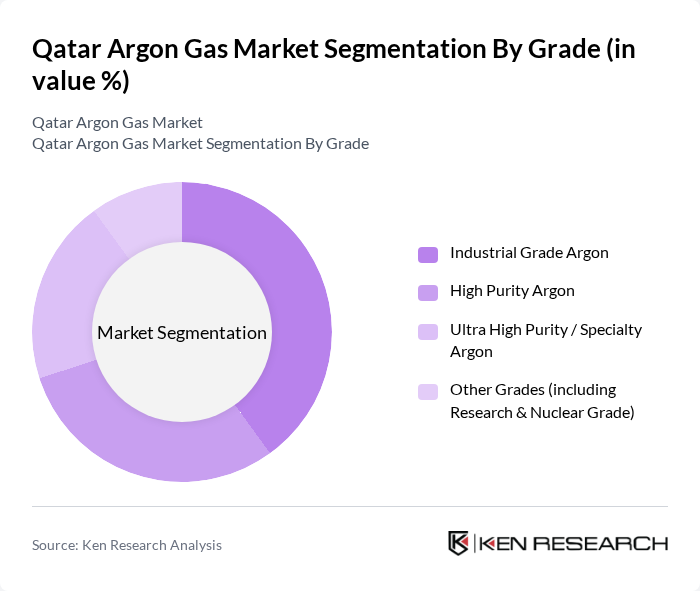
The Industrial Grade Argon segment dominates the market due to its widespread use in welding, cutting, and metal fabrication processes across construction, infrastructure projects, shipbuilding, and maintenance of oil and gas facilities. This grade is favored for its cost-effectiveness and availability in bulk and cylinder form, making it the preferred choice for structural steel fabrication, pipelines, and general engineering workshops. The increasing demand for metal products, fabrication yards supporting LNG and petrochemical megaprojects, and sustained growth in construction and infrastructure in Qatar have further propelled the consumption of industrial-grade argon. High Purity Argon follows closely, driven by its critical applications in electronics, laboratories, specialty welding procedures, and semiconductor-related activities where very low impurity levels are required to avoid contamination and defects.
By Form:The argon gas market can also be segmented by form into Gaseous Argon and Liquid Argon, consistent with industrial gas supply modes in the region. Each form has distinct applications, with gaseous argon being widely used in welding, cutting, shielding, and inerting in fabrication shops and on-site construction work, while liquid argon is often utilized in cryogenic applications, bulk supply to large industrial users, and as feed for on-site vaporization systems in process industries and laboratories.
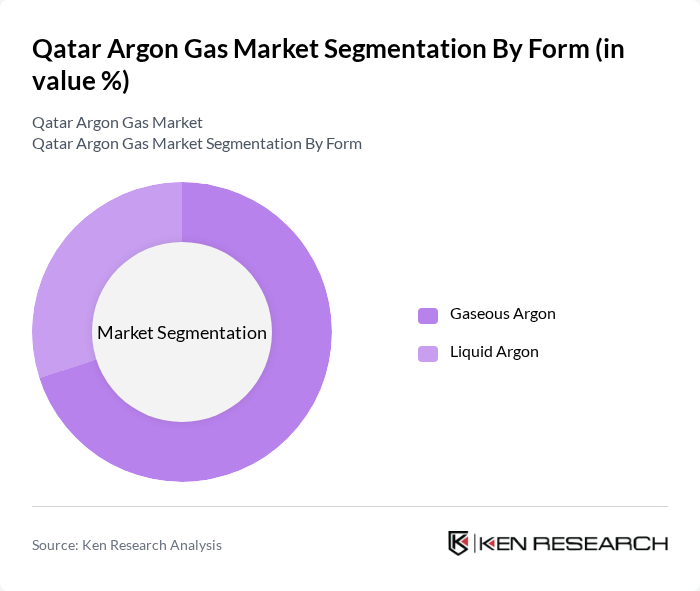
Gaseous Argon is the leading form in the market, primarily due to its extensive use in welding and metal fabrication processes in workshops, construction sites, and maintenance activities, where cylinder and bundled-cylinder supply is standard. The ease of handling, on-site distribution through manifolds, and suitability for a wide range of shielding-gas mixtures make gaseous argon a preferred choice for many industrial applications. Liquid Argon, while smaller in market share, is crucial for applications requiring cryogenic temperatures and high-volume, continuous gas usage, such as in medical and research institutions, steel and metal processing operations, and large industrial complexes where it is used for cooling, inerting, and as a source for on-site gas generation through vaporizers.
The Qatar Argon Gas Market is characterized by a dynamic mix of regional and international players. Leading participants such as Qatar Industrial Gases Company (QIGC), Buzwair Industrial Gases, Gulf Cryo, Air Products and Chemicals, Inc., Linde plc, Messer Group, Air Liquide, Universal Industrial Gases, Qatar Gas Transport Company (Nakilat), Qatar Petrochemical Company (QAPCO), Qatar Chemical Company (Q-Chem), Qatar National Cement Company, Qatar Steel, Qatar Fertiliser Company (QAFCO) contribute to innovation, geographic expansion, and service delivery in this space, supported by ongoing investments in LNG, petrochemicals, metals, and infrastructure that sustain demand for argon and other industrial gases.
The future of the Qatar argon gas market appears promising, driven by ongoing industrialization and healthcare expansion. As the government continues to invest in infrastructure and technology, the production capacity is expected to rise significantly. Additionally, the focus on sustainable practices will likely lead to increased adoption of argon in various applications. With strategic partnerships and government support, the market is poised for growth, enhancing its role in the regional economy and beyond.
| Segment | Sub-Segments |
|---|---|
| By Grade | Industrial Grade Argon High Purity Argon Ultra High Purity / Specialty Argon Other Grades (including Research & Nuclear Grade) |
| By Form | Gaseous Argon Liquid Argon |
| By Application | Welding and Metal Fabrication Steel and Metal Production Electronics and Semiconductor Manufacturing Healthcare and Laboratory Uses Food and Beverage Processing Oil, Gas and Petrochemicals Other Industrial Applications |
| By End-User Industry | Metal & Fabrication Industries Oil & Gas and Petrochemical Sector Electronics & Electrical Manufacturing Healthcare & Pharmaceutical Food & Beverage Industry Other End-User Industries |
| By Distribution Mode | On-site / Pipeline Supply Bulk (Tanker and ISO Containers) Packaged / Cylinder Distribution Others |
| By Production Method | Cryogenic Distillation (Air Separation Units) Non-cryogenic and Recovery Methods Others |
| By Region | Doha Al Rayyan Umm Salal Others |
| Scope Item/Segment | Sample Size | Target Respondent Profiles |
|---|---|---|
| Healthcare Sector Applications | 60 | Medical Gas Suppliers, Hospital Procurement Managers |
| Electronics Manufacturing | 50 | Production Managers, Quality Control Engineers |
| Metal Fabrication Industry | 40 | Welding Supervisors, Operations Managers |
| Research and Development Facilities | 40 | Lab Managers, Research Scientists |
| Industrial Gas Distributors | 50 | Sales Managers, Supply Chain Coordinators |
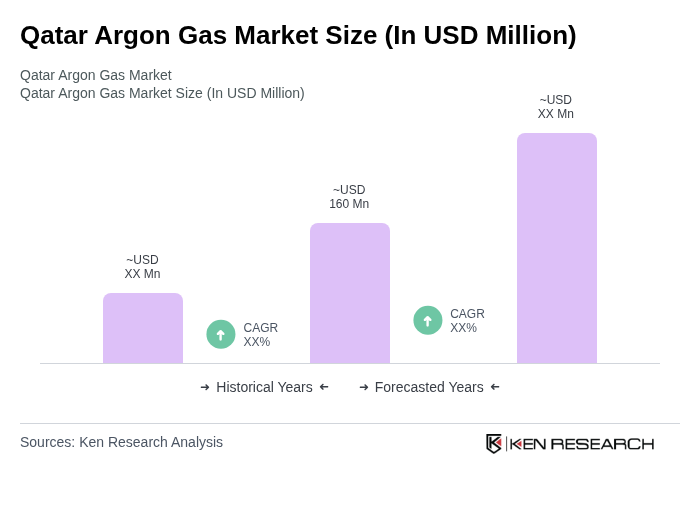
The Qatar Argon Gas Market is valued at approximately USD 160 million, reflecting its significant role within the broader GCC and Middle East industrial gases markets, driven by increasing demand in various industrial applications.

What makes us stand out is that our consultants follow Robust, Refine and Result (RRR) methodology. Robust for clear definitions, approaches and sanity checking, Refine for differentiating respondents' facts and opinions, and Result for presenting data with story.

We have set a benchmark in the industry by offering our clients with syndicated and customized market research reports featuring coverage of entire market as well as meticulous research and analyst insights.

While we don't replace traditional research, we flip the method upside down. Our dual approach of Top Bottom & Bottom Top ensures quality deliverable by not just verifying company fundamentals but also looking at the sector and macroeconomic factors.

With one step in the future, our research team constantly tries to show you the bigger picture. We help with some of the tough questions you may encounter along the way: How is the industry positioned? Best marketing channel? KPI's of competitors? By aligning every element, we help maximize success.

Our report gives you instant access to the answers and sources that other companies might choose to hide. We elaborate each steps of research methodology we have used and showcase you the sample size to earn your trust.

If you need any support, we are here! We pride ourselves on universe strength, data quality, and quick, friendly, and professional service.













