Region:Middle East
Author(s):Rebecca
Product Code:KRAE3461
Pages:90
Published On:February 2026
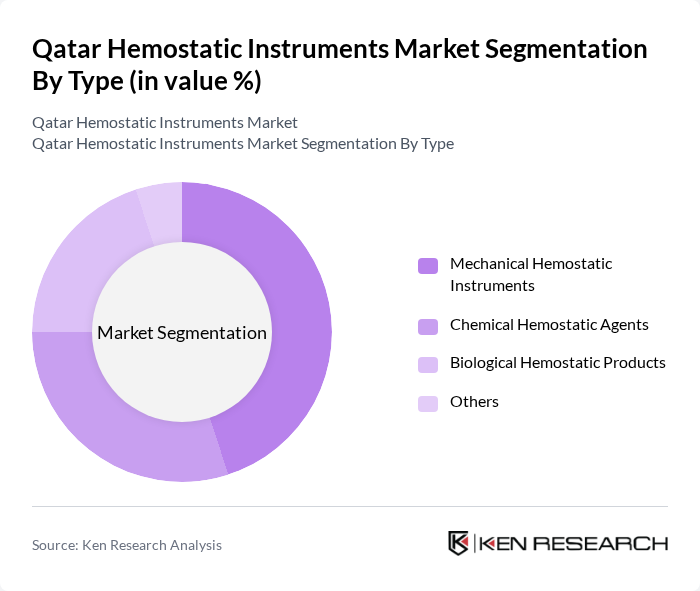
By Type:The market is segmented into Mechanical Hemostatic Instruments, Chemical Hemostatic Agents, Biological Hemostatic Products, and Others. Among these, Mechanical Hemostatic Instruments are leading the market due to their reliability and effectiveness in controlling bleeding during surgical procedures. The demand for these instruments is driven by the increasing number of surgeries performed in hospitals and surgical centers, as well as advancements in surgical techniques that require precise hemostatic control.
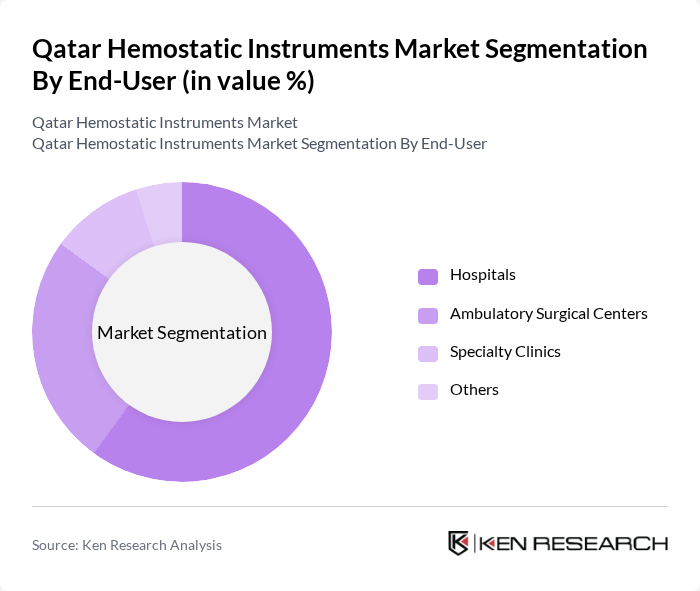
By End-User:The market is segmented into Hospitals, Ambulatory Surgical Centers, Specialty Clinics, and Others. Hospitals dominate the market due to their extensive surgical departments and higher patient volumes. The increasing number of surgical procedures performed in hospitals, coupled with the demand for advanced hemostatic solutions, drives the growth of this segment. Additionally, hospitals are investing in state-of-the-art technologies to enhance patient care and surgical outcomes.
The Qatar Hemostatic Instruments Market is characterized by a dynamic mix of regional and international players. Leading participants such as Medtronic, Johnson & Johnson, B. Braun Melsungen AG, Ethicon (a subsidiary of Johnson & Johnson), Stryker Corporation, Boston Scientific, Terumo Corporation, Smith & Nephew, 3M Health Care, Hemostasis Solutions, Cohera Medical, C.R. Bard (now part of BD), Integra LifeSciences, Acelity (now part of 3M), Baxter International contribute to innovation, geographic expansion, and service delivery in this space.
The future of the Qatar hemostatic instruments market appears promising, driven by ongoing advancements in medical technology and an increasing focus on patient safety. As healthcare providers continue to adopt innovative solutions, the integration of artificial intelligence in surgical procedures is expected to enhance precision and outcomes. Additionally, the expansion of healthcare infrastructure will likely facilitate greater access to advanced hemostatic instruments, ultimately improving surgical care across the region.
| Segment | Sub-Segments |
|---|---|
| By Type | Mechanical Hemostatic Instruments Chemical Hemostatic Agents Biological Hemostatic Products Others |
| By End-User | Hospitals Ambulatory Surgical Centers Specialty Clinics Others |
| By Application | General Surgery Orthopedic Surgery Cardiovascular Surgery Others |
| By Distribution Channel | Direct Sales Distributors Online Sales Others |
| By Region | Doha Al Rayyan Umm Salal Others |
| By Product Formulation | Liquid Formulations Powder Formulations Gel Formulations Others |
| By Patient Demographics | Pediatric Patients Adult Patients Geriatric Patients Others |
| Scope Item/Segment | Sample Size | Target Respondent Profiles |
|---|---|---|
| General Surgery Departments | 100 | Surgeons, Department Heads |
| Emergency Medical Services | 80 | Emergency Physicians, Paramedics |
| Orthopedic Surgery Units | 70 | Orthopedic Surgeons, Surgical Assistants |
| Cardiovascular Surgery Teams | 60 | Cardiothoracic Surgeons, Anesthesiologists |
| Medical Device Procurement | 90 | Procurement Managers, Supply Chain Directors |
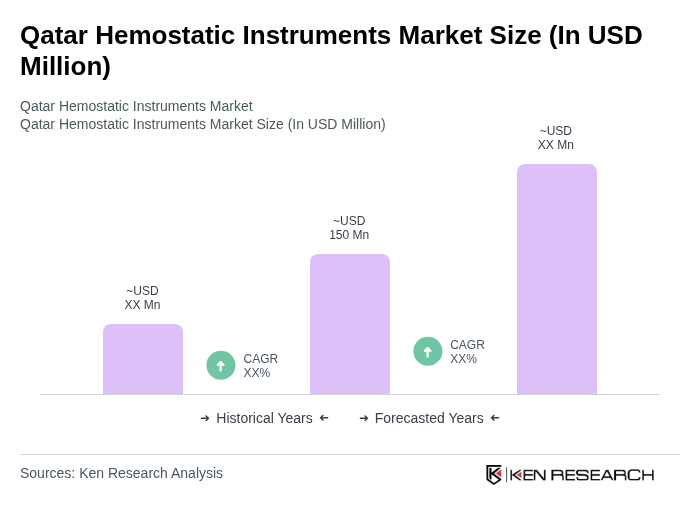
The Qatar Hemostatic Instruments Market is valued at approximately USD 150 million, reflecting a robust growth driven by the increasing number of surgical procedures and advancements in medical technology aimed at enhancing patient safety during surgeries.

What makes us stand out is that our consultants follow Robust, Refine and Result (RRR) methodology. Robust for clear definitions, approaches and sanity checking, Refine for differentiating respondents' facts and opinions, and Result for presenting data with story.

We have set a benchmark in the industry by offering our clients with syndicated and customized market research reports featuring coverage of entire market as well as meticulous research and analyst insights.

While we don't replace traditional research, we flip the method upside down. Our dual approach of Top Bottom & Bottom Top ensures quality deliverable by not just verifying company fundamentals but also looking at the sector and macroeconomic factors.

With one step in the future, our research team constantly tries to show you the bigger picture. We help with some of the tough questions you may encounter along the way: How is the industry positioned? Best marketing channel? KPI's of competitors? By aligning every element, we help maximize success.

Our report gives you instant access to the answers and sources that other companies might choose to hide. We elaborate each steps of research methodology we have used and showcase you the sample size to earn your trust.

If you need any support, we are here! We pride ourselves on universe strength, data quality, and quick, friendly, and professional service.













