About the Report
Base Year 2024Listen to the audio summary
Thailand Forklift Rental Market Overview
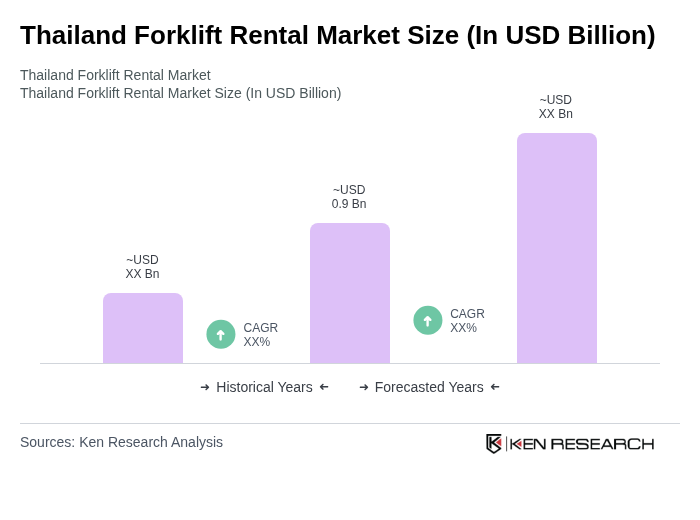
- The Thailand Forklift Rental Market is valued at USD 0.9 billion, based on a five-year historical analysis and benchmarking against the regional share of the Asia-Pacific forklift rental market and Thailand’s construction equipment rental and warehousing activities. This growth is primarily driven by the increasing demand for efficient material handling solutions across logistics, manufacturing, automotive, food and beverage, and construction sectors, supported by expansion in organized warehousing, contract logistics, and e-commerce fulfillment centers. The rise in e-commerce, proliferation of multi-tier distribution hubs, and the need for optimized warehouse operations, including cold-chain and high-velocity inventory handling, have further fueled the market’s expansion.
- Key cities such as Bangkok, Chonburi, and Samut Prakan dominate the market due to their strategic locations, robust industrial infrastructure, major seaports and logistics hubs, and high concentration of manufacturing, automotive, and export-oriented industries, particularly around Laem Chabang Port and surrounding industrial estates. The Eastern Economic Corridor (EEC) covering Chachoengsao, Chonburi, and Rayong continues to attract large-scale investments in logistics parks, special economic zones, and industrial clusters, which in turn supports higher demand for rental forklifts for construction, warehousing, and plant operations.
- To promote cleaner material handling equipment, Thailand has progressively introduced measures encouraging the use of electric industrial vehicles, including forklifts, through energy-efficiency and environmental policy instruments targeting industrial facilities and logistics operations. Under frameworks such as the Thailand Energy Efficiency Plan issued by the Ministry of Energy and greenhouse-gas reduction programs under the Ministry of Natural Resources and Environment, companies that invest in high?efficiency, low?emission equipment—such as electric forklifts and other electric material handling systems—can access incentives including investment promotion, energy-efficiency support schemes, and environmental compliance benefits, which encourages a gradual shift in rental fleets toward electric models.
Thailand Forklift Rental Market Segmentation
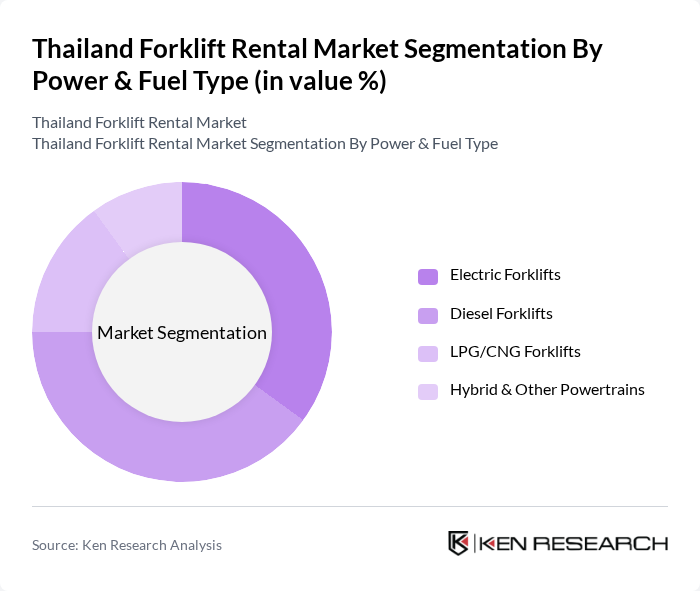
By Power & Fuel Type:The forklift rental market is segmented into various power and fuel types, including Electric Forklifts, Diesel Forklifts, LPG/CNG Forklifts, and Hybrid & Other Powertrains. Electric Forklifts are gaining traction due to their environmental benefits, lower noise, suitability for indoor and food-grade operations, and reduced maintenance requirements, while Diesel Forklifts remain popular for heavy-duty outdoor applications and construction sites. LPG/CNG Forklifts are also utilized for their cleaner combustion compared with diesel and their efficiency in indoor or semi-enclosed operations where emissions limits are stricter, and Hybrid or alternative powertrain options, including lithium-ion based systems, are emerging as a versatile choice for mixed-use and high-uptime applications.
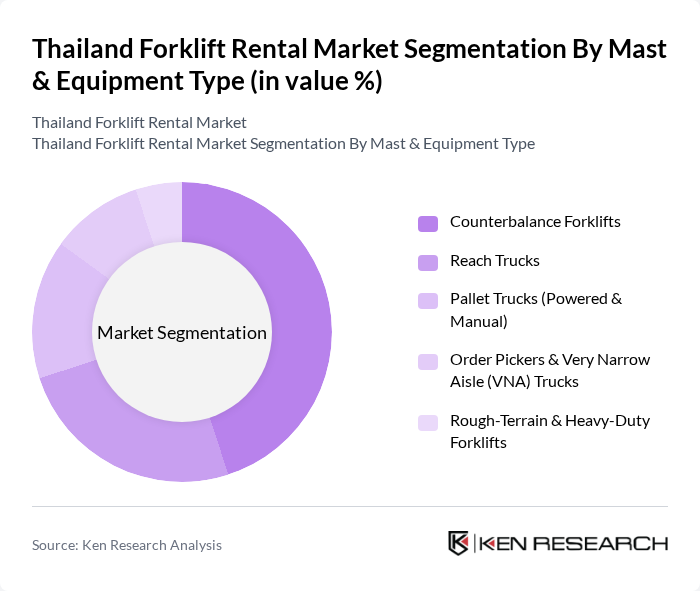
By Mast & Equipment Type:The market is also segmented by mast and equipment types, which include Counterbalance Forklifts, Reach Trucks, Pallet Trucks (Powered & Manual), Order Pickers & Very Narrow Aisle (VNA) Trucks, and Rough-Terrain & Heavy-Duty Forklifts. Counterbalance Forklifts dominate the market due to their versatility, wide lifting-capacity range, and suitability for loading docks, manufacturing plants, and general warehouse operations. Reach Trucks are preferred in modern racked warehouses and distribution centers for their ability to operate in narrow aisles and at higher lift heights, while powered pallet trucks, order pickers, and VNA trucks support high-throughput, space-optimized intralogistics in e-commerce and retail distribution facilities; rough?terrain and heavy?duty forklifts are mainly deployed at construction sites, ports, and outdoor yards.
Thailand Forklift Rental Market Competitive Landscape
The Thailand Forklift Rental Market is characterized by a dynamic mix of regional and international players. Leading participants such as Toyota Material Handling Thailand Co., Ltd., Mitsubishi Logisnext (Thailand) Co., Ltd., Jungheinrich Lift Truck (Thailand) Ltd., Komatsu Forklift (Thailand) Co., Ltd., Crown Equipment (Thailand) Co., Ltd., Hyster-Yale Asia-Pacific Pty Ltd (Thailand Operations), Doosan Industrial Vehicle (Thailand Distributor), KION Group (Linde Material Handling & STILL in Thailand), Manitou Asia-Pacific (Thailand Presence), CLARK Material Handling Asia (Thailand Distributor), Yale Materials Handling (Thailand Dealer Network), Hangcha Group (Thailand Distributor), EP Equipment (Thailand Distributor), Aisle-Master (Combilift) – Thailand Distributor, Genie Industries (Terex AWP) – Thailand Rental & Dealer Network contribute to innovation, geographic expansion, and service delivery in this space.
Thailand Forklift Rental Market Industry Analysis
Growth Drivers
- Increasing Demand for Logistics and Warehousing:The logistics and warehousing sector in Thailand is projected to grow significantly, with the market size reaching approximately THB 1.2 trillion in the future. This growth is driven by the rising need for efficient supply chain management, particularly in urban areas. The Thai government’s investment in logistics infrastructure, estimated at THB 300 billion, further supports this demand, creating a favorable environment for forklift rentals to meet operational needs.
- Expansion of E-commerce and Retail Sectors:Thailand's e-commerce market is expected to reach THB 4.5 trillion in the future, driven by increased internet penetration and consumer spending. This surge in online shopping necessitates enhanced warehousing capabilities, leading to a higher demand for forklifts. Retail giants are investing in automated warehouses, with an estimated THB 50 billion allocated for technology upgrades, further propelling the forklift rental market as businesses seek flexible solutions to manage inventory efficiently.
- Infrastructure Development Projects:The Thai government has earmarked THB 1.5 trillion for infrastructure projects, including transportation and logistics enhancements, in the future. These initiatives aim to improve connectivity and efficiency in supply chains, directly impacting the forklift rental market. As new industrial zones and logistics parks are developed, the demand for material handling equipment, particularly forklifts, is expected to rise, providing rental companies with significant growth opportunities.
Market Challenges
- High Initial Investment Costs:The high upfront costs associated with acquiring forklifts can deter businesses from purchasing equipment outright. For instance, a new electric forklift can cost between THB 800,000 to THB 1.5 million. This financial barrier often leads companies to consider rental options, but it also limits the market's growth potential as smaller firms may struggle to afford even rental fees, impacting overall market dynamics.
- Limited Availability of Skilled Operators:The shortage of skilled forklift operators in Thailand poses a significant challenge for the rental market. According to the Ministry of Labor, there is a gap of approximately 30,000 trained operators needed to meet industry demands. This shortage can lead to operational inefficiencies and increased costs for rental companies, as they may need to invest in training programs to ensure safe and effective equipment use.
Thailand Forklift Rental Market Future Outlook
The Thailand forklift rental market is poised for substantial growth, driven by the ongoing expansion of logistics and e-commerce sectors. As businesses increasingly adopt rental models to mitigate costs and enhance flexibility, the integration of advanced technologies such as IoT in fleet management will become more prevalent. Additionally, the focus on sustainability will likely accelerate the adoption of electric forklifts, aligning with global trends towards greener operations and further shaping the market landscape in the future.
Market Opportunities
- Growth in the Construction Sector:The construction sector in Thailand is projected to grow by 5% annually, reaching THB 1 trillion in the future. This growth will drive demand for forklifts in construction sites, presenting rental companies with opportunities to expand their service offerings and cater to this burgeoning market segment.
- Technological Advancements in Forklift Design:Innovations in forklift technology, such as automation and electric models, are expected to enhance operational efficiency. With the Thai government promoting electric vehicle adoption, rental companies can capitalize on this trend by offering advanced, eco-friendly forklifts, appealing to businesses focused on sustainability and operational cost reduction.
Scope of the Report
| Segment | Sub-Segments |
|---|---|
| By Power & Fuel Type | Electric Forklifts Diesel Forklifts LPG/CNG Forklifts Hybrid & Other Powertrains |
| By Mast & Equipment Type | Counterbalance Forklifts Reach Trucks Pallet Trucks (Powered & Manual) Order Pickers & Very Narrow Aisle (VNA) Trucks Rough?Terrain & Heavy-Duty Forklifts |
| By Load Capacity | Up to 3 Tons –5 Tons –10 Tons Above 10 Tons |
| By Rental Term | Short-Term Rentals (up to 3 months) Long-Term Rentals (above 3 months) Flexible / Pay?per?use Contracts |
| By End-Use Industry | Warehouse & Logistics Manufacturing Construction & Infrastructure Retail & Wholesale Others (Ports, Airports, Utilities, etc.) |
| By Application Environment | Indoor Operations Outdoor & Yard Operations Cold Storage & Specialized Applications |
| By Region | Central Thailand (incl. Bangkok) Eastern Economic Corridor (EEC) Northern Thailand Northeastern Thailand Southern Thailand |
Key Target Audience
Investors and Venture Capitalist Firms
Government and Regulatory Bodies (e.g., Ministry of Industry, Department of Land Transport)
Manufacturers and Producers
Logistics and Supply Chain Companies
Construction and Infrastructure Firms
Warehouse and Distribution Center Operators
Equipment Rental Companies
Financial Institutions
Players Mentioned in the Report:
Toyota Material Handling Thailand Co., Ltd.
Mitsubishi Logisnext (Thailand) Co., Ltd.
Jungheinrich Lift Truck (Thailand) Ltd.
Komatsu Forklift (Thailand) Co., Ltd.
Crown Equipment (Thailand) Co., Ltd.
Hyster-Yale Asia-Pacific Pty Ltd (Thailand Operations)
Doosan Industrial Vehicle (Thailand Distributor)
KION Group (Linde Material Handling & STILL in Thailand)
Manitou Asia-Pacific (Thailand Presence)
CLARK Material Handling Asia (Thailand Distributor)
Yale Materials Handling (Thailand Dealer Network)
Hangcha Group (Thailand Distributor)
EP Equipment (Thailand Distributor)
Aisle-Master (Combilift) Thailand Distributor
Genie Industries (Terex AWP) Thailand Rental & Dealer Network
Table of Contents
Market Assessment Phase
1. Executive Summary and Approach
2. Thailand Forklift Rental Market Overview
2.1 Key Insights and Strategic Recommendations
2.2 Thailand Forklift Rental Market Overview
2.3 Definition and Scope
2.4 Evolution of Market Ecosystem
2.5 Timeline of Key Regulatory Milestones
2.6 Value Chain & Stakeholder Mapping
2.7 Business Cycle Analysis
2.8 Policy & Incentive Landscape
3. Thailand Forklift Rental Market Analysis
3.1 Growth Drivers
3.1.1 Increasing demand for logistics and warehousing
3.1.2 Expansion of e-commerce and retail sectors
3.1.3 Infrastructure development projects
3.1.4 Rising adoption of automation in material handling
3.2 Market Challenges
3.2.1 High initial investment costs
3.2.2 Limited availability of skilled operators
3.2.3 Regulatory compliance issues
3.2.4 Competition from used equipment sales
3.3 Market Opportunities
3.3.1 Growth in the construction sector
3.3.2 Technological advancements in forklift design
3.3.3 Increasing focus on sustainability and electric forklifts
3.3.4 Expansion into rural and underserved markets
3.4 Market Trends
3.4.1 Shift towards rental models over ownership
3.4.2 Integration of IoT in fleet management
3.4.3 Customization of rental packages
3.4.4 Emphasis on safety and training programs
3.5 Government Regulation
3.5.1 Safety standards for forklift operations
3.5.2 Emission regulations for industrial vehicles
3.5.3 Licensing requirements for operators
3.5.4 Tax incentives for electric forklift adoption
4. SWOT Analysis
5. Stakeholder Analysis
6. Porter's Five Forces Analysis
7. Thailand Forklift Rental Market Market Size, 2019-2024
7.1 By Value
7.2 By Volume
7.3 By Average Selling Price
8. Thailand Forklift Rental Market Segmentation
8.1 By Power & Fuel Type
8.1.1 Electric Forklifts
8.1.2 Diesel Forklifts
8.1.3 LPG/CNG Forklifts
8.1.4 Hybrid & Other Powertrains
8.2 By Mast & Equipment Type
8.2.1 Counterbalance Forklifts
8.2.2 Reach Trucks
8.2.3 Pallet Trucks (Powered & Manual)
8.2.4 Order Pickers & Very Narrow Aisle (VNA) Trucks
8.2.5 Rough?Terrain & Heavy-Duty Forklifts
8.3 By Load Capacity
8.3.1 Up to 3 Tons
8.3.2 3–5 Tons
8.3.3 5–10 Tons
8.3.4 Above 10 Tons
8.4 By Rental Term
8.4.1 Short-Term Rentals (up to 3 months)
8.4.2 Long-Term Rentals (above 3 months)
8.4.3 Flexible / Pay?per?use Contracts
8.5 By End-Use Industry
8.5.1 Warehouse & Logistics
8.5.2 Manufacturing
8.5.3 Construction & Infrastructure
8.5.4 Retail & Wholesale
8.5.5 Others (Ports, Airports, Utilities, etc.)
8.6 By Application Environment
8.6.1 Indoor Operations
8.6.2 Outdoor & Yard Operations
8.6.3 Cold Storage & Specialized Applications
8.7 By Region
8.7.1 Central Thailand (incl. Bangkok)
8.7.2 Eastern Economic Corridor (EEC)
8.7.3 Northern Thailand
8.7.4 Northeastern Thailand
8.7.5 Southern Thailand
9. Thailand Forklift Rental Market Competitive Analysis
9.1 Market Share of Key Players
9.2 Cross Comparison of Key Players
9.2.1 Company Name
9.2.2 Group Size (Large, Medium, or Small as per industry convention)
9.2.3 Fleet Size (Number of Units)
9.2.4 Fleet Utilization Rate (%)
9.2.5 Average Daily Rental Rate (THB/unit/day)
9.2.6 Revenue per Unit (THB/unit/year)
9.2.7 EBITDA Margin (%)
9.2.8 Return on Capital Employed (ROCE, %)
9.2.9 Average Contract Tenure (Months)
9.2.10 Customer Retention Rate (%)
9.2.11 Market Share in Thailand Forklift Rental (%)
9.2.12 Geographic Coverage (No. of Provinces/Branches)
9.3 SWOT Analysis of Top Players
9.4 Pricing Analysis
9.5 Detailed Profile of Major Companies
9.5.1 Toyota Material Handling Thailand Co., Ltd.
9.5.2 Mitsubishi Logisnext (Thailand) Co., Ltd.
9.5.3 Jungheinrich Lift Truck (Thailand) Ltd.
9.5.4 Komatsu Forklift (Thailand) Co., Ltd.
9.5.5 Crown Equipment (Thailand) Co., Ltd.
9.5.6 Hyster-Yale Asia-Pacific Pty Ltd (Thailand Operations)
9.5.7 Doosan Industrial Vehicle (Thailand Distributor)
9.5.8 KION Group (Linde Material Handling & STILL in Thailand)
9.5.9 Manitou Asia-Pacific (Thailand Presence)
9.5.10 CLARK Material Handling Asia (Thailand Distributor)
9.5.11 Yale Materials Handling (Thailand Dealer Network)
9.5.12 Hangcha Group (Thailand Distributor)
9.5.13 EP Equipment (Thailand Distributor)
9.5.14 Aisle-Master (Combilift) – Thailand Distributor
9.5.15 Genie Industries (Terex AWP) – Thailand Rental & Dealer Network
10. Thailand Forklift Rental Market End-User Analysis
10.1 Procurement Behavior of Key Ministries
10.1.1 Government procurement policies
10.1.2 Budget allocation for equipment rental
10.1.3 Decision-making processes
10.1.4 Supplier evaluation criteria
10.2 Corporate Spend on Infrastructure & Energy
10.2.1 Investment trends in logistics
10.2.2 Budgeting for equipment rentals
10.2.3 Long-term contracts vs. spot rentals
10.2.4 Impact of economic conditions on spending
10.3 Pain Point Analysis by End-User Category
10.3.1 Equipment availability
10.3.2 Maintenance and support issues
10.3.3 Cost management challenges
10.3.4 Training and safety concerns
10.4 User Readiness for Adoption
10.4.1 Awareness of rental options
10.4.2 Perceived benefits of renting
10.4.3 Barriers to adoption
10.4.4 Training needs
10.5 Post-Deployment ROI and Use Case Expansion
10.5.1 Measurement of ROI
10.5.2 Case studies of successful deployments
10.5.3 Opportunities for expansion
10.5.4 Feedback mechanisms for improvement
11. Thailand Forklift Rental Market Future Size, 2025-2030
11.1 By Value
11.2 By Volume
11.3 By Average Selling Price
Go-To-Market Strategy Phase
1. Whitespace Analysis + Business Model Canvas
1.1 Market gaps and opportunities
1.2 Value proposition development
1.3 Revenue model
1.4 Key partnerships
1.5 Customer segments
1.6 Cost structure
1.7 Channels
2. Marketing and Positioning Recommendations
2.1 Branding strategies
2.2 Product USPs
2.3 Target audience identification
2.4 Communication strategies
2.5 Digital marketing approaches
3. Distribution Plan
3.1 Urban retail vs rural NGO tie-ups
3.2 Logistics and supply chain considerations
3.3 Distribution channel optimization
4. Channel & Pricing Gaps
4.1 Underserved routes
4.2 Pricing bands
4.3 Competitive pricing analysis
5. Unmet Demand & Latent Needs
5.1 Category gaps
5.2 Consumer segments
5.3 Emerging trends
6. Customer Relationship
6.1 Loyalty programs
6.2 After-sales service
6.3 Customer feedback mechanisms
7. Value Proposition
7.1 Sustainability
7.2 Integrated supply chains
7.3 Competitive advantages
8. Key Activities
8.1 Regulatory compliance
8.2 Branding
8.3 Distribution setup
9. Entry Strategy Evaluation
9.1 Domestic Market Entry Strategy
9.1.1 Product mix
9.1.2 Pricing band
9.1.3 Packaging
9.2 Export Entry Strategy
9.2.1 Target countries
9.2.2 Compliance roadmap
10. Entry Mode Assessment
10.1 JV
10.2 Greenfield
10.3 M&A
10.4 Distributor Model
11. Capital and Timeline Estimation
11.1 Capital requirements
11.2 Timelines
12. Control vs Risk Trade-Off
12.1 Ownership vs Partnerships
13. Profitability Outlook
13.1 Breakeven analysis
13.2 Long-term sustainability
14. Potential Partner List
14.1 Distributors
14.2 JVs
14.3 Acquisition targets
15. Execution Roadmap
15.1 Phased Plan for Market Entry
15.1.1 Market Setup
15.1.2 Market Entry
15.1.3 Growth Acceleration
15.1.4 Scale & Stabilize
15.2 Key Activities and Milestones
15.2.1 Milestone tracking
15.2.2 Performance metrics
Research Methodology
Phase 1: Approach1
Desk Research
- Analysis of industry reports from logistics and material handling associations in Thailand
- Review of government publications and economic data related to the construction and manufacturing sectors
- Examination of market trends and forecasts from reputable market research firms focusing on the forklift rental industry
Primary Research
- Interviews with fleet managers and procurement officers in major manufacturing and construction companies
- Surveys conducted with rental service providers to understand pricing strategies and service offerings
- Field interviews with operators and technicians to gather insights on equipment usage and maintenance practices
Validation & Triangulation
- Cross-validation of data through multiple sources including industry reports, expert interviews, and government statistics
- Triangulation of findings from primary and secondary research to ensure consistency and reliability
- Sanity checks through expert panel reviews comprising industry veterans and market analysts
Phase 2: Market Size Estimation1
Top-down Assessment
- Estimation of the total addressable market based on national economic indicators and construction activity levels
- Segmentation of the market by end-user industries such as construction, warehousing, and manufacturing
- Incorporation of growth rates from historical data and projected trends in the forklift rental sector
Bottom-up Modeling
- Collection of rental rates and utilization rates from leading forklift rental companies in Thailand
- Estimation of fleet sizes and turnover rates based on industry benchmarks and company disclosures
- Calculation of revenue potential by multiplying average rental rates by estimated fleet utilization
Forecasting & Scenario Analysis
- Development of forecasting models using historical growth rates and economic indicators
- Scenario analysis based on potential regulatory changes and shifts in market demand
- Creation of multiple projections (baseline, optimistic, and pessimistic) to account for market volatility
Phase 3: CATI Sample Composition1
| Scope Item/Segment | Sample Size | Target Respondent Profiles |
|---|---|---|
| Construction Sector Forklift Usage | 120 | Project Managers, Site Supervisors |
| Warehouse Operations | 90 | Warehouse Managers, Logistics Coordinators |
| Manufacturing Equipment Rental | 80 | Operations Managers, Production Supervisors |
| Rental Service Providers | 70 | Business Development Managers, Fleet Managers |
| Market Analysts and Consultants | 60 | Industry Analysts, Market Researchers |
Frequently Asked Questions
What is the current value of the Thailand Forklift Rental Market?
The Thailand Forklift Rental Market is valued at approximately USD 0.9 billion, reflecting growth driven by increased demand for material handling solutions across various sectors, including logistics, manufacturing, and construction.
What factors are driving the growth of the forklift rental market in Thailand?
Which cities in Thailand are the primary markets for forklift rentals?
What types of forklifts are most commonly rented in Thailand?
Other Regional/Country Reports
Other Adjacent Reports
Vietnam E-commerce Fulfillment Market
North America Electric Vehicle Battery Market Outlook to 2030: Size, Share, Growth and TrendsUnited States Industrial Automation Market Outlook to 2030: Size, Share, Growth and TrendsJapan Cold Chain Logistics MarketSaudi Arabia port equipment market report Size, Share, Growth Drivers, Trends, Opportunities & Forecast 2025–2030Kuwait Heavy Machinery Rental Market
Why Buy From Us?

What makes us stand out is that our consultants follow Robust, Refine and Result (RRR) methodology. Robust for clear definitions, approaches and sanity checking, Refine for differentiating respondents' facts and opinions, and Result for presenting data with story.

We have set a benchmark in the industry by offering our clients with syndicated and customized market research reports featuring coverage of entire market as well as meticulous research and analyst insights.

While we don't replace traditional research, we flip the method upside down. Our dual approach of Top Bottom & Bottom Top ensures quality deliverable by not just verifying company fundamentals but also looking at the sector and macroeconomic factors.

With one step in the future, our research team constantly tries to show you the bigger picture. We help with some of the tough questions you may encounter along the way: How is the industry positioned? Best marketing channel? KPI's of competitors? By aligning every element, we help maximize success.

Our report gives you instant access to the answers and sources that other companies might choose to hide. We elaborate each steps of research methodology we have used and showcase you the sample size to earn your trust.

If you need any support, we are here! We pride ourselves on universe strength, data quality, and quick, friendly, and professional service.