About the Report
Base Year 2024Turkey Car Finance & Leasing Market Overview
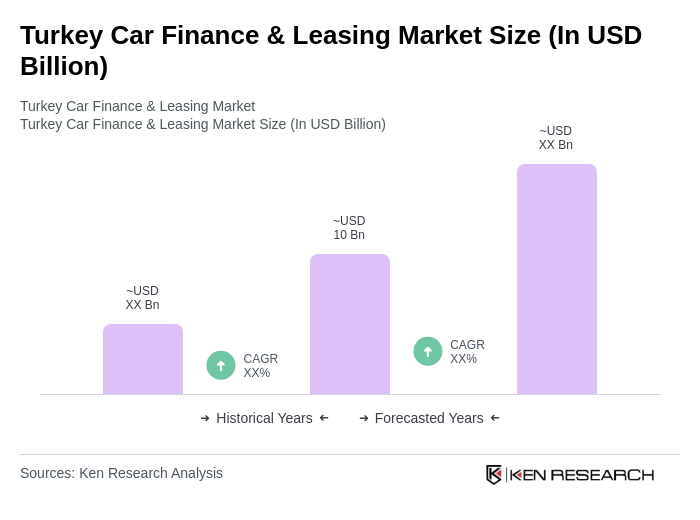
- The Turkey Car Finance & Leasing Market is valued at USD 10 billion, based on a five-year historical analysis. This growth is primarily driven by increasing consumer demand for vehicle ownership, coupled with favorable financing options and competitive interest rates. The rise in urbanization and the need for mobility solutions have further propelled the market, making car finance and leasing an attractive option for many consumers and businesses.
- Istanbul, Ankara, and Izmir are the dominant cities in the Turkey Car Finance & Leasing Market. Istanbul, as the largest city, has a high concentration of businesses and consumers, leading to increased demand for vehicle financing. Ankara, being the capital, hosts numerous government agencies and corporations, while Izmir's growing economy and population contribute to its significance in the market.
- In 2023, the Turkish government implemented a regulation aimed at promoting electric vehicle financing. This initiative includes tax incentives for consumers opting for electric vehicles and mandates financial institutions to offer favorable leasing terms for electric cars. The regulation is designed to encourage sustainable transportation and reduce carbon emissions in urban areas.
Turkey Car Finance & Leasing Market Segmentation
By Type:The market is segmented into various types of leasing options, including personal car leasing, commercial vehicle leasing, fleet leasing, operating lease, finance lease, short-term leasing, and others. Each of these segments caters to different consumer needs and preferences, influencing the overall market dynamics.
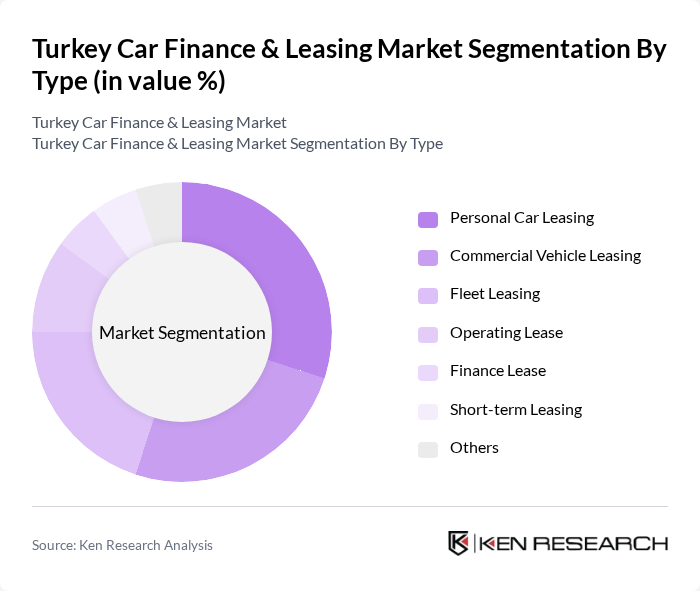
The personal car leasing segment is currently dominating the market due to the increasing preference among consumers for flexible financing options. This trend is driven by the rising cost of vehicle ownership and the desire for lower monthly payments. Additionally, the convenience of leasing, which often includes maintenance and insurance, appeals to a broad demographic, including young professionals and families. The commercial vehicle leasing segment also shows significant growth, fueled by the expansion of businesses requiring transportation solutions.
By End-User:The market is segmented by end-users, including individual consumers, small and medium enterprises (SMEs), large corporations, and government agencies. Each segment has distinct needs and preferences, influencing the types of financing options they pursue.
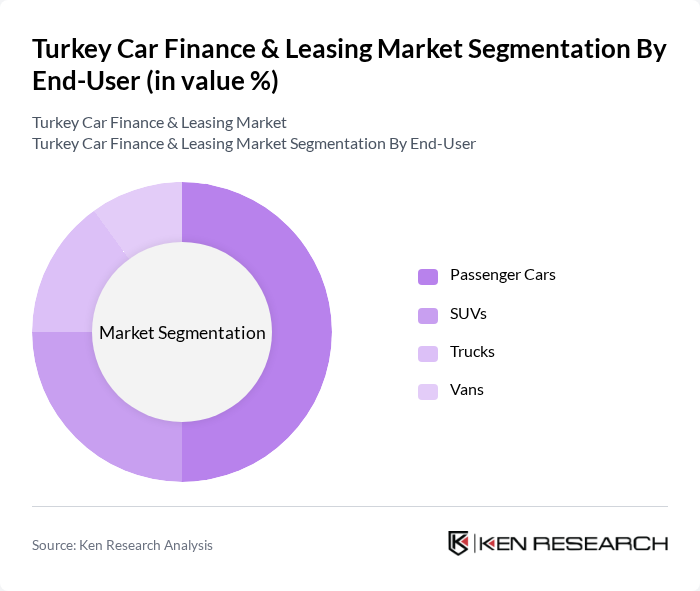
The individual consumers segment leads the market, driven by the growing trend of personal vehicle ownership and the convenience of leasing options. SMEs are also significant players, as they often require vehicles for operational purposes but prefer leasing to manage cash flow effectively. Large corporations and government agencies follow, utilizing leasing for fleet management and operational efficiency.
By Vehicle Type:The market is segmented by vehicle type, including passenger cars, SUVs, trucks, and vans. This segmentation reflects the diverse preferences of consumers and businesses in the Turkey Car Finance & Leasing Market.
Passenger cars dominate the market, accounting for a significant share due to their popularity among individual consumers. SUVs are gaining traction, particularly among families and those seeking larger vehicles. Trucks and vans are primarily utilized by businesses for commercial purposes, contributing to their steady demand in the leasing market.
By Financing Type:The market is segmented by financing type, including traditional financing, Islamic financing, and peer-to-peer financing. Each financing type caters to different consumer preferences and regulatory requirements.
Traditional financing remains the most popular choice, appealing to a broad audience due to its familiarity and established processes. Islamic financing is gaining traction among consumers seeking Sharia-compliant options, while peer-to-peer financing is emerging as a viable alternative for tech-savvy individuals looking for flexible terms.
By Duration:The market is segmented by duration, including short-term leasing and long-term leasing. This segmentation reflects the varying needs of consumers and businesses regarding vehicle usage.
Long-term leasing is the dominant segment, favored by consumers and businesses looking for stability and lower monthly payments over extended periods. Short-term leasing is also popular, particularly among tourists and individuals needing temporary transportation solutions.
By Payment Structure:The market is segmented by payment structure, including fixed payments and variable payments. This segmentation highlights the different financial arrangements available to consumers and businesses.
Fixed payments dominate the market, providing consumers with predictable monthly expenses, which is particularly appealing in uncertain economic conditions. Variable payments are less common but may attract consumers looking for flexibility in their payment arrangements.
By Region:The market is segmented by region, including Marmara, Aegean, Central Anatolia, Eastern Anatolia, Southeastern Anatolia, Black Sea, and others. This segmentation reflects the geographical distribution of demand for car finance and leasing services.
The Marmara region leads the market due to its economic significance and population density, followed by the Aegean and Central Anatolia regions. Each region has unique characteristics that influence consumer preferences and market dynamics.
Turkey Car Finance & Leasing Market Competitive Landscape
The Turkey Car Finance & Leasing Market is characterized by a dynamic mix of regional and international players. Leading participants such as Garanti BBVA, ?? Leasing, QNB Finansinvest, Yap? Kredi Leasing, Halkbank, TEB Leasing, Anadolubank, Denizbank, Finansbank, Türk Ekonomi Bankas?, Ziraat Leasing, Oyak Renault, Ford Otosan, Mercedes-Benz Finansman, Volkswagen Finans contribute to innovation, geographic expansion, and service delivery in this space.
Turkey Car Finance & Leasing Market Industry Analysis
Growth Drivers
- Increasing Consumer Demand for Vehicle Ownership:In Turkey, the number of registered vehicles reached approximately 25 million, reflecting a growing consumer preference for personal vehicle ownership. This trend is driven by a rising middle class, with disposable income increasing by 6% annually, leading to heightened demand for car financing solutions. The desire for personal mobility, especially in urban areas, further fuels this growth, as consumers seek reliable transportation options amidst increasing urban congestion.
- Expansion of Financing Options and Competitive Interest Rates:The Turkish banking sector has seen a significant increase in car financing products, with over 32 banks offering tailored loan solutions. The average interest rate for car loans has decreased to around 11% in future, making financing more accessible. This competitive landscape encourages consumers to explore various financing options, leading to a surge in car purchases. Additionally, flexible repayment terms are attracting more buyers, enhancing the overall market growth.
- Government Incentives for Electric and Hybrid Vehicles:The Turkish government has implemented various incentives to promote electric and hybrid vehicle adoption, including tax reductions and subsidies. In future, over 20,000 electric vehicles are expected to be sold, a 50% increase from the previous year. These incentives are expected to continue in future, with the government aiming for 1.5 million electric vehicles on the road by 2030. This push not only supports environmental goals but also stimulates the car finance market as consumers seek financing for these vehicles.
Market Challenges
- Economic Fluctuations Affecting Consumer Purchasing Power:Turkey's economy has faced volatility, with inflation rates reaching 65%, significantly impacting consumer purchasing power. As living costs rise, many potential buyers are hesitant to commit to car financing, leading to a slowdown in market growth. This economic uncertainty creates a challenging environment for financial institutions, as they must navigate fluctuating demand while maintaining competitive offerings to attract consumers.
- Regulatory Changes Impacting Financing Terms:Recent regulatory changes in Turkey have introduced stricter lending criteria, affecting the availability of car loans. In future, the Central Bank of Turkey raised reserve requirements for banks, limiting their ability to extend credit. This has resulted in a decrease in loan approvals by approximately 25%, making it more difficult for consumers to secure financing. Such regulatory shifts can hinder market growth and create barriers for potential car buyers.
Turkey Car Finance & Leasing Market Future Outlook
The Turkey car finance and leasing market is poised for significant transformation, driven by technological advancements and evolving consumer preferences. The shift towards digital financing platforms is expected to streamline the application process, enhancing customer experience. Additionally, the increasing focus on sustainability will likely drive demand for electric vehicle financing. As urbanization continues, financial institutions may explore innovative solutions to cater to the mobility needs of consumers, ensuring a dynamic and responsive market landscape in the coming years.
Market Opportunities
- Growth in the Electric Vehicle Financing Segment:With the Turkish government’s commitment to increasing electric vehicle adoption, the financing segment for these vehicles presents a lucrative opportunity. As more consumers seek eco-friendly options, financial institutions can develop specialized products to cater to this growing market, potentially increasing their customer base and enhancing profitability.
- Development of Digital Financing Platforms:The rise of digital technology offers a significant opportunity for the car finance market. By investing in user-friendly digital platforms, financial institutions can simplify the financing process, attract tech-savvy consumers, and improve overall customer satisfaction. This shift towards digital solutions can enhance operational efficiency and reduce costs, positioning companies favorably in a competitive market.
Scope of the Report
| Segment | Sub-Segments |
|---|---|
| By Type | Personal Car Leasing Commercial Vehicle Leasing Fleet Leasing Operating Lease Finance Lease Short-term Leasing Others |
| By End-User | Individual Consumers Small and Medium Enterprises (SMEs) Large Corporations Government Agencies |
| By Vehicle Type | Passenger Cars SUVs Trucks Vans |
| By Financing Type | Traditional Financing Islamic Financing Peer-to-Peer Financing |
| By Duration | Short-term Leasing Long-term Leasing |
| By Payment Structure | Fixed Payments Variable Payments |
| By Region | Marmara Aegean Central Anatolia Eastern Anatolia Southeastern Anatolia Black Sea Others |
Key Target Audience
Investors and Venture Capitalist Firms
Government and Regulatory Bodies (e.g., Banking Regulation and Supervision Agency, Capital Markets Board of Turkey)
Automobile Manufacturers
Leasing Companies
Financial Institutions (e.g., Banks, Credit Unions)
Insurance Providers
Automotive Dealerships
Industry Associations (e.g., Automotive Distributors Association)
Players Mentioned in the Report:
Garanti BBVA
Is Leasing
QNB Finansinvest
Yap Kredi Leasing
Halkbank
TEB Leasing
Anadolubank
Denizbank
Finansbank
Turk Ekonomi Bankas
Ziraat Leasing
Oyak Renault
Ford Otosan
Mercedes-Benz Finansman
Volkswagen Finans
Table of Contents
Market Assessment Phase
1. Executive Summary and Approach
2. Turkey Car Finance & Leasing Market Overview
2.1 Key Insights and Strategic Recommendations
2.2 Turkey Car Finance & Leasing Market Overview
2.3 Definition and Scope
2.4 Evolution of Market Ecosystem
2.5 Timeline of Key Regulatory Milestones
2.6 Value Chain & Stakeholder Mapping
2.7 Business Cycle Analysis
2.8 Policy & Incentive Landscape
3. Turkey Car Finance & Leasing Market Analysis
3.1 Growth Drivers
3.1.1 Increasing consumer demand for vehicle ownership
3.1.2 Expansion of financing options and competitive interest rates
3.1.3 Government incentives for electric and hybrid vehicles
3.1.4 Rise in urbanization and mobility needs
3.2 Market Challenges
3.2.1 Economic fluctuations affecting consumer purchasing power
3.2.2 Regulatory changes impacting financing terms
3.2.3 High competition among financial institutions
3.2.4 Limited awareness of leasing benefits among consumers
3.3 Market Opportunities
3.3.1 Growth in the electric vehicle financing segment
3.3.2 Development of digital financing platforms
3.3.3 Partnerships with automotive manufacturers
3.3.4 Expansion into underserved rural markets
3.4 Market Trends
3.4.1 Shift towards online car financing solutions
3.4.2 Increasing popularity of subscription-based car leasing
3.4.3 Focus on sustainability and eco-friendly vehicles
3.4.4 Enhanced customer experience through technology integration
3.5 Government Regulation
3.5.1 Tax incentives for electric vehicle purchases
3.5.2 Regulations on interest rates for car loans
3.5.3 Consumer protection laws in financing agreements
3.5.4 Licensing requirements for financial institutions
4. SWOT Analysis
5. Stakeholder Analysis
6. Porter's Five Forces Analysis
7. Turkey Car Finance & Leasing Market Market Size, 2019-2024
7.1 By Value
7.2 By Volume
7.3 By Average Selling Price
8. Turkey Car Finance & Leasing Market Segmentation
8.1 By Type
8.1.1 Personal Car Leasing
8.1.2 Commercial Vehicle Leasing
8.1.3 Fleet Leasing
8.1.4 Operating Lease
8.1.5 Finance Lease
8.1.6 Short-term Leasing
8.1.7 Others
8.2 By End-User
8.2.1 Individual Consumers
8.2.2 Small and Medium Enterprises (SMEs)
8.2.3 Large Corporations
8.2.4 Government Agencies
8.3 By Vehicle Type
8.3.1 Passenger Cars
8.3.2 SUVs
8.3.3 Trucks
8.3.4 Vans
8.4 By Financing Type
8.4.1 Traditional Financing
8.4.2 Islamic Financing
8.4.3 Peer-to-Peer Financing
8.5 By Duration
8.5.1 Short-term Leasing
8.5.2 Long-term Leasing
8.6 By Payment Structure
8.6.1 Fixed Payments
8.6.2 Variable Payments
8.7 By Region
8.7.1 Marmara
8.7.2 Aegean
8.7.3 Central Anatolia
8.7.4 Eastern Anatolia
8.7.5 Southeastern Anatolia
8.7.6 Black Sea
8.7.7 Others
9. Turkey Car Finance & Leasing Market Competitive Analysis
9.1 Market Share of Key Players
9.2 Cross Comparison of Key Players
9.2.1 Company Name
9.2.2 Group Size (Large, Medium, or Small as per industry convention)
9.2.3 Revenue Growth Rate
9.2.4 Customer Acquisition Cost
9.2.5 Market Penetration Rate
9.2.6 Customer Retention Rate
9.2.7 Pricing Strategy
9.2.8 Average Lease Duration
9.2.9 Portfolio Diversification
9.2.10 Net Promoter Score (NPS)
9.3 SWOT Analysis of Top Players
9.4 Pricing Analysis
9.5 Detailed Profile of Major Companies
9.5.1 Garanti BBVA
9.5.2 ?? Leasing
9.5.3 QNB Finansinvest
9.5.4 Yap? Kredi Leasing
9.5.5 Halkbank
9.5.6 TEB Leasing
9.5.7 Anadolubank
9.5.8 Denizbank
9.5.9 Finansbank
9.5.10 Türk Ekonomi Bankas?
9.5.11 Ziraat Leasing
9.5.12 Oyak Renault
9.5.13 Ford Otosan
9.5.14 Mercedes-Benz Finansman
9.5.15 Volkswagen Finans
10. Turkey Car Finance & Leasing Market End-User Analysis
10.1 Procurement Behavior of Key Ministries
10.1.1 Budget Allocation for Vehicle Procurement
10.1.2 Preference for Leasing vs. Purchasing
10.1.3 Evaluation Criteria for Financing Options
10.2 Corporate Spend on Infrastructure & Energy
10.2.1 Investment in Fleet Expansion
10.2.2 Budgeting for Vehicle Maintenance
10.2.3 Financing for Eco-Friendly Vehicles
10.3 Pain Point Analysis by End-User Category
10.3.1 High Financing Costs
10.3.2 Limited Availability of Flexible Terms
10.3.3 Complexity in Lease Agreements
10.4 User Readiness for Adoption
10.4.1 Awareness of Leasing Benefits
10.4.2 Digital Literacy for Online Financing
10.4.3 Trust in Financial Institutions
10.5 Post-Deployment ROI and Use Case Expansion
10.5.1 Measurement of Cost Savings
10.5.2 Expansion of Vehicle Use Cases
10.5.3 Customer Feedback and Improvement
11. Turkey Car Finance & Leasing Market Future Size, 2025-2030
11.1 By Value
11.2 By Volume
11.3 By Average Selling Price
Go-To-Market Strategy Phase
1. Whitespace Analysis + Business Model Canvas
1.1 Identification of Market Gaps
1.2 Business Model Framework
1.3 Value Proposition Development
1.4 Revenue Streams Analysis
1.5 Cost Structure Evaluation
1.6 Key Partnerships
1.7 Customer Segmentation
2. Marketing and Positioning Recommendations
2.1 Branding Strategies
2.2 Product USPs
2.3 Target Audience Identification
2.4 Communication Channels
2.5 Promotional Activities
2.6 Customer Engagement Strategies
3. Distribution Plan
3.1 Urban Retail Strategies
3.2 Rural NGO Tie-ups
3.3 Online vs Offline Distribution
3.4 Partnerships with Dealerships
3.5 Logistics and Supply Chain Management
4. Channel & Pricing Gaps
4.1 Underserved Routes
4.2 Pricing Bands Analysis
4.3 Competitor Pricing Strategies
4.4 Customer Willingness to Pay
4.5 Discounting Strategies
5. Unmet Demand & Latent Needs
5.1 Category Gaps
5.2 Consumer Segments Analysis
5.3 Emerging Trends and Preferences
5.4 Feedback from Current Users
5.5 Anticipated Future Needs
6. Customer Relationship
6.1 Loyalty Programs
6.2 After-sales Service
6.3 Customer Support Channels
6.4 Feedback Mechanisms
6.5 Community Engagement
7. Value Proposition
7.1 Sustainability Initiatives
7.2 Integrated Supply Chains
7.3 Customer-Centric Offerings
7.4 Competitive Differentiation
7.5 Long-term Value Creation
8. Key Activities
8.1 Regulatory Compliance
8.2 Branding Initiatives
8.3 Distribution Setup
8.4 Training and Development
8.5 Performance Monitoring
9. Entry Strategy Evaluation
9.1 Domestic Market Entry Strategy
9.1.1 Product Mix Considerations
9.1.2 Pricing Band Strategy
9.1.3 Packaging Options
9.2 Export Entry Strategy
9.2.1 Target Countries
9.2.2 Compliance Roadmap
10. Entry Mode Assessment
10.1 Joint Ventures
10.2 Greenfield Investments
10.3 Mergers and Acquisitions
10.4 Distributor Model
11. Capital and Timeline Estimation
11.1 Capital Requirements
11.2 Timelines for Implementation
12. Control vs Risk Trade-Off
12.1 Ownership vs Partnerships
13. Profitability Outlook
13.1 Breakeven Analysis
13.2 Long-term Sustainability
14. Potential Partner List
14.1 Distributors
14.2 Joint Ventures
14.3 Acquisition Targets
15. Execution Roadmap
15.1 Phased Plan for Market Entry
15.1.1 Market Setup
15.1.2 Market Entry
15.1.3 Growth Acceleration
15.1.4 Scale & Stabilize
15.2 Key Activities and Milestones
15.2.1 Milestone Planning
15.2.2 Activity Tracking
Research Methodology
Phase 1: Approach1
Desk Research
- Analysis of government reports and statistics on vehicle financing and leasing trends in Turkey
- Review of industry publications and market analysis reports from financial institutions
- Examination of consumer behavior studies related to car ownership and leasing preferences
Primary Research
- Interviews with financial analysts specializing in automotive finance
- Surveys conducted with car dealerships and leasing companies to gather insights on market dynamics
- Focus group discussions with consumers to understand preferences and pain points in car financing
Validation & Triangulation
- Cross-validation of findings through comparison with historical market data and trends
- Triangulation of insights from primary interviews and secondary data sources
- Sanity checks through expert panel reviews comprising industry veterans and economists
Phase 2: Market Size Estimation1
Top-down Assessment
- Estimation of total market size based on national automotive sales and financing statistics
- Segmentation of the market by vehicle type (new vs. used) and financing method (leasing vs. loans)
- Incorporation of macroeconomic indicators such as GDP growth and consumer confidence indices
Bottom-up Modeling
- Collection of data from leading car finance and leasing companies on their portfolio sizes
- Analysis of average transaction values and financing terms across different vehicle segments
- Estimation of market share based on the number of active leases and loans in the market
Forecasting & Scenario Analysis
- Development of forecasting models using historical growth rates and economic indicators
- Scenario analysis based on potential regulatory changes and shifts in consumer financing preferences
- Creation of multiple projections (baseline, optimistic, and pessimistic) through 2030
Phase 3: CATI Sample Composition1
| Scope Item/Segment | Sample Size | Target Respondent Profiles |
|---|---|---|
| Consumer Car Financing | 150 | Car Buyers, Financial Advisors |
| Leasing Company Insights | 100 | Leasing Managers, Sales Directors |
| Dealership Financing Practices | 80 | Dealership Owners, Finance Managers |
| Market Trends in Used Car Financing | 70 | Used Car Dealers, Financial Analysts |
| Consumer Preferences in Leasing vs. Buying | 90 | Potential Car Buyers, Market Researchers |
Frequently Asked Questions
What is the current value of the Turkey Car Finance & Leasing Market?
The Turkey Car Finance & Leasing Market is valued at approximately USD 10 billion, driven by increasing consumer demand for vehicle ownership and favorable financing options. This growth reflects a five-year historical analysis of market trends and consumer behavior.
Which cities dominate the Turkey Car Finance & Leasing Market?
What types of leasing options are available in Turkey?
How has the Turkish government influenced electric vehicle financing?
Other Adjacent Reports
Germany Automotive Insurance Market
China Vehicle Rental MarketVietnam Used Car Sales Market
Middle East Electric Vehicle Market Report Size, Share, Growth Drivers, Trends, Opportunities & Forecast 2025–2030UAE Fleet Management MarketIndonesia Automotive Parts MarketUAE Consumer Credit MarketQatar Digital Financing Platform Market
Kuwait Islamic Finance Market Size, Share, Growth Drivers, Opportunities & Forecast 2025–2030Malaysia Sustainable Mobility Market
Why Buy From Us?

What makes us stand out is that our consultants follow Robust, Refine and Result (RRR) methodology. Robust for clear definitions, approaches and sanity checking, Refine for differentiating respondents' facts and opinions, and Result for presenting data with story.

We have set a benchmark in the industry by offering our clients with syndicated and customized market research reports featuring coverage of entire market as well as meticulous research and analyst insights.

While we don't replace traditional research, we flip the method upside down. Our dual approach of Top Bottom & Bottom Top ensures quality deliverable by not just verifying company fundamentals but also looking at the sector and macroeconomic factors.

With one step in the future, our research team constantly tries to show you the bigger picture. We help with some of the tough questions you may encounter along the way: How is the industry positioned? Best marketing channel? KPI's of competitors? By aligning every element, we help maximize success.

Our report gives you instant access to the answers and sources that other companies might choose to hide. We elaborate each steps of research methodology we have used and showcase you the sample size to earn your trust.

If you need any support, we are here! We pride ourselves on universe strength, data quality, and quick, friendly, and professional service.