United Arab Emirates Driveline Market Report Size Share Growth Drivers Trends Opportunities & Forecast 2025–2030

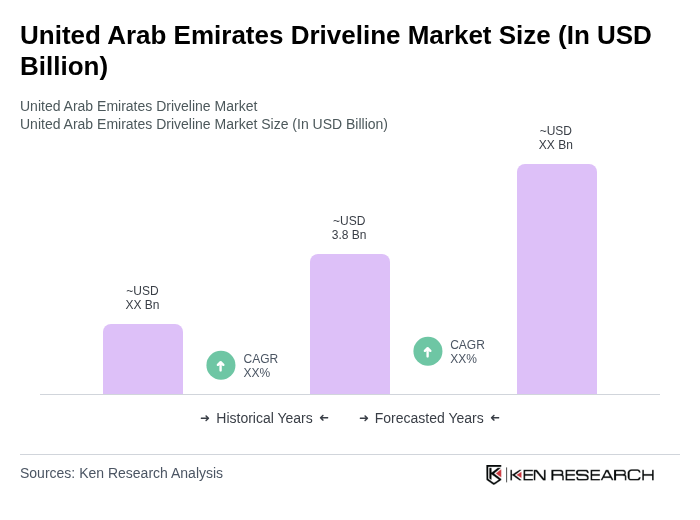
UAE driveline market, valued at USD 3.8 Bn, is propelled by rising demand for passenger and electric vehicles, with key growth in Dubai and Abu Dhabi amid government sustainability initiatives.

Region:Middle East

Author(s):Dev

Product Code:KRAA5321

Pages:81

Published On:January 2026
About the Report

Base Year 2024

United Arab Emirates Driveline Market Overview

  • The United Arab Emirates Driveline Market is valued at USD 3.8 billion, based on a five-year historical analysis. This growth is primarily driven by the increasing demand for passenger and commercial vehicles, alongside the rapid expansion of infrastructure projects across the region. The market is also influenced by the rising adoption of electric vehicles, which is reshaping consumer preferences and driving innovation in driveline technologies.
  • Key cities such as Dubai and Abu Dhabi dominate the market due to their status as economic hubs, attracting significant investments in automotive manufacturing and technology. Dubai commanded 43.37% of commercial vehicle demand, with the emirate positioned as a regulatory sandbox accelerating technology adoption through initiatives like autonomous-vehicle zones and front-loaded bus procurement programs. The presence of a robust infrastructure, coupled with a growing population and rising disposable incomes, further enhances the demand for advanced driveline solutions in these regions.
  • The UAE government has established stringent environmental standards for the automotive sector, with the Road2.0 program targeting massive electric commercial vehicle adoption by 2030. This regulatory framework aims to promote environmental sustainability and reduce the carbon footprint of the automotive sector, encouraging manufacturers to innovate and adopt cleaner driveline technologies. Electric propulsion in commercial vehicles is projected to grow at 7.61% through 2031, with battery-electric trucks and buses penetrating shorter-range operations, evidenced by deployments such as the Mercedes-Benz eActros 300 and eEconic refuse trucks.
United Arab Emirates Driveline Market Size

United Arab Emirates Driveline Market Segmentation

By Vehicle Type:The vehicle type segmentation includes various categories such as passenger vehicles, commercial vehicles, electric vehicles, luxury vehicles, and others. Among these, passenger vehicles are the most dominant segment, driven by the increasing urbanization and rising consumer preferences for personal mobility solutions. The commercial vehicles segment is emerging as the fastest-growing segment in the UAE's electric commercial vehicle market, with a projected growth rate of approximately 35% during 2024-2029, driven by the UAE government's push towards sustainable transportation solutions for businesses and increasing adoption of electric delivery vehicles by e-commerce companies. The demand for electric vehicles is also gaining traction, reflecting a shift towards sustainable transportation options.
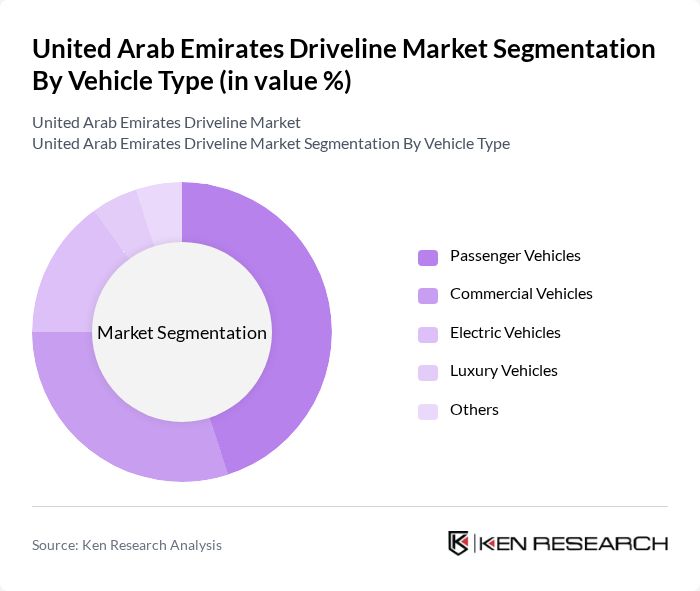
United Arab Emirates Driveline Market segmentation by Vehicle Type.

By Driveline Component:The driveline component segmentation encompasses key elements such as gearboxes, driveshafts, differentials, axles, and others. Gearboxes are the leading component in this market, primarily due to their critical role in vehicle performance and efficiency. The increasing complexity of driveline systems in modern vehicles further emphasizes the importance of advanced gearbox technologies. Integrated e-axles are gaining prominence in electric vehicle drivetrains, comprising 33.81% of the electric vehicle drivetrain market share and growing at 8.36% annually, as original equipment manufacturers seek cost reductions and lightweighting through combined motor, inverter, and reducer integration.
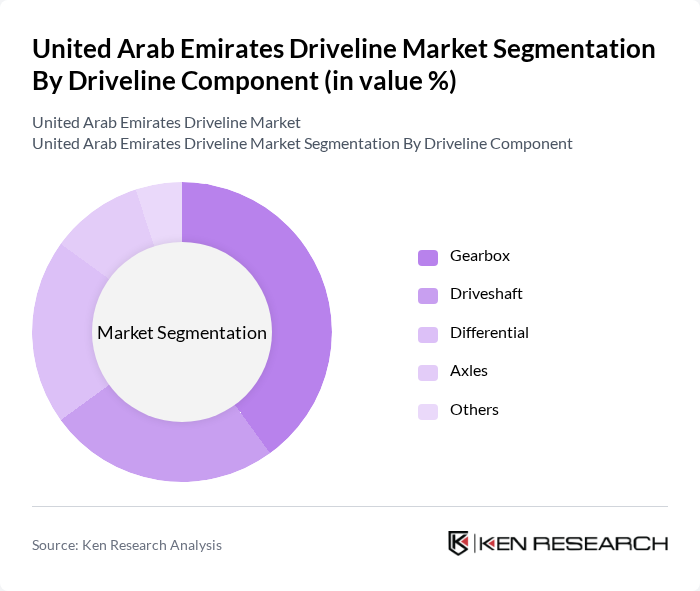
United Arab Emirates Driveline Market segmentation by Driveline Component.

United Arab Emirates Driveline Market Competitive Landscape

The United Arab Emirates Driveline Market is characterized by a dynamic mix of regional and international players. Leading participants such as Al-Futtaim Automotive, Al Nabooda Automobiles, Emirates Motor Company, Al Ghandi Auto, Al Tayer Motors, Al Jaziri Motors, Al Mulla Group, Al-Futtaim Engineering, Daimler Commercial Vehicles MENA FZE, Scania Middle East, Volvo Group Middle East, PACCAR Middle East, Nissan Motors Middle East, Mitsubishi Motors Middle East, Isuzu Motors Middle East contribute to innovation, geographic expansion, and service delivery in this space.

Al-Futtaim Automotive

1930

Dubai, UAE

Al Nabooda Automobiles

1970

Dubai, UAE

Emirates Motor Company

1967

Abu Dhabi, UAE

Al Ghandi Auto

1968

Dubai, UAE

Al Tayer Motors

1982

Dubai, UAE

Company

Establishment Year

Headquarters

Revenue (USD Million)

Year-over-Year Revenue Growth Rate (%)

Market Share (%)

EBITDA Margin (%)

Return on Equity (ROE) (%)

Product Innovation Index

United Arab Emirates Driveline Market Industry Analysis

Growth Drivers

  • Increasing Demand for Fuel-Efficient Vehicles:The United Arab Emirates (UAE) has seen a significant rise in the demand for fuel-efficient vehicles, with sales reaching approximately 160,000 units in future. This trend is driven by rising fuel prices, which averaged AED 3.50 per liter in future, prompting consumers to seek more economical options. The UAE government’s commitment to reducing carbon emissions by 30% by 2030 further supports this shift, encouraging manufacturers to innovate in driveline technologies that enhance fuel efficiency.
  • Expansion of Automotive Manufacturing:The UAE's automotive manufacturing sector is projected to grow, with investments exceeding AED 12 billion in future. This expansion is fueled by the establishment of new manufacturing plants, such as the one in Abu Dhabi, which aims to produce 60,000 vehicles annually. The UAE's strategic location as a trade hub enhances its attractiveness for automotive companies, leading to increased production capabilities and a focus on advanced driveline systems to meet both local and export demands.
  • Government Initiatives for Sustainable Transportation:The UAE government has launched several initiatives to promote sustainable transportation, including the Green Mobility initiative, which aims to increase electric vehicle (EV) usage to 15% of total vehicle sales in future. With over 25,000 EVs registered in future, the government is investing AED 2 billion in charging infrastructure. These initiatives not only support the growth of the driveline market but also align with global sustainability goals, fostering innovation in driveline technologies.

Market Challenges

  • High Initial Investment Costs:The high initial investment required for advanced driveline technologies poses a significant challenge for manufacturers in the UAE. Developing electric and hybrid driveline systems can cost upwards of AED 2.5 million per production line. This financial barrier limits the entry of smaller players into the market, consolidating power among larger manufacturers who can absorb these costs, thereby stifling competition and innovation in the sector.
  • Regulatory Compliance Complexities:Navigating the regulatory landscape in the UAE can be challenging for automotive manufacturers. Compliance with stringent emission standards, which require significant modifications to driveline systems, can incur costs exceeding AED 600,000 per model. Additionally, the evolving nature of regulations necessitates continuous investment in research and development, creating a burden for companies striving to keep pace with compliance while maintaining profitability.

United Arab Emirates Driveline Market Future Outlook

The future of the UAE driveline market appears promising, driven by technological advancements and a growing emphasis on sustainability. As the adoption of electric vehicles continues to rise, manufacturers are likely to invest in innovative driveline solutions that enhance performance and efficiency. Furthermore, the integration of smart technologies and IoT in driveline systems is expected to revolutionize the market, providing opportunities for enhanced vehicle connectivity and user experience, ultimately shaping the future landscape of the automotive industry in the UAE.

Market Opportunities

  • Growth in Electric Vehicle Adoption:The increasing adoption of electric vehicles presents a significant opportunity for the UAE driveline market. With the government targeting a 15% market share for EVs in future, manufacturers can capitalize on this trend by developing specialized driveline systems tailored for electric models, potentially increasing their market share and profitability.
  • Development of Smart Driveline Systems:The rise of smart technologies in the automotive sector offers a lucrative opportunity for innovation in driveline systems. By integrating IoT capabilities, manufacturers can enhance vehicle performance and user experience, tapping into a growing consumer demand for connected vehicles, which is projected to reach AED 6 billion in market value in future.

Scope of the Report

SegmentSub-Segments
By Vehicle Type

Passenger Vehicles

Commercial Vehicles

Electric Vehicles

Luxury Vehicles

Others

By Driveline Component

Gearbox

Driveshaft

Differential

Axles

Others

By Transmission Type

Manual Transmission

Automatic Transmission

CVT (Continuously Variable Transmission)

Dual-Clutch Transmission

Others

By Fuel Type

Gasoline

Diesel

Electric

Hybrid

Others

By Distribution Channel

OEM/Authorized Dealers

Retailers

Distributors

Online Sales

Others

By Region

Abu Dhabi

Dubai

Sharjah

Ajman

Others

Key Target Audience

Investors and Venture Capitalist Firms

Government and Regulatory Bodies (e.g., Ministry of Energy and Infrastructure, Emirates Authority for Standardization and Metrology)

Automotive Manufacturers and Producers

Automotive Component Suppliers

Logistics and Transportation Companies

Industry Associations (e.g., UAE Automobile Association)

Financial Institutions (e.g., banks and investment firms focusing on automotive sector)

Fleet Management Companies

Players Mentioned in the Report:

Al-Futtaim Automotive

Al Nabooda Automobiles

Emirates Motor Company

Al Ghandi Auto

Al Tayer Motors

Al Jaziri Motors

Al Mulla Group

Al-Futtaim Engineering

Daimler Commercial Vehicles MENA FZE

Scania Middle East

Volvo Group Middle East

PACCAR Middle East

Nissan Motors Middle East

Mitsubishi Motors Middle East

Isuzu Motors Middle East

Table of Contents

Market Assessment Phase

1. Executive Summary and Approach


2. United Arab Emirates Driveline Market Overview

2.1 Key Insights and Strategic Recommendations

2.2 United Arab Emirates Driveline Market Overview

2.3 Definition and Scope

2.4 Evolution of Market Ecosystem

2.5 Timeline of Key Regulatory Milestones

2.6 Value Chain & Stakeholder Mapping

2.7 Business Cycle Analysis

2.8 Policy & Incentive Landscape


3. United Arab Emirates Driveline Market Analysis

3.1 Growth Drivers

3.1.1 Increasing demand for fuel-efficient vehicles
3.1.2 Expansion of automotive manufacturing
3.1.3 Government initiatives for sustainable transportation
3.1.4 Rising consumer preference for advanced driveline technologies

3.2 Market Challenges

3.2.1 High initial investment costs
3.2.2 Regulatory compliance complexities
3.2.3 Competition from alternative mobility solutions
3.2.4 Supply chain disruptions

3.3 Market Opportunities

3.3.1 Growth in electric vehicle adoption
3.3.2 Development of smart driveline systems
3.3.3 Partnerships with technology firms
3.3.4 Expansion into emerging markets

3.4 Market Trends

3.4.1 Shift towards hybrid driveline systems
3.4.2 Increasing integration of IoT in driveline technologies
3.4.3 Focus on lightweight materials
3.4.4 Rise of autonomous vehicle technologies

3.5 Government Regulation

3.5.1 Emission standards for vehicles
3.5.2 Incentives for electric vehicle production
3.5.3 Safety regulations for driveline components
3.5.4 Import tariffs on automotive parts

4. SWOT Analysis


5. Stakeholder Analysis


6. Porter's Five Forces Analysis


7. United Arab Emirates Driveline Market Market Size, 2019-2024

7.1 By Value

7.2 By Volume

7.3 By Average Selling Price


8. United Arab Emirates Driveline Market Segmentation

8.1 By Vehicle Type

8.1.1 Passenger Vehicles
8.1.2 Commercial Vehicles
8.1.3 Electric Vehicles
8.1.4 Luxury Vehicles
8.1.5 Others

8.2 By Driveline Component

8.2.1 Gearbox
8.2.2 Driveshaft
8.2.3 Differential
8.2.4 Axles
8.2.5 Others

8.3 By Transmission Type

8.3.1 Manual Transmission
8.3.2 Automatic Transmission
8.3.3 CVT (Continuously Variable Transmission)
8.3.4 Dual-Clutch Transmission
8.3.5 Others

8.4 By Fuel Type

8.4.1 Gasoline
8.4.2 Diesel
8.4.3 Electric
8.4.4 Hybrid
8.4.5 Others

8.5 By Distribution Channel

8.5.1 OEM/Authorized Dealers
8.5.2 Retailers
8.5.3 Distributors
8.5.4 Online Sales
8.5.5 Others

8.6 By Region

8.6.1 Abu Dhabi
8.6.2 Dubai
8.6.3 Sharjah
8.6.4 Ajman
8.6.5 Others

9. United Arab Emirates Driveline Market Competitive Analysis

9.1 Market Share of Key Players

9.2 Cross Comparison of Key Players

9.2.1 Company Name
9.2.2 Revenue (USD Million)
9.2.3 Year-over-Year Revenue Growth Rate (%)
9.2.4 Market Share (%)
9.2.5 EBITDA Margin (%)
9.2.6 Return on Equity (ROE) (%)
9.2.7 Product Innovation Index
9.2.8 Customer Retention Rate (%)
9.2.9 Supply Chain Efficiency Score
9.2.10 Brand Equity Valuation (USD Million)

9.3 SWOT Analysis of Top Players

9.4 Pricing Analysis

9.5 Detailed Profile of Major Companies

9.5.1 Al-Futtaim Automotive
9.5.2 Al Nabooda Automobiles
9.5.3 Emirates Motor Company
9.5.4 Al Ghandi Auto
9.5.5 Al Tayer Motors
9.5.6 Al Jaziri Motors
9.5.7 Al Mulla Group
9.5.8 Al-Futtaim Engineering
9.5.9 Daimler Commercial Vehicles MENA FZE
9.5.10 Scania Middle East
9.5.11 Volvo Group Middle East
9.5.12 PACCAR Middle East
9.5.13 Nissan Motors Middle East
9.5.14 Mitsubishi Motors Middle East
9.5.15 Isuzu Motors Middle East

10. United Arab Emirates Driveline Market End-User Analysis

10.1 Procurement Behavior of Key Ministries

10.1.1 Ministry of Interior
10.1.2 Ministry of Economy
10.1.3 Ministry of Energy and Infrastructure
10.1.4 Ministry of Transport

10.2 Corporate Spend on Infrastructure & Energy

10.2.1 Automotive Sector Investments
10.2.2 Infrastructure Development Projects
10.2.3 Energy Efficiency Initiatives
10.2.4 Research and Development Expenditure

10.3 Pain Point Analysis by End-User Category

10.3.1 Cost of Ownership
10.3.2 Maintenance Challenges
10.3.3 Technology Integration Issues
10.3.4 Regulatory Compliance Costs

10.4 User Readiness for Adoption

10.4.1 Awareness of New Technologies
10.4.2 Training and Support Needs
10.4.3 Financial Readiness
10.4.4 Infrastructure Availability

10.5 Post-Deployment ROI and Use Case Expansion

10.5.1 Performance Metrics
10.5.2 User Satisfaction Levels
10.5.3 Cost Savings Analysis
10.5.4 Future Expansion Opportunities

11. United Arab Emirates Driveline Market Future Size, 2025-2030

11.1 By Value

11.2 By Volume

11.3 By Average Selling Price


Go-To-Market Strategy Phase

1. Whitespace Analysis + Business Model Canvas

1.1 Market Gaps Identification

1.2 Business Model Development


2. Marketing and Positioning Recommendations

2.1 Branding Strategies

2.2 Product USPs


3. Distribution Plan

3.1 Urban Retail Strategies

3.2 Rural NGO Tie-ups


4. Channel & Pricing Gaps

4.1 Underserved Routes

4.2 Pricing Bands


5. Unmet Demand & Latent Needs

5.1 Category Gaps

5.2 Consumer Segments


6. Customer Relationship

6.1 Loyalty Programs

6.2 After-sales Service


7. Value Proposition

7.1 Sustainability Initiatives

7.2 Integrated Supply Chains


8. Key Activities

8.1 Regulatory Compliance

8.2 Branding Efforts

8.3 Distribution Setup


9. Entry Strategy Evaluation

9.1 Domestic Market Entry Strategy

9.1.1 Product Mix Considerations
9.1.2 Pricing Band Strategy
9.1.3 Packaging Solutions

9.2 Export Entry Strategy

9.2.1 Target Countries Identification
9.2.2 Compliance Roadmap Development

10. Entry Mode Assessment

10.1 Joint Ventures

10.2 Greenfield Investments

10.3 Mergers & Acquisitions

10.4 Distributor Model


11. Capital and Timeline Estimation

11.1 Capital Requirements

11.2 Timelines for Implementation


12. Control vs Risk Trade-Off

12.1 Ownership Considerations

12.2 Partnerships Evaluation


13. Profitability Outlook

13.1 Breakeven Analysis

13.2 Long-term Sustainability Strategies


14. Potential Partner List

14.1 Distributors

14.2 Joint Ventures

14.3 Acquisition Targets


15. Execution Roadmap

15.1 Phased Plan for Market Entry

15.1.1 Market Setup
15.1.2 Market Entry
15.1.3 Growth Acceleration
15.1.4 Scale & Stabilize

15.2 Key Activities and Milestones

15.2.1 Milestone Planning
15.2.2 Activity Tracking

Research Methodology

ApproachModellingSample

Phase 1: Approach1

Desk Research

  • Analysis of industry reports from the UAE Ministry of Economy and relevant trade associations
  • Review of market studies published by automotive and driveline industry experts
  • Examination of government publications on transportation and infrastructure development

Primary Research

  • Interviews with key stakeholders in automotive manufacturing and driveline components
  • Surveys conducted with fleet operators and logistics companies regarding driveline needs
  • Field interviews with automotive engineers and product managers in leading firms

Validation & Triangulation

  • Cross-validation of findings through multiple data sources including trade statistics and expert opinions
  • Triangulation of market trends using sales data, production volumes, and regulatory impacts
  • Sanity checks through feedback from industry panels and focus groups

Phase 2: Market Size Estimation1

Top-down Assessment

  • Estimation of the overall automotive market size in the UAE and its growth trajectory
  • Segmentation of the driveline market by vehicle type and application
  • Incorporation of government initiatives promoting electric and hybrid vehicles

Bottom-up Modeling

  • Collection of sales data from leading driveline component manufacturers
  • Estimation of production capacities and operational efficiencies of local manufacturers
  • Volume and pricing analysis based on historical sales data and market trends

Forecasting & Scenario Analysis

  • Multi-variable forecasting models incorporating economic indicators and automotive trends
  • Scenario analysis based on potential shifts in consumer preferences and regulatory changes
  • Development of baseline, optimistic, and pessimistic market projections through 2030

Phase 3: CATI Sample Composition1

Scope Item/SegmentSample SizeTarget Respondent Profiles
Passenger Vehicle Driveline Components120Product Managers, Automotive Engineers
Commercial Vehicle Driveline Solutions100Fleet Managers, Procurement Specialists
Electric Vehicle Driveline Innovations80R&D Directors, Sustainability Officers
Aftermarket Driveline Services70Service Managers, Workshop Owners
Driveline Technology Trends90Industry Analysts, Market Researchers

Frequently Asked Questions

What is the current value of the United Arab Emirates Driveline Market?

The United Arab Emirates Driveline Market is valued at approximately USD 3.8 billion, reflecting a significant growth driven by increasing demand for passenger and commercial vehicles, as well as the rapid expansion of infrastructure projects in the region.

Which cities are the primary drivers of the UAE Driveline Market?

What are the main factors driving growth in the UAE Driveline Market?

How is the UAE government supporting electric vehicle adoption?

Why Buy From Us?

Refine Robust Result (RRR) Framework

What makes us stand out is that our consultants follow Robust, Refine and Result (RRR) methodology. Robust for clear definitions, approaches and sanity checking, Refine for differentiating respondents' facts and opinions, and Result for presenting data with story.

Our Reach Is Unmatched

We have set a benchmark in the industry by offering our clients with syndicated and customized market research reports featuring coverage of entire market as well as meticulous research and analyst insights.

Shifting the Research Paradigm

While we don't replace traditional research, we flip the method upside down. Our dual approach of Top Bottom & Bottom Top ensures quality deliverable by not just verifying company fundamentals but also looking at the sector and macroeconomic factors.

More Insights-Better Decisions

With one step in the future, our research team constantly tries to show you the bigger picture. We help with some of the tough questions you may encounter along the way: How is the industry positioned? Best marketing channel? KPI's of competitors? By aligning every element, we help maximize success.

Transparency and Trust

Our report gives you instant access to the answers and sources that other companies might choose to hide. We elaborate each steps of research methodology we have used and showcase you the sample size to earn your trust.

Round the Clock Support

If you need any support, we are here! We pride ourselves on universe strength, data quality, and quick, friendly, and professional service.

Why Clients Choose Us?

400000+
Reports in repository
150+
Consulting projects a year
100+
Analysts
8000+
Client Queries in 2022








