About the Report
Base Year 2024Vietnam 5G Core Market Overview
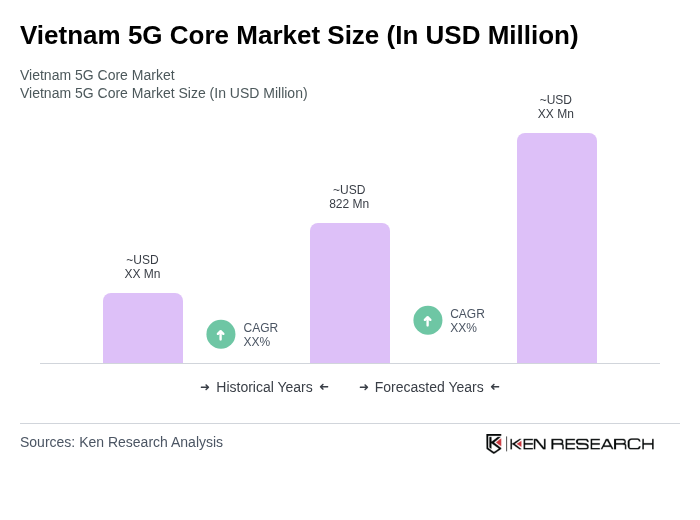
- The Vietnam 5G Core Market is valued at approximately USD 822 million, based on a five-year historical analysis. This growth is primarily driven by the increasing demand for high-speed internet, the proliferation of IoT devices, and the government's push for digital transformation across various sectors. The expansion of 5G infrastructure is also supported by investments from both domestic and foreign entities, enhancing connectivity and enabling new applications. Major telecommunications operators are rapidly advancing large-scale 5G infrastructure deployment, with Viettel targeting 20,000 new base stations in 2025 alone, while VNPT and MobiFone expand coverage to commune-level access points.
- Key players in this market include major telecommunications companies such as Viettel, VNPT, and MobiFone, which dominate due to their extensive network coverage, technological advancements, and strong customer bases. These companies are strategically positioned in urban areas like Ho Chi Minh City and Hanoi, where the demand for high-speed connectivity is the highest, thus driving market growth. Viettel has pioneered the nation's first commercial 5G rollout, achieving broad coverage across all provinces and major cities, with particular emphasis on key economic and social hubs such as industrial parks, airports, seaports, hospitals, and educational institutions.
- The Vietnamese government has established a comprehensive regulatory framework to promote the development of 5G technology, which includes a roadmap for spectrum allocation and guidelines for infrastructure deployment. Prime Minister Pham Minh Chinh's Directive 05/CT-TTg (March 2025) emphasized 5G commercialization and broadband expansion as key drivers of economic growth. In March 2024, Vietnam commenced its highly anticipated 5G spectrum auction, open to all telecom operators, featuring the B1 2500-2600 MHz band and additional auctions for other bands including 2.6 GHz, 3.5 GHz, and 700 MHz. This initiative aims to facilitate the rollout of 5G services nationwide, ensuring that the technology is accessible to both urban and rural populations, thereby fostering economic growth and innovation.
Vietnam 5G Core Market Segmentation
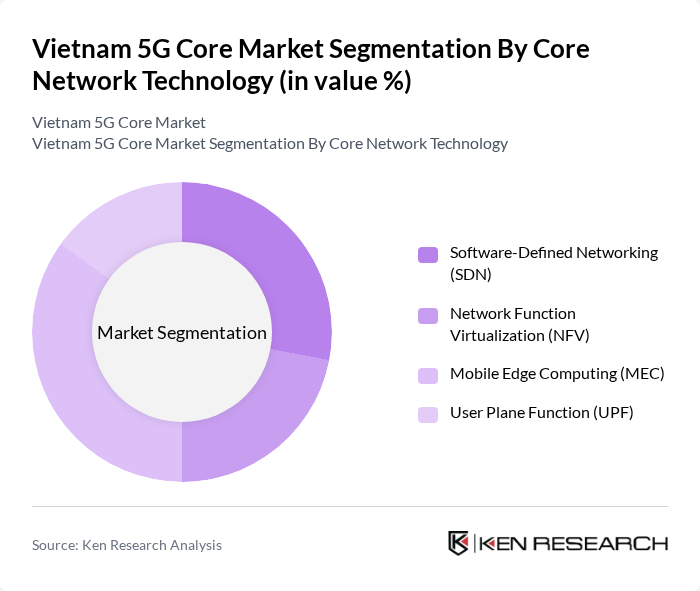
By Core Network Technology:The core network technology segment includes various technologies that enable the functioning of 5G networks. The subsegments are Software-Defined Networking (SDN), Network Function Virtualization (NFV), Mobile Edge Computing (MEC), and User Plane Function (UPF). Mobile Edge Computing (MEC) has emerged as the dominant core network technology segment, driven by the demand for low-latency, high-bandwidth applications. MEC enables innovative use cases and services in various industries, including smart cities, autonomous vehicles, healthcare, and industrial automation. Each of these technologies plays a crucial role in enhancing network efficiency, flexibility, and scalability, which are essential for supporting the growing demand for 5G services.
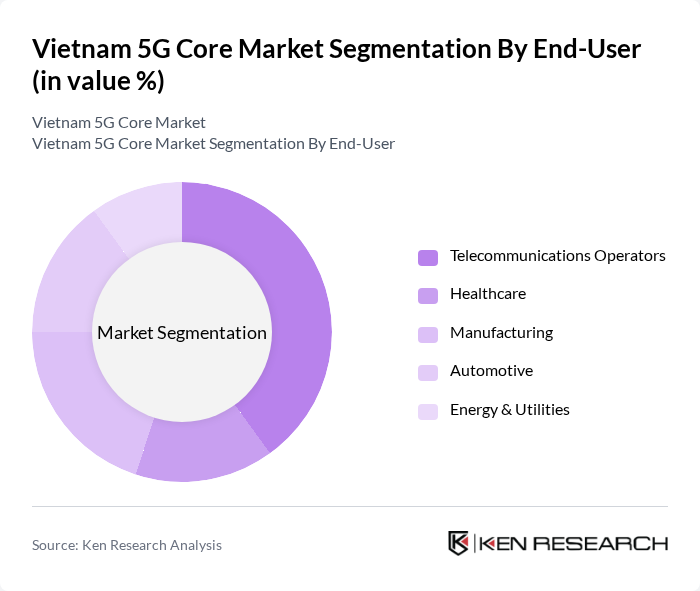
By End-User:The end-user segment encompasses various industries that utilize 5G technology, including Telecommunications Operators, Healthcare, Manufacturing, Automotive, and Energy & Utilities. Each sector leverages 5G capabilities to enhance operational efficiency, improve service delivery, and enable innovative applications that were previously not feasible with older network technologies. Telecommunications firms like MobiFone are expanding 5G-AI integrated B2B portfolios with over 100 digital solutions spanning industrial automation, healthcare, energy, education, and smart city applications.
Vietnam 5G Core Market Competitive Landscape
The Vietnam 5G Core Market is characterized by a dynamic mix of regional and international players. Leading participants such as Viettel Group, VNPT (Vietnam Posts and Telecommunications Group), MobiFone, FPT Telecom, CMC Telecom, Saigon Cable Television (SCTV), Viettel Network, Vietnam Multimedia Corporation (VTC), NetNam, Bkav Corporation, HPT Vietnam, FPT Software, CMC Corporation, VNG Corporation, and Mobifone Technology Solutions contribute to innovation, geographic expansion, and service delivery in this space. Vietnam has emerged as a regional leader in Open RAN implementation, with Viettel High Technology commercially launching the world's first Open RAN-based 5G network using Qualcomm platforms, with over 300 live sites deployed and plans to scale the rollout to thousands of sites across Vietnam and international markets.
Vietnam 5G Core Market Industry Analysis
Growth Drivers
- Increasing Demand for High-Speed Internet:The demand for high-speed internet in Vietnam is surging, with the number of broadband subscriptions reaching approximately 17 million in future. This figure is projected to grow as urbanization increases, with the urban population expected to rise to 48% in future. The World Bank reports that internet penetration in Vietnam is around 75%, indicating a significant market potential for 5G services to meet the growing consumer expectations for faster connectivity.
- Government Initiatives for Digital Transformation:The Vietnamese government has committed to investing $1.8 billion in digital infrastructure in future, aiming to enhance the country's digital economy. This initiative aligns with the national strategy to increase the contribution of the digital economy to GDP from 8% in future to 22% in future. Such government support is crucial for the development and deployment of 5G technology, facilitating a robust digital ecosystem.
- Expansion of IoT Applications:The Internet of Things (IoT) market in Vietnam is expected to reach $3 billion in future, driven by the increasing adoption of smart devices across various sectors. With over 35 million connected devices reported in future, the demand for 5G technology to support these applications is critical. Enhanced connectivity will enable real-time data processing and analytics, fostering innovation in sectors such as agriculture, healthcare, and smart cities.
Market Challenges
- High Infrastructure Costs:The deployment of 5G infrastructure in Vietnam is hindered by high costs, estimated at around $3.5 billion for comprehensive network rollout. This includes expenses related to upgrading existing towers and building new ones. With the average revenue per user (ARPU) in the telecom sector at approximately $6.00, operators face challenges in justifying these investments without substantial increases in user adoption and revenue.
- Regulatory Hurdles:Regulatory challenges pose significant barriers to the 5G rollout in Vietnam. The licensing process for telecom operators can take up to 10 months, delaying network deployment. Additionally, spectrum allocation policies are still evolving, with only 120 MHz of spectrum allocated for 5G as of future. This limited availability can restrict operators' ability to provide comprehensive 5G services, impacting overall market growth.
Vietnam 5G Core Market Future Outlook
The future of the Vietnam 5G core market appears promising, driven by increasing investments in telecom infrastructure and the government's commitment to digital transformation. As urbanization accelerates and consumer demand for high-speed internet rises, the adoption of 5G technology is expected to expand significantly. Furthermore, the integration of advanced technologies such as edge computing and network slicing will enhance service delivery, positioning Vietnam as a competitive player in the regional digital economy landscape.
Market Opportunities
- Development of Smart Cities:The Vietnamese government plans to invest $1.2 billion in smart city projects in future, creating opportunities for 5G technology to support urban infrastructure. Enhanced connectivity will facilitate efficient public services, traffic management, and energy consumption, driving demand for 5G solutions in urban areas.
- Partnerships with Tech Companies:Collaborations between telecom operators and technology firms can accelerate 5G deployment. With over 250 tech startups in Vietnam, partnerships can leverage innovative solutions to enhance service offerings. Such collaborations are expected to drive the development of new applications, particularly in sectors like healthcare and education, fostering market growth.
Scope of the Report
| Segment | Sub-Segments |
|---|---|
| By Core Network Technology | Software-Defined Networking (SDN) Network Function Virtualization (NFV) Mobile Edge Computing (MEC) User Plane Function (UPF) |
| By End-User | Telecommunications Operators Healthcare Manufacturing Automotive Energy & Utilities |
| By Region | Northern Vietnam Central Vietnam Southern Vietnam |
| By Deployment Model | Public 5G Core Networks Private 5G Core Networks Hybrid Deployment |
| By Application | Smart Cities Connected Vehicles Industrial Automation Remote Work & Education |
| By Investment Source | Domestic Investment Foreign Direct Investment (FDI) Public-Private Partnerships (PPP) |
| By Policy Support | Government Subsidies Tax Incentives Regulatory Support Others |
Key Target Audience
Investors and Venture Capitalist Firms
Government and Regulatory Bodies (e.g., Ministry of Information and Communications, Vietnam Telecommunications Authority)
Telecommunications Network Operators
Infrastructure Providers
Technology Solution Developers
Telecom Equipment Manufacturers
Industry Associations (e.g., Vietnam Internet Association)
Financial Institutions
Players Mentioned in the Report:
Viettel Group
VNPT (Vietnam Posts and Telecommunications Group)
MobiFone
FPT Telecom
CMC Telecom
Saigon Cable Television (SCTV)
Viettel Network
Vietnam Multimedia Corporation (VTC)
NetNam
Bkav Corporation
HPT Vietnam
FPT Software
CMC Corporation
VNG Corporation
Mobifone Technology Solutions
Table of Contents
Market Assessment Phase
1. Executive Summary and Approach
2. Vietnam 5G Core Market Overview
2.1 Key Insights and Strategic Recommendations
2.2 Vietnam 5G Core Market Overview
2.3 Definition and Scope
2.4 Evolution of Market Ecosystem
2.5 Timeline of Key Regulatory Milestones
2.6 Value Chain & Stakeholder Mapping
2.7 Business Cycle Analysis
2.8 Policy & Incentive Landscape
3. Vietnam 5G Core Market Analysis
3.1 Growth Drivers
3.1.1 Increasing demand for high-speed internet
3.1.2 Government initiatives for digital transformation
3.1.3 Expansion of IoT applications
3.1.4 Rise in mobile data consumption
3.2 Market Challenges
3.2.1 High infrastructure costs
3.2.2 Regulatory hurdles
3.2.3 Limited consumer awareness
3.2.4 Competition from alternative technologies
3.3 Market Opportunities
3.3.1 Development of smart cities
3.3.2 Partnerships with tech companies
3.3.3 Expansion into rural areas
3.3.4 Enhanced mobile gaming and streaming services
3.4 Market Trends
3.4.1 Increased investment in telecom infrastructure
3.4.2 Adoption of network slicing
3.4.3 Growth of edge computing
3.4.4 Focus on sustainability in network operations
3.5 Government Regulation
3.5.1 Licensing requirements for telecom operators
3.5.2 Spectrum allocation policies
3.5.3 Data privacy regulations
3.5.4 Compliance with international standards
4. SWOT Analysis
5. Stakeholder Analysis
6. Porter's Five Forces Analysis
7. Vietnam 5G Core Market Market Size, 2019-2024
7.1 By Value
7.2 By Volume
7.3 By Average Selling Price
8. Vietnam 5G Core Market Segmentation
8.1 By Core Network Technology
8.1.1 Software-Defined Networking (SDN)
8.1.2 Network Function Virtualization (NFV)
8.1.3 Mobile Edge Computing (MEC)
8.1.4 User Plane Function (UPF)
8.2 By End-User
8.2.1 Telecommunications Operators
8.2.2 Healthcare
8.2.3 Manufacturing
8.2.4 Automotive
8.2.5 Energy & Utilities
8.3 By Region
8.3.1 Northern Vietnam
8.3.2 Central Vietnam
8.3.3 Southern Vietnam
8.4 By Deployment Model
8.4.1 Public 5G Core Networks
8.4.2 Private 5G Core Networks
8.4.3 Hybrid Deployment
8.5 By Application
8.5.1 Smart Cities
8.5.2 Connected Vehicles
8.5.3 Industrial Automation
8.5.4 Remote Work & Education
8.6 By Investment Source
8.6.1 Domestic Investment
8.6.2 Foreign Direct Investment (FDI)
8.6.3 Public-Private Partnerships (PPP)
8.7 By Policy Support
8.7.1 Government Subsidies
8.7.2 Tax Incentives
8.7.3 Regulatory Support
8.7.4 Others
9. Vietnam 5G Core Market Competitive Analysis
9.1 Market Share of Key Players
9.2 Cross Comparison of Key Players
9.2.1 Company Name
9.2.2 Market Capitalization (USD Billion)
9.2.3 Revenue Growth Rate (YoY %)
9.2.4 5G Core Network Coverage (% Population)
9.2.5 Capital Expenditure on 5G Infrastructure (USD Million)
9.2.6 Network Uptime & Reliability (%)
9.2.7 Customer Base (Millions)
9.2.8 Average Revenue Per User (ARPU - USD)
9.2.9 Churn Rate (%)
9.2.10 Open RAN Deployment Status
9.3 SWOT Analysis of Top Players
9.4 Pricing Analysis
9.5 Detailed Profile of Major Companies
9.5.1 Viettel Group
9.5.2 VNPT (Vietnam Posts and Telecommunications Group)
9.5.3 MobiFone
9.5.4 FPT Telecom
9.5.5 CMC Telecom
9.5.6 Saigon Cable Television (SCTV)
9.5.7 Viettel Network
9.5.8 Vietnam Multimedia Corporation (VTC)
9.5.9 NetNam
9.5.10 Bkav Corporation
9.5.11 HPT Vietnam
9.5.12 FPT Software
9.5.13 CMC Corporation
9.5.14 VNG Corporation
9.5.15 Mobifone Technology Solutions
10. Vietnam 5G Core Market End-User Analysis
10.1 Procurement Behavior of Key Ministries
10.1.1 Ministry of Information and Communications
10.1.2 Ministry of Industry and Trade
10.1.3 Ministry of Science and Technology
10.2 Corporate Spend on Infrastructure & Energy
10.2.1 Telecom Infrastructure Investments
10.2.2 Energy Consumption Trends
10.3 Pain Point Analysis by End-User Category
10.3.1 Telecommunications Providers
10.3.2 Enterprises
10.3.3 Government Agencies
10.4 User Readiness for Adoption
10.4.1 Awareness Levels
10.4.2 Training Needs
10.5 Post-Deployment ROI and Use Case Expansion
10.5.1 ROI Measurement Techniques
10.5.2 Use Case Development
11. Vietnam 5G Core Market Future Size, 2025-2030
11.1 By Value
11.2 By Volume
11.3 By Average Selling Price
Go-To-Market Strategy Phase
1. Whitespace Analysis + Business Model Canvas
1.1 Market Gaps Identification
1.2 Business Model Development
2. Marketing and Positioning Recommendations
2.1 Branding Strategies
2.2 Product USPs
3. Distribution Plan
3.1 Urban Retail Strategies
3.2 Rural NGO Tie-ups
4. Channel & Pricing Gaps
4.1 Underserved Routes
4.2 Pricing Bands
5. Unmet Demand & Latent Needs
5.1 Category Gaps
5.2 Consumer Segments
6. Customer Relationship
6.1 Loyalty Programs
6.2 After-sales Service
7. Value Proposition
7.1 Sustainability Initiatives
7.2 Integrated Supply Chains
8. Key Activities
8.1 Regulatory Compliance
8.2 Branding Efforts
8.3 Distribution Setup
9. Entry Strategy Evaluation
9.1 Domestic Market Entry Strategy
9.1.1 Product Mix
9.1.2 Pricing Band
9.1.3 Packaging
9.2 Export Entry Strategy
9.2.1 Target Countries
9.2.2 Compliance Roadmap
10. Entry Mode Assessment
10.1 Joint Ventures
10.2 Greenfield Investments
10.3 Mergers & Acquisitions
10.4 Distributor Model
11. Capital and Timeline Estimation
11.1 Capital Requirements
11.2 Timelines
12. Control vs Risk Trade-Off
12.1 Ownership vs Partnerships
13. Profitability Outlook
13.1 Breakeven Analysis
13.2 Long-term Sustainability
14. Potential Partner List
14.1 Distributors
14.2 Joint Ventures
14.3 Acquisition Targets
15. Execution Roadmap
15.1 Phased Plan for Market Entry
15.1.1 Market Setup
15.1.2 Market Entry
15.1.3 Growth Acceleration
15.1.4 Scale & Stabilize
15.2 Key Activities and Milestones
15.2.1 Activity Planning
15.2.2 Milestone Tracking
Research Methodology
Phase 1: Approach1
Desk Research
- Analysis of government publications and reports on 5G infrastructure development in Vietnam
- Review of industry white papers and market analysis reports from telecommunications authorities
- Examination of academic journals and conference proceedings related to 5G technology and its applications
Primary Research
- Interviews with key stakeholders in the telecommunications sector, including network operators and service providers
- Surveys targeting technology adoption specialists and regulatory bodies involved in 5G deployment
- Field interviews with engineers and technical experts working on 5G core network solutions
Validation & Triangulation
- Cross-validation of findings through multiple data sources, including market reports and expert opinions
- Triangulation of qualitative insights from interviews with quantitative data from industry reports
- Sanity checks conducted through expert panel reviews to ensure data accuracy and relevance
Phase 2: Market Size Estimation1
Top-down Assessment
- Estimation of the overall telecommunications market size in Vietnam and its growth trajectory
- Segmentation of the 5G core market by application areas such as IoT, smart cities, and enhanced mobile broadband
- Incorporation of government initiatives and investments in 5G infrastructure as a growth driver
Bottom-up Modeling
- Collection of data on current 5G core network deployments and their capacities from major telecom operators
- Estimation of revenue generation potential based on service pricing models and user adoption rates
- Volume x pricing analysis to derive market size for various 5G services and applications
Forecasting & Scenario Analysis
- Multi-factor regression analysis incorporating variables such as smartphone penetration and data consumption trends
- Scenario modeling based on regulatory changes, technological advancements, and competitive landscape shifts
- Development of baseline, optimistic, and pessimistic forecasts for the 5G core market through 2030
Phase 3: CATI Sample Composition1
| Scope Item/Segment | Sample Size | Target Respondent Profiles |
|---|---|---|
| Telecom Operators | 45 | Network Engineers, Operations Managers |
| Government Regulatory Bodies | 25 | Policy Makers, Regulatory Analysts |
| Technology Vendors | 35 | Product Managers, Sales Directors |
| Enterprise Users of 5G | 30 | IT Managers, Business Development Executives |
| Research Institutions | 15 | Academic Researchers, Industry Analysts |
Frequently Asked Questions
What is the current value of the Vietnam 5G Core Market?
The Vietnam 5G Core Market is valued at approximately USD 822 million, reflecting significant growth driven by high-speed internet demand, IoT proliferation, and government initiatives for digital transformation across various sectors.
Who are the major players in the Vietnam 5G Core Market?
What technologies are included in the Vietnam 5G Core Market?
What are the growth drivers for the Vietnam 5G Core Market?
Other Regional/Country Reports
Other Adjacent Reports
Qatar Mobile Edge Computing Market
Global Software-Defined Networking Market Size, Share & Forecast, By Solution Type, Deployment Model & End-Use Industry, 2026-2031UAE Network Function Virtualization Market
India Internet of Things Market Size, Share & Forecast, By Solution Type, End-Use Industry & Application, 2026-2031Kuwait smart cities market Size, Share, Growth Drivers, Trends, Opportunities & Forecast 2025–2030Malaysia Healthcare Technology Market
India Industrial Automation Market Size, Share & Forecast, By Solution Type, Deployment Model & End-Use Industry, 2026-2031Kuwait Automotive Electronics (ECUs, Sensors, Controllers) Market Size, Share, Growth Drivers, Trends, Opportunities, Competitive Landscape & Forecast 2025–2030Singapore Energy Management Systems Market
Belgium Telecommunications Infrastructure Market
Why Buy From Us?

What makes us stand out is that our consultants follow Robust, Refine and Result (RRR) methodology. Robust for clear definitions, approaches and sanity checking, Refine for differentiating respondents' facts and opinions, and Result for presenting data with story.

We have set a benchmark in the industry by offering our clients with syndicated and customized market research reports featuring coverage of entire market as well as meticulous research and analyst insights.

While we don't replace traditional research, we flip the method upside down. Our dual approach of Top Bottom & Bottom Top ensures quality deliverable by not just verifying company fundamentals but also looking at the sector and macroeconomic factors.

With one step in the future, our research team constantly tries to show you the bigger picture. We help with some of the tough questions you may encounter along the way: How is the industry positioned? Best marketing channel? KPI's of competitors? By aligning every element, we help maximize success.

Our report gives you instant access to the answers and sources that other companies might choose to hide. We elaborate each steps of research methodology we have used and showcase you the sample size to earn your trust.

If you need any support, we are here! We pride ourselves on universe strength, data quality, and quick, friendly, and professional service.