About the Report
Base Year 2024Listen to the audio summary
Australia Digital Therapeutics Market Overview
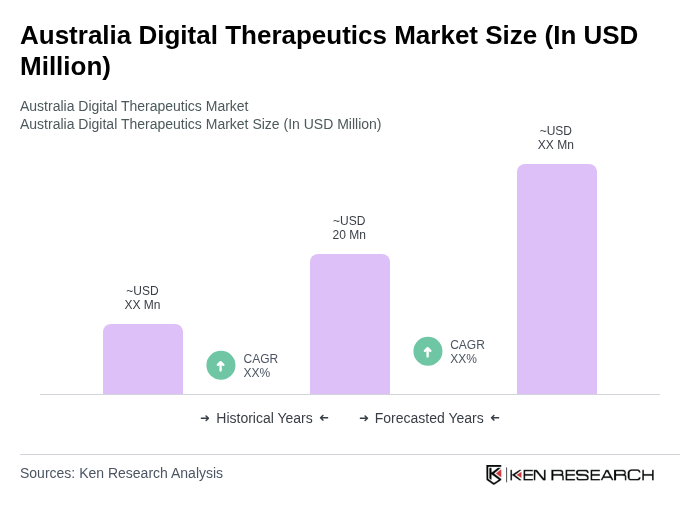
- The Australia Digital Therapeutics Market is valued at USD 20 million, based on a five-year historical analysis. This growth is primarily driven by the increasing prevalence of chronic diseases such as diabetes, cardiovascular disease, and mental health conditions, rising healthcare costs, and the growing acceptance of digital health solutions among patients and healthcare providers. The market is also supported by advancements in mobile health apps, connected devices, cloud platforms, and data analytics, which enhance the effectiveness, personalization, and accessibility of digital therapeutics.
- Key cities dominating the market include Sydney, Melbourne, and Brisbane. These cities are hubs for healthcare innovation and technology, with a strong presence of healthcare institutions, research organizations, digital health accelerators, and tech startups that are active in telehealth, remote monitoring, and digital therapeutics. The concentration of skilled professionals, academic medical centers, and sustained investment in digital health and virtual care initiatives further solidifies their dominance in the digital therapeutics landscape.
- In 2023, the Australian government advanced the National Digital Health Strategy through the work of the Australian Digital Health Agency, which aims to integrate digital health solutions into the healthcare system. Key initiatives include the nationwide My Health Record platform, expansion of telehealth Medicare Benefits Schedule items, and support for virtual care models, all of which create an enabling environment for evidence?based digital therapeutics. Regulatory oversight relevant to software-based therapeutics is provided by the Therapeutic Goods (Medical Devices) Regulations 2002 issued by the Australian Government, under which software-based medical devices and certain digital therapeutic applications are classified, assessed, and included in the Australian Register of Therapeutic Goods, with requirements around safety, performance, clinical evidence, and post?market monitoring.
Australia Digital Therapeutics Market Segmentation
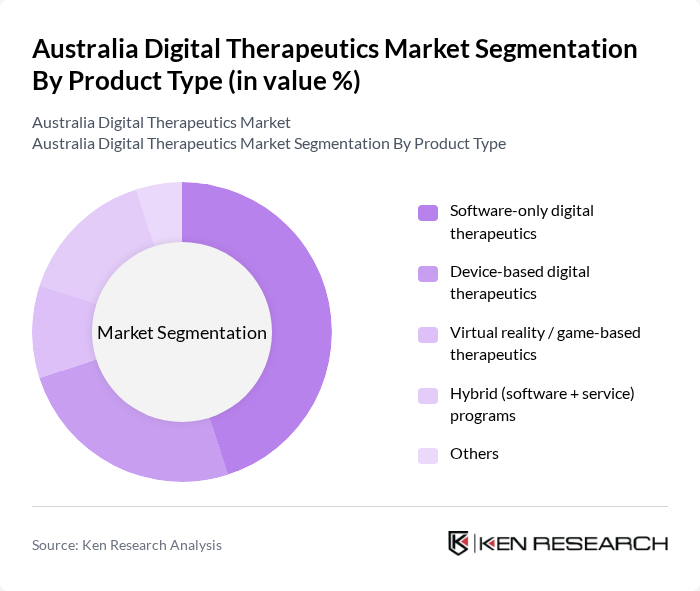
By Product Type:The product type segmentation includes various forms of digital therapeutics, each catering to different user needs and care delivery models. The dominant sub-segment in terms of current revenue is software-only digital therapeutics delivered via mobile apps and web platforms, which are widely adopted due to their ease of use, low marginal cost, and ability to be scaled across large patient populations. Device-based digital therapeutics, including connected sensors and wearables paired with therapeutic software, are also gaining traction, particularly among users seeking integrated solutions for diabetes, sleep apnea, and cardiovascular risk management. Virtual reality and game-based therapeutics are emerging as innovative options, especially in mental health, pain management, and cognitive training, where immersive environments can support behavioral change and symptom reduction. Hybrid programs that combine software and human-led services (such as coaching, telehealth consults, and multidisciplinary care teams) are increasingly popular, offering personalized, continuous support and higher engagement for chronic disease and weight management programs.
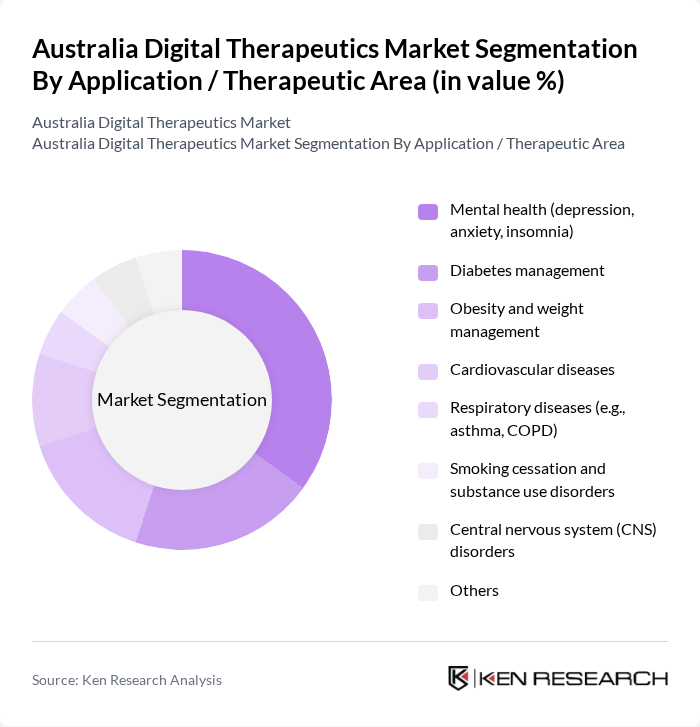
By Application / Therapeutic Area:The application segmentation highlights the various therapeutic areas where digital therapeutics are applied. Mental health is a leading application area globally and in Australia, supported by strong adoption of telepsychiatry, mindfulness and CBT-based apps, and virtual care models addressing depression, anxiety, and insomnia. Diabetes management represents the largest single revenue-generating application segment in the Australia digital therapeutics market, reflecting the high burden of diabetes and the strong evidence base for digital interventions in glycemic control and self-management. Obesity and weight management are also significant areas, driven by lifestyle-related risk factors and the use of app-based coaching, nutrition tracking, and behavior-change programs. Other applications, such as cardiovascular diseases, respiratory diseases (including asthma and COPD), smoking cessation, and central nervous system disorders, are gaining attention as digital solutions become more integrated into standard care pathways and are increasingly used alongside pharmacotherapy and in remote monitoring programs.
Australia Digital Therapeutics Market Competitive Landscape
The Australia Digital Therapeutics Market is characterized by a dynamic mix of regional and international players. Leading participants such as ResMed, Teladoc Health, Welldoc, DarioHealth, Noom, Big Health, Akili Interactive, Omada Health, SilverCloud Health (Amwell), Headspace Health, mySugr (Roche), Mindset Health (Australia), Hello Sunday Morning / Daybreak (Australia), Coviu (Australia), Woebot Health contribute to innovation, geographic expansion, and service delivery in this space.
Australia Digital Therapeutics Market Industry Analysis
Growth Drivers
- Increasing Prevalence of Chronic Diseases:The Australian healthcare system is facing a significant burden from chronic diseases, with approximately 50% of adults living with at least one chronic condition. This statistic translates to around 12 million individuals, highlighting the urgent need for effective management solutions. Digital therapeutics can provide scalable interventions, improving patient outcomes and reducing healthcare costs, which are projected to reach AUD 241 billion in future, according to the Australian Institute of Health and Welfare.
- Rising Demand for Personalized Medicine:The shift towards personalized medicine is gaining momentum in Australia, with the market for personalized healthcare expected to reach substantial multibillion AUD levels in future. This growth is driven by advancements in genomics and biotechnology, allowing for tailored treatment plans. Digital therapeutics play a crucial role in this landscape, offering customized interventions that align with individual patient profiles, thereby enhancing treatment efficacy and patient engagement.
- Growing Acceptance of Digital Health Solutions:The acceptance of digital health solutions among Australian consumers is on the rise, with over 70% of the population expressing willingness to use digital therapeutics for health management in future. This trend is supported by increased smartphone penetration, which stands at approximately 88%, and the proliferation of health apps. As more Australians embrace technology for health monitoring, the demand for digital therapeutics is expected to surge, fostering innovation and investment in this sector.
Market Challenges
- Regulatory Hurdles:Navigating the regulatory landscape poses a significant challenge for digital therapeutics in Australia. The Therapeutic Goods Administration (TGA) has stringent guidelines that require extensive clinical evidence for product approval. As of now, only 15% of digital health products have received TGA approval, creating barriers for new entrants. This slow approval process can hinder innovation and delay the availability of potentially beneficial therapies to patients.
- Limited Reimbursement Policies:The lack of comprehensive reimbursement policies for digital therapeutics remains a critical challenge. Currently, only 20% of digital health solutions are covered under Medicare, limiting patient access and adoption. As healthcare costs continue to rise, the need for clear reimbursement pathways is essential to encourage investment and ensure that patients can benefit from these innovative therapies without incurring significant out-of-pocket expenses.
Australia Digital Therapeutics Market Future Outlook
The future of the digital therapeutics market in Australia appears promising, driven by technological advancements and increasing healthcare demands. As the population ages and chronic disease prevalence rises, the integration of digital solutions into traditional healthcare systems will likely accelerate. Furthermore, ongoing collaborations between tech companies and healthcare providers are expected to enhance the development of innovative therapies, ensuring that digital health solutions become a standard part of patient care, ultimately improving health outcomes across the nation.
Market Opportunities
- Expansion into Rural Healthcare:There is a significant opportunity to expand digital therapeutics into rural areas, where access to healthcare services is limited. Approximately 28% of Australians live in areas classified as outer regional, remote, or very remote, often facing challenges in receiving timely medical care. Digital solutions can bridge this gap, providing remote monitoring and treatment options that enhance healthcare accessibility and equity.
- Integration with Wearable Technology:The integration of digital therapeutics with wearable technology presents a lucrative opportunity. With over 5 million Australians using wearable devices in future, combining these technologies can facilitate real-time health monitoring and personalized interventions. This synergy can lead to improved patient engagement and adherence to treatment plans, ultimately enhancing health outcomes and reducing healthcare costs.
Scope of the Report
| Segment | Sub-Segments |
|---|---|
| By Product Type | Software-only digital therapeutics Device-based digital therapeutics Virtual reality / game-based therapeutics Hybrid (software + service) programs Others |
| By Application / Therapeutic Area | Diabetes management Obesity and weight management Cardiovascular diseases Respiratory diseases (e.g., asthma, COPD) Mental health (depression, anxiety, insomnia) Smoking cessation and substance use disorders Central nervous system (CNS) disorders Others |
| By End-User | Patients / individuals Providers (hospitals, clinics, practitioners) Payers (private health insurers, government schemes) Employers and corporate wellness programs Pharmaceutical and medtech companies Others |
| By Sales / Distribution Channel | Business-to-consumer (B2C) Business-to-business (B2B) Hybrid and partnership-led models Others |
| By Revenue Model | Subscription (SaaS) One-time license / purchase Outcome / value-based contracts Freemium and in-app purchases Others |
| By Technology | Artificial intelligence and machine learning Connected devices and Internet of Things (IoT) Virtual and augmented reality Cloud-based platforms Others |
| By Care Setting | Home and remote care Primary care Specialty clinics Community and rural health settings Others |
Key Target Audience
Investors and Venture Capitalist Firms
Government and Regulatory Bodies (e.g., Therapeutic Goods Administration, Australian Digital Health Agency)
Healthcare Providers and Practitioners
Pharmaceutical Companies
Health Insurance Companies
Technology Providers and Software Developers
Clinical Research Organizations
Health Technology Assessment Bodies
Players Mentioned in the Report:
ResMed
Teladoc Health
Welldoc
DarioHealth
Noom
Big Health
Akili Interactive
Omada Health
SilverCloud Health (Amwell)
Headspace Health
mySugr (Roche)
Mindset Health (Australia)
Hello Sunday Morning / Daybreak (Australia)
Coviu (Australia)
Woebot Health
Table of Contents
Market Assessment Phase
1. Executive Summary and Approach
2. Australia Digital Therapeutics Market Overview
2.1 Key Insights and Strategic Recommendations
2.2 Australia Digital Therapeutics Market Overview
2.3 Definition and Scope
2.4 Evolution of Market Ecosystem
2.5 Timeline of Key Regulatory Milestones
2.6 Value Chain & Stakeholder Mapping
2.7 Business Cycle Analysis
2.8 Policy & Incentive Landscape
3. Australia Digital Therapeutics Market Analysis
3.1 Growth Drivers
3.1.1 Increasing prevalence of chronic diseases
3.1.2 Rising demand for personalized medicine
3.1.3 Growing acceptance of digital health solutions
3.1.4 Supportive government initiatives
3.2 Market Challenges
3.2.1 Regulatory hurdles
3.2.3 Limited reimbursement policies
3.2.4 High competition among players
3.3 Market Opportunities
3.3.1 Expansion into rural healthcare
3.3.2 Integration with wearable technology
3.3.3 Collaborations with healthcare providers
3.3.4 Development of new therapeutic areas
3.4 Market Trends
3.4.1 Increased focus on mental health solutions
3.4.2 Adoption of AI and machine learning
3.4.3 Shift towards preventive healthcare
3.4.4 Rise of mobile health applications
3.5 Government Regulation
3.5.1 Therapeutic Goods Administration (TGA) guidelines
3.5.2 Privacy Act compliance
3.5.3 Digital Health Strategy initiatives
3.5.4 Medicare funding for digital therapies
4. SWOT Analysis
5. Stakeholder Analysis
6. Porter's Five Forces Analysis
7. Australia Digital Therapeutics Market Market Size, 2019-2024
7.1 By Value
7.2 By Volume
7.3 By Average Selling Price
8. Australia Digital Therapeutics Market Segmentation
8.1 By Product Type
8.1.1 Software-only digital therapeutics
8.1.2 Device-based digital therapeutics
8.1.3 Virtual reality / game-based therapeutics
8.1.4 Hybrid (software + service) programs
8.1.5 Others
8.2 By Application / Therapeutic Area
8.2.1 Diabetes management
8.2.2 Obesity and weight management
8.2.3 Cardiovascular diseases
8.2.4 Respiratory diseases (e.g., asthma, COPD)
8.2.5 Mental health (depression, anxiety, insomnia)
8.2.6 Smoking cessation and substance use disorders
8.2.7 Central nervous system (CNS) disorders
8.2.8 Others
8.3 By End-User
8.3.1 Patients / individuals
8.3.2 Providers (hospitals, clinics, practitioners)
8.3.3 Payers (private health insurers, government schemes)
8.3.4 Employers and corporate wellness programs
8.3.5 Pharmaceutical and medtech companies
8.3.6 Others
8.4 By Sales / Distribution Channel
8.4.1 Business-to-consumer (B2C)
8.4.2 Business-to-business (B2B)
8.4.3 Hybrid and partnership-led models
8.4.4 Others
8.5 By Revenue Model
8.5.1 Subscription (SaaS)
8.5.2 One-time license / purchase
8.5.3 Outcome / value-based contracts
8.5.4 Freemium and in-app purchases
8.5.5 Others
8.6 By Technology
8.6.1 Artificial intelligence and machine learning
8.6.2 Connected devices and Internet of Things (IoT)
8.6.3 Virtual and augmented reality
8.6.4 Cloud-based platforms
8.6.5 Others
8.7 By Care Setting
8.7.1 Home and remote care
8.7.2 Primary care
8.7.3 Specialty clinics
8.7.4 Community and rural health settings
8.7.5 Others
9. Australia Digital Therapeutics Market Competitive Analysis
9.1 Market Share of Key Players
9.2 Cross Comparison of Key Players
9.2.1 Company name
9.2.2 Stage and scale (startup, growth, established)
9.2.3 Annual recurring revenue (ARR)
9.2.4 Year-on-year revenue growth rate
9.2.5 Active paying users / covered lives in Australia
9.2.6 Customer acquisition cost (CAC)
9.2.7 Customer lifetime value (LTV)
9.2.8 Monthly active users (MAU) and retention / churn rate
9.2.9 Average revenue per user (ARPU)
9.2.10 Number of reimbursed / prescription products (TGA-listed, MBS-linked)
9.2.11 Number of enterprise contracts (payers, providers, employers)
9.2.12 R&D intensity (% of revenue spent on product development)
9.3 SWOT Analysis of Top Players
9.4 Pricing Analysis
9.5 Detailed Profile of Major Companies
9.5.1 ResMed
9.5.2 Teladoc Health
9.5.3 Welldoc
9.5.4 DarioHealth
9.5.5 Noom
9.5.6 Big Health
9.5.7 Akili Interactive
9.5.8 Omada Health
9.5.9 SilverCloud Health (Amwell)
9.5.10 Headspace Health
9.5.11 mySugr (Roche)
9.5.12 Mindset Health (Australia)
9.5.13 Hello Sunday Morning / Daybreak (Australia)
9.5.14 Coviu (Australia)
9.5.15 Woebot Health
10. Australia Digital Therapeutics Market End-User Analysis
10.1 Procurement Behavior of Key Ministries
10.1.1 Budget allocation for digital health
10.1.2 Decision-making processes
10.1.3 Evaluation criteria for digital solutions
10.1.4 Collaboration with private sector
10.2 Corporate Spend on Infrastructure & Energy
10.2.1 Investment in digital health infrastructure
10.2.2 Funding for research and development
10.2.3 Partnerships with technology firms
10.2.4 Budgeting for employee wellness programs
10.3 Pain Point Analysis by End-User Category
10.3.1 Access to care
10.3.2 Cost of treatment
10.3.3 Quality of care
10.3.4 Integration with existing systems
10.4 User Readiness for Adoption
10.4.1 Awareness of digital therapeutics
10.4.2 Training and support needs
10.4.3 Attitudes towards technology
10.4.4 Infrastructure readiness
10.5 Post-Deployment ROI and Use Case Expansion
10.5.1 Measurement of health outcomes
10.5.2 User satisfaction surveys
10.5.3 Cost savings analysis
10.5.4 Opportunities for scaling solutions
11. Australia Digital Therapeutics Market Future Size, 2025-2030
11.1 By Value
11.2 By Volume
11.3 By Average Selling Price
Go-To-Market Strategy Phase
1. Whitespace Analysis + Business Model Canvas
1.1 Market gaps identification
1.2 Value proposition development
1.3 Revenue model exploration
1.4 Customer segmentation analysis
1.5 Competitive landscape overview
1.6 Key partnerships identification
1.7 Risk assessment
2. Marketing and Positioning Recommendations
2.1 Branding strategies
2.2 Product USPs
2.3 Target audience definition
2.4 Communication channels
2.5 Marketing budget allocation
2.6 Performance metrics
2.7 Feedback mechanisms
3. Distribution Plan
3.1 Urban retail vs rural NGO tie-ups
3.2 Online vs offline distribution
3.3 Partnerships with healthcare providers
3.4 Logistics and supply chain management
3.5 Distribution channel optimization
3.6 Market entry strategies
3.7 Performance tracking
4. Channel & Pricing Gaps
4.1 Underserved routes
4.2 Pricing bands
4.3 Competitor pricing analysis
4.4 Value-based pricing strategies
4.5 Customer willingness to pay
4.6 Pricing model experimentation
4.7 Price sensitivity analysis
5. Unmet Demand & Latent Needs
5.1 Category gaps
5.2 Consumer segments
5.3 Emerging trends analysis
5.4 User feedback incorporation
5.5 Market research findings
5.6 Future demand forecasting
5.7 Product development opportunities
6. Customer Relationship
6.1 Loyalty programs
6.2 After-sales service
6.3 Customer engagement strategies
6.4 Feedback collection methods
6.5 Relationship management tools
6.6 Retention strategies
6.7 Community building initiatives
7. Value Proposition
7.1 Sustainability
7.2 Integrated supply chains
7.3 Unique selling points
7.4 Customer-centric approach
7.5 Competitive advantages
7.6 Value delivery mechanisms
7.7 Long-term benefits
8. Key Activities
8.1 Regulatory compliance
8.2 Branding
8.3 Distribution setup
8.4 Marketing execution
8.5 Performance monitoring
8.6 Stakeholder engagement
8.7 Continuous improvement
9. Entry Strategy Evaluation
9.1 Domestic Market Entry Strategy
9.1.1 Product mix
9.1.2 Pricing band
9.1.3 Packaging
9.2 Export Entry Strategy
9.2.1 Target countries
9.2.2 Compliance roadmap
10. Entry Mode Assessment
10.1 JV
10.2 Greenfield
10.3 M&A
10.4 Distributor Model
11. Capital and Timeline Estimation
11.1 Capital requirements
11.2 Timelines
12. Control vs Risk Trade-Off
12.1 Ownership vs Partnerships
13. Profitability Outlook
13.1 Breakeven analysis
13.2 Long-term sustainability
14. Potential Partner List
14.1 Distributors
14.2 JVs
14.3 Acquisition targets
15. Execution Roadmap
15.1 Phased Plan for Market Entry
15.1.1 Market Setup
15.1.2 Market Entry
15.1.3 Growth Acceleration
15.1.4 Scale & Stabilize
15.2 Key Activities and Milestones
15.2.1 Milestone tracking
15.2.2 Activity scheduling
15.2.3 Resource allocation
Research Methodology
Phase 1: Approach1
Desk Research
- Analysis of industry reports from Australian health authorities and digital health organizations
- Review of academic publications and white papers on digital therapeutics efficacy and adoption
- Examination of market trends and forecasts from reputable market research firms
Primary Research
- Interviews with healthcare professionals specializing in digital therapeutics
- Surveys targeting patients using digital therapeutic solutions
- Focus groups with stakeholders from healthcare providers and payers
Validation & Triangulation
- Cross-validation of findings through multiple data sources, including government health statistics
- Triangulation of insights from primary interviews with secondary research data
- Sanity checks conducted through expert panel discussions and feedback sessions
Phase 2: Market Size Estimation1
Top-down Assessment
- Estimation of market size based on national healthcare expenditure and digital health adoption rates
- Segmentation of the market by therapeutic area, such as mental health, chronic disease management, and rehabilitation
- Incorporation of government initiatives promoting digital health solutions
Bottom-up Modeling
- Collection of usage data from leading digital therapeutic platforms in Australia
- Estimation of revenue based on subscription models and reimbursement rates
- Analysis of user demographics and engagement metrics to project growth
Forecasting & Scenario Analysis
- Multi-variable forecasting using trends in telehealth adoption and regulatory changes
- Scenario analysis based on potential market disruptions, such as technological advancements and policy shifts
- Development of baseline, optimistic, and pessimistic growth projections through 2030
Phase 3: CATI Sample Composition1
| Scope Item/Segment | Sample Size | Target Respondent Profiles |
|---|---|---|
| Healthcare Providers Using Digital Therapeutics | 120 | Doctors, Nurses, Health IT Specialists |
| Patients Engaged with Digital Therapeutics | 100 | Chronic Disease Patients, Mental Health Patients |
| Payers and Insurers Involved in Digital Health | 80 | Health Insurance Executives, Policy Analysts |
| Digital Therapeutics Developers | 70 | Product Managers, R&D Directors |
| Regulatory Bodies and Health Authorities | 50 | Regulatory Affairs Specialists, Public Health Officials |
Frequently Asked Questions
What is the current value of the Australia Digital Therapeutics Market?
The Australia Digital Therapeutics Market is valued at approximately USD 20 million, reflecting a significant growth driven by the rising prevalence of chronic diseases, increasing healthcare costs, and the acceptance of digital health solutions among patients and providers.
What are the main drivers of growth in the Australia Digital Therapeutics Market?
Which cities are leading in the Australia Digital Therapeutics Market?
What role does the Australian government play in the Digital Therapeutics Market?
Other Regional/Country Reports
Other Adjacent Reports
KSA Wearable Health Devices Market
GCC Health Data Analytics Market Size, Share, Growth Drivers, Trends, Opportunities & Forecast 2025–2030US personalized medicine market Size, Share, Growth Drivers, Trends, Opportunities & Forecast 2025–2030Middle East Chronic Disease Management Market Size, Share, Growth Drivers, Trends, Opportunities & Forecast 2025–2030Japan Mental Health Technology Market
Egypt Diabetes Management Market
UAE Virtual Reality Healthcare Market
Why Buy From Us?

What makes us stand out is that our consultants follow Robust, Refine and Result (RRR) methodology. Robust for clear definitions, approaches and sanity checking, Refine for differentiating respondents' facts and opinions, and Result for presenting data with story.

We have set a benchmark in the industry by offering our clients with syndicated and customized market research reports featuring coverage of entire market as well as meticulous research and analyst insights.

While we don't replace traditional research, we flip the method upside down. Our dual approach of Top Bottom & Bottom Top ensures quality deliverable by not just verifying company fundamentals but also looking at the sector and macroeconomic factors.

With one step in the future, our research team constantly tries to show you the bigger picture. We help with some of the tough questions you may encounter along the way: How is the industry positioned? Best marketing channel? KPI's of competitors? By aligning every element, we help maximize success.

Our report gives you instant access to the answers and sources that other companies might choose to hide. We elaborate each steps of research methodology we have used and showcase you the sample size to earn your trust.

If you need any support, we are here! We pride ourselves on universe strength, data quality, and quick, friendly, and professional service.