About the Report
Base Year 2024Listen to the audio summary
Japan Digital Therapeutics Market Overview
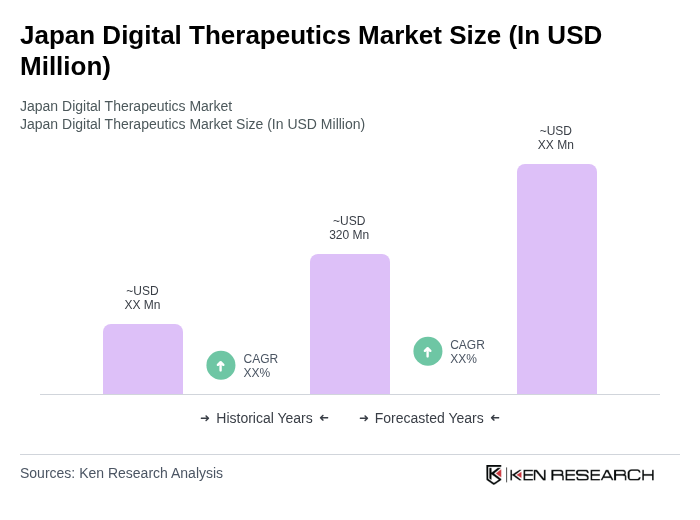
- The Japan Digital Therapeutics Market is valued at USD 320 million, based on a five-year historical analysis. This growth is primarily driven by the increasing prevalence of chronic diseases such as diabetes, cardiovascular diseases, and respiratory disorders, a growing aging population, and the rising adoption of digital health solutions among healthcare providers and patients. The integration of technology in healthcare, including artificial intelligence, machine learning, and connected devices, has led to enhanced patient engagement, remote monitoring, and improved health outcomes, further propelling market expansion.
- Tokyo and Osaka are the dominant cities in the Japan Digital Therapeutics Market due to their advanced healthcare infrastructure, high concentration of technology companies, and significant investment in health tech innovation. These cities are key parts of the Kanto and Kansai regions, which host major hospitals, academic medical centers, pharmaceutical companies, and digital health startups, serving as hubs for research and development and attracting both domestic and international players looking to capitalize on the growing demand for digital health solutions.
- In 2023, the Japanese government implemented a new regulation aimed at promoting the use of digital therapeutics in clinical settings. This regulation includes guidelines for the approval and reimbursement of digital therapeutic products, ensuring that they meet safety and efficacy standards. Specifically, digital therapeutics that fall under Software as a Medical Device are regulated under the Act on Securing Quality, Efficacy and Safety of Products Including Pharmaceuticals and Medical Devices (Pharmaceuticals and Medical Devices Act) administered by the Ministry of Health, Labour and Welfare, with approval pathways and reimbursement handled through the Pharmaceuticals and Medical Devices Agency and the national health insurance listing process. Recent policy initiatives have expanded the coverage of certain digital therapeutics, such as smoking cessation and hypertension apps, under national health insurance, encouraging innovation in the healthcare sector while providing patients with access to effective digital treatment options.
Japan Digital Therapeutics Market Segmentation
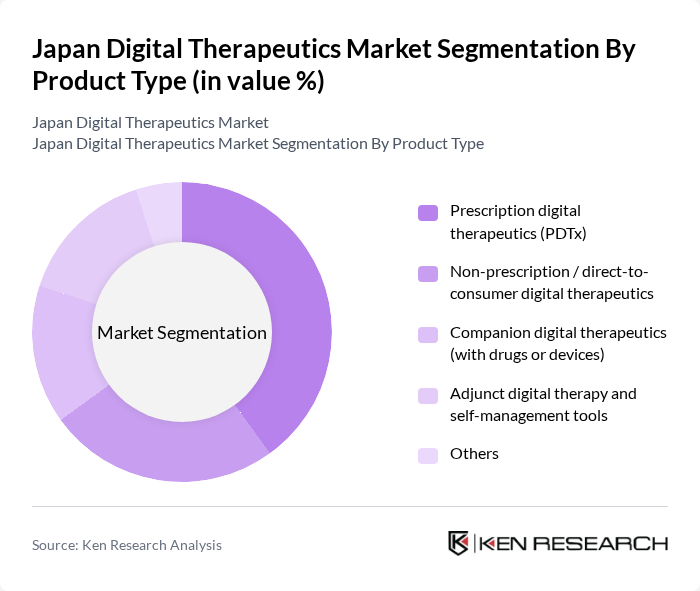
By Product Type:The product type segmentation includes various categories such as Prescription digital therapeutics (PDTx), Non-prescription / direct-to-consumer digital therapeutics, Companion digital therapeutics (with drugs or devices), Adjunct digital therapy and self-management tools, and Others. Each of these subsegments plays a crucial role in addressing specific health needs and preferences among users, with prescription digital therapeutics and regulated Software as a Medical Device products gaining traction through reimbursement, while direct-to-consumer and self-management tools are widely used for lifestyle and chronic disease management.
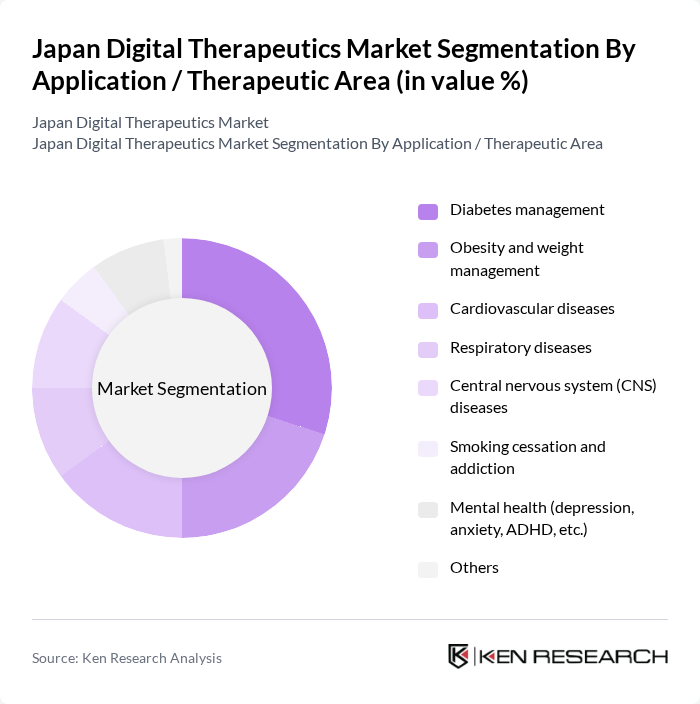
By Application / Therapeutic Area:The application segmentation encompasses various therapeutic areas including Diabetes management, Obesity and weight management, Cardiovascular diseases, Respiratory diseases, Central nervous system (CNS) diseases, Smoking cessation and addiction, Mental health (depression, anxiety, ADHD, etc.), and Others. Each area addresses specific health challenges faced by the population, with diabetes management currently representing the largest application segment in Japan, followed by obesity, cardiovascular, respiratory, CNS diseases, and smoking cessation, and growing interest in mental health and behavioral conditions.
Japan Digital Therapeutics Market Competitive Landscape
The Japan Digital Therapeutics Market is characterized by a dynamic mix of regional and international players. Leading participants such as Otsuka Pharmaceutical Co., Ltd., CureApp, Inc., Welldoc, Inc., Akili Interactive Labs, Inc., Omada Health, Inc., DarioHealth Corp., Biofourmis, Inc., Jolly Good Inc., Medtronic plc, Koninklijke Philips N.V. (Philips Healthcare), Teladoc Health, Inc., ResMed Inc., FitBit LLC, Mango Health, Inc., and others contribute to innovation, geographic expansion, and service delivery in this space, with particular activity in areas such as diabetes, hypertension, smoking cessation, mental health, and virtual care.
Japan Digital Therapeutics Market Industry Analysis
Growth Drivers
- Increasing Prevalence of Chronic Diseases:Japan faces a significant rise in chronic diseases, with approximately 11–12 million people suffering from diabetes. The World Health Organization reported that roughly one quarter of the population is affected by hypertension. This growing health burden necessitates innovative treatment solutions, driving the demand for digital therapeutics. The Japanese government aims to reduce healthcare costs by 20% in future, further incentivizing the adoption of digital health solutions to manage chronic conditions effectively.
- Rising Demand for Personalized Medicine:The Japanese healthcare system is increasingly shifting towards personalized medicine, with a market value of ¥1.2 trillion (approximately $11 billion). This trend is fueled by advancements in genomics and biotechnology, allowing for tailored treatment plans. The Ministry of Health, Labour and Welfare has allocated ¥50 billion ($460 million) for research in personalized therapies, indicating strong governmental support for integrating digital therapeutics that cater to individual patient needs, enhancing treatment efficacy and patient satisfaction.
- Technological Advancements in Healthcare:Japan is at the forefront of healthcare technology, with over 80% of hospitals utilizing electronic health records. The integration of AI and machine learning in healthcare is projected to reach ¥500 billion ($4.6 billion) in future. These advancements facilitate the development of sophisticated digital therapeutic solutions that improve patient outcomes. The government’s investment in health tech innovation, estimated at ¥100 billion ($920 million), further supports the growth of digital therapeutics in the market.
Market Challenges
- Regulatory Hurdles and Compliance Issues:The regulatory landscape for digital therapeutics in Japan is complex, with the Pharmaceuticals and Medical Devices Agency (PMDA) overseeing approvals. As of now, only 15 digital therapeutics have received PMDA approval, highlighting the stringent requirements. The lengthy approval process can take up to 18 months, delaying market entry for innovative solutions. This regulatory bottleneck poses a significant challenge for companies aiming to introduce new digital health products in a timely manner.
- Limited Reimbursement Policies:Reimbursement for digital therapeutics remains a significant barrier in Japan, with only 20% of digital health solutions covered by national health insurance. The Ministry of Health has yet to establish comprehensive reimbursement frameworks for these products, leading to financial uncertainty for developers. This lack of reimbursement limits patient access to digital therapeutics, hindering market growth and adoption rates among healthcare providers and patients alike.
Japan Digital Therapeutics Market Future Outlook
The future of the Japan digital therapeutics market appears promising, driven by ongoing technological advancements and a growing acceptance of digital health solutions among patients and providers. As the government continues to invest in healthcare innovation, the integration of AI and telehealth services is expected to enhance treatment efficacy. Additionally, the increasing focus on preventive healthcare will likely lead to a broader adoption of digital therapeutics, positioning Japan as a leader in this evolving sector in future.
Market Opportunities
- Expansion of Telehealth Services:The telehealth market in Japan is projected to reach ¥300 billion ($2.8 billion) in future, driven by increased demand for remote healthcare solutions. This expansion presents a significant opportunity for digital therapeutics to integrate with telehealth platforms, enhancing patient engagement and adherence to treatment plans. The government’s support for telehealth initiatives further solidifies this opportunity, paving the way for innovative digital health solutions.
- Collaborations with Pharmaceutical Companies:Collaborations between digital therapeutic developers and pharmaceutical companies are on the rise, with over 10 partnerships established recently. These collaborations leverage the strengths of both sectors, facilitating the development of comprehensive treatment solutions. The combined market potential of digital therapeutics and pharmaceuticals is estimated at ¥1 trillion ($9.2 billion), creating a lucrative opportunity for innovation and improved patient outcomes in Japan.
Scope of the Report
| Segment | Sub-Segments |
|---|---|
| By Product Type | Prescription digital therapeutics (PDTx) Non-prescription / direct-to-consumer digital therapeutics Companion digital therapeutics (with drugs or devices) Adjunct digital therapy and self-management tools Others |
| By Application / Therapeutic Area | Diabetes management Obesity and weight management Cardiovascular diseases Respiratory diseases Central nervous system (CNS) diseases Smoking cessation and addiction Mental health (depression, anxiety, ADHD, etc.) Others |
| By End-User | Patients (B2C) Healthcare providers (hospitals, clinics) Payers (insurers, public payers) Employers and corporate wellness programs Others |
| By Delivery Platform | Mobile applications (smartphone / tablet) Web-based platforms Integrated with wearable devices Integrated with telehealth / remote monitoring systems Others |
| By Age Group | Pediatric Adult Geriatric Others |
| By Region | Kanto Region Kansai / Kinki Region Central / Chubu Region Kyushu-Okinawa Region Hokkaido Region Tohoku Region Chugoku Region Shikoku Region |
| By Market Maturity | Emerging Growth Mature Others |
Key Target Audience
Investors and Venture Capitalist Firms
Government and Regulatory Bodies (e.g., Ministry of Health, Labour and Welfare)
Healthcare Providers and Hospitals
Pharmaceutical Companies
Health Insurance Companies
Digital Health Startups
Medical Device Manufacturers
Telehealth Service Providers
Players Mentioned in the Report:
Otsuka Pharmaceutical Co., Ltd.
CureApp, Inc.
Welldoc, Inc.
Akili Interactive Labs, Inc.
Omada Health, Inc.
DarioHealth Corp.
Biofourmis, Inc.
Jolly Good Inc.
Medtronic plc
Koninklijke Philips N.V. (Philips Healthcare)
Teladoc Health, Inc.
ResMed Inc.
FitBit LLC
Mango Health, Inc.
Others
Table of Contents
Market Assessment Phase
1. Executive Summary and Approach
2. Japan Digital Therapeutics Market Overview
2.1 Key Insights and Strategic Recommendations
2.2 Japan Digital Therapeutics Market Overview
2.3 Definition and Scope
2.4 Evolution of Market Ecosystem
2.5 Timeline of Key Regulatory Milestones
2.6 Value Chain & Stakeholder Mapping
2.7 Business Cycle Analysis
2.8 Policy & Incentive Landscape
3. Japan Digital Therapeutics Market Analysis
3.1 Growth Drivers
3.1.1 Increasing prevalence of chronic diseases
3.1.2 Rising demand for personalized medicine
3.1.3 Technological advancements in healthcare
3.1.4 Growing acceptance of digital health solutions
3.2 Market Challenges
3.2.1 Regulatory hurdles and compliance issues
3.2.2 Limited reimbursement policies
3.2.3 Data privacy and security concerns
3.2.4 Resistance from traditional healthcare providers
3.3 Market Opportunities
3.3.1 Expansion of telehealth services
3.3.2 Collaborations with pharmaceutical companies
3.3.3 Development of AI-driven therapeutic solutions
3.3.4 Increasing investment in digital health startups
3.4 Market Trends
3.4.1 Integration of wearables in treatment plans
3.4.2 Shift towards preventive healthcare
3.4.3 Rise of mobile health applications
3.4.4 Focus on mental health digital therapeutics
3.5 Government Regulation
3.5.1 Approval processes for digital therapeutics
3.5.2 Guidelines for data protection in healthcare
3.5.3 Reimbursement frameworks for digital solutions
3.5.4 Standards for clinical validation of digital therapeutics
4. SWOT Analysis
5. Stakeholder Analysis
6. Porter's Five Forces Analysis
7. Japan Digital Therapeutics Market Market Size, 2019-2024
7.1 By Value
7.2 By Volume
7.3 By Average Selling Price
8. Japan Digital Therapeutics Market Segmentation
8.1 By Product Type
8.1.1 Prescription digital therapeutics (PDTx)
8.1.2 Non-prescription / direct-to-consumer digital therapeutics
8.1.3 Companion digital therapeutics (with drugs or devices)
8.1.4 Adjunct digital therapy and self-management tools
8.1.5 Others
8.2 By Application / Therapeutic Area
8.2.1 Diabetes management
8.2.2 Obesity and weight management
8.2.3 Cardiovascular diseases
8.2.4 Respiratory diseases
8.2.5 Central nervous system (CNS) diseases
8.2.6 Smoking cessation and addiction
8.2.7 Mental health (depression, anxiety, ADHD, etc.)
8.2.8 Others
8.3 By End-User
8.3.1 Patients (B2C)
8.3.2 Healthcare providers (hospitals, clinics)
8.3.3 Payers (insurers, public payers)
8.3.4 Employers and corporate wellness programs
8.3.5 Others
8.4 By Delivery Platform
8.4.1 Mobile applications (smartphone / tablet)
8.4.2 Web-based platforms
8.4.3 Integrated with wearable devices
8.4.4 Integrated with telehealth / remote monitoring systems
8.4.5 Others
8.5 By Age Group
8.5.1 Pediatric
8.5.2 Adult
8.5.3 Geriatric
8.5.4 Others
8.6 By Region
8.6.1 Kanto Region
8.6.2 Kansai / Kinki Region
8.6.3 Central / Chubu Region
8.6.4 Kyushu-Okinawa Region
8.6.5 Hokkaido Region
8.6.6 Tohoku Region
8.6.7 Chugoku Region
8.6.8 Shikoku Region
8.7 By Market Maturity
8.7.1 Emerging
8.7.2 Growth
8.7.3 Mature
8.7.4 Others
9. Japan Digital Therapeutics Market Competitive Analysis
9.1 Market Share of Key Players
9.2 Cross Comparison of Key Players
9.2.1 Company name
9.2.2 Funding raised (total and latest round)
9.2.3 Annual revenue and revenue growth rate
9.2.4 Active users (MAU/DAU) and user growth
9.2.5 Customer acquisition cost (CAC)
9.2.6 Customer lifetime value (LTV)
9.2.7 Payor/reimbursement coverage (number of payors, % covered lives)
9.2.8 Market penetration (% of target patients / physicians using solution)
9.2.9 Average selling price (ASP) and pricing model
9.2.10 Churn rate / retention rate
9.2.11 Gross margin and unit economics
9.2.12 Return on investment (ROI) / health economic outcomes (cost savings per patient)
9.3 SWOT Analysis of Top Players
9.4 Pricing Analysis
9.5 Detailed Profile of Major Companies
9.5.1 Otsuka Pharmaceutical Co., Ltd.
9.5.2 CureApp, Inc.
9.5.3 Welldoc, Inc.
9.5.4 Akili Interactive Labs, Inc.
9.5.5 Omada Health, Inc.
9.5.6 DarioHealth Corp.
9.5.7 Biofourmis, Inc.
9.5.8 Jolly Good Inc.
9.5.9 Medtronic plc
9.5.10 Koninklijke Philips N.V. (Philips Healthcare)
9.5.11 Teladoc Health, Inc.
9.5.12 ResMed Inc.
9.5.13 FitBit LLC
9.5.14 Mango Health, Inc.
9.5.15 Others
10. Japan Digital Therapeutics Market End-User Analysis
10.1 Procurement Behavior of Key Ministries
10.1.1 Ministry of Health, Labour and Welfare
10.1.2 Ministry of Education, Culture, Sports, Science and Technology
10.1.3 Ministry of Economy, Trade and Industry
10.1.4 Others
10.2 Corporate Spend on Infrastructure & Energy
10.2.1 Healthcare institutions
10.2.2 Corporate wellness programs
10.2.3 Research and development
10.2.4 Others
10.3 Pain Point Analysis by End-User Category
10.3.1 Healthcare providers
10.3.2 Patients
10.3.3 Payers
10.3.4 Others
10.4 User Readiness for Adoption
10.4.1 Awareness levels
10.4.2 Training and support needs
10.4.3 Technology infrastructure
10.4.4 Others
10.5 Post-Deployment ROI and Use Case Expansion
10.5.1 Measurement of health outcomes
10.5.2 Cost savings analysis
10.5.3 User feedback and satisfaction
10.5.4 Others
11. Japan Digital Therapeutics Market Future Size, 2025-2030
11.1 By Value
11.2 By Volume
11.3 By Average Selling Price
Go-To-Market Strategy Phase
1. Whitespace Analysis + Business Model Canvas
1.1 Market gaps identification
1.2 Business model development
2. Marketing and Positioning Recommendations
2.1 Branding strategies
2.2 Product USPs
3. Distribution Plan
3.1 Urban retail vs rural NGO tie-ups
4. Channel & Pricing Gaps
4.1 Underserved routes
4.2 Pricing bands
5. Unmet Demand & Latent Needs
5.1 Category gaps
5.2 Consumer segments
6. Customer Relationship
6.1 Loyalty programs
6.2 After-sales service
7. Value Proposition
7.1 Sustainability
7.2 Integrated supply chains
8. Key Activities
8.1 Regulatory compliance
8.2 Branding
8.3 Distribution setup
9. Entry Strategy Evaluation
9.1 Domestic Market Entry Strategy
9.1.1 Product mix
9.1.2 Pricing band
9.1.3 Packaging
9.2 Export Entry Strategy
9.2.1 Target countries
9.2.2 Compliance roadmap
10. Entry Mode Assessment
10.1 Joint Ventures
10.2 Greenfield Investments
10.3 Mergers & Acquisitions
10.4 Distributor Model
11. Capital and Timeline Estimation
11.1 Capital requirements
11.2 Timelines
12. Control vs Risk Trade-Off
12.1 Ownership vs Partnerships
13. Profitability Outlook
13.1 Breakeven analysis
13.2 Long-term sustainability
14. Potential Partner List
14.1 Distributors
14.2 Joint Ventures
14.3 Acquisition targets
15. Execution Roadmap
15.1 Phased Plan for Market Entry
15.1.1 Market Setup
15.1.2 Market Entry
15.1.3 Growth Acceleration
15.1.4 Scale & Stabilize
15.2 Key Activities and Milestones
15.2.1 Milestone tracking
15.2.2 Activity scheduling
Research Methodology
Phase 1: Approach1
Desk Research
- Analysis of market reports from health technology organizations and industry associations
- Review of government publications and healthcare policies related to digital therapeutics in Japan
- Examination of academic journals and white papers on the efficacy and adoption of digital therapeutics
Primary Research
- Interviews with healthcare professionals, including physicians and therapists, utilizing digital therapeutics
- Surveys targeting patients who have used digital therapeutic solutions for chronic conditions
- Focus groups with stakeholders from healthcare institutions and insurance companies
Validation & Triangulation
- Cross-validation of findings through multiple data sources, including market trends and user feedback
- Triangulation of qualitative insights from interviews with quantitative data from surveys
- Sanity checks conducted through expert panel reviews comprising industry veterans and academic researchers
Phase 2: Market Size Estimation1
Top-down Assessment
- Estimation of the total addressable market based on Japan's healthcare expenditure and digital health adoption rates
- Segmentation of the market by therapeutic area, such as mental health, diabetes management, and cardiovascular health
- Incorporation of demographic trends and aging population statistics influencing digital therapeutic usage
Bottom-up Modeling
- Collection of usage data from leading digital therapeutic applications and platforms in Japan
- Estimation of revenue per user based on subscription models and reimbursement rates
- Analysis of growth rates from pilot programs and case studies in healthcare settings
Forecasting & Scenario Analysis
- Multi-factor regression analysis incorporating technological advancements and regulatory changes
- Scenario modeling based on varying levels of market penetration and user adoption rates
- Development of baseline, optimistic, and pessimistic forecasts through 2030
Phase 3: CATI Sample Composition1
| Scope Item/Segment | Sample Size | Target Respondent Profiles |
|---|---|---|
| Healthcare Professionals | 120 | Physicians, Psychologists, Therapists |
| Patients Using Digital Therapeutics | 100 | Chronic Disease Patients, Mental Health Patients |
| Healthcare Administrators | 60 | Hospital Administrators, Clinic Managers |
| Insurance Providers | 50 | Health Insurance Executives, Policy Analysts |
| Technology Developers | 50 | Product Managers, Software Developers in Health Tech |
Frequently Asked Questions
What is the current value of the Japan Digital Therapeutics Market?
The Japan Digital Therapeutics Market is valued at approximately USD 320 million, reflecting a significant growth driven by the increasing prevalence of chronic diseases, an aging population, and the rising adoption of digital health solutions among healthcare providers and patients.
What are the main drivers of growth in the Japan Digital Therapeutics Market?
Which cities are leading in the Japan Digital Therapeutics Market?
What recent regulations have impacted the Japan Digital Therapeutics Market?
Other Regional/Country Reports
Other Adjacent Reports
Belgium Pharmaceutical Companion Apps Market
Why Buy From Us?

What makes us stand out is that our consultants follow Robust, Refine and Result (RRR) methodology. Robust for clear definitions, approaches and sanity checking, Refine for differentiating respondents' facts and opinions, and Result for presenting data with story.

We have set a benchmark in the industry by offering our clients with syndicated and customized market research reports featuring coverage of entire market as well as meticulous research and analyst insights.

While we don't replace traditional research, we flip the method upside down. Our dual approach of Top Bottom & Bottom Top ensures quality deliverable by not just verifying company fundamentals but also looking at the sector and macroeconomic factors.

With one step in the future, our research team constantly tries to show you the bigger picture. We help with some of the tough questions you may encounter along the way: How is the industry positioned? Best marketing channel? KPI's of competitors? By aligning every element, we help maximize success.

Our report gives you instant access to the answers and sources that other companies might choose to hide. We elaborate each steps of research methodology we have used and showcase you the sample size to earn your trust.

If you need any support, we are here! We pride ourselves on universe strength, data quality, and quick, friendly, and professional service.