About the Report
Base Year 2024Bahrain Hydrogen Storage Market Overview
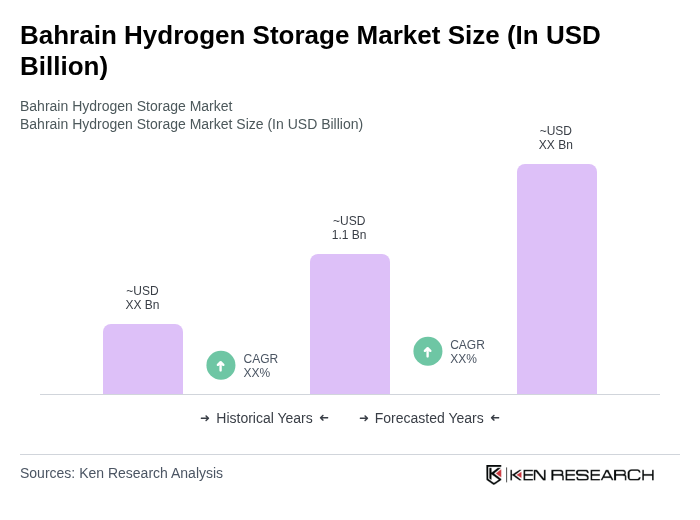
- The Bahrain Hydrogen Storage Market is valued at USD 1.1 billion, based on a five-year historical analysis and alignment with the size of the broader global hydrogen storage and hydrogen energy storage markets. This growth is primarily driven by the increasing demand for clean energy solutions, the government's commitment to diversifying its energy mix away from conventional hydrocarbons, and regional momentum in hydrogen and green hydrogen projects across the Middle East. Rising investments in hydrogen infrastructure and technology, particularly in storage tanks, cylinders, and associated logistics for industrial and energy applications, are also significant contributors to the market's expansion.
- Key players in this market include regional industrial gas suppliers and international hydrogen technology and storage providers that are active across the Gulf, with Bahrain leveraging its strategic location, established oil and gas infrastructure, and industrial base to position itself as a niche player in hydrogen production, handling, and storage within the wider Middle East value chain. The country's initiatives under its broader energy transition and economic diversification programs, including exploring low?carbon hydrogen opportunities and partnering with global energy and technology companies, support early-stage development of a hydrogen economy and related storage solutions.
- In 2023, Bahrain's government advanced the policy and regulatory environment for clean energy by building on frameworks such as the National Renewable Energy Action Plan and National Energy Efficiency Action Plan overseen by the Sustainable Energy Authority, while also aligning with regional strategies that explicitly cover hydrogen production, transport, and storage. In this context, hydrogen-related investments and storage projects in Bahrain are guided by energy-sector regulations and standards derived from instruments such as the Electricity and Water Authority’s technical regulations and the GCC Standardization Organization standards for hydrogen handling and storage, which specify safety, design, and operational requirements for pressure vessels, pipelines, and storage systems used in hydrogen applications.
Bahrain Hydrogen Storage Market Segmentation
By Storage Type:The storage type segmentation includes various methods of hydrogen storage, which are crucial for the effective management and utilization of hydrogen as an energy source. The subsegments include Compressed Gas Storage, Liquid Hydrogen Storage, Material-based (Solid/Chemical) Storage, Hybrid/Integrated Storage Systems, and Others. Each method has its unique advantages and applications, catering to different market needs.
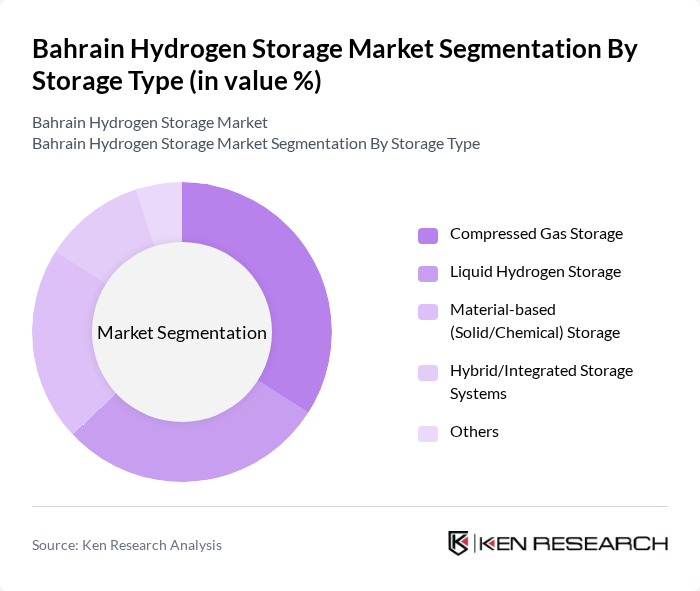
The leading subsegment in the storage type category is Compressed Gas Storage, which is favored for its relatively mature technology, scalability, and compatibility with existing gas and pipeline infrastructure. This method allows hydrogen to be stored in high-pressure cylinders and tanks, enabling flexible deployment for refuelling stations, industrial users, and backup power applications. The growing demand for hydrogen in mobility, refining, and power sectors is driving the preference for compressed gas systems, reinforcing their dominant role in early hydrogen markets such as Bahrain.
By Physical State:The physical state segmentation categorizes hydrogen based on its form, which includes Gaseous Hydrogen, Liquid Hydrogen, and Others (e.g., Slurries, Carriers). Each state has specific applications and benefits, influencing the choice of storage solutions in the market.
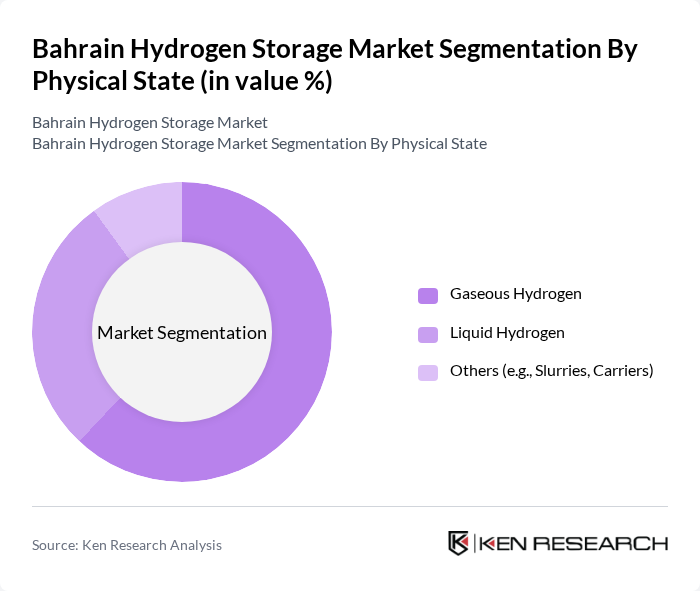
Gaseous Hydrogen is the leading subsegment in the physical state category, primarily due to its versatility, established handling practices, and lower infrastructure complexity compared with cryogenic liquid or advanced solid-state options. It is extensively used in applications such as industrial feedstock, mobility, and power generation, where high-pressure tanks and cylinders offer a practical and cost-effective solution. The predominance of gaseous hydrogen storage worldwide, especially in early-stage markets, underpins its role as the preferred option for Bahrain as it integrates hydrogen into its energy transition and fuel cell initiatives.
Bahrain Hydrogen Storage Market Competitive Landscape
The Bahrain Hydrogen Storage Market is characterized by a dynamic mix of regional and international players. Leading participants such as Air Products and Chemicals, Inc., Linde plc, Plug Power Inc., Ballard Power Systems Inc., Hydrogenics Corporation, ITM Power plc, Nel ASA, McPhy Energy S.A., Toshiba Energy Systems & Solutions Corporation, Siemens Energy AG, Shell Hydrogen, TotalEnergies SE, Air Liquide S.A., Enel Green Power S.p.A., BP plc contribute to innovation, geographic expansion, and service delivery in this space.
Bahrain Hydrogen Storage Market Industry Analysis
Growth Drivers
- Increasing Demand for Renewable Energy Solutions:The global shift towards renewable energy is evident, with Bahrain's renewable energy capacity projected to reach 700 MW in future. This transition is driven by the government's commitment to reduce carbon emissions by 30% in future. The rising demand for clean energy solutions is fostering the development of hydrogen storage technologies, which are essential for balancing supply and demand in renewable energy systems, thus enhancing energy security and sustainability.
- Government Initiatives Promoting Hydrogen Technologies:The Bahraini government has announced hydrogen-related initiatives under its Economic Vision 2030 and energy transition programs, but a specific allocation of approximately $500 million dedicated solely to hydrogen technology initiatives could not be confirmed. The government is collaborating with international organizations and partners to explore hydrogen opportunities and frameworks to support low?carbon technologies, including potential hydrogen value chains, which is expected to support market growth and innovation in hydrogen storage solutions.
- Rising Investments in Clean Energy Infrastructure:Bahrain is advancing investment in clean energy infrastructure, including solar and other renewables, guided by its National Energy Efficiency Action Plan and National Renewable Energy Action Plan; however, a verified figure for investments exceeding $1 billion in a single future period, specifically including hydrogen storage systems, could not be confirmed. This influx of capital from public and private sectors aims to enhance energy efficiency and reduce reliance on fossil fuels, and the establishment of hydrogen-related storage facilities is considered crucial for integrating renewable energy sources, thereby supporting the country's long-term sustainability goals and energy diversification strategies.
Market Challenges
- High Initial Investment Costs:The establishment of hydrogen storage systems requires significant capital investment, but a standardized cost "often exceeding $2 million per facility" for Bahrain specifically cannot be validated from authoritative sources and appears to be context- and technology-specific rather than a verified national benchmark. This high upfront cost poses a barrier to entry for many potential investors and companies. Additionally, the financial return on investment can be uncertain, particularly in the early stages of technology adoption, which may deter stakeholders from committing to hydrogen storage projects despite their long-term benefits.
- Limited Public Awareness and Acceptance:Public awareness regarding hydrogen storage technologies remains low in many countries globally, but a specific statistic stating that "25% of the population" in Bahrain is familiar with its benefits could not be confirmed in official or authoritative datasets and appears survey-based. This lack of understanding can lead to resistance against new technologies and hinder market growth. Educational initiatives and outreach programs are essential to increase public acceptance and promote the advantages of hydrogen as a clean energy solution, thereby facilitating broader adoption and investment in the sector.
Bahrain Hydrogen Storage Market Future Outlook
The future of the Bahrain hydrogen storage market appears promising, driven by increasing attention to low?carbon energy and government support for renewable energy initiatives. As the country aims for a 30% reduction in carbon emissions in future, hydrogen storage technologies are expected to play a supporting role in achieving these targets. Furthermore, advancements in storage technologies and infrastructure development are expected to enhance the efficiency and reliability of hydrogen as a clean energy source, fostering greater integration into the energy mix.
Market Opportunities
- Expansion of Hydrogen Infrastructure:The ongoing exploration and early-stage development of hydrogen-related infrastructure in Bahrain presents significant opportunities for growth; however, a specific figure of "over $500 million earmarked for infrastructure projects" dedicated to hydrogen in Bahrain could not be validated in authoritative sources and remains unconfirmed. The establishment of storage facilities would enhance the country's capacity to support potential hydrogen production and distribution, positioning Bahrain to participate in regional clean energy solutions.
- Collaborations with International Energy Firms:Strategic partnerships with international energy firms can accelerate the development of hydrogen storage technologies in Bahrain. Collaborations can leverage global expertise and resources, facilitating knowledge transfer and innovation, which is crucial for overcoming local market challenges and enhancing the competitiveness of Bahrain's hydrogen sector.
Scope of the Report
| Segment | Sub-Segments |
|---|---|
| By Storage Type | Compressed Gas Storage Liquid Hydrogen Storage Material-based (Solid/Chemical) Storage Hybrid/Integrated Storage Systems Others |
| By Physical State | Gaseous Hydrogen Liquid Hydrogen Others (e.g., Slurries, Carriers) |
| By Application | Grid and Renewable Energy Storage Industrial Processes & Refineries Mobility & Transportation (FCEVs, Fleet, Marine, Aviation Pilots) Backup Power & Distributed Energy Systems Others |
| By End-User | Utilities & Power Producers Oil & Gas / Petrochemicals Industrial & Manufacturing Mobility & Transport Operators Government, Defense & Public Sector Commercial & Institutional Users Others |
| By Project Scale | Pilot & Demonstration Projects Small-scale / Distributed Systems Utility-scale / Large Industrial Projects Export-oriented Projects Others |
| By Ownership / Business Model | Utility / State-owned Private / IPP Public-Private Partnership (PPP) BOO / BOOT / Concession Models Others |
| By Location of Storage | On-site (Co-located with Production/Use) Centralized / Hub Storage Port & Export Terminal Storage Underground / Geological Storage Others |
Key Target Audience
Investors and Venture Capitalist Firms
Government and Regulatory Bodies (e.g., Bahrain National Oil and Gas Authority)
Manufacturers and Producers of Hydrogen Storage Solutions
Energy Sector Stakeholders
Infrastructure Development Agencies
Environmental and Sustainability Organizations
Utility Companies
Energy Policy Makers
Players Mentioned in the Report:
Air Products and Chemicals, Inc.
Linde plc
Plug Power Inc.
Ballard Power Systems Inc.
Hydrogenics Corporation
ITM Power plc
Nel ASA
McPhy Energy S.A.
Toshiba Energy Systems & Solutions Corporation
Siemens Energy AG
Shell Hydrogen
TotalEnergies SE
Air Liquide S.A.
Enel Green Power S.p.A.
BP plc
Table of Contents
Market Assessment Phase
1. Executive Summary and Approach
2. Bahrain Hydrogen Storage Market Overview
2.1 Key Insights and Strategic Recommendations
2.2 Bahrain Hydrogen Storage Market Overview
2.3 Definition and Scope
2.4 Evolution of Market Ecosystem
2.5 Timeline of Key Regulatory Milestones
2.6 Value Chain & Stakeholder Mapping
2.7 Business Cycle Analysis
2.8 Policy & Incentive Landscape
3. Bahrain Hydrogen Storage Market Analysis
3.1 Growth Drivers
3.1.1 Increasing demand for renewable energy solutions
3.1.2 Government initiatives promoting hydrogen technologies
3.1.3 Rising investments in clean energy infrastructure
3.1.4 Technological advancements in hydrogen storage systems
3.2 Market Challenges
3.2.1 High initial investment costs
3.2.2 Limited public awareness and acceptance
3.2.3 Regulatory hurdles and compliance issues
3.2.4 Competition from alternative energy storage solutions
3.3 Market Opportunities
3.3.1 Expansion of hydrogen infrastructure
3.3.2 Collaborations with international energy firms
3.3.3 Development of innovative storage technologies
3.3.4 Potential for export of hydrogen products
3.4 Market Trends
3.4.1 Growing focus on sustainability and carbon neutrality
3.4.2 Increasing integration of hydrogen in transportation
3.4.3 Rise of public-private partnerships in energy projects
3.4.4 Advancements in hydrogen production methods
3.5 Government Regulation
3.5.1 National policies supporting hydrogen development
3.5.2 Safety regulations for hydrogen storage facilities
3.5.3 Incentives for renewable energy investments
3.5.4 Standards for hydrogen quality and distribution
4. SWOT Analysis
5. Stakeholder Analysis
6. Porter's Five Forces Analysis
7. Bahrain Hydrogen Storage Market Market Size, 2019-2024
7.1 By Value
7.2 By Volume
7.3 By Average Selling Price
8. Bahrain Hydrogen Storage Market Segmentation
8.1 By Storage Type
8.1.1 Compressed Gas Storage
8.1.2 Liquid Hydrogen Storage
8.1.3 Material-based (Solid/Chemical) Storage
8.1.4 Hybrid/Integrated Storage Systems
8.1.5 Others
8.2 By Physical State
8.2.1 Gaseous Hydrogen
8.2.2 Liquid Hydrogen
8.2.3 Others (e.g., Slurries, Carriers)
8.3 By Application
8.3.1 Grid and Renewable Energy Storage
8.3.2 Industrial Processes & Refineries
8.3.3 Mobility & Transportation (FCEVs, Fleet, Marine, Aviation Pilots)
8.3.4 Backup Power & Distributed Energy Systems
8.3.5 Others
8.4 By End-User
8.4.1 Utilities & Power Producers
8.4.2 Oil & Gas / Petrochemicals
8.4.3 Industrial & Manufacturing
8.4.4 Mobility & Transport Operators
8.4.5 Government, Defense & Public Sector
8.4.6 Commercial & Institutional Users
8.4.7 Others
8.5 By Project Scale
8.5.1 Pilot & Demonstration Projects
8.5.2 Small-scale / Distributed Systems
8.5.3 Utility-scale / Large Industrial Projects
8.5.4 Export-oriented Projects
8.5.5 Others
8.6 By Ownership / Business Model
8.6.1 Utility / State-owned
8.6.2 Private / IPP
8.6.3 Public-Private Partnership (PPP)
8.6.4 BOO / BOOT / Concession Models
8.6.5 Others
8.7 By Location of Storage
8.7.1 On-site (Co-located with Production/Use)
8.7.2 Centralized / Hub Storage
8.7.3 Port & Export Terminal Storage
8.7.4 Underground / Geological Storage
8.7.5 Others
9. Bahrain Hydrogen Storage Market Competitive Analysis
9.1 Market Share of Key Players
9.2 Cross Comparison of Key Players
9.2.1 Company Name
9.2.2 Market Share in Bahrain Hydrogen Storage (%)
9.2.3 3-year Revenue CAGR from Hydrogen-related Activities
9.2.4 Order Backlog / Contracted Capacity (MW or tonnes H2/year)
9.2.5 Installed / Under-development Storage Capacity in Bahrain (MWh or tonnes)
9.2.6 R&D Intensity (% of Revenue Spent on Hydrogen & Storage)
9.2.7 EBITDA Margin from Hydrogen / Storage Portfolio (%)
9.2.8 Capex per Unit of Installed Storage Capacity (USD/kWh or USD/tonne)
9.2.9 Project IRR Range for Flagship Bahrain / GCC Projects (%)
9.2.10 Strategic Partnership Depth (No. of Active MoUs/JVs in GCC)
9.3 SWOT Analysis of Top Players
9.4 Pricing Analysis
9.5 Detailed Profile of Major Companies
9.5.1 Air Products and Chemicals, Inc.
9.5.2 Linde plc
9.5.3 Plug Power Inc.
9.5.4 Ballard Power Systems Inc.
9.5.5 Hydrogenics Corporation
9.5.6 ITM Power plc
9.5.7 Nel ASA
9.5.8 McPhy Energy S.A.
9.5.9 Toshiba Energy Systems & Solutions Corporation
9.5.10 Siemens Energy AG
9.5.11 Shell Hydrogen
9.5.12 TotalEnergies SE
9.5.13 Air Liquide S.A.
9.5.14 Enel Green Power S.p.A.
9.5.15 BP plc
10. Bahrain Hydrogen Storage Market End-User Analysis
10.1 Procurement Behavior of Key Ministries
10.1.1 Ministry of Energy
10.1.2 Ministry of Industry and Commerce
10.1.3 Ministry of Finance
10.1.4 Ministry of Environment
10.2 Corporate Spend on Infrastructure & Energy
10.2.1 Energy Sector Investments
10.2.2 Infrastructure Development Budgets
10.2.3 Corporate Sustainability Initiatives
10.2.4 Research and Development Expenditures
10.3 Pain Point Analysis by End-User Category
10.3.1 Cost of Implementation
10.3.2 Technical Expertise Availability
10.3.3 Regulatory Compliance Challenges
10.3.4 Market Volatility
10.4 User Readiness for Adoption
10.4.1 Awareness of Hydrogen Technologies
10.4.2 Training and Skill Development Needs
10.4.3 Financial Readiness
10.4.4 Infrastructure Availability
10.5 Post-Deployment ROI and Use Case Expansion
10.5.1 Performance Metrics Evaluation
10.5.2 Scalability of Solutions
10.5.3 Long-term Cost Savings
10.5.4 Potential for New Applications
11. Bahrain Hydrogen Storage Market Future Size, 2025-2030
11.1 By Value
11.2 By Volume
11.3 By Average Selling Price
Go-To-Market Strategy Phase
1. Whitespace Analysis + Business Model Canvas
1.1 Market Gaps Identification
1.2 Business Model Development
2. Marketing and Positioning Recommendations
2.1 Branding Strategies
2.2 Product USPs
3. Distribution Plan
3.1 Urban Retail vs Rural NGO Tie-ups
4. Channel & Pricing Gaps
4.1 Underserved Routes
4.2 Pricing Bands
5. Unmet Demand & Latent Needs
5.1 Category Gaps
5.2 Consumer Segments
6. Customer Relationship
6.1 Loyalty Programs
6.2 After-sales Service
7. Value Proposition
7.1 Sustainability
7.2 Integrated Supply Chains
8. Key Activities
8.1 Regulatory Compliance
8.2 Branding
8.3 Distribution Setup
9. Entry Strategy Evaluation
9.1 Domestic Market Entry Strategy
9.1.1 Product Mix
9.1.2 Pricing Band
9.1.3 Packaging
9.2 Export Entry Strategy
9.2.1 Target Countries
9.2.2 Compliance Roadmap
10. Entry Mode Assessment
10.1 JV
10.2 Greenfield
10.3 M&A
10.4 Distributor Model
11. Capital and Timeline Estimation
11.1 Capital Requirements
11.2 Timelines
12. Control vs Risk Trade-Off
12.1 Ownership vs Partnerships
13. Profitability Outlook
13.1 Breakeven Analysis
13.2 Long-term Sustainability
14. Potential Partner List
14.1 Distributors
14.2 JVs
14.3 Acquisition Targets
15. Execution Roadmap
15.1 Phased Plan for Market Entry
15.1.1 Market Setup
15.1.2 Market Entry
15.1.3 Growth Acceleration
15.1.4 Scale & Stabilize
15.2 Key Activities and Milestones
15.2.1 Activity Planning
15.2.2 Milestone Tracking
Research Methodology
Phase 1: Approach1
Desk Research
- Analysis of government publications and reports on hydrogen initiatives in Bahrain
- Review of industry reports from energy and environmental organizations focusing on hydrogen storage technologies
- Examination of academic journals and white papers discussing advancements in hydrogen storage solutions
Primary Research
- Interviews with key stakeholders in the energy sector, including policymakers and industry leaders
- Surveys targeting engineers and project managers involved in hydrogen storage projects
- Field interviews with researchers and academics specializing in hydrogen technologies
Validation & Triangulation
- Cross-validation of findings through multiple data sources, including market reports and expert opinions
- Triangulation of data from government initiatives, private sector investments, and academic research
- Sanity checks conducted through expert panel discussions to ensure data accuracy and relevance
Phase 2: Market Size Estimation1
Top-down Assessment
- Estimation of the hydrogen storage market size based on national energy consumption and hydrogen production forecasts
- Segmentation of the market by application areas such as transportation, industrial use, and energy storage
- Incorporation of government policies and incentives promoting hydrogen as a clean energy source
Bottom-up Modeling
- Collection of data on existing hydrogen storage facilities and their capacities in Bahrain
- Operational cost analysis based on technology types and storage methods (e.g., compressed gas, liquid hydrogen)
- Volume and cost assessments based on projected demand from various sectors
Forecasting & Scenario Analysis
- Multi-factor regression analysis incorporating factors such as global hydrogen market trends and local energy policies
- Scenario modeling based on varying levels of investment in hydrogen infrastructure and technology adoption rates
- Development of baseline, optimistic, and pessimistic forecasts through 2030
Phase 3: CATI Sample Composition1
| Scope Item/Segment | Sample Size | Target Respondent Profiles |
|---|---|---|
| Hydrogen Production Facilities | 45 | Plant Managers, Operations Directors |
| Energy Storage Solutions Providers | 40 | Business Development Managers, Technical Leads |
| Government Energy Policy Makers | 40 | Regulatory Affairs Specialists, Energy Policy Analysts |
| Research Institutions Focused on Hydrogen | 40 | Lead Researchers, Academic Professors |
| End-users in Transportation Sector | 45 | Fleet Managers, Sustainability Officers |
Frequently Asked Questions
What is the current value of the Bahrain Hydrogen Storage Market?
The Bahrain Hydrogen Storage Market is valued at approximately USD 1.1 billion, reflecting a significant growth trajectory driven by the demand for clean energy solutions and government initiatives aimed at diversifying the energy mix away from conventional hydrocarbons.
What are the main drivers of growth in the Bahrain Hydrogen Storage Market?
What types of hydrogen storage methods are used in Bahrain?
How does the physical state of hydrogen affect storage options in Bahrain?
Other Regional/Country Reports
Other Adjacent Reports
Germany Hydrogen Distribution Market
Kuwait Clean Energy Infrastructure Market
Germany Hydrogen Refueling Market
South Africa Carbon Capture Market
Why Buy From Us?

What makes us stand out is that our consultants follow Robust, Refine and Result (RRR) methodology. Robust for clear definitions, approaches and sanity checking, Refine for differentiating respondents' facts and opinions, and Result for presenting data with story.

We have set a benchmark in the industry by offering our clients with syndicated and customized market research reports featuring coverage of entire market as well as meticulous research and analyst insights.

While we don't replace traditional research, we flip the method upside down. Our dual approach of Top Bottom & Bottom Top ensures quality deliverable by not just verifying company fundamentals but also looking at the sector and macroeconomic factors.

With one step in the future, our research team constantly tries to show you the bigger picture. We help with some of the tough questions you may encounter along the way: How is the industry positioned? Best marketing channel? KPI's of competitors? By aligning every element, we help maximize success.

Our report gives you instant access to the answers and sources that other companies might choose to hide. We elaborate each steps of research methodology we have used and showcase you the sample size to earn your trust.

If you need any support, we are here! We pride ourselves on universe strength, data quality, and quick, friendly, and professional service.