Indonesia Forklift Rental Market Report Size Share Growth Drivers Trends Opportunities & Forecast 2025–2030

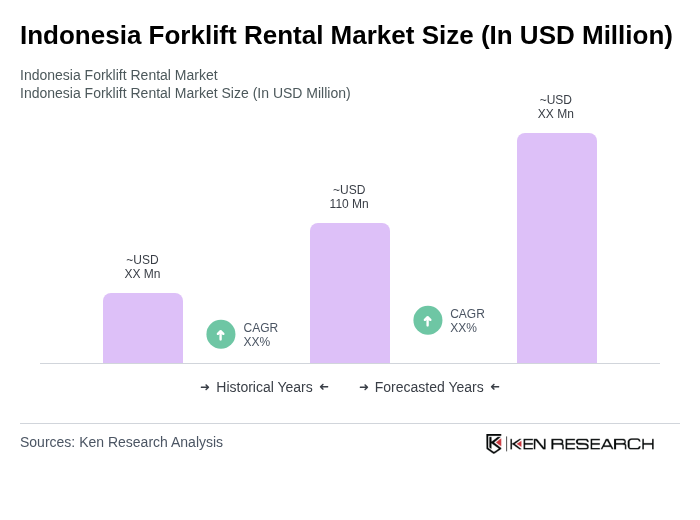
Indonesia forklift rental market, valued at USD 110 million, is expanding due to booming e-commerce, warehousing needs, and safety regulations, with key segments in electric forklifts and 3.5-10 ton capacities.

Region:Asia

Author(s):Geetanshi

Product Code:KRAA4155

Pages:80

Published On:January 2026
About the Report

Base Year 2024

Indonesia Forklift Rental Market Overview

  • The Indonesia Forklift Rental Market is valued at USD 110 million, based on a five-year historical analysis. This growth is primarily driven by the rapid expansion of the logistics and warehousing sectors, coupled with increasing demand for efficient material handling solutions across manufacturing, retail, and construction industries. The rise in e-commerce, third-party logistics (3PL) outsourcing, and the need for modernized supply chain operations with higher warehouse automation levels have significantly contributed to the market's expansion.
  • Key cities such as Jakarta, Surabaya, and Bandung dominate the market due to their strategic locations, robust infrastructure, and concentration of industrial and logistics activities. Jakarta, being the capital, serves as a major hub for logistics, ports, and trade corridors, while Surabaya and Bandung support significant manufacturing, warehousing, and distribution operations within Java’s industrial belt, making them critical players in the forklift rental landscape.
  • In 2023, the Indonesian government implemented regulations aimed at enhancing safety standards in the forklift rental industry. These requirements are anchored in the Minister of Manpower Regulation No. 8 of 2020 on Work Safety for Overhead Cranes, Gantry Cranes, and Forklifts (Peraturan Menteri Ketenagakerjaan Republik Indonesia Nomor 8 Tahun 2020 tentang Keselamatan dan Kesehatan Kerja Pesawat Angkat dan Angkut), issued by the Ministry of Manpower. This framework includes mandatory competency certification and training for forklift operators, periodic testing and inspection of lifting and transport equipment by authorized inspectors, and the obligation for employers and service providers to maintain inspection records and safety documentation, all designed to reduce workplace accidents and improve operational efficiency across sectors utilizing forklifts.
Indonesia Forklift Rental Market Size

Indonesia Forklift Rental Market Segmentation

By Equipment Type:The equipment type segmentation includes Electric Forklifts, Internal Combustion Engine (ICE) Forklifts, Rough Terrain Forklifts, Reach Trucks & Order Pickers, Pallet Trucks & Stackers, and Others. Electric Forklifts are gaining traction due to their eco-friendliness, lower lifecycle and maintenance costs, and alignment with corporate sustainability targets, especially in indoor warehousing and retail distribution centers. ICE Forklifts remain popular for heavy-duty applications and outdoor operations in construction, ports, plantations, and manufacturing where higher load capacities and longer operating hours are required. Rough Terrain Forklifts are essential for construction sites and infrastructure projects, particularly in conditions with uneven ground or remote locations. Reach Trucks & Order Pickers are favored in warehousing operations and e-commerce fulfillment centers that use high-rack storage and narrow aisles, while Pallet Trucks & Stackers and Others (such as specialized lift trucks and telehandlers) serve short-distance pallet movement and specialized industrial tasks.
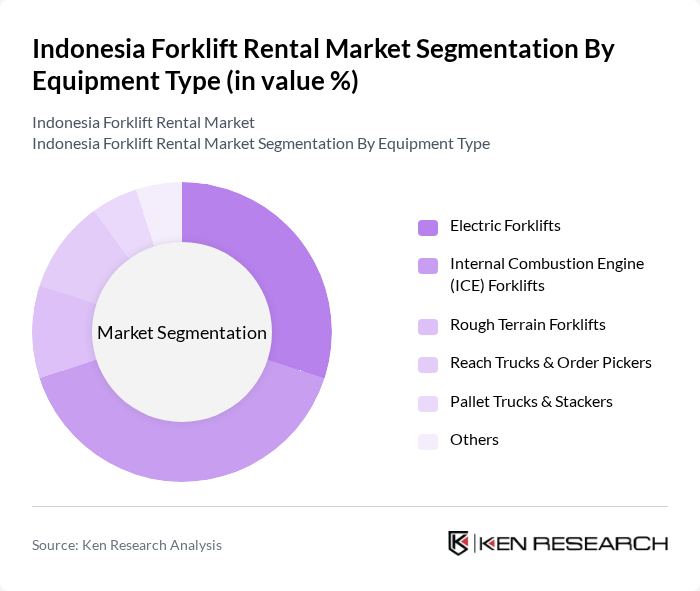
Indonesia Forklift Rental Market segmentation by Equipment Type.

By Load Capacity:The load capacity segmentation includes Less than 3.5 Tons, 3.5 to 10 Tons, and More than 10 Tons. Forklifts with a load capacity of 3.5 to 10 tons continue to account for a substantial share of rental demand due to their versatility in general manufacturing, construction, and logistics applications. Forklifts under 3.5 tons are increasingly prominent and represent the leading segment in new rental activity, driven by e-commerce fulfillment, retail warehousing, and space-constrained urban logistics that favor compact and maneuverable units. Units over 10 tons remain essential for heavy industrial operations in sectors such as steel, cement, ports, and mining, where high-capacity lifting and specialized handling are required.
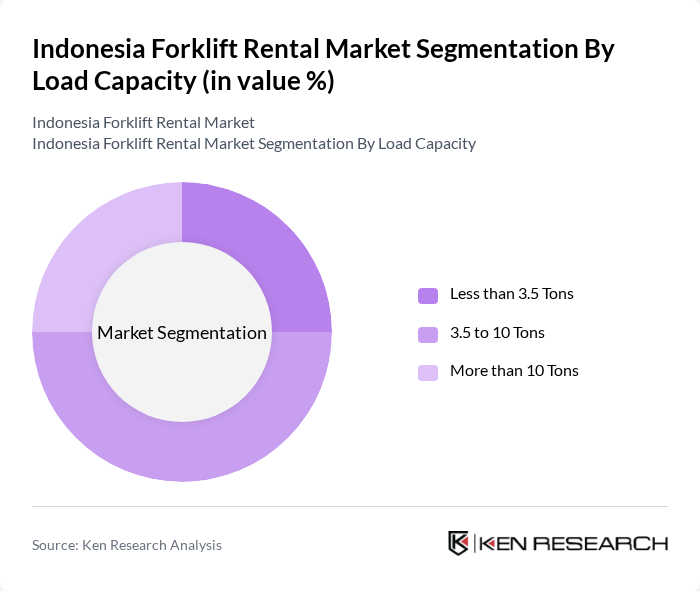
Indonesia Forklift Rental Market segmentation by Load Capacity.

Indonesia Forklift Rental Market Competitive Landscape

The Indonesia Forklift Rental Market is characterized by a dynamic mix of regional and international players. Leading participants such as PT Sarana Mitra Luas, PT United Tractors Tbk, PT Toyota Tsusho Forklift Indonesia, PT Trakindo Utama, PT Berlian Cranserco Indonesia, PT Berca Mandiri Perkasa, PT Mitra Indo Forklift, PT Central Autowheel, PT Daya Kobelco Construction Machinery Indonesia, PT Cipta Krida Bahari, PT Papasari, PT Indotruck Utama, PT Hyster-Yale Indonesia, PT Tunas Andalan Perkasa, PT Gosyen Pacific contribute to innovation, geographic expansion, and service delivery in this space.

PT Sarana Mitra Luas

1995

Jakarta, Indonesia

PT United Tractors Tbk

1972

Jakarta, Indonesia

PT Toyota Tsusho Forklift Indonesia

2000

Jakarta, Indonesia

PT Trakindo Utama

1970

Jakarta, Indonesia

PT Berlian Cranserco Indonesia

1990

Jakarta, Indonesia

Company

Establishment Year

Headquarters

Group Size (Large, Medium, or Small as per industry convention)

Fleet Size (Number of Units)

Fleet Utilization Rate (%)

Annual Rental Revenue (IDR/US$)

Revenue Growth Rate (% CAGR)

EBITDA Margin (%)

Indonesia Forklift Rental Market Industry Analysis

Growth Drivers

  • Increasing Demand for Logistics and Warehousing:The logistics and warehousing sector in Indonesia is projected to grow significantly, with the market size reaching approximately IDR 200 trillion in the future. This growth is driven by the rising need for efficient supply chain management, particularly in urban areas. The World Bank estimates that Indonesia's logistics performance index will improve, enhancing the demand for forklifts in warehouses and distribution centers, thereby boosting rental services.
  • Expansion of E-commerce and Retail Sectors:Indonesia's e-commerce market is expected to surpass IDR 500 trillion in the future, fueled by a growing middle class and increased internet penetration. This surge in online shopping is driving the need for efficient material handling solutions in warehouses. As retailers seek to optimize operations, the demand for forklift rentals is anticipated to rise, providing a cost-effective solution for managing inventory and logistics.
  • Infrastructure Development Projects:The Indonesian government has allocated IDR 400 trillion for infrastructure development in the future, focusing on transportation and logistics improvements. This investment is expected to enhance the efficiency of supply chains and increase the demand for forklifts in construction and logistics sectors. As new warehouses and distribution centers are built, the need for rental forklifts will grow, supporting the overall market expansion.

Market Challenges

  • High Competition Among Rental Service Providers:The forklift rental market in Indonesia is characterized by intense competition, with over 150 registered rental companies. This saturation leads to price wars, which can erode profit margins. According to industry reports, the average rental price for forklifts has decreased by 10% over the past two years, making it challenging for companies to maintain profitability while providing quality services.
  • Fluctuating Economic Conditions:Indonesia's economy is projected to grow at a rate of 5.1% in the future, but fluctuations in global commodity prices can impact local businesses. Economic instability can lead to reduced spending on logistics and material handling equipment, affecting the demand for forklift rentals. Companies may delay rental decisions during uncertain economic times, posing a challenge for rental service providers.

Indonesia Forklift Rental Market Future Outlook

The future of the forklift rental market in Indonesia appears promising, driven by ongoing investments in logistics and infrastructure. As e-commerce continues to expand, the demand for efficient material handling solutions will likely increase. Additionally, the adoption of electric forklifts and automation technologies is expected to reshape the market landscape, offering rental companies opportunities to innovate and enhance service offerings while meeting sustainability goals.

Market Opportunities

  • Adoption of Electric Forklifts:The shift towards electric forklifts is gaining momentum, with the government promoting green technologies. In the future, it is estimated that electric forklifts will account for 30% of the rental market, driven by lower operational costs and environmental benefits. This transition presents a significant opportunity for rental companies to diversify their fleets and attract eco-conscious clients.
  • Expansion into Untapped Regional Markets:Many regions in Indonesia remain underserved in terms of forklift rental services. With a growing industrial base in areas like East Java and Sumatra, rental companies can capitalize on this opportunity by establishing operations in these regions. Targeting local businesses in emerging markets can lead to increased revenue and market share for rental service providers.

Scope of the Report

SegmentSub-Segments
By Equipment Type

Electric Forklifts

Internal Combustion Engine (ICE) Forklifts

Rough Terrain Forklifts

Reach Trucks & Order Pickers

Pallet Trucks & Stackers

Others

By Load Capacity

Less than 3.5 Tons

to 10 Tons

More than 10 Tons

By End-use Industry

Warehousing and Logistics

Manufacturing

Construction

Automotive

Food and Beverage

Retail and E-commerce

Others

By Rental Term

Short-term Rentals

Mid-term Rentals

Long-term Rentals

By Region

Java

Sumatra

Kalimantan

Sulawesi

Others

By Fleet Size of Rental Provider

Small Fleet Operators

Medium Fleet Operators

Large Fleet Operators

By Service Offering

Dry Rental (Equipment Only)

Full-Service Rental (Equipment, Maintenance & Parts)

Rental with Operator

Others

Key Target Audience

Investors and Venture Capitalist Firms

Government and Regulatory Bodies (e.g., Ministry of Industry, Ministry of Transportation)

Manufacturers and Producers

Logistics and Supply Chain Companies

Construction and Infrastructure Firms

Warehouse and Distribution Center Operators

Equipment Rental Companies

Financial Institutions

Players Mentioned in the Report:

PT Sarana Mitra Luas

PT United Tractors Tbk

PT Toyota Tsusho Forklift Indonesia

PT Trakindo Utama

PT Berlian Cranserco Indonesia

PT Berca Mandiri Perkasa

PT Mitra Indo Forklift

PT Central Autowheel

PT Daya Kobelco Construction Machinery Indonesia

PT Cipta Krida Bahari

PT Papasari

PT Indotruck Utama

PT Hyster-Yale Indonesia

PT Tunas Andalan Perkasa

PT Gosyen Pacific

Table of Contents

Market Assessment Phase

1. Executive Summary and Approach


2. Indonesia Forklift Rental Market Overview

2.1 Key Insights and Strategic Recommendations

2.2 Indonesia Forklift Rental Market Overview

2.3 Definition and Scope

2.4 Evolution of Market Ecosystem

2.5 Timeline of Key Regulatory Milestones

2.6 Value Chain & Stakeholder Mapping

2.7 Business Cycle Analysis

2.8 Policy & Incentive Landscape


3. Indonesia Forklift Rental Market Analysis

3.1 Growth Drivers

3.1.1 Increasing demand for logistics and warehousing
3.1.2 Expansion of e-commerce and retail sectors
3.1.3 Infrastructure development projects
3.1.4 Rising awareness of rental benefits over ownership

3.2 Market Challenges

3.2.1 High competition among rental service providers
3.2.2 Fluctuating economic conditions
3.2.3 Limited availability of skilled operators
3.2.4 Regulatory compliance issues

3.3 Market Opportunities

3.3.1 Adoption of electric forklifts
3.3.2 Growth in the manufacturing sector
3.3.3 Technological advancements in forklift design
3.3.4 Expansion into untapped regional markets

3.4 Market Trends

3.4.1 Shift towards sustainable and eco-friendly solutions
3.4.2 Increasing use of telematics in fleet management
3.4.3 Rise of flexible rental agreements
3.4.4 Integration of automation in material handling

3.5 Government Regulation

3.5.1 Safety standards for forklift operations
3.5.2 Environmental regulations on emissions
3.5.3 Licensing requirements for operators
3.5.4 Tax incentives for rental businesses

4. SWOT Analysis


5. Stakeholder Analysis


6. Porter's Five Forces Analysis


7. Indonesia Forklift Rental Market Market Size, 2019-2024

7.1 By Value

7.2 By Volume

7.3 By Average Selling Price


8. Indonesia Forklift Rental Market Segmentation

8.1 By Equipment Type

8.1.1 Electric Forklifts
8.1.2 Internal Combustion Engine (ICE) Forklifts
8.1.3 Rough Terrain Forklifts
8.1.4 Reach Trucks & Order Pickers
8.1.5 Pallet Trucks & Stackers
8.1.6 Others

8.2 By Load Capacity

8.2.1 Less than 3.5 Tons
8.2.2 3.5 to 10 Tons
8.2.3 More than 10 Tons

8.3 By End-use Industry

8.3.1 Warehousing and Logistics
8.3.2 Manufacturing
8.3.3 Construction
8.3.4 Automotive
8.3.5 Food and Beverage
8.3.6 Retail and E-commerce
8.3.7 Others

8.4 By Rental Term

8.4.1 Short-term Rentals
8.4.2 Mid-term Rentals
8.4.3 Long-term Rentals

8.5 By Region

8.5.1 Java
8.5.2 Sumatra
8.5.3 Kalimantan
8.5.4 Sulawesi
8.5.5 Others

8.6 By Fleet Size of Rental Provider

8.6.1 Small Fleet Operators
8.6.2 Medium Fleet Operators
8.6.3 Large Fleet Operators

8.7 By Service Offering

8.7.1 Dry Rental (Equipment Only)
8.7.2 Full-Service Rental (Equipment, Maintenance & Parts)
8.7.3 Rental with Operator
8.7.4 Others

9. Indonesia Forklift Rental Market Competitive Analysis

9.1 Market Share of Key Players

9.2 Cross Comparison of Key Players

9.2.1 Company Name
9.2.2 Group Size (Large, Medium, or Small as per industry convention)
9.2.3 Fleet Size (Number of Units)
9.2.4 Fleet Utilization Rate (%)
9.2.5 Annual Rental Revenue (IDR/US$)
9.2.6 Revenue Growth Rate (% CAGR)
9.2.7 EBITDA Margin (%)
9.2.8 Average Rental Yield per Unit
9.2.9 Average Rental Duration (Days/Months)
9.2.10 Market Share (%)
9.2.11 Customer Retention Rate (%)
9.2.12 On-time Service Response Rate (%)
9.2.13 Net Promoter Score (NPS) / Customer Satisfaction Score

9.3 SWOT Analysis of Top Players

9.4 Pricing Analysis

9.5 Detailed Profile of Major Companies

9.5.1 PT Sarana Mitra Luas
9.5.2 PT United Tractors Tbk
9.5.3 PT Toyota Tsusho Forklift Indonesia
9.5.4 PT Trakindo Utama
9.5.5 PT Berlian Cranserco Indonesia
9.5.6 PT Berca Mandiri Perkasa
9.5.7 PT Mitra Indo Forklift
9.5.8 PT Central Autowheel
9.5.9 PT Daya Kobelco Construction Machinery Indonesia
9.5.10 PT Cipta Krida Bahari
9.5.11 PT Papasari
9.5.12 PT Indotruck Utama
9.5.13 PT Hyster-Yale Indonesia
9.5.14 PT Tunas Andalan Perkasa
9.5.15 PT Gosyen Pacific

10. Indonesia Forklift Rental Market End-User Analysis

10.1 Procurement Behavior of Key Ministries

10.1.1 Ministry of Transportation
10.1.2 Ministry of Industry
10.1.3 Ministry of Trade
10.1.4 Ministry of Public Works

10.2 Corporate Spend on Infrastructure & Energy

10.2.1 Investment in Logistics Infrastructure
10.2.2 Spending on Material Handling Equipment
10.2.3 Budget Allocation for Fleet Management
10.2.4 Others

10.3 Pain Point Analysis by End-User Category

10.3.1 Cost Management
10.3.2 Equipment Downtime
10.3.3 Compliance with Safety Standards
10.3.4 Others

10.4 User Readiness for Adoption

10.4.1 Awareness of Rental Benefits
10.4.2 Training and Skill Development
10.4.3 Financial Readiness
10.4.4 Others

10.5 Post-Deployment ROI and Use Case Expansion

10.5.1 Measurement of Cost Savings
10.5.2 Expansion into New Applications
10.5.3 Customer Feedback and Adaptation
10.5.4 Others

11. Indonesia Forklift Rental Market Future Size, 2025-2030

11.1 By Value

11.2 By Volume

11.3 By Average Selling Price


Go-To-Market Strategy Phase

1. Whitespace Analysis + Business Model Canvas

1.1 Market Gaps Identification

1.2 Value Proposition Development

1.3 Revenue Streams Analysis

1.4 Cost Structure Evaluation

1.5 Key Partnerships Exploration

1.6 Customer Segmentation

1.7 Channels and Customer Relationships


2. Marketing and Positioning Recommendations

2.1 Branding Strategies

2.2 Product USPs


3. Distribution Plan

3.1 Urban Retail vs Rural NGO Tie-ups


4. Channel & Pricing Gaps

4.1 Underserved Routes

4.2 Pricing Bands


5. Unmet Demand & Latent Needs

5.1 Category Gaps

5.2 Consumer Segments


6. Customer Relationship

6.1 Loyalty Programs

6.2 After-sales Service


7. Value Proposition

7.1 Sustainability

7.2 Integrated Supply Chains


8. Key Activities

8.1 Regulatory Compliance

8.2 Branding

8.3 Distribution Setup


9. Entry Strategy Evaluation

9.1 Domestic Market Entry Strategy

9.1.1 Product Mix
9.1.2 Pricing Band
9.1.3 Packaging

9.2 Export Entry Strategy

9.2.1 Target Countries
9.2.2 Compliance Roadmap

10. Entry Mode Assessment

10.1 JV

10.2 Greenfield

10.3 M&A

10.4 Distributor Model


11. Capital and Timeline Estimation

11.1 Capital Requirements

11.2 Timelines


12. Control vs Risk Trade-Off

12.1 Ownership vs Partnerships


13. Profitability Outlook

13.1 Breakeven Analysis

13.2 Long-term Sustainability


14. Potential Partner List

14.1 Distributors

14.2 JVs

14.3 Acquisition Targets


15. Execution Roadmap

15.1 Phased Plan for Market Entry

15.1.1 Market Setup
15.1.2 Market Entry
15.1.3 Growth Acceleration
15.1.4 Scale & Stabilize

15.2 Key Activities and Milestones

15.2.1 Milestone Planning
15.2.2 Activity Tracking

Research Methodology

ApproachModellingSample

Phase 1: Approach1

Desk Research

  • Analysis of industry reports from Indonesian logistics and transportation authorities
  • Review of government publications on infrastructure development and investment in the forklift sector
  • Examination of market trends and forecasts from trade associations and industry journals

Primary Research

  • Interviews with fleet managers and logistics coordinators in key industries such as manufacturing and construction
  • Surveys targeting rental companies and equipment suppliers to gather insights on pricing and demand
  • Field interviews with operators and maintenance personnel to understand usage patterns and preferences

Validation & Triangulation

  • Cross-validation of data through multiple sources including industry reports and expert opinions
  • Triangulation of findings from primary interviews with secondary data trends
  • Sanity checks conducted through expert panel reviews to ensure data reliability

Phase 2: Market Size Estimation1

Top-down Assessment

  • Estimation of market size based on national economic indicators and industrial growth rates
  • Segmentation of the market by end-user industries such as construction, warehousing, and manufacturing
  • Incorporation of government initiatives promoting the use of forklifts in logistics and supply chain management

Bottom-up Modeling

  • Collection of rental rates and utilization data from leading forklift rental companies
  • Estimation of fleet sizes and turnover rates across different sectors
  • Calculation of revenue potential based on average rental duration and frequency of use

Forecasting & Scenario Analysis

  • Development of growth scenarios based on economic recovery post-pandemic and infrastructure investments
  • Analysis of potential impacts from regulatory changes and environmental sustainability trends
  • Creation of baseline, optimistic, and pessimistic forecasts through 2030

Phase 3: CATI Sample Composition1

Scope Item/SegmentSample SizeTarget Respondent Profiles
Construction Equipment Rental110Project Managers, Equipment Rental Coordinators
Warehouse Operations85Warehouse Managers, Logistics Supervisors
Manufacturing Sector Forklift Usage95Production Managers, Supply Chain Analysts
Retail Distribution Centers75Operations Managers, Inventory Control Specialists
Food and Beverage Industry60Logistics Managers, Quality Control Officers

Frequently Asked Questions

What is the current value of the Indonesia Forklift Rental Market?

The Indonesia Forklift Rental Market is valued at approximately USD 110 million, driven by the growth of logistics, warehousing, and manufacturing sectors, alongside increasing demand for efficient material handling solutions.

What factors are driving the growth of the forklift rental market in Indonesia?

Which cities are the primary markets for forklift rentals in Indonesia?

What types of forklifts are most commonly rented in Indonesia?

Why Buy From Us?

Refine Robust Result (RRR) Framework

What makes us stand out is that our consultants follow Robust, Refine and Result (RRR) methodology. Robust for clear definitions, approaches and sanity checking, Refine for differentiating respondents' facts and opinions, and Result for presenting data with story.

Our Reach Is Unmatched

We have set a benchmark in the industry by offering our clients with syndicated and customized market research reports featuring coverage of entire market as well as meticulous research and analyst insights.

Shifting the Research Paradigm

While we don't replace traditional research, we flip the method upside down. Our dual approach of Top Bottom & Bottom Top ensures quality deliverable by not just verifying company fundamentals but also looking at the sector and macroeconomic factors.

More Insights-Better Decisions

With one step in the future, our research team constantly tries to show you the bigger picture. We help with some of the tough questions you may encounter along the way: How is the industry positioned? Best marketing channel? KPI's of competitors? By aligning every element, we help maximize success.

Transparency and Trust

Our report gives you instant access to the answers and sources that other companies might choose to hide. We elaborate each steps of research methodology we have used and showcase you the sample size to earn your trust.

Round the Clock Support

If you need any support, we are here! We pride ourselves on universe strength, data quality, and quick, friendly, and professional service.

Why Clients Choose Us?

400000+
Reports in repository
150+
Consulting projects a year
100+
Analysts
8000+
Client Queries in 2022








