About the Report
Base Year 2024Indonesia Long Term Care Private Insurance Market Overview
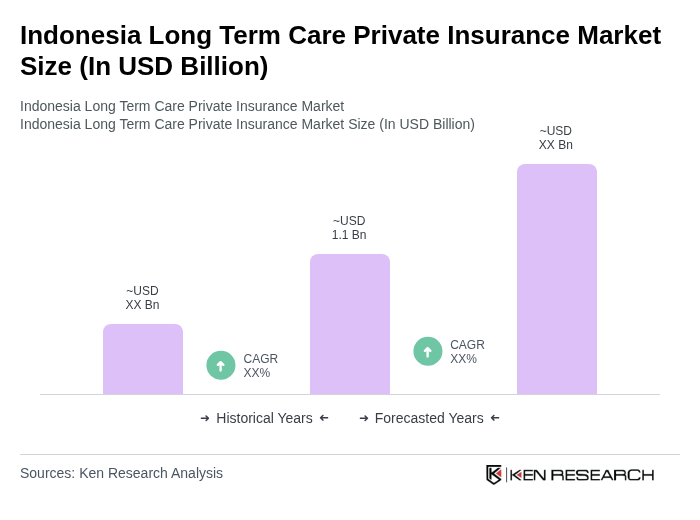
- The Indonesia Long Term Care Private Insurance Market is valued at USD 1.1 billion, based on a five-year historical analysis of Indonesia’s private health and medical insurance segment and the growing share of products covering longer-term care needs within that portfolio. This growth is primarily driven by an aging population, increasing prevalence of chronic conditions, rising healthcare costs, and higher awareness of the financial risks associated with long-term care among urban middle-income households. The market is witnessing a gradual shift towards private insurance solutions that complement the national JKN scheme, as individuals seek to secure their financial future against potential long-term care needs and demand access to higher-quality facilities and services.
- Key cities such as Jakarta, Surabaya, and Bandung dominate the market due to their high population density, concentration of healthcare infrastructure, and stronger economic activity. Jakarta, being the capital, has a higher concentration of private insurers, corporate headquarters, and a more affluent population, leading to greater demand for supplementary health and long-term care oriented insurance products. Surabaya and Bandung also contribute significantly as secondary growth hubs, supported by expanding middle-class segments, employer-funded group health benefits, and increasing healthcare awareness.
- In place of a specific 2023 mandate focused solely on long-term care insurance, the regulatory environment for health and related long-duration products is shaped by broader insurance and health protection rules overseen by the Financial Services Authority (Otoritas Jasa Keuangan, OJK), including the OJK Regulation Number 71/POJK.05/2016 on Health Insurance and Personal Accident Insurance Products issued by OJK in 2016, which sets product approval, benefit design, solvency, and consumer protection requirements for insurers offering health-related coverage. These frameworks, together with the national JKN scheme, encourage insurers to develop longer-term protection solutions and riders that can support long-term care needs, improving accessibility and financial preparedness as the population ages.
Indonesia Long Term Care Private Insurance Market Segmentation
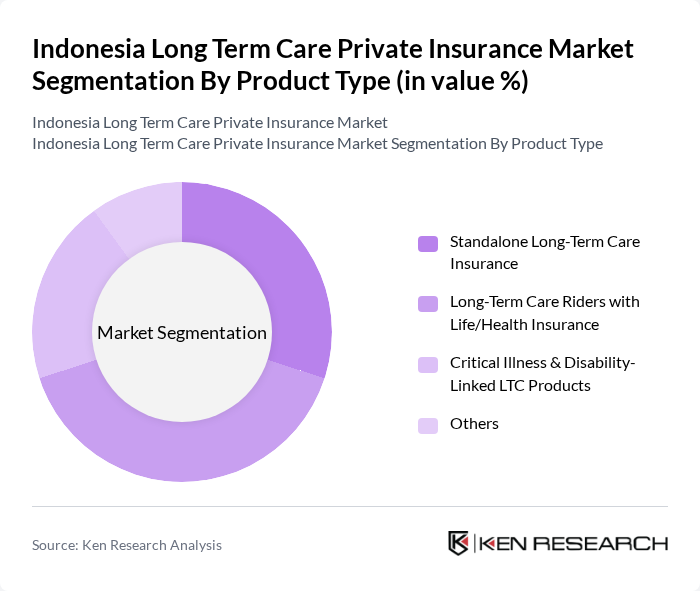
By Product Type:The product type segmentation includes various offerings tailored to meet the diverse needs of consumers. Standalone long-term care insurance is designed specifically for long-term care needs, while long-term care riders with life or health insurance provide additional coverage options. Critical illness and disability-linked products cater to those facing specific health challenges that may lead to functional impairment and prolonged care, and other products encompass a range of innovative solutions such as hospital cash plans or comprehensive medical policies with extended rehabilitation and post-acute care benefits. The standalone long-term care insurance segment is emerging but remains smaller than rider-based and critical-illness-linked solutions; riders and bundled products currently capture strong demand due to their integration with existing life and health policies and the preference of Indonesian consumers for multi-benefit protection plans.
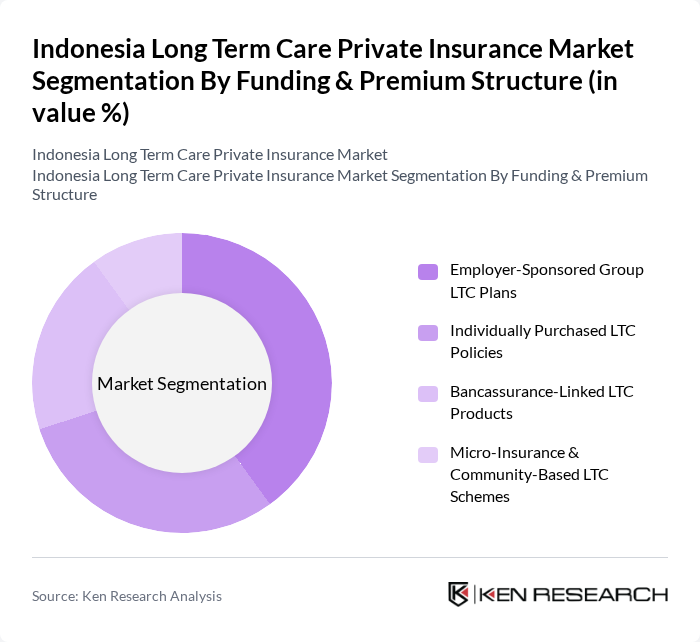
By Funding & Premium Structure:This segmentation focuses on how long-term care oriented insurance is funded and how premiums are structured. Employer-sponsored group health plans with extended benefits are expanding as companies, particularly in urban and industrial corridors, recognize the importance of employee welfare and use health and long-duration benefits to attract and retain talent. Individually purchased policies, including health plans with long-term care features and riders, cater to those seeking personalized and portable coverage, while bancassurance-linked products leverage bank networks for distribution to the growing middle class. Micro-insurance and community-based schemes are emerging as affordable options for lower-income and rural segments, often supported by TPAs and digital platforms to manage claims and provider networks. Employer-sponsored group arrangements are among the fastest-growing channels within private medical coverage; however, in the broader long-term care related space, individually purchased covers and bancassurance-linked products also command a significant and rising share as financial literacy and preference for tailored protection increase.
Indonesia Long Term Care Private Insurance Market Competitive Landscape
The Indonesia Long Term Care Private Insurance Market is characterized by a dynamic mix of regional and international players. Leading participants such as PT Asuransi Allianz Life Indonesia (Allianz Indonesia), PT AXA Mandiri Financial Services (AXA Mandiri), PT Prudential Life Assurance (Prudential Indonesia), PT Asuransi Jiwa Manulife Indonesia (Manulife Indonesia), PT Asuransi Cigna (Cigna Indonesia), PT BNI Life Insurance (BNI Life), PT Asuransi Jiwa Sinarmas MSIG (Sinarmas MSIG Life), PT Asuransi Jiwa Sequis Life, PT Avrist Assurance, PT Tokio Marine Life Insurance Indonesia, PT Great Eastern Life Indonesia, PT AIA Financial (AIA Financial Indonesia), PT FWD Insurance Indonesia, PT Sequis Life, PT PFI Mega Life Insurance (Mega Life Insurance) contribute to innovation, geographic expansion, and service delivery in this space, often by embedding long-term care benefits within broader health or life insurance propositions.
Indonesia Long Term Care Private Insurance Market Industry Analysis
Growth Drivers
- Increasing Aging Population:Indonesia's population aged 60 and above is projected to reach 36 million in future, representing a significant demographic shift. This growing segment is expected to drive demand for long-term care insurance, as older individuals typically require more healthcare services. The World Bank indicates that the elderly population will constitute approximately 13% of the total population in future, highlighting the urgent need for sustainable long-term care solutions.
- Rising Healthcare Costs:Healthcare expenditure in Indonesia is anticipated to rise to IDR 1,200 trillion (approximately USD 80 billion) in future, driven by increased demand for medical services and advanced treatments. This surge in costs is prompting individuals to seek long-term care insurance as a financial safeguard against unexpected healthcare expenses. The average annual healthcare cost per capita is projected to reach IDR 4.5 million, further emphasizing the necessity for insurance coverage.
- Growing Awareness of Long-Term Care Needs:As awareness of long-term care needs increases, more Indonesians are recognizing the importance of planning for future healthcare requirements. Educational campaigns and community outreach programs are expected to reach over 10 million individuals in future, fostering a culture of proactive health management. This shift in mindset is likely to enhance the uptake of long-term care insurance products, as consumers seek to mitigate potential financial burdens associated with aging.
Market Challenges
- Limited Consumer Awareness:Despite the growing need for long-term care insurance, consumer awareness remains low, with only 30% of the population familiar with available products. This lack of understanding poses a significant barrier to market growth. Efforts to educate consumers about the benefits and necessity of long-term care insurance are crucial, as many still rely on traditional family support systems, which may not be sustainable in the long term.
- Regulatory Hurdles:The long-term care insurance market in Indonesia faces regulatory challenges, including complex licensing requirements for insurers. In future, only 15 companies are licensed to offer long-term care products, limiting competition and innovation. Additionally, regulatory frameworks are still evolving, which can create uncertainty for potential investors and hinder the development of comprehensive insurance solutions tailored to the needs of the aging population.
Indonesia Long Term Care Private Insurance Market Future Outlook
The future of the long-term care private insurance market in Indonesia appears promising, driven by demographic changes and increasing healthcare costs. As the elderly population grows, the demand for tailored insurance products is expected to rise. Innovations in digital insurance solutions and partnerships with healthcare providers will likely enhance service delivery. Furthermore, government initiatives aimed at improving elderly care will create a supportive environment for market expansion, encouraging more individuals to invest in long-term care insurance.
Market Opportunities
- Technological Advancements in Insurance:The integration of technology in insurance processes, such as telemedicine and mobile applications, presents a significant opportunity. In future, it is estimated that 60% of insurance transactions will occur online, making it easier for consumers to access long-term care products and services, thus enhancing market penetration.
- Government Initiatives for Elderly Care:The Indonesian government is expected to allocate IDR 50 trillion (approximately USD 3.3 billion) towards elderly care initiatives in future. This funding will support the development of infrastructure and services, creating a favorable environment for long-term care insurance providers to expand their offerings and reach more consumers.
Scope of the Report
| Segment | Sub-Segments |
|---|---|
| By Product Type | Standalone Long-Term Care Insurance Long-Term Care Riders with Life/Health Insurance Critical Illness & Disability-Linked LTC Products Others |
| By Funding & Premium Structure | Employer-Sponsored Group LTC Plans Individually Purchased LTC Policies Bancassurance-Linked LTC Products Micro-Insurance & Community-Based LTC Schemes |
| By Care Setting Coverage | Home-Based & Community Care Assisted Living & Residential Care Facilities Nursing Homes & Skilled Nursing Facilities Hospice & Palliative Care |
| By Benefit Design | Indemnity (Expense-Reimbursement) Policies Defined Daily/Monthly Cash Benefit Policies Hybrid/Linked-Benefit Policies Inflation-Indexed Benefit Policies |
| By Distribution Channel | Agency & Tied Agents Brokers Bancassurance Digital & Online Platforms Others |
| By Insured Demographics | Pre-Retirement Segment (40–59 Years) Senior Segment (60–74 Years) Elderly Segment (75+ Years) High-Net-Worth & Expatriate Segment |
| By Policy Duration | Short-Term Policies (< 3 Years) Medium-Term Policies (3–10 Years) Long-Term / Lifetime Policies (> 10 Years) Others |
Key Target Audience
Investors and Venture Capitalist Firms
Government and Regulatory Bodies (e.g., OJK - Otoritas Jasa Keuangan, BPK - Badan Pemeriksa Keuangan)
Insurance Companies
Healthcare Providers
Senior Care Facilities
Financial Advisors and Planners
Non-Governmental Organizations (NGOs) focused on elder care
Technology Providers specializing in health insurance solutions
Players Mentioned in the Report:
PT Asuransi Allianz Life Indonesia (Allianz Indonesia)
PT AXA Mandiri Financial Services (AXA Mandiri)
PT Prudential Life Assurance (Prudential Indonesia)
PT Asuransi Jiwa Manulife Indonesia (Manulife Indonesia)
PT Asuransi Cigna (Cigna Indonesia)
PT BNI Life Insurance (BNI Life)
PT Asuransi Jiwa Sinarmas MSIG (Sinarmas MSIG Life)
PT Asuransi Jiwa Sequis Life
PT Avrist Assurance
PT Tokio Marine Life Insurance Indonesia
PT Great Eastern Life Indonesia
PT AIA Financial (AIA Financial Indonesia)
PT FWD Insurance Indonesia
PT Sequis Life
PT PFI Mega Life Insurance (Mega Life Insurance)
Table of Contents
Market Assessment Phase
1. Executive Summary and Approach
2. Indonesia Long Term Care Private Insurance Market Overview
2.1 Key Insights and Strategic Recommendations
2.2 Indonesia Long Term Care Private Insurance Market Overview
2.3 Definition and Scope
2.4 Evolution of Market Ecosystem
2.5 Timeline of Key Regulatory Milestones
2.6 Value Chain & Stakeholder Mapping
2.7 Business Cycle Analysis
2.8 Policy & Incentive Landscape
3. Indonesia Long Term Care Private Insurance Market Analysis
3.1 Growth Drivers
3.1.1 Increasing Aging Population
3.1.2 Rising Healthcare Costs
3.1.3 Growing Awareness of Long-Term Care Needs
3.1.4 Expansion of Middle-Class Income
3.2 Market Challenges
3.2.1 Limited Consumer Awareness
3.2.2 Regulatory Hurdles
3.2.3 High Competition from Traditional Insurance
3.2.4 Affordability Issues
3.3 Market Opportunities
3.3.1 Technological Advancements in Insurance
3.3.2 Partnerships with Healthcare Providers
3.3.3 Customization of Insurance Products
3.3.4 Government Initiatives for Elderly Care
3.4 Market Trends
3.4.1 Shift Towards Digital Insurance Solutions
3.4.2 Increased Focus on Preventive Care
3.4.3 Rise of Hybrid Insurance Products
3.4.4 Growing Demand for Personalized Services
3.5 Government Regulation
3.5.1 Mandatory Insurance Coverage for Elderly
3.5.2 Tax Incentives for Long-Term Care Insurance
3.5.3 Consumer Protection Regulations
3.5.4 Licensing Requirements for Insurers
4. SWOT Analysis
5. Stakeholder Analysis
6. Porter's Five Forces Analysis
7. Indonesia Long Term Care Private Insurance Market Market Size, 2019-2024
7.1 By Value
7.2 By Volume
7.3 By Average Selling Price
8. Indonesia Long Term Care Private Insurance Market Segmentation
8.1 By Product Type
8.1.1 Standalone Long-Term Care Insurance
8.1.2 Long-Term Care Riders with Life/Health Insurance
8.1.3 Critical Illness & Disability-Linked LTC Products
8.1.4 Others
8.2 By Funding & Premium Structure
8.2.1 Employer-Sponsored Group LTC Plans
8.2.2 Individually Purchased LTC Policies
8.2.3 Bancassurance-Linked LTC Products
8.2.4 Micro-Insurance & Community-Based LTC Schemes
8.3 By Care Setting Coverage
8.3.1 Home-Based & Community Care
8.3.2 Assisted Living & Residential Care Facilities
8.3.3 Nursing Homes & Skilled Nursing Facilities
8.3.4 Hospice & Palliative Care
8.4 By Benefit Design
8.4.1 Indemnity (Expense-Reimbursement) Policies
8.4.2 Defined Daily/Monthly Cash Benefit Policies
8.4.3 Hybrid/Linked-Benefit Policies
8.4.4 Inflation-Indexed Benefit Policies
8.5 By Distribution Channel
8.5.1 Agency & Tied Agents
8.5.2 Brokers
8.5.3 Bancassurance
8.5.4 Digital & Online Platforms
8.5.5 Others
8.6 By Insured Demographics
8.6.1 Pre-Retirement Segment (40–59 Years)
8.6.2 Senior Segment (60–74 Years)
8.6.3 Elderly Segment (75+ Years)
8.6.4 High-Net-Worth & Expatriate Segment
8.7 By Policy Duration
8.7.1 Short-Term Policies (< 3 Years)
8.7.2 Medium-Term Policies (3–10 Years)
8.7.3 Long-Term / Lifetime Policies (> 10 Years)
8.7.4 Others
9. Indonesia Long Term Care Private Insurance Market Competitive Analysis
9.1 Market Share of Key Players
9.2 Cross Comparison of Key Players
9.2.1 Company Name
9.2.2 Gross Written Premiums (LTC Segment)
9.2.3 LTC In-Force Policies
9.2.4 LTC New Business Annualized Premium Equivalent (NB-APE)
9.2.5 LTC Claims Ratio (Incurred Claims / Earned Premiums)
9.2.6 Claims Settlement Turnaround Time (Average Days)
9.2.7 Persistency Ratio (13th / 25th Month)
9.2.8 Embedded Value & Value of New Business (VNB) – LTC Portfolio
9.2.9 Distribution Mix (Agency, Bancassurance, Digital, Others)
9.2.10 Return on Equity (ROE) – Health & Protection Lines
9.2.11 Solvency Ratio
9.3 SWOT Analysis of Top Players
9.4 Pricing Analysis
9.5 Detailed Profile of Major Companies
9.5.1 PT Asuransi Allianz Life Indonesia (Allianz Indonesia)
9.5.2 PT AXA Mandiri Financial Services (AXA Mandiri)
9.5.3 PT Prudential Life Assurance (Prudential Indonesia)
9.5.4 PT Asuransi Jiwa Manulife Indonesia (Manulife Indonesia)
9.5.5 PT Asuransi Cigna (Cigna Indonesia)
9.5.6 PT BNI Life Insurance (BNI Life)
9.5.7 PT Asuransi Jiwa Sinarmas MSIG (Sinarmas MSIG Life)
9.5.8 PT Asuransi Jiwa Sequis Life
9.5.9 PT Avrist Assurance
9.5.10 PT Tokio Marine Life Insurance Indonesia
9.5.11 PT Great Eastern Life Indonesia
9.5.12 PT AIA Financial (AIA Financial Indonesia)
9.5.13 PT FWD Insurance Indonesia
9.5.14 PT Sequis Life
9.5.15 PT PFI Mega Life Insurance (Mega Life Insurance)
10. Indonesia Long Term Care Private Insurance Market End-User Analysis
10.1 Procurement Behavior of Key Ministries
10.1.1 Budget Allocation for Long-Term Care
10.1.2 Decision-Making Processes
10.1.3 Preferred Insurance Providers
10.1.4 Others
10.2 Corporate Spend on Infrastructure & Energy
10.2.1 Investment in Employee Health Plans
10.2.2 Budgeting for Long-Term Care Insurance
10.2.3 Trends in Corporate Insurance Spending
10.2.4 Others
10.3 Pain Point Analysis by End-User Category
10.3.1 Affordability Concerns
10.3.2 Lack of Awareness
10.3.3 Complexity of Policies
10.3.4 Others
10.4 User Readiness for Adoption
10.4.1 Awareness Levels
10.4.2 Financial Preparedness
10.4.3 Attitudes Towards Insurance
10.4.4 Others
10.5 Post-Deployment ROI and Use Case Expansion
10.5.1 Evaluation of Insurance Benefits
10.5.2 Customer Feedback Mechanisms
10.5.3 Opportunities for Policy Upgrades
10.5.4 Others
11. Indonesia Long Term Care Private Insurance Market Future Size, 2025-2030
11.1 By Value
11.2 By Volume
11.3 By Average Selling Price
Go-To-Market Strategy Phase
1. Whitespace Analysis + Business Model Canvas
1.1 Market Gaps Identification
1.2 Business Model Framework
2. Marketing and Positioning Recommendations
2.1 Branding Strategies
2.2 Product USPs
3. Distribution Plan
3.1 Urban Retail vs Rural NGO Tie-ups
4. Channel & Pricing Gaps
4.1 Underserved Routes
4.2 Pricing Bands
5. Unmet Demand & Latent Needs
5.1 Category Gaps
5.2 Consumer Segments
6. Customer Relationship
6.1 Loyalty Programs
6.2 After-sales Service
7. Value Proposition
7.1 Sustainability
7.2 Integrated Supply Chains
8. Key Activities
8.1 Regulatory Compliance
8.2 Branding
8.3 Distribution Setup
9. Entry Strategy Evaluation
9.1 Domestic Market Entry Strategy
9.1.1 Product Mix
9.1.2 Pricing Band
9.1.3 Packaging
9.2 Export Entry Strategy
9.2.1 Target Countries
9.2.2 Compliance Roadmap
10. Entry Mode Assessment
10.1 JV
10.2 Greenfield
10.3 M&A
10.4 Distributor Model
11. Capital and Timeline Estimation
11.1 Capital Requirements
11.2 Timelines
12. Control vs Risk Trade-Off
12.1 Ownership vs Partnerships
13. Profitability Outlook
13.1 Breakeven Analysis
13.2 Long-term Sustainability
14. Potential Partner List
14.1 Distributors
14.2 JVs
14.3 Acquisition Targets
15. Execution Roadmap
15.1 Phased Plan for Market Entry
15.1.1 Market Setup
15.1.2 Market Entry
15.1.3 Growth Acceleration
15.1.4 Scale & Stabilize
15.2 Key Activities and Milestones
15.2.1 Milestone Planning
15.2.2 Activity Tracking
Research Methodology
Phase 1: Approach1
Desk Research
- Analysis of government reports on healthcare expenditure and aging population demographics in Indonesia
- Review of existing literature on long-term care insurance trends and consumer behavior in Southeast Asia
- Examination of industry publications and white papers from insurance associations and healthcare organizations
Primary Research
- Interviews with executives from leading private insurance companies offering long-term care products
- Surveys targeting potential policyholders to understand awareness and perceptions of long-term care insurance
- Focus groups with healthcare professionals to gather insights on patient needs and insurance coverage gaps
Validation & Triangulation
- Cross-validation of findings through comparison with international long-term care insurance models
- Triangulation of data from government statistics, industry reports, and primary research insights
- Sanity checks conducted through expert panel reviews comprising actuaries and healthcare economists
Phase 2: Market Size Estimation1
Top-down Assessment
- Estimation of the total addressable market based on national healthcare spending and aging population statistics
- Segmentation of the market by demographic factors, including age, income level, and urban vs. rural distribution
- Incorporation of government initiatives aimed at promoting private insurance uptake in long-term care
Bottom-up Modeling
- Collection of premium data from existing long-term care insurance policies offered by major insurers
- Analysis of policyholder demographics and claims data to establish average policy sizes and coverage levels
- Estimation of market penetration rates based on consumer surveys and historical growth trends
Forecasting & Scenario Analysis
- Development of predictive models using demographic trends, economic indicators, and healthcare policy changes
- Scenario analysis based on varying levels of insurance adoption and potential regulatory impacts
- Creation of baseline, optimistic, and pessimistic forecasts for market growth through 2035
Phase 3: CATI Sample Composition1
| Scope Item/Segment | Sample Size | Target Respondent Profiles |
|---|---|---|
| Insurance Policyholders | 120 | Individuals aged 50+, current long-term care insurance holders |
| Potential Policyholders | 100 | Individuals aged 30-50, considering long-term care insurance |
| Healthcare Professionals | 80 | Doctors, nurses, and social workers involved in elder care |
| Insurance Executives | 50 | Senior management from insurance companies offering long-term care products |
| Regulatory Bodies | 40 | Officials from government health departments and insurance regulators |
Frequently Asked Questions
What is the current value of the Indonesia Long Term Care Private Insurance Market?
The Indonesia Long Term Care Private Insurance Market is valued at approximately USD 1.1 billion. This valuation reflects a five-year historical analysis and highlights the increasing demand for long-term care solutions driven by an aging population and rising healthcare costs.
What factors are driving the growth of long-term care insurance in Indonesia?
Which cities in Indonesia are leading in the long-term care insurance market?
What types of products are available in the Indonesia Long Term Care Private Insurance Market?
Other Regional/Country Reports
Other Adjacent Reports
South Africa Healthcare Services Market
UAE pharmaceutical market report size, share, growth drivers, trends, opportunities & forecast 2025–2030Oman Medical Devices Market Size, Share & Forecast, By Product Type, Care Setting & End User, 2025-2032Global Telemedicine Market Report Size, Share, Growth Drivers, Trends, Opportunities & Forecast 2025–2030Bahrain Bancassurance Market Report Size, Share, Growth Drivers, Trends, Opportunities & Forecast 2025–2030Why Buy From Us?

What makes us stand out is that our consultants follow Robust, Refine and Result (RRR) methodology. Robust for clear definitions, approaches and sanity checking, Refine for differentiating respondents' facts and opinions, and Result for presenting data with story.

We have set a benchmark in the industry by offering our clients with syndicated and customized market research reports featuring coverage of entire market as well as meticulous research and analyst insights.

While we don't replace traditional research, we flip the method upside down. Our dual approach of Top Bottom & Bottom Top ensures quality deliverable by not just verifying company fundamentals but also looking at the sector and macroeconomic factors.

With one step in the future, our research team constantly tries to show you the bigger picture. We help with some of the tough questions you may encounter along the way: How is the industry positioned? Best marketing channel? KPI's of competitors? By aligning every element, we help maximize success.

Our report gives you instant access to the answers and sources that other companies might choose to hide. We elaborate each steps of research methodology we have used and showcase you the sample size to earn your trust.

If you need any support, we are here! We pride ourselves on universe strength, data quality, and quick, friendly, and professional service.