About the Report
Base Year 2024Listen to the audio summary
Philippines Nutrition & Supplements Market Overview
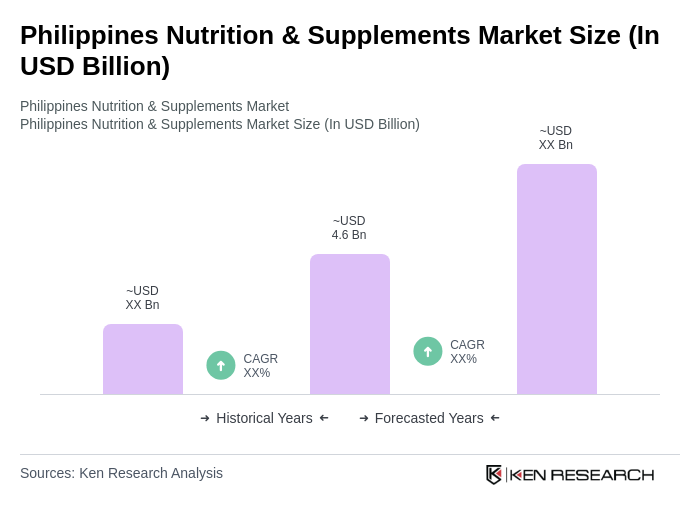
- The Philippines Nutrition & Supplements Market is valued at USD 4.6 billion, based on a five-year historical analysis. This growth is primarily driven by increasing health consciousness, higher disposable incomes, rapid urbanization, and a strong shift toward preventive healthcare. Consumers are actively seeking nutritional supplements to enhance overall well-being, address specific health concerns, and support immunity, which has led to robust demand across multiple product categories .
- Metro Manila, Cebu, and Davao are the dominant cities in the Philippines Nutrition & Supplements Market. Metro Manila, as the capital and primary urban center, has the highest concentration of health-conscious consumers and retail outlets. Cebu and Davao are also emerging as key markets due to their expanding urban populations, increasing disposable incomes, and growing access to modern retail and e-commerce channels, all of which contribute to rising demand for nutritional products .
- The Food and Drug Administration (FDA) Administrative Order No. 2014-0030, issued by the Department of Health, regulates the labeling and advertising of food supplements in the Philippines. This regulation requires all nutritional products to be accurately labeled and marketed, ensuring consumers receive reliable information about the health benefits and ingredients of the supplements they purchase. The order mandates clear ingredient disclosure, health claim substantiation, and compliance with advertising standards .
Philippines Nutrition & Supplements Market Segmentation
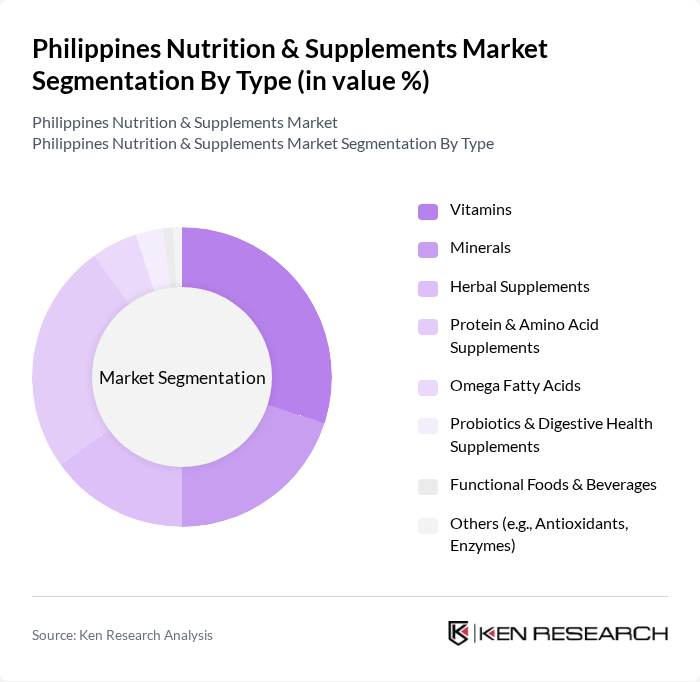
By Type:The market is segmented into various types of nutritional products, including Vitamins, Minerals, Herbal Supplements, Protein & Amino Acid Supplements, Omega Fatty Acids, Probiotics & Digestive Health Supplements, Functional Foods & Beverages, and Others (e.g., Antioxidants, Enzymes). Among these, Vitamins and Protein & Amino Acid Supplements remain particularly popular due to their perceived health benefits, effectiveness in supporting immunity, and alignment with fitness and wellness trends. The surge in fitness culture, preventive health practices, and demand for natural and specialty supplements continues to drive growth in these segments .
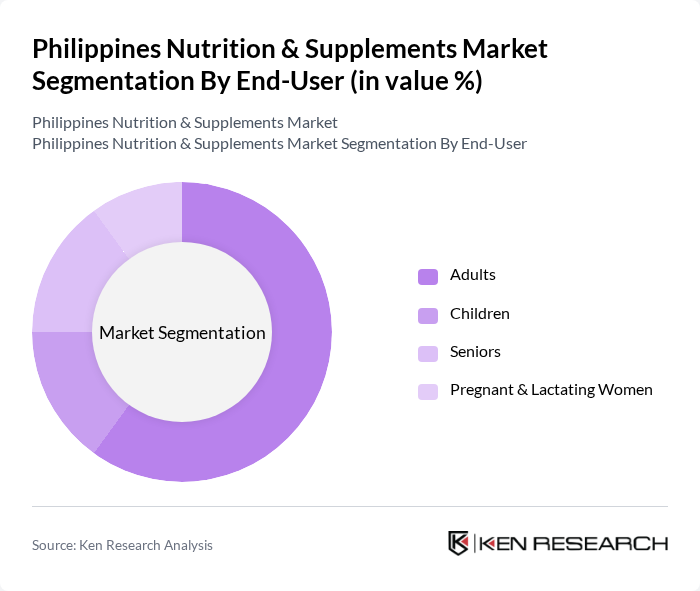
By End-User:The end-user segmentation includes Adults, Children, Seniors, and Pregnant & Lactating Women. Adults represent the largest segment, driven by a growing focus on health, fitness, and preventive care, as well as the increasing prevalence of lifestyle-related diseases. The demand for nutritional supplements among adults is further fueled by the rise of fitness trends, urban lifestyles, and the desire for proactive health management .
Philippines Nutrition & Supplements Market Competitive Landscape
The Philippines Nutrition & Supplements Market is characterized by a dynamic mix of regional and international players. Leading participants such as United Laboratories, Inc. (Unilab), Pascual Laboratories, Inc., GNC Holdings, Inc., Abbott Laboratories, Amway Corporation, Nestlé S.A., Unilever PLC, Glanbia PLC, Nature's Way, Blackmores Limited, USANA Health Sciences, Inc., Bayer AG, DSM Nutritional Products, Swisse Wellness Pty Ltd., Mega We Care, Nature’s Spring, ATC Healthcare International Corp., and Santé International, Inc. contribute to innovation, geographic expansion, and service delivery in this space.
Philippines Nutrition & Supplements Market Industry Analysis
Growth Drivers
- Increasing Health Awareness:The Philippines has seen a significant rise in health consciousness, with 75% of Filipinos actively seeking healthier lifestyles. This trend is supported by the World Health Organization's report indicating that non-communicable diseases account for 72% of deaths in the country. As a result, the demand for nutritional supplements has surged, with the market expected to reach PHP 35 billion in future, driven by consumers prioritizing health and wellness.
- Rising Disposable Incomes:The Philippines' GDP per capita is projected to increase to PHP 110,000 in future, reflecting a growing middle class with more disposable income. This economic growth enables consumers to invest in health and wellness products, including nutritional supplements. As purchasing power rises, the market for these products is expected to expand, with an estimated 20% increase in sales in future, driven by higher consumer spending on health-related products.
- Growth of E-commerce Platforms:E-commerce in the Philippines is projected to grow to PHP 250 billion in future, significantly impacting the nutrition and supplements market. With 76% of Filipinos shopping online, brands are increasingly leveraging digital platforms to reach consumers. This shift not only enhances accessibility but also allows for targeted marketing strategies, leading to a projected 25% increase in online sales of nutritional supplements as consumers prefer the convenience of online shopping.
Market Challenges
- Regulatory Compliance Issues:The Philippines' regulatory landscape poses challenges for nutrition and supplement companies, with the Food and Drug Administration (FDA) enforcing strict guidelines. In future, over 35% of products submitted for approval faced delays due to non-compliance with labeling and health claims regulations. This can hinder market entry and increase operational costs, impacting the overall growth of the industry as companies navigate complex regulatory requirements.
- Consumer Misinformation:Misinformation regarding nutritional supplements is prevalent, with 45% of consumers relying on unverified online sources for health information. This can lead to skepticism about product efficacy and safety, ultimately affecting purchasing decisions. The lack of consumer education on proper supplement use can result in decreased market trust, making it essential for companies to invest in transparent communication and educational campaigns to counteract misinformation and build consumer confidence.
Philippines Nutrition & Supplements Market Future Outlook
The Philippines nutrition and supplements market is poised for significant growth, driven by increasing health awareness and rising disposable incomes. As consumers prioritize wellness, the demand for personalized nutrition solutions is expected to rise. Additionally, the integration of digital health technologies will enhance consumer engagement and product accessibility. Companies that adapt to these trends and invest in innovative product offerings will likely capture a larger market share, positioning themselves favorably in a competitive landscape.
Market Opportunities
- Expansion of Product Lines:Companies have the opportunity to diversify their product offerings by introducing specialized supplements targeting specific health concerns, such as immunity and digestive health. With the market for functional foods projected to grow by PHP 7 billion in future, brands can capitalize on this trend by developing innovative products that cater to evolving consumer needs.
- Increasing Demand for Organic Products:The organic supplement market is gaining traction, with sales expected to reach PHP 12 billion in future. As consumers become more health-conscious, the demand for organic and natural products is rising. Companies that focus on sourcing high-quality organic ingredients can tap into this lucrative segment, appealing to environmentally conscious consumers seeking healthier alternatives.
Scope of the Report
| Segment | Sub-Segments |
|---|---|
| By Type | Vitamins Minerals Herbal Supplements Protein & Amino Acid Supplements Omega Fatty Acids Probiotics & Digestive Health Supplements Functional Foods & Beverages Others (e.g., Antioxidants, Enzymes) |
| By End-User | Adults Children Seniors Pregnant & Lactating Women |
| By Distribution Channel | Online Retail (e.g., Lazada, Shopee) Supermarkets/Hypermarkets Pharmacies (e.g., Mercury Drug, Watsons) Health & Specialty Stores Direct Selling |
| By Price Range | Budget Mid-Range Premium |
| By Formulation | Tablets Capsules Powders Liquids Gummies & Chewables |
| By Packaging Type | Bottles Blister Packs Pouches Sachets |
| By Brand Loyalty | Brand Loyal Customers Price-Sensitive Customers Occasional Buyers |
Key Target Audience
Investors and Venture Capitalist Firms
Government and Regulatory Bodies (e.g., Food and Drug Administration, Department of Health)
Manufacturers and Producers
Distributors and Retailers
Health and Wellness Influencers
Pharmaceutical Companies
Health Insurance Providers
Industry Associations (e.g., Philippine Chamber of Commerce and Industry)
Players Mentioned in the Report:
United Laboratories, Inc. (Unilab)
Pascual Laboratories, Inc.
GNC Holdings, Inc.
Abbott Laboratories
Amway Corporation
Nestle S.A.
Unilever PLC
Glanbia PLC
Nature's Way
Blackmores Limited
USANA Health Sciences, Inc.
Bayer AG
DSM Nutritional Products
Swisse Wellness Pty Ltd.
Mega We Care
Natures Spring
ATC Healthcare International Corp.
Sante International, Inc.
Table of Contents
Market Assessment Phase
1. Executive Summary and Approach
2. Philippines Nutrition & Supplements Market Overview
2.1 Key Insights and Strategic Recommendations
2.2 Philippines Nutrition & Supplements Market Overview
2.3 Definition and Scope
2.4 Evolution of Market Ecosystem
2.5 Timeline of Key Regulatory Milestones
2.6 Value Chain & Stakeholder Mapping
2.7 Business Cycle Analysis
2.8 Policy & Incentive Landscape
3. Philippines Nutrition & Supplements Market Analysis
3.1 Growth Drivers
3.1.1 Increasing Health Awareness
3.1.2 Rising Disposable Incomes
3.1.3 Growth of E-commerce Platforms
3.1.4 Expanding Aging Population
3.2 Market Challenges
3.2.1 Regulatory Compliance Issues
3.2.2 High Competition
3.2.3 Consumer Misinformation
3.2.4 Supply Chain Disruptions
3.3 Market Opportunities
3.3.1 Expansion of Product Lines
3.3.2 Increasing Demand for Organic Products
3.3.3 Growth in Preventive Healthcare
3.3.4 Rising Popularity of Plant-Based Supplements
3.4 Market Trends
3.4.1 Personalization of Nutrition
3.4.2 Digital Health Integration
3.4.3 Sustainability in Packaging
3.4.4 Increased Focus on Mental Health Supplements
3.5 Government Regulation
3.5.1 Food and Drug Administration (FDA) Guidelines
3.5.2 Labeling Requirements
3.5.3 Import Regulations
3.5.4 Health Claims Regulations
4. SWOT Analysis
5. Stakeholder Analysis
6. Porter's Five Forces Analysis
7. Philippines Nutrition & Supplements Market Market Size, 2019-2024
7.1 By Value
7.2 By Volume
7.3 By Average Selling Price
8. Philippines Nutrition & Supplements Market Segmentation
8.1 By Type
8.1.1 Vitamins
8.1.2 Minerals
8.1.3 Herbal Supplements
8.1.4 Protein & Amino Acid Supplements
8.1.5 Omega Fatty Acids
8.1.6 Probiotics & Digestive Health Supplements
8.1.7 Functional Foods & Beverages
8.1.8 Others (e.g., Antioxidants, Enzymes)
8.2 By End-User
8.2.1 Adults
8.2.2 Children
8.2.3 Seniors
8.2.4 Pregnant & Lactating Women
8.3 By Distribution Channel
8.3.1 Online Retail (e.g., Lazada, Shopee)
8.3.2 Supermarkets/Hypermarkets
8.3.3 Pharmacies (e.g., Mercury Drug, Watsons)
8.3.4 Health & Specialty Stores
8.3.5 Direct Selling
8.4 By Price Range
8.4.1 Budget
8.4.2 Mid-Range
8.4.3 Premium
8.5 By Formulation
8.5.1 Tablets
8.5.2 Capsules
8.5.3 Powders
8.5.4 Liquids
8.5.5 Gummies & Chewables
8.6 By Packaging Type
8.6.1 Bottles
8.6.2 Blister Packs
8.6.3 Pouches
8.6.4 Sachets
8.7 By Brand Loyalty
8.7.1 Brand Loyal Customers
8.7.2 Price-Sensitive Customers
8.7.3 Occasional Buyers
9. Philippines Nutrition & Supplements Market Competitive Analysis
9.1 Market Share of Key Players
9.2 Cross Comparison of Key Players
9.2.1 Company Name
9.2.2 Company Type (Local, Multinational)
9.2.3 Group Size (Large, Medium, or Small as per industry convention)
9.2.4 Annual Revenue (USD Million)
9.2.5 Revenue Growth Rate (%)
9.2.6 Market Penetration Rate (%)
9.2.7 Customer Retention Rate (%)
9.2.8 Product Portfolio Breadth (Number of SKUs)
9.2.9 Distribution Network Coverage (Number of Retail Points/Regions)
9.2.10 Pricing Strategy (Budget, Mid, Premium)
9.2.11 Brand Recognition Score (Survey-Based or Digital Index)
9.2.12 Customer Satisfaction Index (NPS or Equivalent)
9.2.13 Regulatory Compliance Record (FDA Approvals, Recalls)
9.3 SWOT Analysis of Top Players
9.4 Pricing Analysis
9.5 Detailed Profile of Major Companies
9.5.1 United Laboratories, Inc. (Unilab)
9.5.2 Pascual Laboratories, Inc.
9.5.3 GNC Holdings, Inc.
9.5.4 Abbott Laboratories
9.5.5 Amway Corporation
9.5.6 Nestlé S.A.
9.5.7 Unilever PLC
9.5.8 Glanbia PLC
9.5.9 Nature's Way
9.5.10 Blackmores Limited
9.5.11 USANA Health Sciences, Inc.
9.5.12 Bayer AG
9.5.13 DSM Nutritional Products
9.5.14 Swisse Wellness Pty Ltd.
9.5.15 Mega We Care
9.5.16 Nature’s Spring
9.5.17 ATC Healthcare International Corp.
9.5.18 Santé International, Inc.
10. Philippines Nutrition & Supplements Market End-User Analysis
10.1 Procurement Behavior of Key Ministries
10.1.1 Health Ministry Initiatives
10.1.2 Nutrition Programs
10.1.3 Public Health Campaigns
10.2 Corporate Spend on Infrastructure & Energy
10.2.1 Investment in Health Facilities
10.2.2 Funding for Nutritional Research
10.2.3 Partnerships with NGOs
10.3 Pain Point Analysis by End-User Category
10.3.1 Accessibility of Products
10.3.2 Affordability Issues
10.3.3 Quality Concerns
10.4 User Readiness for Adoption
10.4.1 Awareness Levels
10.4.2 Education on Nutrition
10.4.3 Willingness to Pay
10.5 Post-Deployment ROI and Use Case Expansion
10.5.1 Measurement of Health Outcomes
10.5.2 Long-term User Engagement
10.5.3 Expansion into New Demographics
11. Philippines Nutrition & Supplements Market Future Size, 2025-2030
11.1 By Value
11.2 By Volume
11.3 By Average Selling Price
Go-To-Market Strategy Phase
1. Whitespace Analysis + Business Model Canvas
1.1 Market Gaps Identification
1.2 Business Model Framework
2. Marketing and Positioning Recommendations
2.1 Branding Strategies
2.2 Product USPs
3. Distribution Plan
3.1 Urban Retail Strategies
3.2 Rural NGO Tie-ups
4. Channel & Pricing Gaps
4.1 Underserved Routes
4.2 Pricing Bands
5. Unmet Demand & Latent Needs
5.1 Category Gaps
5.2 Consumer Segments
6. Customer Relationship
6.1 Loyalty Programs
6.2 After-sales Service
7. Value Proposition
7.1 Sustainability Initiatives
7.2 Integrated Supply Chains
8. Key Activities
8.1 Regulatory Compliance
8.2 Branding Efforts
8.3 Distribution Setup
9. Entry Strategy Evaluation
9.1 Domestic Market Entry Strategy
9.1.1 Product Mix Considerations
9.1.2 Pricing Band Strategy
9.1.3 Packaging Innovations
9.2 Export Entry Strategy
9.2.1 Target Countries
9.2.2 Compliance Roadmap
10. Entry Mode Assessment
10.1 Joint Ventures
10.2 Greenfield Investments
10.3 Mergers & Acquisitions
10.4 Distributor Model
11. Capital and Timeline Estimation
11.1 Capital Requirements
11.2 Timelines for Entry
12. Control vs Risk Trade-Off
12.1 Ownership Considerations
12.2 Partnerships Evaluation
13. Profitability Outlook
13.1 Breakeven Analysis
13.2 Long-term Sustainability
14. Potential Partner List
14.1 Distributors
14.2 Joint Ventures
14.3 Acquisition Targets
15. Execution Roadmap
15.1 Phased Plan for Market Entry
15.1.1 Market Setup
15.1.2 Market Entry
15.1.3 Growth Acceleration
15.1.4 Scale & Stabilize
15.2 Key Activities and Milestones
15.2.1 Milestone Planning
15.2.2 Activity Tracking
Research Methodology
Phase 1: Approach1
Desk Research
- Analysis of government health and nutrition reports from the Department of Health (DOH)
- Review of market reports from industry associations such as the Food and Nutrition Research Institute (FNRI)
- Examination of academic journals and publications on dietary supplements and nutrition trends in the Philippines
Primary Research
- Interviews with nutritionists and dietitians to gather insights on consumer preferences
- Surveys with health and wellness retailers to understand product offerings and sales trends
- Focus group discussions with consumers to explore attitudes towards nutrition and supplements
Validation & Triangulation
- Cross-validation of findings with data from health organizations and market analysts
- Triangulation of consumer insights with sales data from major retailers
- Sanity checks through expert reviews from industry stakeholders and academic professionals
Phase 2: Market Size Estimation1
Top-down Assessment
- Estimation of total market size based on national health expenditure and consumer spending on wellness
- Segmentation of the market by product categories such as vitamins, minerals, and herbal supplements
- Incorporation of demographic data to assess potential market growth among different age groups
Bottom-up Modeling
- Collection of sales data from leading nutrition and supplement brands in the Philippines
- Estimation of average retail prices and volume sold across various distribution channels
- Analysis of consumer purchasing behavior to determine frequency and volume of purchases
Forecasting & Scenario Analysis
- Utilization of historical growth rates to project future market trends through 2030
- Scenario analysis based on potential regulatory changes affecting the supplement industry
- Development of optimistic, pessimistic, and baseline forecasts considering economic factors and health trends
Phase 3: CATI Sample Composition1
| Scope Item/Segment | Sample Size | Target Respondent Profiles |
|---|---|---|
| Consumer Attitudes towards Supplements | 150 | Health-conscious Consumers, Fitness Enthusiasts |
| Retailer Insights on Nutrition Products | 100 | Store Managers, Product Buyers |
| Healthcare Professionals' Perspectives | 80 | Nutritionists, General Practitioners |
| Market Trends in Dietary Supplements | 120 | Industry Analysts, Market Researchers |
| Consumer Purchase Behavior Analysis | 140 | Online Shoppers, Supermarket Customers |
Frequently Asked Questions
What is the current value of the Philippines Nutrition & Supplements Market?
The Philippines Nutrition & Supplements Market is valued at approximately USD 4.6 billion, driven by increasing health consciousness, higher disposable incomes, and a shift towards preventive healthcare. This growth reflects a robust demand for nutritional products across various categories.
Which cities are the key markets for nutrition and supplements in the Philippines?
What regulations govern the labeling of nutritional supplements in the Philippines?
What are the main types of nutritional products available in the Philippines?
Other Regional/Country Reports
Indonesia Nutrition & Supplements Market
Malaysia Nutrition & Supplements Market
Other Adjacent Reports
Japan Weight Management Products Market
Kuwait probiotics market Size, Share, Growth Drivers, Trends, Opportunities & Forecast 2025–2030Saudi Arabia Herbal Supplements MarketIndonesia Vitamin Supplements Market Size, Share & Forecast, By Product Type, Form, Application & Distribution Channel, 2026–2031Brazil Omega Fatty Acids Market
Indonesia Beauty Supplements Market Size, Share & Forecast, By Product Type, Price Tier & Distribution Channel, 2026–2032Indonesia Infant Nutrition Market Outlook to 2030Why Buy From Us?

What makes us stand out is that our consultants follow Robust, Refine and Result (RRR) methodology. Robust for clear definitions, approaches and sanity checking, Refine for differentiating respondents' facts and opinions, and Result for presenting data with story.

We have set a benchmark in the industry by offering our clients with syndicated and customized market research reports featuring coverage of entire market as well as meticulous research and analyst insights.

While we don't replace traditional research, we flip the method upside down. Our dual approach of Top Bottom & Bottom Top ensures quality deliverable by not just verifying company fundamentals but also looking at the sector and macroeconomic factors.

With one step in the future, our research team constantly tries to show you the bigger picture. We help with some of the tough questions you may encounter along the way: How is the industry positioned? Best marketing channel? KPI's of competitors? By aligning every element, we help maximize success.

Our report gives you instant access to the answers and sources that other companies might choose to hide. We elaborate each steps of research methodology we have used and showcase you the sample size to earn your trust.

If you need any support, we are here! We pride ourselves on universe strength, data quality, and quick, friendly, and professional service.